Ancient woodland indicator species are plants that take a long time to colonise new areas. Because they prefer the stable, undisturbed conditions of long-established woods, they can help us tell whether a woodland is truly ancient.
The exact species to look for vary from county to county. Spotting just one doesn’t prove much on its own, but the more indicator species you find, the more likely it is that the woodland has been there for centuries.
Below is the current list of ancient woodland indicator species for Northumberland, which includes flowering plants, grasses, and ferns that are used locally to identify this special habitat. A separate list for County Durham can be found online (here). As a rule of thumb, finding at least 10 species gives a good chance of confirming ancient woodland. The more you find, the stronger the evidence and usually, the healthier the woodland.
At the end of the list, you’ll also see a few extra species. These aren’t on the official list, but I’ve included them because they have a strong connection with ancient woodland in this area.
Herbaceous Plants
Field MapleAcer campestre
MoschatelAdoxa moschatellina
RamsonsAllium ursinum
Wood AnemoneAnemone nemorosa
Lords-and-ladiesArum maculatum
Giant BellflowerCampanula latifolia
Alternate-leaved Golden SaxifrageChrysosplenium alternifolium
Northumberland’s Cheviot Hills have been a major focus of my extracurricular botany outings so far this year. Back in May, we enjoyed a fantastic visit to the Hen Hole and later returned with a group from the Natural History Society of Northumbria for another day of hills, ferns, and mountain flowers. Fast forward a few weeks, and it was time for another trip—this time to a part of the area I’m less familiar with.
The Bizzle Burn is a small waterway that flows down from Bizzle Crags toward Dunsdale in the College Valley. It’s a steep walk, but one that offers plenty for the keen-eyed botanist. The site has drawn attention for centuries due to its rare arctic-alpine flora, interesting ferns, and other botanical gems. This was our second attempt to explore it, having been rained off the hill late last year.
Spoiler – due to an unfortunate phone malfunction, pictures from this trip are somewhat limited. Sadly this included some of the special plants seen during the day. Still, we’ll preserve.
Setting out from our starting point at Cuddystone Hall, the walk to the base of the hill proved highly interesting. Along the path, typical upland grassland species such as Fairy Flax Linum catharticum, Wavy Hair-grass Avenella flexuosa and Wild Thyme Thymus drucei were seen. These are all plants commonly associated with the thin, parched soils of this terrain. On the walls surrounding a farmhouse passed early in the walk, the day’s first ferns made an appearance in the form of Maidenhair Spleenwort Asplenium trichomanes subsp. quadrivalens and Wall-rue Asplenium ruta-muraria. The Harebells Campanula rotundifolia were also particularly striking along this stretch.
Slightly more unusual species were encountered in a damp rut about halfway along the trail. The vivid flowers of Bog Asphodel Narthecium ossifragum were an immediate draw, and a closer inspection revealed the characteristic leaves of Round-leaved Sundew Drosera rotundifolia, one of our region’s few carnivorous plants.
Further uphill, a pause to explore the scree slopes yielded a fascinating suite of ferns. The most plentiful was Narrow Male-fern Dryopteris cambrensis, easily recognised by its distinctive wavy pinnae but also recorded were Male-fern Dryopteris filix-mas and several young specimens of the quirky Parsley Fern Cryptogramma crispa. A bit of poking around beneath overhangs revealed both Brittle Bladder-fern Cystopteris fragilis and Polypody Polypodium vulgare.
At the bridge at the foot of the trail leading up the Bizzle, another overhang held a somewhat desiccated example of what I believe to be Delicate Maidenhair Spleenwort Asplenium trichomanes subsp. trichomanes — a relatively rare relative of the more familiar Maidenhair Spleenwort commonly found on garden walls. A few Common Spotted-orchids Dactylorhiza fuchsii were also growing nearby, and a look at the riverside gravels revealed an interesting variety of willows. These included Purple Willow Salix purpurea, Osier Salix viminalis, Goat Willow Salix caprea, Eared Willow Salix aurita, and Grey Willow Salix cinerea.
Having passed the last vestiges of civilisation, we soon began our walk up the burn, initially passing through heather and areas of acid grassland before following the now stone-dry watercourse the rest of the way. It was tough going in places, and a near miss with a large female Adder certainly livened up proceedings. A few Common Lizards were also spotted along this stretch.
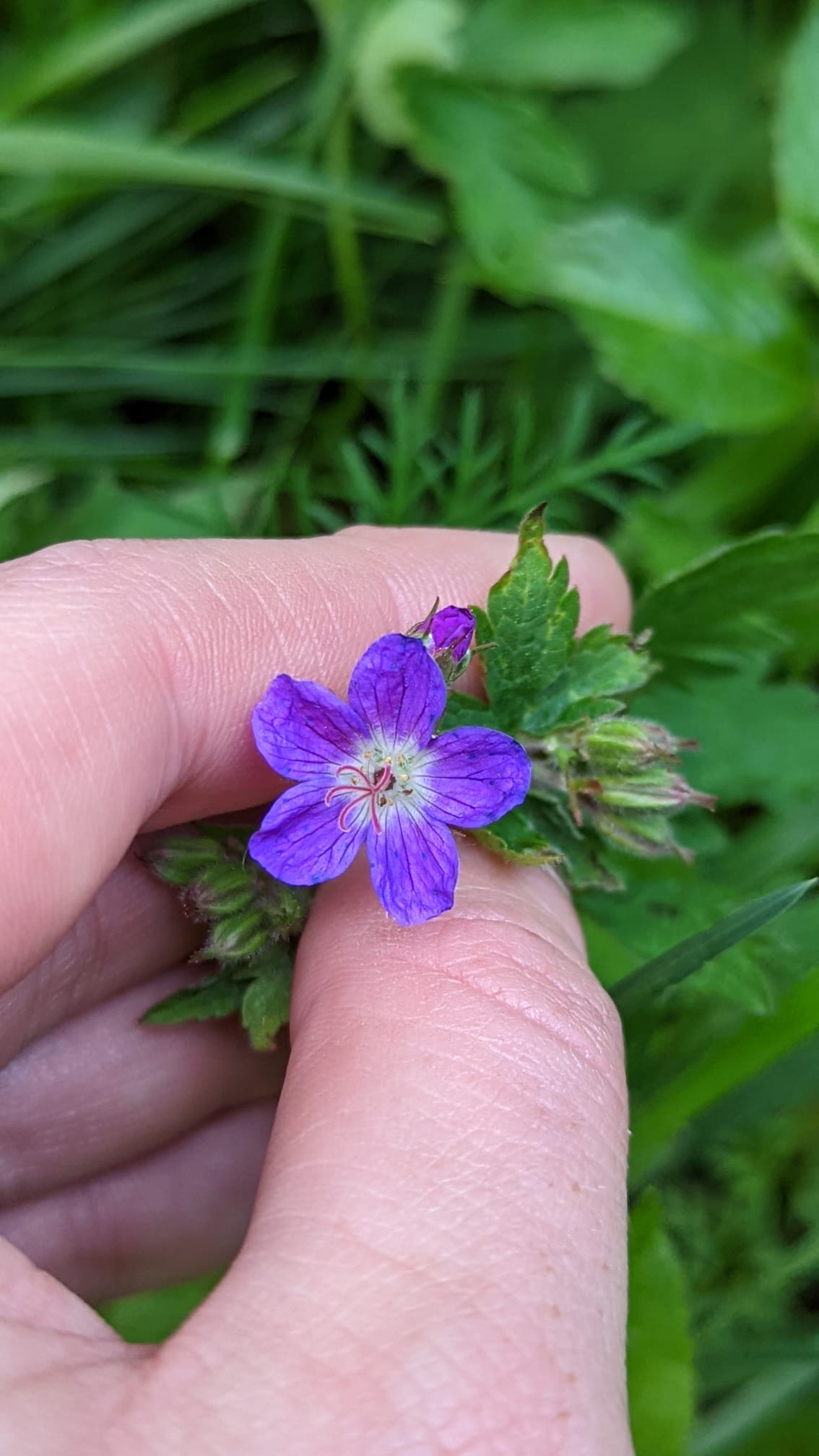
It was around this point that my camera began to malfunction, so photographic evidence is limited. Nevertheless, the plant life in the burn bed was typical for this part of the valley. The montane willowherbs were in full flower, with some attractive examples of Chickweed Willowherb Epilobium alsinifolium found alongside Alpine Willowherb Epilobium anagallidifolium and the non-native New Zealand Willowherb Epilobium brunnescens. Also of note was a lingering patch of Pale Forget-me-not Myosotis stolonifera, another local speciality. A suite of species more commonly associated with woodland was also encountered, including Opposite-leaved Golden Saxifrage Chrysosplenium oppositifolium, Wood Crane’s-bill Geranium sylvaticum, and Wood Sorrel Oxalis acetosella.
Chickweed Willowherb Epilobium alsinifoliumAscending the Bizzle Burn
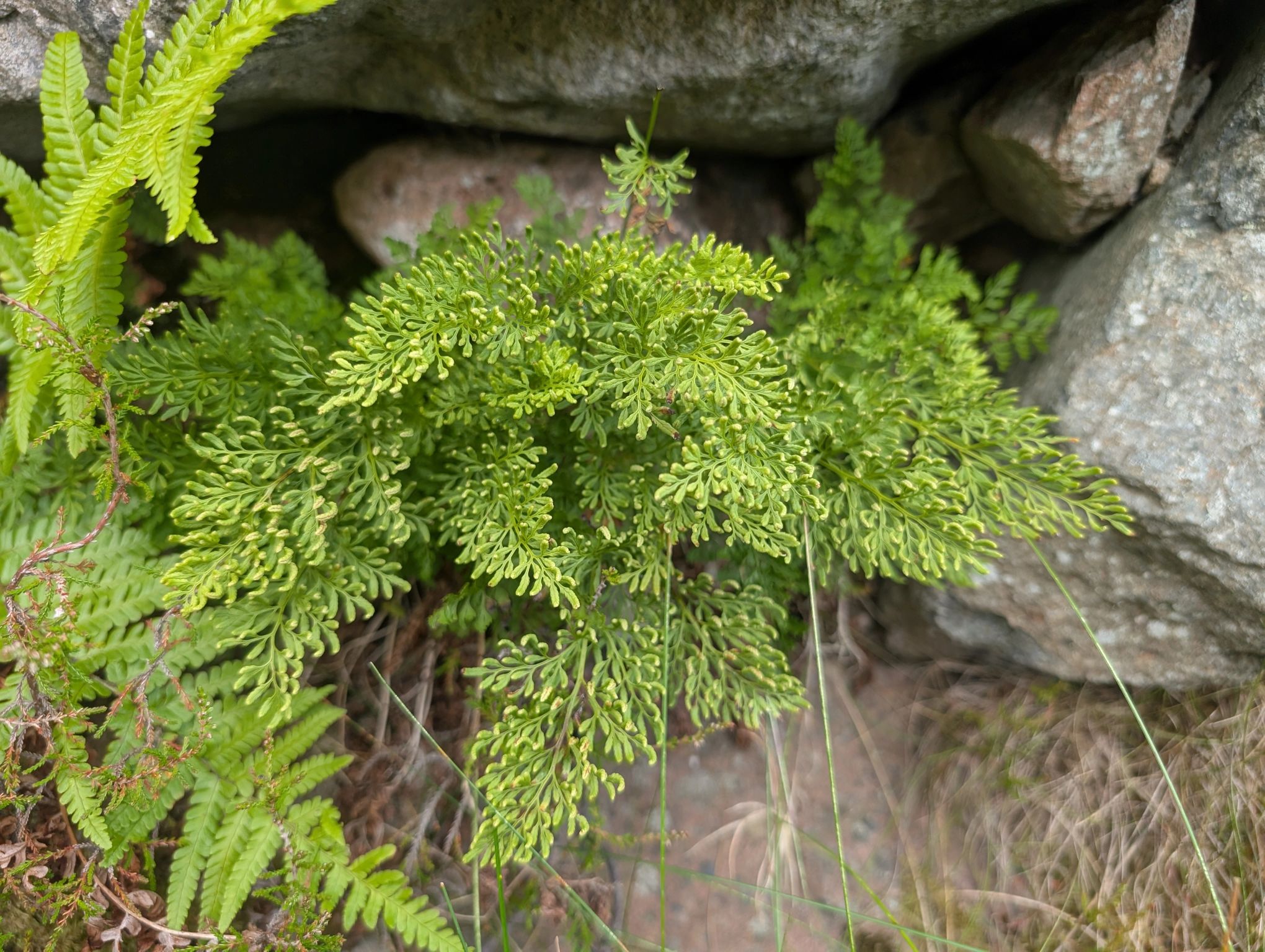
Befitting my newfound obsession with ferns, it was the pteridophytes that proved most interesting at these lofty heights. The day’s target species, Northern Buckler-fern Dryopteris expansa, was eventually located after considerable effort tucked among its preferred scree habitat. The diversity of other species present was impressive as well and, in no particular order, included common types such as Broad Buckler-fern Dryopteris dilatata, Narrow Male-fern Dryopteris cambrensis and Hard-fern Blechnum spicant, along with some altogether scarcer finds: Oak-fern Gymnocarpium dryopteris, Parsley Fern Cryptogramma crispa, and Borrer’s Male-fern Dryopteris borreri. The latter was a bit of a surprise, as I’ve always associated it with woodland – but who knows!
An assortment of fernsBorrer’s Male-fern Dryopteris borreriNarrow Male-fern Dryopteris cambrensisOak-fern Gymnocarpium dryopterisParsley Fern Cryptogramma crispa
At the top of the burn, we eventually emerged into a vast, open corrie at the foot of Bizzle Crags. This is where many of the more interesting plants are known to grow, though oddly, we struggled to locate several of the anticipated targets – including Alpine Clubmoss and Fir Clubmoss – and some others were well past their best due to the heat, particularly the Mossy Saxifrage.
That said, Beech Fern Phegopteris connectilis was a pleasing find among the scree, and a scramble up to a damp ledge yielded some interesting discoveries, including Butterwort Pinguicula vulgaris and Viviparous Sheep’s-fescue Festuca vivipara. I had considered continuing higher, but by this point, my legs were beginning to protest. The 1970s record of Green Spleenwort will have to wait for another day…
Viviparous Sheep’s-fescue Festuca viviparaGoldenrod Solidago virgaureaUp, up we goBeech Fern Phegopteris connectilis
We ended our hike at the corrie, opting not to follow the burn further on this occasion. A walk beyond that point will have to be saved for a cooler day, I think. Still, the descent via a slightly different route added plenty to the plant list and offered some truly stunning views.
In my opinion, this walk isn’t quite as botanically diverse as the Hen Hole, but it’s a beautiful route nonetheless and well worth doing if you find yourself with a day to spare.
I must confess that although I have been botanising for some time now, ferns have proven a difficult group to master. Indeed, master is probably the wrong word as despite countless trips in search of the species found across North East England, I am still but a novice. Or perhaps an improver!
Despite the difficulties associated with telling many of them apart, August is a great month to look closer at ferns and last week, I decided it was high time I bit the bullet and factored them into the programme of ‘Botanists Year’ trips I am currently leading for the Natural History Society. Knowing the perfect place, with 10 botanists in toe, we decided on a visit to the pteridologist’s paradise that is Hareshaw Linn in Northumberland.
Starting out, a variety of common and widespread ferns were easy to find as we made our way into the wooded valley. Broad Buckler-fern (Dryopteris dilatata), Bracken (Pteridium aquilinum) and Male-fern (Dryopteris filix-mas) came first, followed by the distinctive Hard-fern (Blechnum spicant) and later, some rather nice stands of Polypody (Polypodium vulgare). Upon scrutiny when I returned home, these were confirmed to the be common sort.
In the initial stages of our walk at Hareshaw Linn, several other interesting plants were noted too including Wood Melick (Melica uniflora), Giant Fescue (Schedonorus giganteus) and a sizeable patch of Good-king-henry (Blitum bonus-henricus) but ferns soon rose to the fore once more with new additions in Lady-fern (Athyrium filix-femina), with it’s lovely j-shaped sori, and the first of the day’s scaly male-ferns. After a closer look, this was revealed to be Golden-scaled Male-fern (Dryopteris affinis) on account of the rounded, toothed lower pinnule.
In my experience, most of the scaly male-ferns I check near Newcastle turn out to be Borrer’s Male-fern (Dryopteris borreri) but this did not appear to be the case at Hareshaw. Indeed, checking dozens of ferns along the initial leg of our walk, almost all proved to be affinis. We did, however, find a nice example of Borrer’s Male-fern a little further into the Linn, spending some time ogling its distinctive, square pinnules.
This aside, other new ferns included Soft Shield-fern (Polystichum setiferum), likely a new colonist at this site, and Hard Shield-fern (Polystichum aculeatum) which provided a nice opportunity for comparison. Other notable plants included Wood Horsetail (Equisetum sylvaticum) and Marsh Hawk’s-beard (Crepis paludosa).
The first true highlights came after crossing a small bridge in a deeper part of the Linn where we encountered an entirely new species for me in Beech Fern (Phegopteris connectilis). A rather rare species in our area, this fern is much more numerous in parts of Scotland, Cumbria and Wales were it favours woodlands dominated by Oak. It proved to be quite the lovely little plant.
Pausing for lunch about midway into the wood, we were pleased to stumble across a bankside strewn with Oak Fern (Gymnocarpium dryopteris) – a species I see very infrequently in the North East. This proved ample compensation for failing to find even a single example of Lemon-scented Fern (Oreopteris limbosperma) which I know from past walks inhabits the site also. Keen to add a few more species to our swelling tally, from here it was a straight hike to the site’s famed waterfall where a few more species awaited.
Arriving at the waterfall, we were pleased to note several examples of Hart’s-tongue (Asplenium scolopendrium), a typically common fern that had proved conspicuously absent thus far during our trip. The real excitement here was to be found in the walls of the ravine however, where, alongside some nice examples of Brittle Bladder-fern (Cystopteris fragilis) the group found many examples of Lobed Maidenhair Spleenwort (Asplenium trichomanes subsp. pachyrachis) – this being the only place you can see this lovely little fern in all of Northumberland. The subspecies of Maidenhair Spleenwort differs from that we see in garden walls in having scalloped margins to the leaflets and grows mainly on limestone outcrops, typically where conditions are very humid.
Interestingly, I had also expected to find Green Spleenwort (Asplenium viride) on this outcrop also, having noted it on trips in 2020 and 2022. Hopefully it is still kicking about there somewhere…
I make that 15 fern species in just a few hours – not bad going at all. In reality, the total was 18 including Wall-rue (Asplenium ruta-muraria), Maidenhair Spleenwort (Asplenium trichomanes subsp. quadrivalens) and Black Spleenwort (Asplenium adiantum-nigrum) observed as we departed from Newcastle. All in all, the trip was a success and I would strongly recommend that anyone with a penchant for ferns pay Hareshaw Linn a visit. You will not leave disappointed.
Newcastle, my hometown, is a haven for wildlife enthusiasts. While it might not seem obvious at first, the city’s streets, parks, nature reserves, and even industrial zones offer plenty to enjoy throughout the year. In the next instalment of a new series on this blog, I’ve put together a curated list of ten places in Newcastle you should visit to enjoy wildlife. Some are well-known, while others might surprise you. And don’t worry, I promise there won’t be a Kittiwake in sight – they already get plenty of attention elsewhere!
1: Jesmond Dene
Jesmond Dene, a picturesque park located in the heart of Newcastle, has a rich history that can be traced back to the 19th century. The park owes much to industrialist and businessman Lord Armstrong, who, in the mid-1800s, transformed the previously private estate into a public park for the enjoyment of the local community. Armstrong’s vision was to create an urban escape that harmoniously blended natural beauty with innovative landscaping. I’d like to think he succeeded…
Much of the interest in the dene centres on its birds. Kingfishers are a firm fixture of the Ouse Burn here and Grey Wagtail and Dipper can also be found. Add to these a typical mix of woodland birds, and treats like Tawny Owl and Sparrowhawk and you have the makings of a great day’s birding. There are mammals here too, though they are more elusive. Local people often report Roe Deer and Otters are occasionally sighted on the burn. Wander at dusk, and you’re also likely to encounter bats.
What about plants I hear you say? Owing to its roots as a naturalistic garden, the dene is quite eclectic. As well as host of woodland indicator species – Bluebell, Wood Anemone, Dog’s-mercury and the like – you can also expect to see a whole host of modern colonists, from White-stemmed Bramble and Autumn Crocus to Italian Lords-and-Ladies. These aside, a personal favourite of mine has to be the North American Salmonberry, a relative of the Raspberry, that blooms in the Dene each spring. While non-native plants aren’t always to be celebrated, here they add another layer of complexity to an already interesting site.
Established as a nature reserve in 1998, Havannah and Three Hills, formerly the site of a drift mine and slag heaps linked to the Hazelrigg Colliery, is designated as a Site of Local Conservation Interest. This urban oasis is notable for its diverse range of habitats, a relative rarity in Newcastle. Notably, it holds one of only two remaining areas of lowland heath in the city, marked by extensive areas of Heather. Elsewhere, the landscape comprises restored woodlands, grasslands, and small ponds.
Havannah is important for its wildlife, especially as the last known spot in Newcastle where Red Squirrels can be found. Though their numbers have declined recently, sightings from 2024 confirm they’re still around. Other mammals like Weasel, Brown Hare, Roe Deer, and Red Fox can also be seen from time to time and birdwatchers will enjoy the site too thanks to species such as Yellowhammer and Linnet, typically rare in the city. The pond attracts various birds, with the occasional visit from a Little Egret.
Invertebrates add to Havannah’s ecological significance. The heathland supports Dingy Skipper, alongside other specialists like Mother Shipton, while the varied habitats contribute to a thriving community of ladybirds, notably featuring species such as Striped and Heather Ladybirds.
Plants can be interesting too with seasonal highlights including the fluffy heads of Common Cottongrass, the flowers of Northern Marsh Orchid, and the yellow blooms of the scarce Dyer’s Greenweed during the summer months.
Scrub habitat at HavannahIt is worth checking the noticesStriped Ladybird (Myzia oblongoguttata)18-spot ladybird (Myrrha octodecimguttata)
3: Walker Riverside Park
Nestled on the banks of the Tyne River adjacent to Walker, this diverse site encompasses a popular yet somewhat overlooked riverside park under the management of Urban Green Newcastle. The landscape here includes calcareous grassland atop abandoned industrial ground, amenity woodland, intertidal mudflats, and various disturbed habitats. Within the park, remnants of the former St. Anthony’s Tar Works are rich in wildflowers like Wild Basil, Greater Knapweed, Small Scabious, Clustered Bellflower, and Sainfoin. Along the riverside walls, one can find Musk Thistle, Perennial Wall-rocket, and other noteworthy species. Additionally, areas of relic saltmarsh offer a glimpse of coastal flora, including Purple Glasswort, Sea-aster, and other salt-loving species.
The abundance of wildflowers at Walker is mirrored by a diverse insect community. Similar to Havannah, Dingy Skipper butterflies inhabit the area, accompanied by Common Blue, Small Skipper, and Small Copper. The bee, hoverfly, and moth communities add interest too, while the location recognised as the sole local outpost of the Speckled Bush-cricket. A new arrival in the city!
Located close to the River Tyne, sightings of Grey Seal, Common Seal, and even Otter are not uncommon here either.
Managed by the Natural History Society of Northumbria, Gosforth Nature Reserve is perhaps the oldest nature reserve in North East England. An urban oasis, it features many habitats altogether rare in the wider city including fen, wet woodland, expansive reebeds and even some vibrant meadow areas.
The reserve’s larger wildlife is its greatest draw with visitors regularly reporting sightings of Otter, Red Fox, Roe Deer, Weasel and Stoat. More secretive are the Badgers and several bats species, while birds too are diverse. Depending on the season, highlights may include Bittern, Water Rail, Little Egret, Barn Owl and Green Woodpecker. In the warmer months, large numbers of Swallows and martins can be seen and far rarer visitors appear on occasion, among them Marsh Harrier and Hobby.
Gosforth Nature Reserve is similarly noteworthy for its smaller inhabitants. Insects can be exceptionally diverse with a great many dragon and damselflies and of course, a wide-range of butterflies. The latter includes Purple Hairstreak and White-letter Hairstreak and often, Holly Blue. In Spring, look out for Clarke’s Mining Bee on willow flowers and in high summer, Oak Bush-crickets adorning the trunks of trees in the wood.
Finally, if flowers are your forte, the reserve supports its fair share. Look out for the pompon-like flowers of Devil’s-bit Scabious, the tall yellow blooms of Greater Spearwort and several species of orchid among others.
The Lower Ouseburn Valley is a thing of beauty. An amalgamation of industry, dereliction and rejuvination, it perfectly demonsrates the value human centric habitats can hold for biodiversity. Local CIC, Wild Intrigue, share so much lovely content on the the Ouse Burn and the surrounding area that expansion seems unecessary but suffice to say, for the budding botanist, it is a very interesting site. There a few places locally where you can see scarce natives and archaeophytes such as Gypsywort, Water Figwort, Green Field-speedwell and Small Nettle growing side-by-side with such well established recent escapes. Hjelmqvist’s Cotoneaster, Tall Melilot, Giant Hogweed, and so much more, there is no better place to experience the ‘new’ flora of Newcastle.
For those not so fascinated by botanicals, there is a great deal to see. The Ouse Burn itself holds Otter (check out these AMAZING images), Kingfisher, Grey Wagtail, Dipper and resident pair of Mute Swans that insist on breeding in awkward positions each year, much to the delight of residents.
Insect wise, look out for large gatherings of ladybirds on the Ouseburn’s ornamental shrubs. Sure, most will be the non-native Harlequin Ladybird but recent records show Cream-spot, Orange, 7-spot, Pine and so many other species.
As someone who visits the Ouseburn area regularly, I must confess, this site is my guilty pleasure. Jampacked with wildlife and people too, it shows how both can live together in relative tranquility.
Fiddleneck (Amsinckia micrantha)Yellow-wort (Blackstonia perfoliata)A typical view of the Ouse Burn
6: Big Waters Country Park
I love this one. A Northumberland Wildlife Trust reserve shared with Urban Green Newcastle, it is one of the best places in Newcastle to observe our native flora. The ponds are wonderfully diverise with Rigid Hornwort and Fennel Pondweed and the grasslands packed with scarcities such as Fairy Flax and Agrimony. Alas, this isn’t a botanical blog so I will endevor to delve deeper…
Big Waters is most notable for its birdlife. In Winter, you can expect to see an eccelctic mix of wildfowl including Pochard, Teal, Wigeon, Shovler and Goleneye, even the odd Pintail and Whooper Swan. In fact, the site is well known for attracting local rarities including a returning American Wigeon which routinely delights crowds come Autumn and Winter.
Beyond birdlife, this is a phenominal site to observe insects. Bees include Tawny Mining Bee, Buffish Mining Bee, Vestal Cuckoo Bee and more, while ladybirds include the rare 18-spot, a specialist of conifer trees. There are too many records to summarise here but it is worth checking out iRecord for the records of Chris Barlow who has shared much about the site.
A botanical montage from a Summer’s day at Big Waters
7: Scotswood Road
Positioned along Scotswood Road, a significant thoroughfare leading into the city from the west, lies an unexpected haven for wildlife enthusiasts. Despite their urban location, the grasslands, scrub, and wooded areas along the road are rather diverse, providing a home for various species.
An abundance of wildflowers in the grasslands here attracts many insects, especially butterflies. Dingy Skipper, uncommon in the nearby area, are plentiful in spring and later, other butterfly species like Common Blue, Small Skipper, Large Skipper, Meadow Brown, and Ringlet can be seen. Bees are also plentiful here, including Buffish and Chocolate Mining Bees, along with seven species of bumblebees. Lucky observers might even spot the Mother Shipton moth – a grassland specialist with at first, may appear more like a butterfly in flight.
Insects aside, Scotswood Road boasts a variety of wild plants, particularly species associated with calcareous grassland. In the summer, visitors can enjoy sepcies such as Small Scabious, Greater and Chalk Knapweed, Hoary Plantain, Wild Basil, and Kidney-vetch. Bee Orchids are also thriving in the area, with hundreds spotted nearby in 2023.
Surprisingly, an industrial estate well and truly earns its place among the city’s top spots for wildlife enthusiasts. Despite its somewhat neglected appearance, this area offers a remarkable experience throughout the year. Its main allure lies in the fact that it is one of Newcastle’s premier locations to observe wild orchids. During summer, visitors can easily spot varieties such as Bee Orchid, Common Spotted Orchid, Northern Marsh Orchid, and Broad-leaved Helleborine. However, the real gem is the flourishing populations of Dune Helleborine, an rather rare plant with some of its densest concentrations found along the River Tyne. The little video below should give a flavour of what to expect…
But orchids aren’t the only floral treasures here. Newburn boasts an array of local specialties including Nettle-leaved Bellflower, Marsh Pennywort, Viper’s-bugloss, and the delicate Blue Fleabane, thriving in the chalky remnants of former industrial sites.
This site is also an underappreciated haven for urban birdwatchers. Green Woodpecker, a rarity in Newcastle, is a frequent visitor, alongside Kestrel, Sparrowhawk, and Peregrine. In winter, Jack Snipe can be found amidst rushes, while the numerous Alders attract sizable flocks of Siskin and Lesser Redpoll. Gazing across the Tyne towards Gateshead, one might even catch sight of a majestic Red Kite on the wing.
Another park managed by Urban Green Newcastle, and perhaps my favorite of them all, is Iris Brickfield. Despite its small size, this small, green island showcases the rich variety of life that can thrive in tiny spaces.
Thanks to careful management, the park boasts an abundance of wildflowers, with around 220 species recorded in the past year alone. Some notable ones include Sweet Violet, Yellow-rattle, Green Field-speedwell, Field Scabious, and Wood Anemone, among many others. The park also features a lovely small pond, where you can spot Bog Bean, Purple Loosestrife, Mare’s-tail, and other wetland plants not often encountered in the city. Somewhat outdated now, I previously shared a post detailing the flora of this park.
Where there’s water, there’s wildlife. From amphibians like Common Frog and Smooth Newt to dragonflies like Broad-bodied Chaser, there’s plenty to see.
Insects are abundant too, with thriving colonies of several solitary bees such as the Tawny Mining Bee, Buffish Mining Bee, and Gooden’s Nomad Bee. Holly Blue butterflies grace the park in spring, while ladybirds are a year-round highlight. The pond is known to harbor Water Ladybirds, and you might spot 10-spot, Pine, and 2-spot Ladybirds among the trees on site.
Sugley Dene is a new discovery for me, one I started exploring in 2023. It’s one of the few remaining areas of ancient semi-natural woodland in Newcastle, offering a glimpse into the landscape of times past.
The woodland is thriving with ancient woodland wildflowers like Great Wood-rush, Wood Anemone, and Bluebell. If you look closely, you’ll also find two grasses typical of older woodlands: Wood Melick and Wood Millet. Thanks to its damp and shady environment, Sugley Dene is a haven for ferns, including Lady-fern, Hard Shield-fern, Hart’s-tongue, Hard-fern, and Soft Shield-fern.
Since it’s visited by few people and quite distant from nearby roads, Sugley Dene is an ideal spot to experience the dawn chorus. The melodies of birds like Chiffchaff, Blackcap, Willow Warbler, and Song Thrush create a beautiful symphony each spring, making it a perfect place to unwind and enjoy the early morning tranquility.
It’s no secret that I’m a big fan of snowdrops. These delicate flowers, signaling the arrival of spring, have become an obsession of mine in recent years. So much so that I spend a lot of my free time exploring the Northumbrian countryside, looking for new varieties, and browsing the internet for more options to add to our tiny yarden – much to Matt’s annoyance!
Although February is winding down and the peak snowdrop season is almost over, there are still plenty to be found in different parts of my home county. In this week’s blog post, I’ll share some of the snowdrops I’ve spotted recently on jaunts around the county. Let’s start with a new discovery for me – a snowdrop I stumbled upon while walking through rough terrain in Monkseaton last week. With it’s pleated green leaves with a distinct glaucous central band, and after some research, it seems to be the Pleated Snowdrop (Galanthus plicatus), a species not often encountered in these parts, at least according maps held by the BSBI.
Also known as the Crimean Snowdrop, this species is indigeonous to Türkiye, Romania, and Crimea and is thought to have been brought to the UK by British soldiers fighting in the 1850s Crimean war. It is widely grown in gardens but far less common in a wild state than the plentiful Common Snowdrop (Galanthus nivalis).
Churchyards are great places to find snowdrops, as they’re often planted in large numbers and left to spread naturally. Some of the best spots I know locally are in churchyards, and they often have surprises in store. After a meeting with our wedding venue a couple of weeks ago, Matt and I visited two such sites in quick succession, specifically to look for a local specialty: yellow snowdrops, also known as Galanthus nivalis ‘Sandersii Group’.
These yellow snowdrops occur naturally, though not abundantly, within populations of Common Snowdrop in parts of Northumberland. They’re named after James Sanders, who first identified them at Chillingham. While they’re not as common nowadays due to enthusiasts collecting them, they can still be found if you know where to look.
During our visit, we managed to find a few isolated patches of them, alongside plenty of the double-flowered variant of Common Snowdrops, Galanthus nivalis ‘Flore Pleno’. It was a successful trip!
Fast forward to last weekend, and once again, I found myself exploring another remarkable churchyard, this time as part of a course I’m leading for the Natural History Society of Northumbria. This site proved to be quite fascinating, yielding more of the exquisite Sandersii snowdrops along with two interesting snowdrop hybrids: Galanthus x hybridus, a cross between Pleated and Giant Snowdrops (Galanthus elwesii), and Galanthus x valentini, a hybrid of Common and Pleated Snowdrops.
Interestingly, despite our thorough search, we completely failed to find any pure Pleated Snowdrops in the entire cemetery. It left us pondering whether they had bred out of existence in this particular location. Nonetheless, we were treated to large patches of pure Greater Snowdrops, characterised by their broad, glaucous leaves and the variable green markings on their flowers.
Galanthus nivalis ‘Sandersii Group’Galanthus nivalis ‘Sandersii Group’Half way to Galanthus nivalis ‘Flore Pleno’Common Snowdrops (Galanthus nivalis)Greater Snowdrops (Galanthus elwesii)
Howick Hall Gardens
Howick Hall Gardens has become a go-to destination for my Sunday strolls. With its expansive grounds and rich history, it’s especially charming during “snowdrop season.” The dedicated Snowdrop Trail they offer is definitely worth checking out.
While the gardens may not feature a wide variety of snowdrop species, the sheer number of Common Snowdrops blanketing the woodland is quite remarkable. There are millions of them scattered throughout, creating a breath-taking sight.
Of course, it wasn’t just snowdrops in flower at Howick and fabulous scones aside, we also enjoyed the sight of several crocus species, well naturalised at this point, our first Buff-tailed Bumblebee (Bombus terrestris) of the year and even
Early Crocus (Crocus tommasinianus)The year’s first daffodilsBuff-tailed Bumblebee in White Crocus (Crocus vernus)Yellow Crocus (Crocus x luteus)Spring Crocus (Crocus neapolitanus)Snow Crocus (Crocus x hybridus)
And there we have it, a hopefully not too tedious account of a wonderful few weeks spent hunting for these endearing little flowers. To finish on a high, I should say that another snowdrop species, the Green Snowdrop (Galanthus woronowii) is once again flowering in a handful of wilder spaces close to home in Newcastle. A favourite of mine, I am ashamed to admit that I completely forgot to take photos. Instead, you’ll need to make do with this one from 2022.
Northumberland, my home county, is a haven for botanists, offering a rich tapestry of landscapes that range from windswept hills and expansive moors to coastal dunes, wetlands, and impressive woodlands. As a lifelong resident, I may be a tad biased, but the flora here truly spoils enthusiasts for choice.
To help inspire your next stroll in nature, I thought I’d share a curated list of ten great places to enjoy wildflowers in Northumberland. While some may be familiar, a couple might just surprise you, hopefully adding an extra layer of discovery to your next botanical adventure.
As a quick disclaimer, I should add now that list is not exhaustive. There are many other great places out there to be explored…
1: The Snook, Holy Island
Lindisfarne, a part-time island off the North Northumberland coast, needs little introduction. Revered for its religious significance, rich history, and breathtaking scenery, the island is undoubtedly Northumberland’s premier botanical hotspot, offering an abundance that exceeds the scope of a single visit.
Among Lindisfarne’s diverse habitats, ‘The Snook’ stands out with its slacks, grey dunes, and saltmarsh. This peninsula, distinguished by a solitary house famous for its role in the ITV series Vera, is home to botanical treasures too numerous to detail here.
For orchid enthusiasts, early summer unveils a spectacular display of Common Spotted Orchid, Early and Northern Marsh Orchids, alongside various hybrids, Common Twayblade, and a profusion of Marsh Helleborine. Recently demoted to a sub-species but still rather species, drier spots also hold populations of Lindisfarne Helleborine – once thought of as a Northumbrian endemic.
Beyond orchids, The Snook boasts exceptional diversity. Highlights include the rare Seaside Centaury, the delicate Bog Pimpernel, and Scots Lovage, teetering on the southern edge of its range in Northumberland. Brookweed, an unassuming yet notable plant, thrives here, alongside Autumn Gentian and smaller wonders like Lesser Clubmoss, Variegated Horsetail, and Black Bog-rush (okay, these aren’t wildflowers but they are interesting!).
While visiting the Snook, you may also like to pop into the nearby dunes where species like Pyramidal Orchid, Bee Orchid, Blue Fleabane and Viper’s-bugloss also await.
East Chevington, a Northumberland Wildlife Trust reserve perched atop a former mine overlooking scenic Druridge Bay, is well worth a visit. Featuring expansive wetlands, reedbeds, dunes, and grassland, the site is a haven not only for more obvious wildlife but also for a diverse array of plants which we’ll explore here.
As one of the rare pockets of high-quality coastal grassland in South Northumberland, the reserve has an intriguing flora. Standouts include Lesser Butterfly-orchid, Dyer’s Greenweed, Pyramidal Orchid, not to mention Marsh Helleborine and Sea Bindweed, rediscovered at the site in 2023. And, of course, one can’t easily overlook expanses of Bloody Crane’s-bill, Northumberland’s county flower, adorning pathsides and grassy areas.
Beyond the more prominent blooms, attentive visitors will be rewarded with sightings of Zigzag Clover, Fairy Flax, Celery-leaved Buttercup, Long-headed Poppy, and a myriad other plants. For an extra treat, a brief detour to the nearby beach unveils the hardy coastal flora of the county, featuring Prickly Saltwort and other specialists like Sea-rocket and Sea Sandwort.
Accessible to all, like many Wildlife Trust reserves, East Chevington invites exploration.
The town of Warkworth, nestled close to Amble on the Northumberland coast, is picturesque in its own right. However, the nearby dunes, saltmarsh and coastal grasslands, somewhat overlooked compared to more famous sites like Holy Island, possess much more to be admired.
In late spring, the dune slacks come alive with the countless flowering spikes of the Early Purple-orchid and as summer unfolds, visitors can delight in another local specialty, Maiden Pink, as its diminutive flowers peek out amidst a tapestry of interesting, albeit less vibrant, grasses and sedges.
A close inspection of the sward at Warkworth reveals a miniature world with species like Little Mouse-ear, Mouse-ear Hawkweed, Common Stork’s-bill, and an assortment of delicate eyebrights. Yet, larger blooms are equally abundant. Keep an eye out for Viper’s-bugloss, the frothy flowers of Hoary Cress, and treats like Wild Basil and Burnet Rose.
The strandline and saltmarsh at Warkworth add another layer of interest with a rich community of salt-loving plants. Among these, Sea Sandwort, Sea Purslane, Spear-leaved Orache, and the ever-charming Thrift. Undoubtedly, Warkworth is a special place and there undoubtedly new species to be found.
Maidan Pink (Dianthus deltoides) at Warkworth
4: Embleton Quarry Nature Reserve
Embleton Quarry Nature Reserve, a hidden gem often overshadowed by more well-known sites on this list, boasts a quiet charm. Managed with dedication by local volunteers, this small but tranquil reserve has much to offer visiting botanists.
Orchids take center stage at Embleton (don’t they always?) and are represented by Common Spotted, Northern Marsh, and, notably, Bee Orchid. Beyond these fan favorites, the site stands out for harboring populations of Purple Ramping-fumitory and White Ramping-fumitory, alongside a cheery array of familiar species such as Wild Teasel, Red Bartsia, Salad Burnet, and Weld.
Much of Embleton’s interest lies its close proximity to residential areas, responsible for introducing a mix of garden escapes. While none have become invasive, the reserve hosts several botanical oddities like Lamb’s-ear, Garden Peony, Poet’s Daffodil, and Hidcote Comfrey, among a plethora of other aliens.
For those with a penchant for exploration, a visit to the nearby Embleton Churchyard unveils another fascinating plant — Deadly Nightshade, thriving as one of its only Northumberland strongholds.
White Campion (Silene latifolia)Hidcote Comfrey (Symphytum x hidcotense)Poet’s Daffodil (Narcissus poeticus)Scarlet Pimpernel (Lysimachia arvensis)Northern Marsh-orchid (Dactylorhiza purpurella)Garden Star-of-Bethlehem (Ornithogalum umbellatum)
5: Newbiggin-by-the-Sea
Newbiggin and its surrounds stand out as an ecologically rich area that might just surprise visitors. A northward walk from Church Point reveals a varied landscape encompassing sandy shoreline, relic dunes, and the rough grassland of the golf course. Here, several notable wildflower species can be found including the diminutive Bird’s-foot, a member of the pea family, the coastal specialist Purple Milk-vetch, and just occasionally, Bee Orchids. The Church Point car park itself is noteworthy, teeming with Hoary-cress, Thrift, Dwarf Mallow, and other interesting plants.
Exploring the sandy shoreline may yield four species of Orache, among them Frosted Orache and Babbington’s Orache. Additionally, common coastal plants such as Buck’s-horn Plantain and Sea Milkwort are abundant. Heading higher up, the cliffs offer Sea Campion, while the golf course holds rarer species such as Good-King-Henry, Northern Marsh-orchid, Burnet Rose, and Pencilled Crane’s-bill — a notable escapee at the site.
Managed by the National Trust, Allen Banks boasts a distinctive blend of ancient woodland and ornamental planting, reflecting the influence of the past custodians on the estate. Renowned as one of the premier locations in Northumberland to investigate our ancient woodland flora, the site offers much of interest with highlights of Bird’s-nest Orchid, Early-purple Orchid, and the peculiar-looking Toothwort.
A stroll along the wooded banks of the Allen introduces visitors to other indicators of ancient woodland, including Goldilock’s Buttercup, Bitter Vetch, Wood Crane’s-bill, and Great Horsetail. The presence of Calaminarian Grassland, characterised by its soil polluted with industrial metals, adds another layer of interest. In this area, delicate Mountain Pansies flourish.
For those seeking a longer walk, a well-signposted trail to Morralee Tarn is recommended. Once a Victorian boating lake, it has transformed into a rich wetland habitat. Timing your visit right may reward you with sightings of White Water-lily, Mare’s-tail, and the intriguing Marsh Cinquefoil.
Letah Wood, believed to be Northumberland’s last surviving ‘Daffodil wood,’ offers a spectacular display with its abundant Wild Daffodils blanketing the woodland floor each spring.
Beyond the captivating display of Daffodils, the wood boasts a rich diversity of woodland wildflowers. Visitors can expect to encounter Giant Bellflower, Wood Anemone, Pignut, Lords-and-Ladies and the iconic English Bluebell. A special highlight for those exploring the woodland is the much rarer Herb-paris.
Additionally, Letah Wood is a haven for those interesting in trees, ferns and bryophytes. While these aspects are beyond the scope of this post, they contribute to the overall richness of the wood.
Wild Daffodiils (Narcissus pseudonarcissus subsp. pseudonarcissus) at Letah Wood
8: Hen Hole, College Valley
The Hen Hole stands out as arguably the most spectacular gorge in Northumberland, and earns its place as one of the county’s top botanical sites. While its remoteness may pose a challenge, the awe-inspiring scenery and diverse flora make it well worth the effort. Before embarking on the journey, be sure to pack sturdy walking boots and ample snacks for the hike that awaits!
Hen Hole has been visited by many notable botanists over the years, from Baker & Tate to George Swan, and is celebrated for its rare arctic-alpine plants, including Alpine Saw-wort and Roseroot. While these flowers are elusive, the journey toward the gorge from Mounthooley offers more obvious specialities such as Alpine Willowherb, Pale Forget-me-not, Starry Saxifrage, and Butterwort. Be sure to stick close to the College Burn – most of the more interesting plants seldom grow far from water.
The more abundant flora of Hen Hole includes familiar species like Heath Bedstraw, Goldenrod, Heath Spotted-orchid, Wild Thyme, and Wood Crane’s-bill. Beyond those, however, the gorge treats visitors to superb views, scenic waterfalls, and a plethora of other wildlife, ensuring that the journey is rewarding in any season.
Cullernose Point, located between Craster and Howick, is a relatively small but ecologically significant coastal site. As part of the Northumberland Coast Path, it provides easy access for visitors interested in exploring its clifftop grasslands, which boast noteworthy populations of Purple Milk-vetch and Spring Squill – a charming little bulb with bright blue, starry flowers.
Beyond these botanical highlights, the clifftop grasslands support additional plants including Sea Mouse-ear, Thrift, Wild Thyme, Heath Milkwort, Heath Groundsel, and other flora characteristic of coastal environments.
The small size of this site mean it is often better suited as a pitstop, perhaps on route to more floriferous sites further North?
Spring Squill (Scilla verna)
10: Scotch Gill Wood, Morpeth
Scotch Gill Wood, situated just outside the market town of Morpeth, stands out as a prime example of semi-natural ancient woodland. Notably, this woodland offers a much more accessible destination for those interested in exploring our woodland flora.
The wood is home to a variety of plant species characteristic of older woodlands. Careful exploration might reveal Toothwort, Goldilocks Buttercup, Spurge-laurel, Yellow Star-of-Bethlehem, and the intriguing Mochstatel, among others.
In addition to the vibrant species listed above, Scotch Gill Wood hosts several less colorful but equally interesting plants, notably the Rough Horsetail. Damp areas within the wood add another layer of botanical interest with the occurrence of Hemlock Water-dropwort, Brooklime, and Large Bittercress.
The accessibility of Scotch Gill Wood makes it an ideal destination for those seeking a woodland walk without venturing too far from civilisation.
Yellow Star-of-Bethlehem (Gagea lutea)
Planning a trip in search of wildflowers? Remember to record them. Doing so helps conservationists monitor populations and protect rich and important sites like those mentioned in this post.
For a little more information on logging your finds, please see below.
A quick account of an overdue run-in with a Northumbrian speciality – Asplenium x clermontiae
Now, I am rather dreadful at ferns and for a while now have been trying to improve by tracking down our region’s scarcer species. Top of that list for quite a while has been Lady Clermont’s Spleenwort (Asplenium x clermontiae), a hybrid between Wall-rue (Asplenium ruta-muraria) and Maidenhair Spleenwort (Asplenium trichomanes).
Now, this is a rather special fern. Despite its parents being rather widespread and growing together on walls and structures across the UK, it is only known from three sites nationally and only as individual plants. This means that population of this unassuming little plant stands at three individuals nationally, just maybe with a few more out there to be discovered.
Of the sites where Asplenium x clermontiae is known, it is a site in North Northumberland (VC68) that is perhaps the most studied. Indeed, after it was first identified in 2000 by George Swan, it was recorded 20 or so times until 2012 and visited by many more botanists keen to see it. Interestingly, local records held by the BSBI stopped post-2012 though it was reported by Stewart Sexton in this blog post. All of this means that this single little fern hasn’t been reported in almost a decade. Had it gone or was it simply being kept quiet? Today, I went North once again to try and find out and this time, it appears I was successful!
Asplenium x clermontiae, Howick Scar
This was my third attempt at looking for this plant in truth but I won’t begrudge myself too much – finding a single rare fern among a sea of commoner species is actually quite a challenge. Still, I am glad to finally lay eyes on what is perhaps the scarcest plant I have encountered anywhere in Britain to date. Never a dull day, eh?
A quick account of a fantastic botanical outing to the famed Hen Hole, one of the Cheviot’s hidden gems.
Last Sunday I finally ticked off an ambition I’ve held since I first became involved with botanical recording in Northumberland – a visit to the fabled Hen Hole gorge, located at the foot of the Cheviot. Now, as well as being perhaps one of the most remote and beautiful areas of the county, this site is fabled locally as a botanical hotspot. A ‘must-see site’ in a local context.
Visited by successive generations of botanists from Baker & Tate to George Swan, Hen Hole is renowned as one of the few sites locally at which to observe a range of rare arctic-alpine plants, from Alpine Saw-wort (Saussurea alpina) to Roseroot (Rhodiola rosea). Unique quirks outstanding, with its dramatic landscape and tantalizing plants, it reminded me a lot of Upper Teesdale.
Spoiler: we saw neither the saw-wort nor Roseroot – our legs had all but given in by the time we reached the fabled spot. A full account of the history and botanical notability of Hen Hole can, however, be found here courtesy of Chris Metherell.
While we didn’t catch up with the famed rarities on our first visit, there was still lots to see and no end of incredible scenery to enjoy. Some of this is summarised below…
Setting out…Heath Bedstraw (Galium saxatile)Hat definitely needed in the blazing sunA surprisingly chipper Matt
Beginning our hike at Mounthooly, the walk to the gorge was an enjoyable one. We passed first through an area of stunted woodland where it was exciting to note Red-berried Elder (Sambucus racemosa) and later, through a large expanse of grassland rich in sedges, great drifts of Silver Hair-grass (Aira caryophyllea) and large expanses of both Hare’s-tail (Eriophorum vaginatum) and Common Cottongrass (Eriophorum angustifolium).
It wasn’t until we reached the rocky, moss-laden banks of the College Burn that things began to get really interesting. Here, in the splash zone, rocks were adorned by New Zealand Willowherb (Epilobium brunnescens), an invader, and plenty of Starry Saxifrage (Micranthes stellaris), a most pretty native. More interesting still, we also encountered a few examples of Alpine Willowherb (Epilobium anagallidifolium), one of the area’s specialties, and Matt was drawn to a creeping mass of forget-me-nots which lo and behold, turned out to be Pale Forget-me-not (Myosotis stolonifera). Another one off the bucket list.
Inspecting the banks further, areas of scree and exposed stone on the site of previous collapses proved interesting, most notably for their ferns. Here, the dominant species seemed to be Narrow Male-fern (Dryopteris cambrensis), a new one for me. There were also a few examples of the common Male-fern (Dryopertis filix-mas) in there too and, much more exciting, several examples of Parsley Fern (Cryptogramma crispa) which we diligently mapped. I do like this one and if my memory serves, this is only the second site at which I’ve seen it up here.
Beyond these, other sightings included Wood Crane’s-bill (Geranium sylvaticum), Water Horsetail (Equisetum fluviatile) and some likely Mountain Male-ferns (Dryopteris oreades) grouped together on the steep slopes opposite. I left these to scramble to next time but the sight of multiple ‘shuttlecock’ growths clustered together looked promising.
Beginning our ascent into the gorge, things became more interesting still. Not least the scenery with multiple waterfalls, including the well-known Three Sisters, coupled with slopes, scree, and some hulking outcrops. Were I a geologist, I’d surely have been elated.
Here too, insects became more prominent with plenty of Small Heath (Coenonympha pamphilus) butterflies darting about and astronomical quantities of bees. The most notable of these being Bilberry Bumblebee (Bombus monticola) found on almost every patch of Wild Thyme (Thymus drucei) we encountered. We also spotted Heath Bumblebee (Bomus jonellus) and Forest Cuckoo Bee (Bombus sylvestris).
Impressive bouldersThe three sistersBilberry Bumblebees (Bombus monticola)Thew view, a little higher up
Dalience with bees concluded, our attention turned back to the plants, and here with enjoyed more of the same, albeit in greater quantity. New additions came from Butterwort (Pinguicula vulgaris), a carnivorous plant, and Chickweed Willowherb (Epilobium alsinifolium), another of the area’s specialties. Annoyingly, in my excitement, I forgot to photograph this!
Upon hauling ourselves up the final waterfall, we were greeted by the pleasant sight of many Heath Spotted Orchids (Dactylorhiza maculata) in full bloom, alongside less striking plants in Deergrass (Trichophorum germanicum) and Carnation Sedge (Carex panicea).
Feeling the strain in our legs and realising that we had spent almost five hours exploring already, we concluded our trip here. Had I gone a little further, and up a few more hills, we likely would have encountered several of the more specialised plants mentioned in Chris’ report above. That said, there’s always next time and I plan to return in July alongside a few friends to explore further. Throughout the walk, I did manage 150+ records which gets me off to a good start at least!
Since becoming a botanical co-recorder for North Northumberland (VC68) I’ve been gradually getting acquainted with some of the area’s notable botanical sites. Hen Hole was right there at the top of the list and as far as first impressions go, it was wonderful. I’ll be back soon…
A short account of a frosty trip to Hareshaw Linn in Northumberland last weekend
Hareshaw Linn, a designated SSSI near Bellingham in Northumberland, is a truly lovely spot. One which I have visited previously in summer (writing about it here) but never during the colder months. Given the site’s reputation as a botanical hotspot perhaps that is little wonder – most plants tend to vanish in winter – but keen to get out and about in the winter air, we thought we would give it a go anyway. We certainly weren’t disappointed.
Ferns are a real specialty of Hareshaw Linn with the wooded valley and shady slopes here playing host to myriad rare and unusual species. While many of the ground-dwelling species had been flattened by recent frosts, during our walk, we noted several species including Lady-fern (Athyrium filix-femina), Male-fern (Dryopteris filix-mas) and Hard-fern (Blechnum spicant). The scaly ferns had taken a battering but it was still possible to discern Golden-scaled Male-fern (Dryopteris affinis) and its cousin, Borrer’s Scaly Male-fern (Dryopteris borreri). Hard Shield-fern (Polystichum aculeatum) with its rigid fronds also proved numerous – a welcome change to other sites I have visited recently.
Ferns growing higher up on rocks and trees seemed to have fared better than their relatives on the floor. On tree trunks strewn throughout the gorge, we noted both Common Polypody (Polypodium vulgare) and Intermediate Polypody (Polypodium interjectum), while boulders held Brittle Bladder-fern (Cystopteris fragilis) too. Of course, the area around the waterfall proved most productive with both local specialties observed. Lobed Maidenhair Spleenwort (Asplenium trichomanes subsp. pachyrachis) can be seen in good numbers here at its only Northumberland site. Green Spleenwort (Asplenium viride) was harder to come by but still present.
Of course, ferns are not the only thing to appreciate about Hareshaw Linn. The site is rather beautiful in any season but now, in the depths of winter, looks remarkable clad in snow and ice. Given the sub-zero temperatures, the famed waterfall here had partially frozen making for an impressive sight. Better still was the presence of ice pancakes on the burn itself. Believed to form when foam floating on the water’s surface begins to freeze, this was the first time either of us had seen these. An impressive sight!
A frozen plunge pool beneath the fallsThe Hareshaw waterfall with Matt for scaleIce pancakesAttempting to photograph said pancakes
While everything looked more than a tad wintery at the Linn, signs of spring could also be seen and heard. The leaves of typical spring flowers such as Wood Anemone (Anemone nemorosa) had begun to appear and in the wood, various birds had begun singing. It was nice to catch the drumming of Great Spotted Woodpecker (Dendrocopos major) in particular.
With my Natural History Society of Northumbria hat on, yesterday I had the pleasure of leading a small group of students from Newcastle University to one of my favourite local haunts: the glorious National Trust reserve at Allen Banks. The wooded areas here making for a superb location at which to enjoy a range of seldom seem woodland wildflowers and of course, to try our hand at a spot of orchid hunting too.
Starting out from the public car park and heading South on the West side of the river, things started out well with a range of interesting ferns spotted along the way. Among these, Broad Buckler-fern (Dryopteris dilatata), Hard Fern (Blechnum spicant), Male Fern (Dryopteris filix-mas) and both Soft Shield-fern (Polystichum setiferum) and its cousin, the Hard Shield-fern (Polystichum aculeatum). If you had told me a year back that I’d be getting exciting over ferns, I’m not sure I would have believed you…
In flower here was Yellow Pimpernel (Lysimachia nemorum) and Opposite-leaved Golden-saxifrage (Chrysosplenium oppositifolium), while a little further in, we were treated to remains of Toothwort (Lathraea squamaria) and an Alchemilla later [tentatively] ID’d as Intermediate Lady’s-mantle (Alchemilla xanthochlora).
Making plenty of pitstops along the way to our chosen destination, it was interesting to stumble across a mature variegated Sycamore (Acer pseudoplatanus) which made for an impressive sight with its marbled, yellow leaves. Whether this was a naturally occurring mutation or something planted by the Victorians, I am not sure…
Also nearby were a number of white form English Bluebells (Hyacinthoides non-scripta), as well as Bitter-vetch (Lathyrus linifolius), Wood Sedge (Carex sylvatica) and plenty of woodland indicator species. Bugle (Ajuga reptans) and blooming Woodruff (Galium odoratum) certainly made for a pleasing sight.
Further into the wood, after quite a bit of searching, we stumbled across the first of the day’s intended targets – a glorious clump of Bird’s-nest Orchids (Neottia nidus-avis). Growing under Hazel, as opposed to Beech on this occasion, these were not quite in flower yet but still gave plenty of cause for celebration. Nearby a separate, individual flower spike was found soon after.
Bird’s-nest Orchids (Neottia nidus-avis)
Next came a pause and lunch break at a small area of calaminarian grassland strewn with countless Mountain Pansies (Viola lutea). The fantastic array of colour forms on show here certainly made for an enjoyable break with the countless blooms ranging from deep purple to lilac and of course, yellow.
Mountain Pansy (Viola lutea)
Reaching Planky Mill, it didn’t take us long to find our first Early Purple Orchids (Orchis mascula) of the day. While less numerous than on my last visit in 2020, we still managed to count seven flower spikes during our short stay. A few non-blooming rosettes were observed nearby also.
More run of the mill wildflowers were abundant here too with Wood Speedwell (Veronica montana), Common Dog-violet (Viola riviniana) and Sanicle (Sanicula europaea) spotted, among others. A brief foray into a square known for Herb Paris (Paris quadrifolia) yielded no results but alas, it hasn’t been seen here in a good few decades…
Early Purple Orchids (Orchis mascula)
As ever, it wasn’t long before time got the better of us and we were forced to head back. It always amazes me how little ground you cover when looking for plants…
Dashing back, a few interesting species were noted along the upper reaches of the gorge, not least Wood Crane’s-bill (Geranium sylvaticum) and Goldilocks Buttercup (Ranunculus auricomus) – the latter a great find by a member of the group. In addition to these, we were pleased to find yet more Bird’s-nest Orchids in a new square. This particular group looking particularly striking against the dull, grey woodland floor.
All in all, a great day in great company. Our orchid sightings will be added to NHSN’s ongoing Discovering Orchids project seeking to map the distribution of these fascinating plants across the North East. If you’re out and about locally, please do consider sharing a sighting.
2021 has been a funny old year but despite the big c and the various restrictions it brought, it has also been a memorable one. While time outdoors has been limited this year, thankfully, I have still been lucky enough to observe, enjoy and record some fantastic wildlife. As the New Year dawns, I thought I’d share some highlights here.
Truthfully, I have seen more bees in 2021 than in any other year of my life to date, but perhaps that is because I have actually been looking?
Regardless, spurred on by NHSN’s North East Bee Hunt and supported to no end by helpful local experts, I have encountered some rather lovely species this year: my first Moss Carders on Lindisfarne, my first Hairy-footed Flower Bees (a county scarcity) and some delightful Bilberry Bumblebees to name but a few. All of which goes without mention of a dazzling assortment of other leafcutters, yellow-faced bees and bumbles.
Perhaps the highlight of the year on this front was finding this little Northern Mining Bee on spring wander through Ingram Valley in North Northumberland. This marked the first vice-county record for this attractive little insect and certainly made the hike worthwhole.
Northern Mining Bee, Andrena ruficrus
Lots of ladybirds
2021 marked my first year of purposefully seeking out ladybirds and I have been lucky to find and record a great many this year. Some of these, the 22-spot, 7-spot and Orange Ladybirds were familiar while others including the Eyed and 11-Spot Ladybirds shown below were entirely new for me.
A real highlight was discovering the inconspicuous but beautiful Water Ladybird at several new sites around Newcastle; while I also caught up with my first Adonis’ and Kidney-spot Ladybirds locally,
A little account of ladybird recording in Newcastle can be found here.
Befitting two exciting (but equally terrifying) new roles as joint BSBI vice-county recorder for North Northumberland, and joint Botany Specialist Group lead for NHSN, much of this year has been spent admiring plants.
Highlights here are too numerous to list with many interesting sites visited and many species observed. Instead, a few local finds spring to mind including the first county record of Curry Plant growing on the pavement here in Heaton, and a county-first Marshmallow spotted beside a local pond. Vosges Whitebeam was a notable find at a couple of local sites, if only because it took some time to ID it, while it has been interesting to observe several Thorn-apple plants growing close to home. A sure sign of their spread into the North of the UK.
Of course, our native species have enchanted too with a particular highlight coming from an encounter with my first-ever Maiden Pinks on the North Northumberland coast. I will make a point of revisiting these next year.
Spending so much time at home, it was inevitable that more time would be dedicated to recording wildlife in our little garden. With over 200 species encountered, there are too many to list but standout moments include the arrival of Currant Clearwing and Mint Moth, plenty of Davies’ Colletes and some nice moth trap finds, including the superb Figure-of-Eighty shown below.
In the latter half of 2021, I set about attempting to learn urban trees with a focus on the more unusual, non-native species so commonly planted in our parks, towns and cities. Spending countless hours roaming various sites in Newcastle, I was delighted to encounter dozens of new species, from North American Pin and Red Oaks to Himalayan Birch and a range of unusual maples. While conifers still baffle me, getting to grips with the various globe-trotters with whom I share the city has certainly been eye-opening – there are so many out there!
You can share a closer look at Newcastle’s trees (and shrubs) with me here.
A slightly unusual one now and while searching for ladybirds, I have been amazed by the quantity and diversity of shieldbugs uncovered at a range of local haunts. Some of these, like the Green, Hairy and Hawthorn Shieldbugs were familiar to me already; though a range of new species were encountered too including the striking Spiked Shieldbug and aptly named Parent Bug. I will certainly spend more time exploring this group in 2022.
A small, artificial reserve on the fringes of the city, Silverlink Biodiversity Park in North Tyneside has long been a favourite of mine when it comes to plants and invertebrates. Each year, I make a point of visiting the site in Summer with the aim of counting and enjoying its beautiful Bee Orchids and this year, the plants did not disappoint.
2021 was a record-breaking year for these colourful little wildflowers and here, hundreds were observed blooming across the site’s small but diverse grassland areas. It was also great to share this little-known with local naturalists as part of a guided walk back in July.
Bee Orchid, Ophrys apiferaA group walk at SilverlinkBee Orchid, Ophrys apifera
A trip to Teesdale
At the tail end of Spring, I was lucky enough to pay my first visit to the botanist’s paradise that is Upper Teesdale. While our walk may have been a little longer than planned – I severely misjudged the route – it was sensational to observe many of the plants that help make this area so special. Iconic and beautiful Spring Gentians, Alpine Meadow-rue, Bird’s-eye Primrose, Mountain Pansy and Green Spleenwort, there was certainly much to see.
I look forward to visiting again in 2022 and hopefully catching up with a few of the species that eluded me this time around. I’m looking at you Shrubby Cinquefoil and Holly Fern…
While pottering about in search of plants, bees and ladybirds, it would have been rude not to pay closer attention to the other taxa seen on my travels. From butterflies and hoverflies to fascinating fungi, highlights have been too many to count but a few stand out moments include more Dingy Skippers than I can shake a stick at, thirty species of hoverfly, some impressive longhorn beetles and the first record of Diprion similis, a scarce Sawfly, for North East England.
While I have a long way to go before I can confidently identify species in these groups, I look forward to broadening my horizons further next year.
Nature is better when enjoyed together and it would be rude of me not to mention the many passionate naturalists I have had the pleasure to meet and work with this year. By offering help with species identification and sharing experiences in the field, it is the people that have made 2021 so rewarding for this amateur naturalist.
Special thanks go to Louise Hislop and Charlotte Rankin for their help identifying bees and to Chris and Hazel Metherell for some memorable botanical moments, but really, it has been wonderful to share experiences with so many committed wildlife-watchers. I hope to meet many more next year.
Bees at SilverlinkBotany at WylamAdmiring Bombus rupestrisLook, a Moss Carder!
Beginning a week of annual leave, a fortnight past, I hopped on the train keen to explore surrounds of Lesbury in North Northumberland. Arriving at Alnmouth station and taking the short walk North to where the circular walk begins beside the River Aln, a roadside field rife with Common Knapweed provided an interesting first port of call.
Here, the plentiful purple flower-heads were strewn with countless bumblebees, making for quite the sight as I set about trying to identify those in front of me. A male Buff-tailed Bumblee came first, followed by Common Carder Bee and a handful of vibrant male Red-tailed Bumblebees. White-tailed were present too, though proved too quick for the camera, and it soon became clear that plenty of cuckoo bumblebees were present also.
With many of these looking somewhat bleached and faded, identifying them was quite a task and I stress that my current identifications are entirely provisional. That said, most numerous was Vestal Cuckoo Bumblebee, followed the red-tailed Hill Cuckoo Bumblebee. More interesting still what was what likely amale Field Cuckoo Bumblebee with its extensive tail markings, and a rather fluffy looking bee may have been Barbut’s Cuckoo Bumblebee. A new species for me if so – I just hope that someone with more knowledge than I can confirm or correct.
Here too, a solitary bee feeding on Cat’s-ear was likely Gwynne’s Mining Bee. My first since spring and no doubt part of a second generation.
Finding myself heading North along the margins of a nearby arable field, my attention soon turned to plants. Most interesting among the lush riverside vegatation was an abundance of Hemp Agrimony, while the lovely white blooms of Common Hemp-nettle were plentiful. Closer to the crop, and at times interwoven with the planted broad beans, a number of interesting arable ‘weeds’ were also spotted. Field Pansy, Sun Spurge, Common Poppy and Redshank were numerous, and Welted Thistle was nice to see.
A closer look at the invertebrate life here revealed a number of 14 and 7-Spot Ladybirds, while Small Copper, Small Skipper and Peacock butterflies made the most of the abundant thistle blooms. Lesser numerous (and not at all interested in the thistles) it was also nice to encounter Wall Brown here, alongside a lone Silver Y.
Perhaps the most interesting insect of the trip, the inconsicuous ladybird, Rhyzobius litura, was found here too while sweeping a stand of Tansy. Tiny and anything but brightly covered, I confess that at the time, I had no idea this was in fact a ladybird. Thank goodness for the UK Ladybirds Facebook group, and many thanks to Richard Comont for the speedy ID.
Further North along the Aln, the vegatation changed somewhat with smaller, arable plants giving way to an abundance of Wild Carrot and Common Ragwort. As ever, these proved popular with pollinators and a number of hoverflies were recorded, among these, Leucozona laternaria and Cheilosia illustrata pictured below. Also spotted here were plenty of Marmalade Hoverflies, along with Syritta pipiens and the striking Leucozona lucorum. More Hill Cuckoo Bumblebees could also be seen, while butterflies included more Small Copper and new for the day, Large White.
Leucozona laternariaCheilosia illustrata
Further on towards the stepping stones at Greenrigg, edible crops gave way to what could almost be described as a somewhat beautiful meadow habitat, chock-full of Musk-mallow, Red Clover and Bird’s-foot Trefoil. This might just have seemed natural if it were not for the the striking (but introduced) flowers of Lucerne and Sainfoin also present. Plants which together with the native species here proved a magnet for insects – new species here including Early Bumblebee and the impressive Pied Hoverfly.
Crossing the river at Greenrigg, a hasty rush along the opposing bank ensued as I tried to squeeze in a look around Lesbury itself before needing the board my train. Trying and failing to ignore the plantlife here, a few interesting finds included Small Bugloss (not a plant I see very often) and an extensive patch of Enchanter’s Nightshade tucked away in a small roadside copse.
Owing to a few too many pauses, I did not have time for a proper look around Lesbury, though I did squeeze in wander along the river. Here, riparian plants proved interesting with Water Figwort spotted first, followed by two mint species. One of which looked a lot like Apple Mint while the other remains a mystery. Both Purple and Yellow Loosestrife were notable here too, and the beautiful yellow flowers of the non-native Monkeyflower were conspicuous.
A few weeks past, a Saturday free of commitments provided a rare opportunity for a trip North. Opting for a walk on the Northumberland coast, on this occasion we headed for Alnmouth, intending to walk a few miles up the shoreline towards Boulmer, recording as we went.
Arriving at Alnmouth train station, it was interesting to note a profusion of “sweet peas” clambering through the track-side vegatation. Not something I have seen before; though with a little digging I am fairly confident the culprit was Two-flowered Everlasting-Pea. Walking through Alnmouth, we paused breifly to admire Black Horehound by the roadisde, and a number of Pot Marigolds that that escaped the confines of nearby gardens to colonise the pavement.
Arriving at the beach and setting off North through the dunes, it was interesting to encounter Wild Onion, and a glut of Common Restharrow, Common Ragowort and other dune-loving species in full bloom made for pleasant viewing.
The strandline here was dominated by Sea Rocket, and a breif look elsewhere revealed Sea Sandwort, and both Frosted and Spear-leaved Orache. A little further up the beach, a solitary and rather odd looking plant was revealed to be Caper Spurge – a noxious weed in Southern parts of the UK but a new species for me nontheless.
Owing to a wealth of Hemlock Water-dropwort in full bloom nearby, insects were particularly numerous along this stretch. Most of the common and familiar bumblebees were represented and a couple of Vestal Cuckoo Bees were spotted nectaring on the frothy white flowers. A small, solitary bee potted for closer inspection was likely Sandpit Mining Bee but alas, I will await confirmation on iRecord!
Butterflies were well represented too with Small Skipper, Common Blue, Green-veined White, Red Admiral, Ringlet and Meadow Brown all observed nearby, and on the moth front, Matt drew my attention to a Yellow Shell at rest on some nearby bracken.
Back to plants now and as we drew closer to Boulmer a number of new species began to appear. First came Agrimony with its deligtful yellow flower spikes and next, the delicate pink flowers of Field Bindweed.
A slightly more unusual sighting came in the form of twenty or so Tomato plants growing merrily along the strandline, some in flower and others starting to fruit. We contemplated these arriving as a result of a discarded picnic but the number and spread of the plants would suggest they arrived as a result of sewage washing up on the beach. No doubt having passed through a human first!
Arriving at Boulmer, the dune flora changed somewhat with lots of Bloody Crane’s-bill and Red Bartsia observed. Near the village, two more garden escapes were noticed in the form of Horse-raddish and Onion, the latter complete a towering, purple bloom. More interesting was an expansive (and rather beautiful) patch of Musk-mallow.
After a prolonged search, we finally stumbled across what I confess had been the target of the day’s outing. A hulking speciment of Henbane, almost completely in seed. Thankfully, a single flower was still present and I can now at least say I have seen this impressive wildflower in bloom in Northumberland.
Boulmer is a known site for this locally rare species but even then, an encounter is far from guaranteed with Henbane seeds able to lie dormant for many years until disturbance encourages them to germinate.
Further North ,where dunes give way to a concrete seawall, the flora here took an interesting turn with countless garden escapes blending with native plants to create an intriguing mosaic of colour. While it was quite difficult to discern what was self-sown here and what had been planted, a hulking brute of Cotton Thistle certainly appeared ‘wild’. It was also interesting to note a wealth of White Stonecrop strewn across the rocks and Wormwood was plentiful.
Slightly more interesting was a fine example of Monk’s-hood in full flower and Dwarf Mallow, as ever, was nice to see. Little of note was found in the grassland where the village gives way to fields besides a good sized patch of Good-king-henry .
A short while ago, a sunny Saturday afternoon provided the perfect opportunity for a June venture to the Northumberland coast. Deciding against sites we visit frequently, it was decided that we would head to Newbiggin for a closer look at the plants and insects that abound along a stretch of coastline we seldom visit.
Departing the bus at church point, we were immediately struck by a mighty profusion of blooming Hoary Cress, with countless foamy flowers strewn across the car park, adorning pavement, verges and once manicured flower beds alike. Here too, it was interesting to find two garden escapes: Silver Ragwort, with its lovely pale foliage, and Pink-sorrel, a particularly vibrant oxalis native to South American.
Stopping briefly by the rocky beach here, it was nice to see the delicate but beautiful flowers of Sea Milkwort while the strandline held what I think might be Frosted Orache. The queer-looking succulent leaves of Sea Sandwort were a nice find nearby, as was a substantial patch of Good King Henry growing amid the cliff-top grassland a little further North.
Walking North along the margin of the golf course, the number of bees on show was quite remarkable. Common bumblebee species, mostly, though we did notice several male Vestal Cuckoo Bees, all looking rather fresh and colourful. Given the number seen during our walk (around 16) it was likely these had just emerged. Nearby here, a rather large red-tailed bee turned out to be Red-tailed Cuckoo Bee – only my second of the year and still quite a scarce bee locally. A male Fork-tailed Flower Bee was also a nice spot here.
Further North still, a large expanse of Sea Thrift provided an opportunity to admire yet more insects. Green-veined White were numerous and a couple more Fork-tailed Flower Bees were seen. More exciting still was what appeared to be a small colony of Chocolate Mining Bees nesting in the exposed soil of the cliff. After a breif wait (and a very undignfied pursuit with a net) their cuckoo, Marsham’s Nomad Bee, was also found.
As you near the hulking power station at Lynemouth, the small cliffs meander down into a sandy bay and here, making the most of the countless blooms of Mouse-ear Hawkweek and other plants growing on the exposed sand, a number of Sandpit Mining Bees were seen, alongside the rather striking wasp shown below. Thanks to a speedy identification by an expert online, this turned out to be Ancistrocerus scoticus or the Maritime Mason Wasp. A fitting choice of location!
Here too, a sharp-tailed bee of some description was also potted as it inspected the nest holes of a potential victim. While it impossible to be sure, it seems likely that this was Dull-vented Sharp-tailed Bee – a new one for me.
Nearing the power station, we decided to detour back up to rough edges of the golf course to take a closer look at the plants here. A good job as we immediately stumbled across a sizable patch of Purple Milk-vetch. A rare plant in Northumberland, and one that suffers from poor management of coastal grasslands, it was interesting to note the greatest densities growing on the golf course itself where mowing had removed much of the taller vegatation. Lets just hope the mowers don’t return before it seeds…
Here too, a number of Northern Marsh Orchids were seen, alongside a glut of Burnet Rose and stacks of Bloody Crane’s-bill – the county flower of Northumberland. Our attention was also grabbed by a particularly large orchid with spotted leaves, looking superfisically similar to marsh orchids growing nearby yet, at the same time, completely different. We chalked this up to a hybird between Northern Marsh Orchid and Common Spotted Orchid.
Dactylorhiza fuchsii x purpurellaDactylorhiza fuchsii x purpurellaBurnet Rose, Rosa pimpinellifoliaNorthern Marsh Orchid, Dactylorhiza purpurella
What else did we encounter? Well, it was interesting to find a solitary patch of Snow-in-summer growing in the dunes, silver foliage contrasting sharply with the surrounding grasses. A rather beefy crane’s-bill growing on a patch of wasteland by the power station looked like a good candidate for French Crane’s-bill and a small, stocky umbellifer confused me no end at first but was later revealed to be Wild Parsnip. An 11-spot Ladybird resting on a fence post proved a nice way to end a productive coastal walk.