It will come as no surprise to regular readers of this blog that I spend rather a lot of time on Holy Island during the spring and summer months. Quite simply, it is one of the finest botanical destinations in the North East. A large part of that appeal lies in its orchids and, while I am more accustomed to visiting in late June to enjoy the island’s helleborines, this year I arrived a little earlier courtesy of a work field trip.
Although the opening days of June are not the best time to see some of Lindisfarne’s more iconic orchids, they are an excellent time to focus on the marsh orchids, Dactylorhiza. In the dune slacks, three species can usually be found in good numbers: Early Marsh-orchid Dactylorhiza incarnata, Common Spotted-orchid Dactylorhiza fuchsii and Northern Marsh-orchid Dactylorhiza purpurella. All three were well represented during our visit.
Of the three, Early Marsh-orchid Dactylorhiza incarnata is arguably the most interesting and is certainly the scarcest locally. Holy Island is one of the best places in the region to appreciate the species’ variation, supporting three distinctive subspecies that correspond rather neatly with different colour forms.
The commonest is Dactylorhiza incarnata subsp. incarnata, with its characteristically pale pink flowers. Somewhat less frequent is Dactylorhiza incarnata subsp. coccinea, whose flowers range from deep pink to rich brick-red. Happily, we encountered both during our wanderings. The third subspecies, Dactylorhiza incarnata subsp. pulchella, proved more elusive. With flowers that can closely resemble those of Northern Marsh-orchid, it remained stubbornly absent from our day list.
The three species are straightforward enough to identify in their typical forms, but as many botanists will know, Dactylorhiza is a notoriously challenging genus owing to the prolific hybridisation that occurs between species. Spotting hybrids is often less a matter of working through a key and more a case of noticing an orchid that looks just a little “off” and investigating further.
By far the commonest hybrid on Holy Island is Dactylorhiza x venusta, the cross between Northern Marsh-orchid and Common Spotted-orchid. Several examples were encountered during our wanderings, typically displaying a pleasing blend of characters from both parents.
Dactylorhiza x venustaDactylorhiza x venusta
The next orchid we encountered on the Snook was considerably more interesting and, indeed, the reason this blog post came into being.
The plant pictured below was a rather handsome pale-pink orchid that immediately struck me as sitting somewhere between Early Marsh-orchid and Common Spotted-orchid. Its colour alone suggested as much, but a closer look revealed several additional clues. The flowers possessed the rather half-hearted spotting one might expect from a plant with D. fuchsii in its parentage, while the lower lip was somewhat swept back, recalling D. incarnata. The leaf tips were slightly hooded in places, and the markings on the labellum took the form of distinct loops concentrated towards the centre of the flower.
Taken individually, none of these features would be especially convincing. Viewed together, however, they painted a rather intriguing picture. The plant appeared to fit the description of Dactylorhiza × kerneriorum, the hybrid between Early Marsh-orchid and Common Spotted-orchid – a scarce orchid that, remarkably, had not been recorded on Holy Island, or indeed anywhere in North Northumberland, since 1985.
Having tentatively convinced myself of the identification, and after sending photographs to a few knowledgeable people for a second opinion, I was delighted when, later that week, my colleague Chris Metherell visited the site to take a look in person. Happily, he agreed with the determination, pointing out several additional intermediate characters, including, importantly, a stomatal arrangement inherited from both parent species.
It seems that, on this occasion at least, my suspicions were correct (hooray!). More importantly, it serves as a useful reminder that taking the time to investigate a slightly unusual plant can sometimes pay off. Interestingly, a glance at the BSBI distribution map suggests that Dactylorhiza × kerneriorum is genuinely scarce across the UK, making the discovery all the more satisfying. Not bad for an orchid that initially caught my attention simply because it looked a little different from its neighbours.
Holy Island is a botanist’s paradise, famed for its orchids but also home to many other fascinating plants. Its dune slack flora, in particular, is a thing of beauty, though from the village to the shoreline and quarry, there are interesting things to see at every turn. For more information, I strongly recommend this book.
Please note that this page and other site features are a work in progress. More plants will be added as they are photographed.
Orchids
Lindisfarne Helleborine Epipactis sancta
The Lindisfarne Helleborine is one of Britain’s rarest orchids, known only from a small area of dune slacks on Holy Island. It is a delicate, often self-pollinating species, producing greenish flowers that are easy to overlook amid surrounding vegetation. Endemic to this single locality, it is a good example of how specialised and localised Britain’s flora can be.
Most sources now regard this orchid as a subspecies of the Dune Helleborine Epipactis dunensis, though either way, it is rather special.
Marsh Helleborine Epipactis palustris
Marsh Helleborine is arguably one of Britain’s most striking orchids, typically found in calcareous wetlands such as dune slacks and fens. Its elegant spikes carry numerous flowers, each with a distinctive white lip marked with pink and purple. It is rather conspicuous species when in bloom.
Although locally abundant in suitable habitat, it is sensitive to changes in hydrology and habitat quality, and so remains an important indicator of healthy wetland systems.
Frog Orchid Dactylorhiza viridis
Frog Orchid is a small and rather inconspicuous species of short turf, dunes and unimproved grassland. Its dense spike of greenish flowers, often flushed with brown or purple, can be easily overlooked. Formerly placed in the genus Coeloglossum, it is a distinctive orchid whose subtle colouring sets it apart from its more showy relatives.
The individual flowers are said to resemble tiny frogs, though that could equally apply to the muddy brown colour of many individuals.
Early Marsh-orchid Dactylorhiza incarnatasubsp. incarnata
Early Marsh-orchid is a characteristic species of calcareous wetlands, including dune slacks, fens and marshy grassland. Its dense spikes of flowers range from whitish to pale flesh-pink, often accompanied by unspotted, narrow leaves. Flowering earlier than many related species, it can be rather abundant throughout dune slacks on the island.
Several subspecies of Early Marsh-orchid are known, often defined by the colour of their flowers. Of these, D. incarnata subsp. incarnata is most abundant.
Early Marsh-orchid Dactylorhiza incarnata subsp. coccinea
A scarcer form of Early Marsh-orchid, Dactylorhiza incarnata subsp. coccinea is very much a plant of dune slacks and, unsurprisingly, can be locally abundant on parts of Holy Island. It differs from the more widespread subsp. incarnata in its richer flower colour, with blooms typically ranging from deep pink to brick red. It is a particularly handsome plant and one of the highlights of an early summer visit to the island.
Hybrid Marsh-orchid Dactylorhiza x kerneriorum
The hybrid between Common Spotted-orchid Dactylorhiza fuchsii and Early Marsh-orchid Dactylorhiza incarnata is a rather scarce plant that, until recently, had not been recorded on Holy Island since 1985. In good examples, it is almost perfectly intermediate between its parents, combining subtle leaf spotting inherited from D. fuchsii with the overall shape and structure of D. incarnata. The flowers are typically pale pink, and the labellum bears distinctive looped markings concentrated towards the centre.
Only a few examples of this plant are known, but it seems reasonable that it may be more widespread.
Northern Marsh-orchid Dactylorhiza purpurella
Northern Marsh-orchid is a robust and variable species of damp grassland, dune slacks and coastal habitats, particularly in the north and west of Britain. Its dense flower spikes are typically rich purple, though paler forms occur, and the lower lip is roughly diamond-shaped.
Locally abundant in suitable conditions, this is probably the most abundant orchid on Holy Island. You would struggle to miss it in early summer.
Hybrid Marsh-orchid Dactylorhiza x venusta
Dactylorhiza × venusta is the hybrid between Northern Marsh-orchid Dactylorhiza purpurella and Common Spotted-orchid Dactylorhiza fuchsii, and is probably the most frequently encountered hybrid orchid in the North East. Like many hybrid Dactylorhiza, it combines a mixture of characters inherited from both parents. One useful clue is its size. Thanks to hybrid vigour, D. × venusta can be an impressively robust plant, often towering above the surrounding orchids.
Pyramidal Orchid Anacamptis pyramidalis
Pyramidal Orchid is a distinctive and often abundant species of calcareous grassland and dunes, occupying drier habitats than many of the species above. Its vivid pink flowers are borne in a tightly packed, pyramidal spike that gradually elongates with age, making it one of our most recognisable orchids. Flowering in early to mid-summer, it can form impressive displays in suitable conditions.
Whilst the typical form of Pyramidal Orchid is pink, white-flowered variants also occur on the island, albeit rarely.
Coralroot Orchid Corallorhiza trifida
Coralroot Orchid is a small and unusual species of damp woodland and dune slacks, often associated with mossy, shaded conditions. Lacking chlorophyll, it appears pale and leafless, deriving its nutrients from fungi in the soil rather than through photosynthesis. Even on Holy Island, it is a rare and quite special little plant.
Common Twayblade is a widespread and adaptable orchid of grassland, woodland edges and dune systems. It is easily recognised by its pair of broad, opposite leaves and its tall spike of numerous small green flowers.
Common Spotted-orchid Dactylorhiza fuchsii
Common Spotted-orchid is one of Britain’s most widespread and familiar orchids, occurring in grassland, dune slacks, woodland edges and roadside verges. Its flower spikes carry numerous pale pink to lilac blooms, each intricately marked with darker loops and spots, while the leaves are typically boldly spotted.
Holy Island is one of the few places, locally at least, where pure white Common Spotted-orchids are quite common.
Wildflowers
Pirri-pirri-bur Acaena novae-zelandiae
Pirri-pirri-bur, is a low-growing, mat-forming plant of coastal grassland and dunes, introduced to Britain from New Zealand. Its small, inconspicuous flowers give way to distinctive spiny burrs that readily cling to clothing and animal fur, aiding its spread. It is a prodigious weed on Holy Island, though one which can be encountered rather widely.
This species was introduced as a wool contaminant and was first recorded in the wild in the UK in 1901. The populations on Holy Island show a preference for fixed dunes.
Purple Milk-vetch Astragalus danicus
Purple milk-vetch is a low-growing legume of dry, calcareous grassland, including coastal dunes. Its compact clusters of rich purple, pea-like flowers sit above finely divided, grey-green foliage, creating a striking display in late spring. Now scarce and local in Britain, it is a species of considerable conservation interest.
It is classified as ‘Endangered’ in The Vascular Plant Red Data List for Great Britain due to a substantial decline since 1930.
Carline Thistle Carlina vulgaris
A distinctive plant of dry, calcareous grassland, including dunes and limestone slopes. Its stiff, spiny leaves form a low rosette, from which arises a striking, star-like flower head surrounded by straw-coloured bracts. Unusual among thistles, the flower heads open in dry, sunny conditions and close in damp weather, a trait once used as a natural weather indicator.
Seaside Centaury Centaurium littorale
Seaside Centaury is a delicate annual of coastal habitats, particularly dune slacks and salt marsh edges. Its slender stems bear clusters of small, star-like pink flowers that open in bright sunlight, adding subtle colour to short, open turf. It is quite widespread on the island but is perhaps best observed on the Snook.
Autumn Gentian Gentianella amarella subsp. septentrionalis
Gentianella amarella subsp. septentrionalis is a diminutive but striking plant of short, calcareous turf, including coastal dunes and grassland. This uncommon subspecies has pale white flowers, contrasting with the pink flowers of the common variety, and is confined primarily to coastal areas of Scotland and Northern England. It flowers later than most of the species on this list.
Henbane Hyoscyamus niger
Henbane is a striking and rather sinister plant of disturbed ground, coastal dunes and waste places. Its large, sticky, foul-smelling leaves and pale yellow flowers, intricately veined with purple and marked by a dark centre, give it a distinctive and somewhat eerie appearance. Long associated with folklore and medicine, it is highly toxic and now a scarce and local species in Britain.
Look for this one on disturbed ground around the village and harbour.
Common Sea-lavender Limonium vulgare
Common Sea-lavender is a characteristic plant of salt marshes and estuarine mudflats in southern England, but is altogether rarer in the North East. Here, it grows on the rocky shore of Cuthbert’s Isle, its airy sprays of small, violet flowers, each held within a papery calyx, can create a soft purple haze in summer.
The colony on Holy Island was (and may still be) the most northernly on the east coast of England.
Grass-of-Parnassus Parnassia palustris
This is a beautiful plant of calcareous flushes, fens and dune slacks. Its solitary white flowers, delicately veined with green and held above a basal rosette of leaves, are among the most elegant in the British flora. Flowering late in the season, it is a characteristic species of unspoilt, high-quality habitat.
Rough Clover Trifolium scabrum
Trifolium scabrum is a small annual of dry, open ground, particularly in coastal grassland and sandy soils. Its compact flower heads consist of tiny pink to whitish florets that can be easily overlooked among short turf. It grows in bare, open areas with little competition and can often be hard to find.
Look for Rough Clover on the Whin outcrops at Lindisfarne Castle.
Scots Lovage Ligusticum scoticum
Scots Lovage is a robust coastal plant of rocky shores, dunes, cliffs and maritime grassland. Its fleshy, aromatic leaves and rounded umbels of greenish-white flowers are well adapted to salt-laden winds and exposed conditions. Largely confined to northern and western coasts, the colony of Holy Island represents its most southerly outpost on the east coast of Britain.
It is thought that drought sensitivity and the requirement for cold, wet conditions for germination may be responsible for limiting its spread to more southerly areas.
Round-leaved Wintergreen is an elegant and rather local plant of dune slacks and fens. Its glossy, rounded evergreen leaves form a low rosette, from which rise slender stems bearing nodding, white, sweetly scented flowers. Often associated with base-rich, undisturbed habitats, it is a species of conservation concern.
This is a delicate creeping plant of damp, calcareous dune-slacks. Its slender stems bear small, rounded leaves and charming pink, striped star-like flowers that appear in summer.
Dwarf Mallow Malva neglecta
Dwarf Mallow is a low-growing, often prostrate plant of disturbed ground, pavements and waste places. Its rounded, shallowly lobed leaves and small, pale pink flowers with darker veins give it a modest but attractive appearance.
This one is rather plentiful around the village, where it occurs at wall bases and on areas of waste ground.
Common Butterwort Pinguicula vulgaris
Butterwort is a small carnivorous plant of wet heaths, flushes and calcareous wetlands. Its pale green, greasy leaves form a low rosette that traps small insects, supplementing its nutrient intake in poor soils. Above these, delicate purple flowers are borne on slender stems in early summer.
A naturalised introduction, Tree Mallow is a tall, conspicuous plant of coastal cliffs, islands and maritime grassland. Its large, softly hairy leaves and pale pink to lilac flowers are quite distinctive.
Tree Lupin Lupinus arboreus
Tree Lupin is a robust, shrubby plant of coastal dunes and sandy soils, introduced to Britain from western North America. Its tall spikes of yellow, pea-like flowers are often conspicuous, forming dense stands in suitable conditions.
While attractive, it can be invasive, altering dune habitats by fixing nitrogen and outcompeting native vegetation.
Parsley Water-dropwort Oenanthe lachenalii
Oenanthe lachenalii is a slender plant of coastal salt marshes and damp grassland. Its finely divided leaves and loose umbels of small white flowers give it a delicate, airy appearance in summer.
Rather rare on the island, it occurs scantily in a few permanently damp dune slacks but is nowhere common.
Milk Thistle Silybum marianum
Best found at the base of the Vicar’s Garden, Milk Thistle is a bold and distinctive plant of disturbed ground, roadsides, and coastal habitats. Large, glossy leaves display striking white marbling and sharp spines along their edges, while tall stems carry prominent purple flower heads that create an impressive sight.
Long associated with herbal medicine, it is likely a long-established introduction on Holy Island.
Brookweed Samolus valerandi
Brookweed is a small and rather unobtrusive plant of damp ground, particularly in coastal habitats such as salt marshes and wet flushes. Its low rosette of fleshy leaves gives rise to slender stems bearing tiny white flowers, each delicately marked at the throat. Easily overlooked, it is a characteristic species of open, periodically inundated ground.
Hare’s-foot Clover Trifolium arvense
A distinctive annual of dry, sandy soils, including dunes, heaths and disturbed ground. Its soft, cylindrical flower heads bristle with silky hairs, giving them a pale, silvery sheen reminiscent of a hare’s foot. It often thrives abundantly in open habitats, well-adapted to nutrient-poor conditions and sparse vegetation, and commonly appears throughout the village and harbour.
Blue Fleabane Erigeron acris
Blue fleabane is a slender and often overlooked plant of dry, open ground, including dunes, grassland and disturbed soils. Its small, daisy-like flower heads are composed of numerous narrow rays, often tinged with lilac or purplish hues.
Rather localised, this one is best looked for in the quarry area.
Hound’s-tongue Cynoglossum officinale
Hound’s-tongue, is a softly hairy plant of dry, often calcareous soils, including dunes, grassland and disturbed ground. Its dull reddish-purple flowers are borne in coiled clusters, while the elongated, velvety leaves are said to resemble a dog’s tongue, giving rise to its common name. The plant produces barbed burrs that readily cling to clothing and animal fur, aiding its dispersal.
Bugloss Lycopsis arvensis
Bugloss is a rough, bristly annual of arable land, sandy soils and disturbed ground. Its small blue flowers, borne in coiled clusters, resemble those of forget-me-nots, though the plant itself is far coarser in texture.
Now much declined due to agricultural intensification, it is a scarce and local species of open, low-nutrient habitats.
Marsh Pennywort Hydrocotyle vulgaris
Marsh Pennywort is a creeping plant of damp grassland, marshes and dune slacks. Its rounded, coin-like leaves are borne on slender stalks, forming spreading mats across wet ground.
This one is rather common across the island and can be found in most areas of suitable habitat.
Common Broomrape Orobanche minor
Common Broomrape is a curious parasitic plant of grassland and dunes, most often associated with clovers. Lacking chlorophyll, it appears as a leafless spike of pale brown to purplish flowers, drawing all its nutrients from the roots of its host.
Shoreweed Littorella uniflora
Littorella uniflora is a small and specialised plant of clean, nutrient-poor waters, typically found along the margins of lakes, pools and dune slacks. Its tight rosettes of narrow, fleshy leaves often grow submerged or on wet sand, making it easy to overlook. The tiny, inconspicuous flowers are borne singly on short stems
Ferns, Horsetails & Clubmosses
Small Adder’s-tongue Ophioglossum azoricum
Small Adder’s-tongue is a minute and easily overlooked fern of short, often coastal grassland and dune slacks. It typically produces a single, simple frond alongside a slender, fertile spike, both close to the ground.
This is a very rare plant in Northumberland; thus, no information on location is provided.
Variegated Horsetail Equisetum variegatum
Variegated Horsetail is a distinctive species of damp, often calcareous habitats, including dune slacks and lake margins. Its stiff, jointed stems are marked with characteristic black-and-white banding at the nodes, giving it a striking appearance. Often forming low, spreading patches, it is well adapted to open, seasonally wet conditions.
Lesser Clubmoss Selaginella selaginoides
Lesser Clubmoss is a small and rather moss-like plant of damp grassland, heaths and flushes. Its delicate, creeping stems are clothed in tiny leaves, giving it a soft, low-growing appearance. Though easily overlooked, it is rather abundant across suitable habitats on the island.
Grasses, Rushes & Sedges
Sand Cat’s-tail Phleum arenarium
A small annual grass of dry, sandy soils, particularly in coastal dunes and disturbed ground. Its short, dense, cylindrical flower spikes resemble a miniature cat’s tail, giving rise to its common name. Localised and easily overlooked, it is well adapted to open, shifting substrates with little competition.
Black Bog-rush Schoenus nigricans
Black Bog-rush is a distinctive plant of base-rich fens, flushes and dune slacks. It forms dense tussocks of wiry stems topped with clusters of dark brown to black spikelets, giving it a characteristic appearance. Often dominant in suitable conditions, it is incredibly abundant on the Snook, where it forms dense drifts across damp depressions close to the car park.
Flat-sedge is a low-growing plant of damp, calcareous grassland, fens and dune slacks. It forms small tufts of flattened stems bearing neat rows of brown spikelets, giving it a distinctive, orderly appearance.
A rare plant regionally, it is by no means scarce on Holy Island.
Long-bracted Sedge Carex extensa
A characteristic plant of coastal salt marshes and maritime grassland, the flowering stems bear distinctive, leaf-like bracts that extend well beyond the spikelets, giving it a recognisable appearance. Tolerant of saline conditions, it is a typical species of the upper marsh and transitional coastal habitats.
Saltmarsh Rush Juncus gerardii
Saltmarsh Rush is a characteristic species of coastal salt marshes and upper shore habitats. It forms dense tufts of stiff, grass-like stems, often dominating areas subject to regular salt spray and occasional inundation. Its compact clusters of small brown flowers are subtle but rather frequent once you get your eye in.
A robust plant of brackish wetlands, including salt marshes, estuaries and coastal lagoons. The tall, triangular stems of Sea Club-rush bear clusters of brown spikelets, often forming conspicuous stands in shallow water or wet mud. Spreading by rhizomes and tubers, it can be locally dominant in suitable areas.
Newcastle, my hometown, is a haven for wildlife enthusiasts. While it might not seem obvious at first, the city’s streets, parks, nature reserves, and even industrial zones offer plenty to enjoy throughout the year. In the next instalment of a new series on this blog, I’ve put together a curated list of ten places in Newcastle you should visit to enjoy wildlife. Some are well-known, while others might surprise you. And don’t worry, I promise there won’t be a Kittiwake in sight – they already get plenty of attention elsewhere!
1: Jesmond Dene
Jesmond Dene, a picturesque park located in the heart of Newcastle, has a rich history that can be traced back to the 19th century. The park owes much to industrialist and businessman Lord Armstrong, who, in the mid-1800s, transformed the previously private estate into a public park for the enjoyment of the local community. Armstrong’s vision was to create an urban escape that harmoniously blended natural beauty with innovative landscaping. I’d like to think he succeeded…
Much of the interest in the dene centres on its birds. Kingfishers are a firm fixture of the Ouse Burn here and Grey Wagtail and Dipper can also be found. Add to these a typical mix of woodland birds, and treats like Tawny Owl and Sparrowhawk and you have the makings of a great day’s birding. There are mammals here too, though they are more elusive. Local people often report Roe Deer and Otters are occasionally sighted on the burn. Wander at dusk, and you’re also likely to encounter bats.
What about plants I hear you say? Owing to its roots as a naturalistic garden, the dene is quite eclectic. As well as host of woodland indicator species – Bluebell, Wood Anemone, Dog’s-mercury and the like – you can also expect to see a whole host of modern colonists, from White-stemmed Bramble and Autumn Crocus to Italian Lords-and-Ladies. These aside, a personal favourite of mine has to be the North American Salmonberry, a relative of the Raspberry, that blooms in the Dene each spring. While non-native plants aren’t always to be celebrated, here they add another layer of complexity to an already interesting site.
Established as a nature reserve in 1998, Havannah and Three Hills, formerly the site of a drift mine and slag heaps linked to the Hazelrigg Colliery, is designated as a Site of Local Conservation Interest. This urban oasis is notable for its diverse range of habitats, a relative rarity in Newcastle. Notably, it holds one of only two remaining areas of lowland heath in the city, marked by extensive areas of Heather. Elsewhere, the landscape comprises restored woodlands, grasslands, and small ponds.
Havannah is important for its wildlife, especially as the last known spot in Newcastle where Red Squirrels can be found. Though their numbers have declined recently, sightings from 2024 confirm they’re still around. Other mammals like Weasel, Brown Hare, Roe Deer, and Red Fox can also be seen from time to time and birdwatchers will enjoy the site too thanks to species such as Yellowhammer and Linnet, typically rare in the city. The pond attracts various birds, with the occasional visit from a Little Egret.
Invertebrates add to Havannah’s ecological significance. The heathland supports Dingy Skipper, alongside other specialists like Mother Shipton, while the varied habitats contribute to a thriving community of ladybirds, notably featuring species such as Striped and Heather Ladybirds.
Plants can be interesting too with seasonal highlights including the fluffy heads of Common Cottongrass, the flowers of Northern Marsh Orchid, and the yellow blooms of the scarce Dyer’s Greenweed during the summer months.
Scrub habitat at HavannahIt is worth checking the noticesStriped Ladybird (Myzia oblongoguttata)18-spot ladybird (Myrrha octodecimguttata)
3: Walker Riverside Park
Nestled on the banks of the Tyne River adjacent to Walker, this diverse site encompasses a popular yet somewhat overlooked riverside park under the management of Urban Green Newcastle. The landscape here includes calcareous grassland atop abandoned industrial ground, amenity woodland, intertidal mudflats, and various disturbed habitats. Within the park, remnants of the former St. Anthony’s Tar Works are rich in wildflowers like Wild Basil, Greater Knapweed, Small Scabious, Clustered Bellflower, and Sainfoin. Along the riverside walls, one can find Musk Thistle, Perennial Wall-rocket, and other noteworthy species. Additionally, areas of relic saltmarsh offer a glimpse of coastal flora, including Purple Glasswort, Sea-aster, and other salt-loving species.
The abundance of wildflowers at Walker is mirrored by a diverse insect community. Similar to Havannah, Dingy Skipper butterflies inhabit the area, accompanied by Common Blue, Small Skipper, and Small Copper. The bee, hoverfly, and moth communities add interest too, while the location recognised as the sole local outpost of the Speckled Bush-cricket. A new arrival in the city!
Located close to the River Tyne, sightings of Grey Seal, Common Seal, and even Otter are not uncommon here either.
Managed by the Natural History Society of Northumbria, Gosforth Nature Reserve is perhaps the oldest nature reserve in North East England. An urban oasis, it features many habitats altogether rare in the wider city including fen, wet woodland, expansive reebeds and even some vibrant meadow areas.
The reserve’s larger wildlife is its greatest draw with visitors regularly reporting sightings of Otter, Red Fox, Roe Deer, Weasel and Stoat. More secretive are the Badgers and several bats species, while birds too are diverse. Depending on the season, highlights may include Bittern, Water Rail, Little Egret, Barn Owl and Green Woodpecker. In the warmer months, large numbers of Swallows and martins can be seen and far rarer visitors appear on occasion, among them Marsh Harrier and Hobby.
Gosforth Nature Reserve is similarly noteworthy for its smaller inhabitants. Insects can be exceptionally diverse with a great many dragon and damselflies and of course, a wide-range of butterflies. The latter includes Purple Hairstreak and White-letter Hairstreak and often, Holly Blue. In Spring, look out for Clarke’s Mining Bee on willow flowers and in high summer, Oak Bush-crickets adorning the trunks of trees in the wood.
Finally, if flowers are your forte, the reserve supports its fair share. Look out for the pompon-like flowers of Devil’s-bit Scabious, the tall yellow blooms of Greater Spearwort and several species of orchid among others.
The Lower Ouseburn Valley is a thing of beauty. An amalgamation of industry, dereliction and rejuvination, it perfectly demonsrates the value human centric habitats can hold for biodiversity. Local CIC, Wild Intrigue, share so much lovely content on the the Ouse Burn and the surrounding area that expansion seems unecessary but suffice to say, for the budding botanist, it is a very interesting site. There a few places locally where you can see scarce natives and archaeophytes such as Gypsywort, Water Figwort, Green Field-speedwell and Small Nettle growing side-by-side with such well established recent escapes. Hjelmqvist’s Cotoneaster, Tall Melilot, Giant Hogweed, and so much more, there is no better place to experience the ‘new’ flora of Newcastle.
For those not so fascinated by botanicals, there is a great deal to see. The Ouse Burn itself holds Otter (check out these AMAZING images), Kingfisher, Grey Wagtail, Dipper and resident pair of Mute Swans that insist on breeding in awkward positions each year, much to the delight of residents.
Insect wise, look out for large gatherings of ladybirds on the Ouseburn’s ornamental shrubs. Sure, most will be the non-native Harlequin Ladybird but recent records show Cream-spot, Orange, 7-spot, Pine and so many other species.
As someone who visits the Ouseburn area regularly, I must confess, this site is my guilty pleasure. Jampacked with wildlife and people too, it shows how both can live together in relative tranquility.
Fiddleneck (Amsinckia micrantha)Yellow-wort (Blackstonia perfoliata)A typical view of the Ouse Burn
6: Big Waters Country Park
I love this one. A Northumberland Wildlife Trust reserve shared with Urban Green Newcastle, it is one of the best places in Newcastle to observe our native flora. The ponds are wonderfully diverise with Rigid Hornwort and Fennel Pondweed and the grasslands packed with scarcities such as Fairy Flax and Agrimony. Alas, this isn’t a botanical blog so I will endevor to delve deeper…
Big Waters is most notable for its birdlife. In Winter, you can expect to see an eccelctic mix of wildfowl including Pochard, Teal, Wigeon, Shovler and Goleneye, even the odd Pintail and Whooper Swan. In fact, the site is well known for attracting local rarities including a returning American Wigeon which routinely delights crowds come Autumn and Winter.
Beyond birdlife, this is a phenominal site to observe insects. Bees include Tawny Mining Bee, Buffish Mining Bee, Vestal Cuckoo Bee and more, while ladybirds include the rare 18-spot, a specialist of conifer trees. There are too many records to summarise here but it is worth checking out iRecord for the records of Chris Barlow who has shared much about the site.
A botanical montage from a Summer’s day at Big Waters
7: Scotswood Road
Positioned along Scotswood Road, a significant thoroughfare leading into the city from the west, lies an unexpected haven for wildlife enthusiasts. Despite their urban location, the grasslands, scrub, and wooded areas along the road are rather diverse, providing a home for various species.
An abundance of wildflowers in the grasslands here attracts many insects, especially butterflies. Dingy Skipper, uncommon in the nearby area, are plentiful in spring and later, other butterfly species like Common Blue, Small Skipper, Large Skipper, Meadow Brown, and Ringlet can be seen. Bees are also plentiful here, including Buffish and Chocolate Mining Bees, along with seven species of bumblebees. Lucky observers might even spot the Mother Shipton moth – a grassland specialist with at first, may appear more like a butterfly in flight.
Insects aside, Scotswood Road boasts a variety of wild plants, particularly species associated with calcareous grassland. In the summer, visitors can enjoy sepcies such as Small Scabious, Greater and Chalk Knapweed, Hoary Plantain, Wild Basil, and Kidney-vetch. Bee Orchids are also thriving in the area, with hundreds spotted nearby in 2023.
Surprisingly, an industrial estate well and truly earns its place among the city’s top spots for wildlife enthusiasts. Despite its somewhat neglected appearance, this area offers a remarkable experience throughout the year. Its main allure lies in the fact that it is one of Newcastle’s premier locations to observe wild orchids. During summer, visitors can easily spot varieties such as Bee Orchid, Common Spotted Orchid, Northern Marsh Orchid, and Broad-leaved Helleborine. However, the real gem is the flourishing populations of Dune Helleborine, an rather rare plant with some of its densest concentrations found along the River Tyne. The little video below should give a flavour of what to expect…
But orchids aren’t the only floral treasures here. Newburn boasts an array of local specialties including Nettle-leaved Bellflower, Marsh Pennywort, Viper’s-bugloss, and the delicate Blue Fleabane, thriving in the chalky remnants of former industrial sites.
This site is also an underappreciated haven for urban birdwatchers. Green Woodpecker, a rarity in Newcastle, is a frequent visitor, alongside Kestrel, Sparrowhawk, and Peregrine. In winter, Jack Snipe can be found amidst rushes, while the numerous Alders attract sizable flocks of Siskin and Lesser Redpoll. Gazing across the Tyne towards Gateshead, one might even catch sight of a majestic Red Kite on the wing.
Another park managed by Urban Green Newcastle, and perhaps my favorite of them all, is Iris Brickfield. Despite its small size, this small, green island showcases the rich variety of life that can thrive in tiny spaces.
Thanks to careful management, the park boasts an abundance of wildflowers, with around 220 species recorded in the past year alone. Some notable ones include Sweet Violet, Yellow-rattle, Green Field-speedwell, Field Scabious, and Wood Anemone, among many others. The park also features a lovely small pond, where you can spot Bog Bean, Purple Loosestrife, Mare’s-tail, and other wetland plants not often encountered in the city. Somewhat outdated now, I previously shared a post detailing the flora of this park.
Where there’s water, there’s wildlife. From amphibians like Common Frog and Smooth Newt to dragonflies like Broad-bodied Chaser, there’s plenty to see.
Insects are abundant too, with thriving colonies of several solitary bees such as the Tawny Mining Bee, Buffish Mining Bee, and Gooden’s Nomad Bee. Holly Blue butterflies grace the park in spring, while ladybirds are a year-round highlight. The pond is known to harbor Water Ladybirds, and you might spot 10-spot, Pine, and 2-spot Ladybirds among the trees on site.
Sugley Dene is a new discovery for me, one I started exploring in 2023. It’s one of the few remaining areas of ancient semi-natural woodland in Newcastle, offering a glimpse into the landscape of times past.
The woodland is thriving with ancient woodland wildflowers like Great Wood-rush, Wood Anemone, and Bluebell. If you look closely, you’ll also find two grasses typical of older woodlands: Wood Melick and Wood Millet. Thanks to its damp and shady environment, Sugley Dene is a haven for ferns, including Lady-fern, Hard Shield-fern, Hart’s-tongue, Hard-fern, and Soft Shield-fern.
Since it’s visited by few people and quite distant from nearby roads, Sugley Dene is an ideal spot to experience the dawn chorus. The melodies of birds like Chiffchaff, Blackcap, Willow Warbler, and Song Thrush create a beautiful symphony each spring, making it a perfect place to unwind and enjoy the early morning tranquility.
Northumberland, my home county, is a haven for botanists, offering a rich tapestry of landscapes that range from windswept hills and expansive moors to coastal dunes, wetlands, and impressive woodlands. As a lifelong resident, I may be a tad biased, but the flora here truly spoils enthusiasts for choice.
To help inspire your next stroll in nature, I thought I’d share a curated list of ten great places to enjoy wildflowers in Northumberland. While some may be familiar, a couple might just surprise you, hopefully adding an extra layer of discovery to your next botanical adventure.
As a quick disclaimer, I should add now that list is not exhaustive. There are many other great places out there to be explored…
1: The Snook, Holy Island
Lindisfarne, a part-time island off the North Northumberland coast, needs little introduction. Revered for its religious significance, rich history, and breathtaking scenery, the island is undoubtedly Northumberland’s premier botanical hotspot, offering an abundance that exceeds the scope of a single visit.
Among Lindisfarne’s diverse habitats, ‘The Snook’ stands out with its slacks, grey dunes, and saltmarsh. This peninsula, distinguished by a solitary house famous for its role in the ITV series Vera, is home to botanical treasures too numerous to detail here.
For orchid enthusiasts, early summer unveils a spectacular display of Common Spotted Orchid, Early and Northern Marsh Orchids, alongside various hybrids, Common Twayblade, and a profusion of Marsh Helleborine. Recently demoted to a sub-species but still rather species, drier spots also hold populations of Lindisfarne Helleborine – once thought of as a Northumbrian endemic.
Beyond orchids, The Snook boasts exceptional diversity. Highlights include the rare Seaside Centaury, the delicate Bog Pimpernel, and Scots Lovage, teetering on the southern edge of its range in Northumberland. Brookweed, an unassuming yet notable plant, thrives here, alongside Autumn Gentian and smaller wonders like Lesser Clubmoss, Variegated Horsetail, and Black Bog-rush (okay, these aren’t wildflowers but they are interesting!).
While visiting the Snook, you may also like to pop into the nearby dunes where species like Pyramidal Orchid, Bee Orchid, Blue Fleabane and Viper’s-bugloss also await.
East Chevington, a Northumberland Wildlife Trust reserve perched atop a former mine overlooking scenic Druridge Bay, is well worth a visit. Featuring expansive wetlands, reedbeds, dunes, and grassland, the site is a haven not only for more obvious wildlife but also for a diverse array of plants which we’ll explore here.
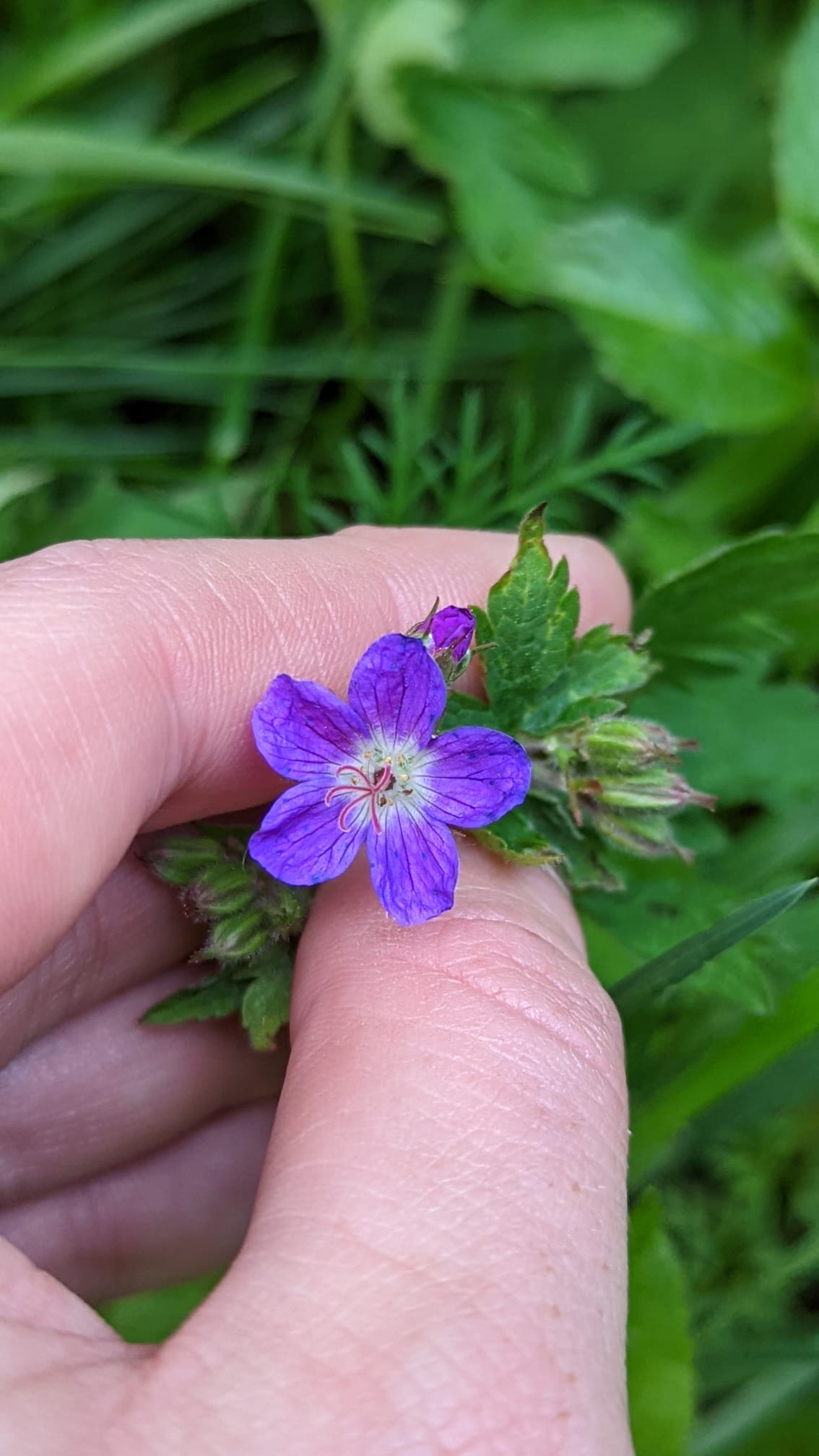
As one of the rare pockets of high-quality coastal grassland in South Northumberland, the reserve has an intriguing flora. Standouts include Lesser Butterfly-orchid, Dyer’s Greenweed, Pyramidal Orchid, not to mention Marsh Helleborine and Sea Bindweed, rediscovered at the site in 2023. And, of course, one can’t easily overlook expanses of Bloody Crane’s-bill, Northumberland’s county flower, adorning pathsides and grassy areas.
Beyond the more prominent blooms, attentive visitors will be rewarded with sightings of Zigzag Clover, Fairy Flax, Celery-leaved Buttercup, Long-headed Poppy, and a myriad other plants. For an extra treat, a brief detour to the nearby beach unveils the hardy coastal flora of the county, featuring Prickly Saltwort and other specialists like Sea-rocket and Sea Sandwort.
Accessible to all, like many Wildlife Trust reserves, East Chevington invites exploration.
The town of Warkworth, nestled close to Amble on the Northumberland coast, is picturesque in its own right. However, the nearby dunes, saltmarsh and coastal grasslands, somewhat overlooked compared to more famous sites like Holy Island, possess much more to be admired.
In late spring, the dune slacks come alive with the countless flowering spikes of the Early Purple-orchid and as summer unfolds, visitors can delight in another local specialty, Maiden Pink, as its diminutive flowers peek out amidst a tapestry of interesting, albeit less vibrant, grasses and sedges.
A close inspection of the sward at Warkworth reveals a miniature world with species like Little Mouse-ear, Mouse-ear Hawkweed, Common Stork’s-bill, and an assortment of delicate eyebrights. Yet, larger blooms are equally abundant. Keep an eye out for Viper’s-bugloss, the frothy flowers of Hoary Cress, and treats like Wild Basil and Burnet Rose.
The strandline and saltmarsh at Warkworth add another layer of interest with a rich community of salt-loving plants. Among these, Sea Sandwort, Sea Purslane, Spear-leaved Orache, and the ever-charming Thrift. Undoubtedly, Warkworth is a special place and there undoubtedly new species to be found.
Maidan Pink (Dianthus deltoides) at Warkworth
4: Embleton Quarry Nature Reserve
Embleton Quarry Nature Reserve, a hidden gem often overshadowed by more well-known sites on this list, boasts a quiet charm. Managed with dedication by local volunteers, this small but tranquil reserve has much to offer visiting botanists.
Orchids take center stage at Embleton (don’t they always?) and are represented by Common Spotted, Northern Marsh, and, notably, Bee Orchid. Beyond these fan favorites, the site stands out for harboring populations of Purple Ramping-fumitory and White Ramping-fumitory, alongside a cheery array of familiar species such as Wild Teasel, Red Bartsia, Salad Burnet, and Weld.
Much of Embleton’s interest lies its close proximity to residential areas, responsible for introducing a mix of garden escapes. While none have become invasive, the reserve hosts several botanical oddities like Lamb’s-ear, Garden Peony, Poet’s Daffodil, and Hidcote Comfrey, among a plethora of other aliens.
For those with a penchant for exploration, a visit to the nearby Embleton Churchyard unveils another fascinating plant — Deadly Nightshade, thriving as one of its only Northumberland strongholds.
White Campion (Silene latifolia)Hidcote Comfrey (Symphytum x hidcotense)Poet’s Daffodil (Narcissus poeticus)Scarlet Pimpernel (Lysimachia arvensis)Northern Marsh-orchid (Dactylorhiza purpurella)Garden Star-of-Bethlehem (Ornithogalum umbellatum)
5: Newbiggin-by-the-Sea
Newbiggin and its surrounds stand out as an ecologically rich area that might just surprise visitors. A northward walk from Church Point reveals a varied landscape encompassing sandy shoreline, relic dunes, and the rough grassland of the golf course. Here, several notable wildflower species can be found including the diminutive Bird’s-foot, a member of the pea family, the coastal specialist Purple Milk-vetch, and just occasionally, Bee Orchids. The Church Point car park itself is noteworthy, teeming with Hoary-cress, Thrift, Dwarf Mallow, and other interesting plants.
Exploring the sandy shoreline may yield four species of Orache, among them Frosted Orache and Babbington’s Orache. Additionally, common coastal plants such as Buck’s-horn Plantain and Sea Milkwort are abundant. Heading higher up, the cliffs offer Sea Campion, while the golf course holds rarer species such as Good-King-Henry, Northern Marsh-orchid, Burnet Rose, and Pencilled Crane’s-bill — a notable escapee at the site.
Managed by the National Trust, Allen Banks boasts a distinctive blend of ancient woodland and ornamental planting, reflecting the influence of the past custodians on the estate. Renowned as one of the premier locations in Northumberland to investigate our ancient woodland flora, the site offers much of interest with highlights of Bird’s-nest Orchid, Early-purple Orchid, and the peculiar-looking Toothwort.
A stroll along the wooded banks of the Allen introduces visitors to other indicators of ancient woodland, including Goldilock’s Buttercup, Bitter Vetch, Wood Crane’s-bill, and Great Horsetail. The presence of Calaminarian Grassland, characterised by its soil polluted with industrial metals, adds another layer of interest. In this area, delicate Mountain Pansies flourish.
For those seeking a longer walk, a well-signposted trail to Morralee Tarn is recommended. Once a Victorian boating lake, it has transformed into a rich wetland habitat. Timing your visit right may reward you with sightings of White Water-lily, Mare’s-tail, and the intriguing Marsh Cinquefoil.
Letah Wood, believed to be Northumberland’s last surviving ‘Daffodil wood,’ offers a spectacular display with its abundant Wild Daffodils blanketing the woodland floor each spring.
Beyond the captivating display of Daffodils, the wood boasts a rich diversity of woodland wildflowers. Visitors can expect to encounter Giant Bellflower, Wood Anemone, Pignut, Lords-and-Ladies and the iconic English Bluebell. A special highlight for those exploring the woodland is the much rarer Herb-paris.
Additionally, Letah Wood is a haven for those interesting in trees, ferns and bryophytes. While these aspects are beyond the scope of this post, they contribute to the overall richness of the wood.
Wild Daffodiils (Narcissus pseudonarcissus subsp. pseudonarcissus) at Letah Wood
8: Hen Hole, College Valley
The Hen Hole stands out as arguably the most spectacular gorge in Northumberland, and earns its place as one of the county’s top botanical sites. While its remoteness may pose a challenge, the awe-inspiring scenery and diverse flora make it well worth the effort. Before embarking on the journey, be sure to pack sturdy walking boots and ample snacks for the hike that awaits!
Hen Hole has been visited by many notable botanists over the years, from Baker & Tate to George Swan, and is celebrated for its rare arctic-alpine plants, including Alpine Saw-wort and Roseroot. While these flowers are elusive, the journey toward the gorge from Mounthooley offers more obvious specialities such as Alpine Willowherb, Pale Forget-me-not, Starry Saxifrage, and Butterwort. Be sure to stick close to the College Burn – most of the more interesting plants seldom grow far from water.
The more abundant flora of Hen Hole includes familiar species like Heath Bedstraw, Goldenrod, Heath Spotted-orchid, Wild Thyme, and Wood Crane’s-bill. Beyond those, however, the gorge treats visitors to superb views, scenic waterfalls, and a plethora of other wildlife, ensuring that the journey is rewarding in any season.
Cullernose Point, located between Craster and Howick, is a relatively small but ecologically significant coastal site. As part of the Northumberland Coast Path, it provides easy access for visitors interested in exploring its clifftop grasslands, which boast noteworthy populations of Purple Milk-vetch and Spring Squill – a charming little bulb with bright blue, starry flowers.
Beyond these botanical highlights, the clifftop grasslands support additional plants including Sea Mouse-ear, Thrift, Wild Thyme, Heath Milkwort, Heath Groundsel, and other flora characteristic of coastal environments.
The small size of this site mean it is often better suited as a pitstop, perhaps on route to more floriferous sites further North?
Spring Squill (Scilla verna)
10: Scotch Gill Wood, Morpeth
Scotch Gill Wood, situated just outside the market town of Morpeth, stands out as a prime example of semi-natural ancient woodland. Notably, this woodland offers a much more accessible destination for those interested in exploring our woodland flora.
The wood is home to a variety of plant species characteristic of older woodlands. Careful exploration might reveal Toothwort, Goldilocks Buttercup, Spurge-laurel, Yellow Star-of-Bethlehem, and the intriguing Mochstatel, among others.
In addition to the vibrant species listed above, Scotch Gill Wood hosts several less colorful but equally interesting plants, notably the Rough Horsetail. Damp areas within the wood add another layer of botanical interest with the occurrence of Hemlock Water-dropwort, Brooklime, and Large Bittercress.
The accessibility of Scotch Gill Wood makes it an ideal destination for those seeking a woodland walk without venturing too far from civilisation.
Yellow Star-of-Bethlehem (Gagea lutea)
Planning a trip in search of wildflowers? Remember to record them. Doing so helps conservationists monitor populations and protect rich and important sites like those mentioned in this post.
For a little more information on logging your finds, please see below.
A quick account of a fruitful few days spend admiring orchids in Newcastle.
As the NHSN’s Discovering Orchids project continues, I’ve been making an effort to check in on my local orchids. Visiting a number of post-industrial sites around Newcastle this week, it is safe to say that the plants did not disappoint. From your ‘everyday’ spotted orchids to a selection of scarcer species, there has been an awful lot to see.
Silverlink
Starting out at Silverlink Park, a site I talk about often, and Bee Orchids are having a good year. Indeed, during a quick visit, Matt and I recorded over sixty in bloom across the site. Big ones, small ones, some growing in grassland, others in flowerbeds, it is great to see this species doing so well here.
Bee Orchid (Ophrys apifera)
Straying from Silverlink for a minute, and Bee Orchids seem to be having a fantastic year locally on the whole. Not only are they performing well at traditional sites but are popping up in a host of new places too. I mentioned those at Scotswood a few weeks back, but I have also encountered them recently at Walker, Wallsend and Cobalt. At the latter, a number could even be seen invading the landscaped gardens of various office blocks!
Bee Orchid (Ophrys apifera)
Back to Silverlink and it was great to see Common Spotted Orchid becoming more numerous too. As expected, these have now taken over from Northern Marsh Orchid as the most numerous species blooming on site. A few marsh orchids could still be seen, of course, though these were invariably those growing in shady locations. The vast majority of those visible only a week back had long since browned and died.
Somewhat more exciting here was the discovery of a single Pyramidal Orchid. Growing within the site’s rich calcareous grassland, this looks to be the first record for the site. Indeed, having visited for many years, I can safely say I have never seen one here until now.
Moving on, a kind tip-off from a local naturalist resulted in a bit of a surprise this week, a few Facebook messages leading to an encounter with an altogether more special orchid. The delicate plant seen below is Heath Fragrant Orchid, an entirely new species for me.
Smaller and with fewer flowers than its larger cousins, this orchid really is a beauty. Better still, it smells amazing! A scent I would describe as sweet and citrusy that others have hailed as ‘spicy’.
Heath Fragrant Orchid is a scarce species in the North East and one usually found in the uplands. To see one in urban Tyneside certainly is a treat.
Heath Fragrant Orchid (Gymnadenia borealis)
Newburn
To some abandoned brownfield land at Newburn now and more Common Spotted Orchids. So many in fact that we lost count at 250! An abundant and familiar species across most of the UK, it is not often I see them in such numbers. The sight of so many flowers swaying in the breeze a welcome reminder of what more grasslands in our nation should look like.
Here too, a few Northern Marsh Orchid were hanging on, though looking a little worse for wear, and we identified several Common Spotted Orchid x Northern Marsh Orchid hybrids. Seeking out the biggest visible plant before looking closer seems to be a good technique for this – Dactylorhiza x venusta tends to be a whopper.
Common Spotted Orchids (Dactylorhiza fuchsii)
Down by the river, we soon discovered the first of the day’s targets: Dune Helleborine. A rare plant nationally, those on the Tyne are said to be the locally endemic Epipactis dunensis subsp. tynensis. Or Tyne Helleborine, to use simple terminology. Either way, for some, the jury remains out as to whether they truly are a subspecies or not. Personally, I quite like them, but perhaps I’m just patriotic?
It was surprising to find over sixty Dune Helleborine in just thirty minutes of casual searching at Newburn. So many, in fact, that they outnumbered their larger and usually more abundant cousin, the Broad-leaved Helleborine. These were present in good numbers, perhaps forty or so, but still seemed scarcer than in previous years. Most of the plants we noticed had yet to flower, but a few had just dared open.
A mongtage of Dune Helleborines (Epipactis dunensis subsp. tynensis)
Well, that concludes this orchid-focused ramble. The diversity of these mesmerising plants around Newcastle never fails to amaze me and I’ll be looking for more in the future!
With my Natural History Society of Northumbria hat on, yesterday I had the pleasure of leading a small group of students from Newcastle University to one of my favourite local haunts: the glorious National Trust reserve at Allen Banks. The wooded areas here making for a superb location at which to enjoy a range of seldom seem woodland wildflowers and of course, to try our hand at a spot of orchid hunting too.
Starting out from the public car park and heading South on the West side of the river, things started out well with a range of interesting ferns spotted along the way. Among these, Broad Buckler-fern (Dryopteris dilatata), Hard Fern (Blechnum spicant), Male Fern (Dryopteris filix-mas) and both Soft Shield-fern (Polystichum setiferum) and its cousin, the Hard Shield-fern (Polystichum aculeatum). If you had told me a year back that I’d be getting exciting over ferns, I’m not sure I would have believed you…
In flower here was Yellow Pimpernel (Lysimachia nemorum) and Opposite-leaved Golden-saxifrage (Chrysosplenium oppositifolium), while a little further in, we were treated to remains of Toothwort (Lathraea squamaria) and an Alchemilla later [tentatively] ID’d as Intermediate Lady’s-mantle (Alchemilla xanthochlora).
Making plenty of pitstops along the way to our chosen destination, it was interesting to stumble across a mature variegated Sycamore (Acer pseudoplatanus) which made for an impressive sight with its marbled, yellow leaves. Whether this was a naturally occurring mutation or something planted by the Victorians, I am not sure…
Also nearby were a number of white form English Bluebells (Hyacinthoides non-scripta), as well as Bitter-vetch (Lathyrus linifolius), Wood Sedge (Carex sylvatica) and plenty of woodland indicator species. Bugle (Ajuga reptans) and blooming Woodruff (Galium odoratum) certainly made for a pleasing sight.
Further into the wood, after quite a bit of searching, we stumbled across the first of the day’s intended targets – a glorious clump of Bird’s-nest Orchids (Neottia nidus-avis). Growing under Hazel, as opposed to Beech on this occasion, these were not quite in flower yet but still gave plenty of cause for celebration. Nearby a separate, individual flower spike was found soon after.
Bird’s-nest Orchids (Neottia nidus-avis)
Next came a pause and lunch break at a small area of calaminarian grassland strewn with countless Mountain Pansies (Viola lutea). The fantastic array of colour forms on show here certainly made for an enjoyable break with the countless blooms ranging from deep purple to lilac and of course, yellow.
Mountain Pansy (Viola lutea)
Reaching Planky Mill, it didn’t take us long to find our first Early Purple Orchids (Orchis mascula) of the day. While less numerous than on my last visit in 2020, we still managed to count seven flower spikes during our short stay. A few non-blooming rosettes were observed nearby also.
More run of the mill wildflowers were abundant here too with Wood Speedwell (Veronica montana), Common Dog-violet (Viola riviniana) and Sanicle (Sanicula europaea) spotted, among others. A brief foray into a square known for Herb Paris (Paris quadrifolia) yielded no results but alas, it hasn’t been seen here in a good few decades…
Early Purple Orchids (Orchis mascula)
As ever, it wasn’t long before time got the better of us and we were forced to head back. It always amazes me how little ground you cover when looking for plants…
Dashing back, a few interesting species were noted along the upper reaches of the gorge, not least Wood Crane’s-bill (Geranium sylvaticum) and Goldilocks Buttercup (Ranunculus auricomus) – the latter a great find by a member of the group. In addition to these, we were pleased to find yet more Bird’s-nest Orchids in a new square. This particular group looking particularly striking against the dull, grey woodland floor.
All in all, a great day in great company. Our orchid sightings will be added to NHSN’s ongoing Discovering Orchids project seeking to map the distribution of these fascinating plants across the North East. If you’re out and about locally, please do consider sharing a sighting.
I have visited the Holy Island of Lindisfarne many times to admire the sites birdlife, chase rarities and even seek out insects, but never to appreciate its diverse and interesting flora.
Lindisfarne is well known as an excellent site for those interested in botany, it’s unspoilt beaches, sprawling dune slacks, fields and expansive areas of salt marsh reminiscent of a time before man altered Britain’s coastal habitats beyond recognition. Home to many intriguing and, in some cases, scarce species, the botanical community here is diverse enough to keep visitors enthralled for hours. As it did us on overdue visit this week.
Brace yourselves, this could be a long one…
Arriving on Lindisfarne and heading first for the quiet reaches of The Snook, we set off in search of the islands most sought after plant species: the Lindisfarne Helleborine. First discovered on Holy Island in 1958, this understated but beautiful orchid is endemic here and in July, blooms in small numbers across the Western tip of the island.
During a half-hour search of the Snook, we were able to locate just a single orchid. Stumbling across the delicate, green and white flower atop a small mound where it grew conspicuously amongst the Marram. Perhaps a little muted, at least compared to the island’s larger, showier orchids, but a pleasure to behold nevertheless.
Moving on to investigate the nearby dune slacks, it seemed we had timed our visit perfectly to coincide with the emergence of another, arguably more appealing orchid: the Marsh Helleborine. Blooming in their hundreds right across the Western tip of the island, these orchids made for quite the sight – purplish flowers contrasting with the suppressed tones of many other Helleborines, and boasting an exceedingly frilly ‘lip’. These locally abundant flowers are by all accounts a real beauty.
Now well and truly hostage to the ‘orchid fever’, a search for the islands other orchid species revealed good numbers of vibrant Pyramidal Orchid, now reaching their peak; while other species observed included Common Spotted Orchid, Northern Marsh Orchid and Common Twayblade – the latter three now appearing somewhat haggard and spent. No matter.
Orchids are special but by no means are the be-all and end-all of the trip to Lindisfarne, and during our stay, many other interesting species were to be found. None more so than a single specimen of Scots Lovage found nestled in a sheltered area of the dunes. An Arctic plant, Northumberland marks the most Southerly limit of its UK range and records from Lindisfarne have been few and far between since 1985.
Here too, the succulent stalks of Sea Sandwort protruded from the bare sand, reminiscent of something you would find in the houseplant section of your local garden centre.
Back in the dune slacks and we were delighted to encounter the deep-pink flowers of Seaside Centaury; whilst a low-growing purple flower turned out to be Purple Milk-vetch, another first for this amateur botanist. I confess, I almost mistook it for one of the countless Self-heal flowers showing en masse here…
Common Valarian and Tansy were observed here too and the wetter areas were flush with the delicate yellow flowers of Lesser Spearwort and the curious, circular leaves of Marsh Pennywort.
At ground-level, Creeping Willow was conspicuous and a few large areas of blooming Hop Trefoil provided interest.
Departing the Western reaches of Lindisfarne, we headed East to the village. Passing through, it was difficult not to appreciate the plant diversity present in the high garden walls – old stone painted a wonderful mix of greens by the fronds of countless ferns. Here, we found a good range of common species, including Wall-rue, Maidenhair Spleenwort and Polypody; while it was nice to see both Biting and White Stonecrop in bloom. The island’s abundant Wallflowers had gone over, now displaying a glut of pea-like seed pods.
Departing the thronging village streets, a long walk around the Eastern side of the island ensued, taking in the iconic castle en route. In the vicinity of the castle, we stumbled across a nice clump of blooming Harebell alongside Thrift and a pretty example of what I think could be Dwarf Mallow – far daintier than its hulking cousin found growing here too. The castle walls were draped in an impressive display of Red Valarian and both Sea and Buck’s-horn Plantain were noted.
Attempting to curtail this particular botanical tale, towards the North Shore of the island highlights included large expanses of Wild Thyme and Common Cottongrass, as well as what I think could have been Slender Thistle (I really must practice my thistles). Grassier areas proved productive too with an impressive display of Meadow Vetchling interspersed with the pink blooms of Red Bartsia and, in select places, the familiar flowers of Field Scabious. Finally, the buried remnants of an old wall held Carline Thistle – a species I have seen further afield but never before in my native Northumberland.
Of course, no trip to Lindisfarne would be complete absent an encounter with the omnipresent Pirri-Pirri-bur which blights the island. Originating from Australia, this tenacious invader was observed right across the site; though only twice did I fall foul of its hooked burs. Controlling this species presents many problems and it seems unlikely that it will be going anywhere anytime soon, despite the best efforts of those who manage the reserve.
Of course, where there are wildflowers, there will also be pollinators and it would be rude not to cast the spotlight on a few of the insects observed throughout the day. In particular, this superb Dark-green Fritillary delighted as it nectared from the blooms of Creeping Thistle. Other butterflies observed include many Small Heath, Ringlet, Meadow Brown and Common Blue, alongside smaller numbers of Small Tortoiseshell, Red Admiral and Large White.
A Special Site of Scientific Interest (SSSI) and Durham Wildlife Trust nature reserve encompassing a disused magnesian limestone quarry, I have read about Bishop Middleham Quarry for years. People, it seems, visit the site from far and wide to experience the fantastic flora on offer here. As well as for an abundance of colourful insects.
It is the bedrock here that gives the site such appeal. The quarry itself ceased work in 1934 and was left to restore naturally, providing a rare opportunity for magnesian limestone plant species to colonise and stay put. The quarry holds a number of quite rare species, restricted by the scarcity of limestone habitats in the wider countryside, but rarity aside provides an opportunity to marvel at a vibrant community of plants, insects and other wildlife. It really is a fantastic site.
Arriving at the site with orchids on the brain, it wasn’t long before we encountered our first. Scattered across the upper-tier of the quarry grassland, Common Spotted Orchids bloomed in their dozens – tall spikes of alternating shades of pink, purple and white looking lovely amid swaying stems of Quaking Grass and the blooms of Restharrow, Common Rock Rose and Bird’s-foot Trefoil.
Here, we stumbled across a beautiful, pure white specimen – the alba variant of this common species?
Scattered among the paler blooms of the spotted orchids, the deep-purple flowers of Northern Marsh Orchid were easy to make out. Less numerous, by far, but nice to see. Perhaps more exciting, however, was a single flower of Pyramidal Orchid found only metres into the reserve. A new species for me, a joy to behold and the first of many seen throughout our visit.
Still only metres from the reserve entrance, we soon encountered the day’s target species: Dark-red Helleborine. Bishop Middleham Quarry is known as the best place in the UK to observe this limestone-loving orchid and, sure enough, we encountered hundreds during our stay. Perhaps we were a little early as many had yet to open; though some pioneering plants were in full bloom. Thankfully!
Prying ourselves away from the helleborines, it was not long before we stumbled across two new orchids. On the quarry floor, the egg-shaped leaves and fading flower spikes of Common Twayblade were immediately apparent – not exactly striking by orchid standards but nice to see. Here too, a few Fragrant Orchids were found, another first for me and definitely deserving of a sniff to test their validity. The verdict? They did smell rather nice!
The least abundant orchids on-site were Bee Orchids but, having been pointed in the direction of a particular slope by a kind passer-by, we soon found three spikes in full flower. A plant that warrants little exposition and never fails to earn a smile. Here too, more Pyramidal Orchids were found.
As someone with very much limited knowledge of plants, Bishop Middleham Quarry also provided an opportunity to get to grips with a number of less-specialist species I seldom encounter around my usual haunts. It was nice to be able to compare Small and Field Scabious found growing side-by-side in a more verdant area of the site; while a tall yellow flower could well have been Agrimony. Perforate St. John’s-wort was numerous but we failed to find (or at least, identify) the scarcer Pale St. John’s-wort which is said to grow here. A fine reason for another visit, I think.
Whilst trying (and failing) to locate Moonwort, I was pleased to stumble across a single flowering Harebell; while the strange, pea-like stalks of what I think was Yellow-wort were found on an old spoil heap. Other species observed included Wild Thyme, Greater Knapweed, Mouse-ear Hawkweed, Red Valarian and Wild Strawberry.
Whilst many of our walks focus on plant life these days (I’m not sure what has happened to me, in truth) we did find the time to admire some of the insect life present on site. Butterflies were incredibly numerous with plenty of Ringlet and Meadow Brown seen, alongside smaller numbers of Small Skipper, Common Blue, Speckled Wood, Small Heath and Small Tortoiseshell. Moths on the wing included Six-spot Burnet, Latticed Heath and Shaded Broad-bar.
A brief scan of the plentiful Hogweed tops on site revealed a few common hoverflies including Heliphilus pendulus, Volucella pellucens and Marmalade Hoverfly. Here too a grasshopper was apprehended (with great difficulty) and tentatively identified as Common Green Grasshopper owing to the in incurved, cream-coloured line on its shoulder.
Common Green Grasshopper
None of the sites famous Northern Brown Argus were seen on this occasion but, with countless other items of interest observed, a fantastic day was had.
Bishop Middleham Quarry is an exceptional, altogether beautiful site. A fine testament to what can happen when sites exploited by humans are returned to nature. I will definitely be visiting the site again in the future, even if it does involve more frequent trips (dare I say it) south of the Tyne!
Orchids hold a fascination for many people around the world. For me that began when a Common Spotted Orchid (Dactylorhiza fuchsii) popped up in an unmown area of my parents’ lawn one summer when I was a child. They slowly spread and it became a game each summer to see how many there were flowering alongside the Knapweed in the long grass. Last year there were over thirty.
As I’ve grown, my passion for wildlife has grown too and my love of wildflowers has intensified. I am lucky now to have travelled to some wonderful locations and seen some incredible wild Orchid species. As the Green Winged Orchids (Anacamptis morio) are in full bloom in a local meadow I thought I’d share a few of my favourites and my experiences finding them.
Common Spotted Orchid & Green-Winged Orchid
For many, Orchids can be a confusing group of flowers to study and it is true that they seem to hybridise readily which doesn’t always help with identification. With a little perseverance and a keen eye though, it soon becomes apparent that there are certain characteristics to look out for which will give a definitive answer. The next challenge is where to find them in the first place.
In the French Alps if you want to know where you might find Orchids, ask a local – it seems like almost everybody knows where to find some and they are proud of it too. This is particularly true of some of the bigger, blousier species like the glorious Lady’s Slipper Orchid (Cypripedium calceolus). By contrast, in Britain, it was collected nearly to the point of extinction and now clings on at only one closely guarded site.
I will never forget the first time I saw these spectacular flowers as a teenager on holiday with my parents in Austria, my mother suddenly asked that we stop the car on a quiet country road because she thought she’d seen some and sure enough in the dappled shade there was a clump set back from the road a few meters under the trees. Her knack of spotting unusual flowers from a moving car is incredible and my husband claims I’ve inherited the trait, as I too often ask him to stop in strange places so I can jump out and look at things!
For me one of the appeals is the common names of the Orchids – there are Lady, Man, Military, Frog, Monkey, Bee, Woodcock, Butterfly and Fly Orchids fro name a few. They are often reflective of the individual flower shape or colouring and are somehow quite charming. The Monkey Orchid (Orchis simia) is one of my many favourites with beautiful bright colouring and a very monkey-like shape complete with tail.
Some names are less imaginative but very descriptive such as the Pyramidal Orchid (Anacamptis pyramidalis) named for the shape of the flower spike, or the Burnt Tip Orchid (Neotinea ustulata) which has dark purple flower buds that open from the bottom up into white speckled flowers, and give the impression that the tip of the flower spike is blackened.
There is a sense of the exotic in many species of Orchid, we are of course all familiar with the brightly coloured potted versions available from supermarkets and garden centres but we don’t expect to find anything quite so striking in the wild. I haven’t had the opportunity to visit a jungle habitat to see any really large orchid species (yet!) but I was pleasantly surprised that there are some European species which are not a million miles from those aforementioned shop-bought varieties. Of course the Lady’s Slipper falls into this category but there are others too. The Violet Bird’s Nest Orchid (Limodorum abortivum) of the Alps, and the Eastern Marsh Helleborine (Epipactis veratrifolia) found in Cyprus despite being more common in Asia, are both contenders.
Bird’s Nest Orchid, Lady’s Slipper Orchid and Mirror Orchid.
The most recent orchids I’ve added to my list were in Sardinia where my favourite was the Mirror Orchid (Ophrys speculum). It was quite different from a lot of the other species I had found in the past and illustrates my continual astonishment at just how diverse Orchids are from those which are parasitic and lack chlorophyll such as the Bird’s Nest Orchid (Neottia nidus-avis), to the Fragrant Orchid (Gymnadenia conopsea) which lives up to its name and grows in great swathes where the habitat is suitable. Sometimes even that first species to take my interest surprises me, such as the time I came across a rare variant, Dactylorhiza fuchsii var. rhodochila.
Despite all of my wonder and excitement at finding, photographing and identifying Orchids, there is one major factor that I alluded to earlier which I simply don’t understand: Seemingly in Britain in particular, Orchids continue to be sought for collections to the point of detriment. It is such a shame that these beautiful flowers seem to be at greater risk on home shores than abroad despite the efforts of charities like the Wildlife Trusts and Plantlife. I can only wonder whether I will be able to pass on my love of Orchids to my children in the future as my mother did to me, or whether I will have to settle for telling stories of the days when they grew in the lawn.