Motivated by last year’s fern forays and spurred on by my new membership of the British Pteridological Society, I have decided to try something different this year: a personal challenge to see as many of Britain’s fern species as possible in a single year. The idea being that, by seeking out our ferns, I’ll learn more about them, their habitats, and the subtleties involved in identifying them. This blog will be part #3.
Asplenium x clermoniae – 26th January
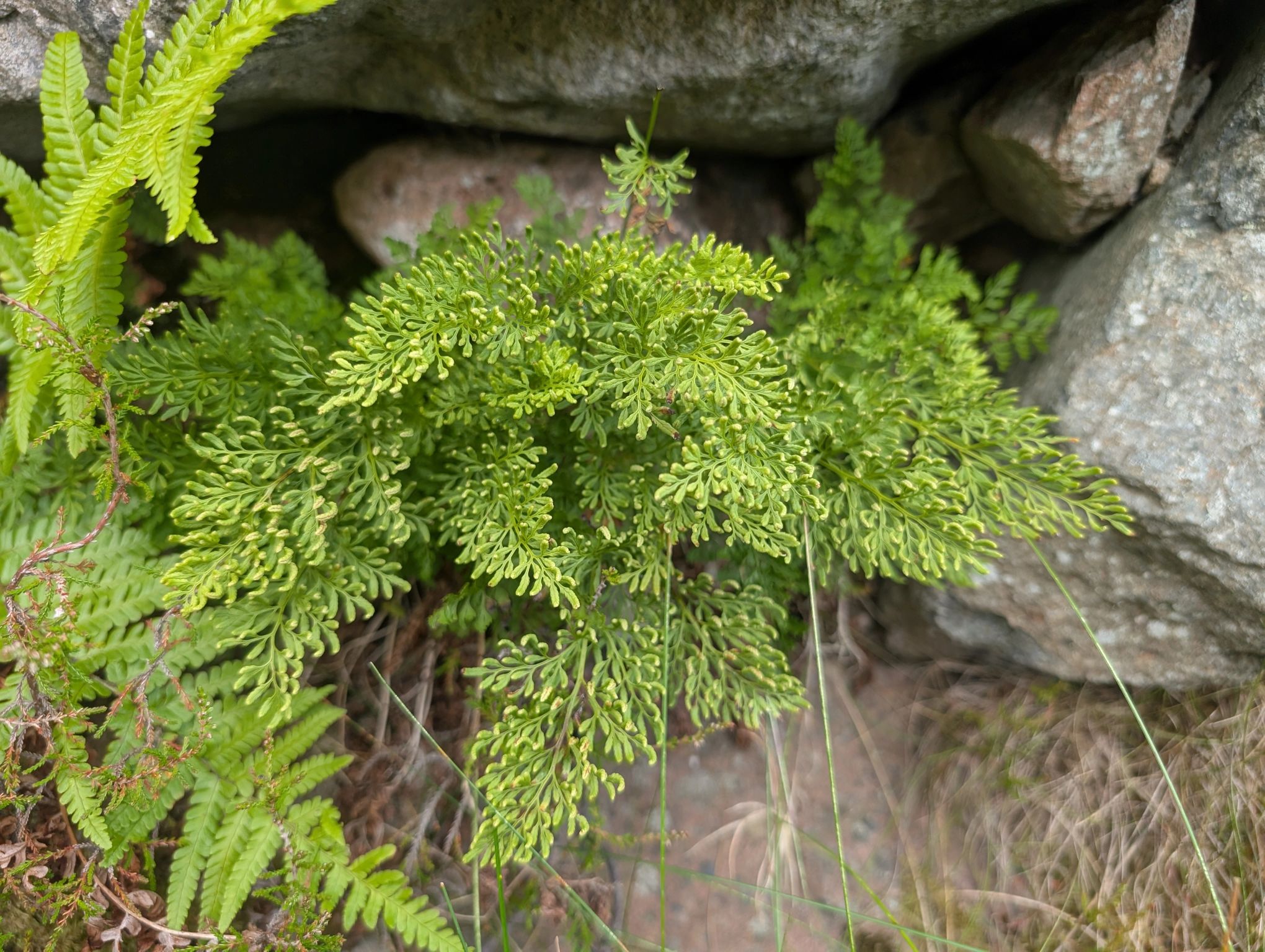
On Sunday, a trip north into rural Northumberland provided a welcome opportunity to check in on one of the rarest and most intriguing ferns in North East England: Lady Clermont’s Spleenwort Asplenium × clermontiae – a hybrid I hadn’t seen since 2023, when I published a short blog about it here.
To cut a long story short, this is an exceedingly rare hybrid between Wall-rue Asplenium ruta-muraria and Maidenhair Spleenwort Asplenium trichomanes subsp. quadrivalens. On paper, it ought to be more widespread, given the abundance of its parent species, but this is very much not the case. In fact, it is currently known from just three individual plants across the entirety of the British Isles. The Northumberland plant has been known since the early 2000s and has been visited by many pteridologists over the years.
It is a rather unruly-looking fern, showing characteristics of both parents, and so far as this year’s pteridological challenge goes, an excellent one to notch up early on.
Lady Clermont’s Spleenwort Asplenium x clermontiae
A short distance away, another unassuming wall played host to a second rare little spleenwort, though not quite so rare as the species mentioned above. Rustyback Asplenium ceterach is common in many parts of the UK but decidedly scarce in the North East and, despite an abundance of seemingly suitable habitat, remains confined to a small number of quarries and walls across the region. I do wonder whether climate plays a part. In North Northumberland, it is a Rare Plant Register species, meaning it should be reported whenever encountered.
A lover of limestone rocks and lime-rich mortar, this species is easy to identify thanks to its thick, leathery, almost once-pinnate fronds and the dense covering of rust-coloured scales on the underside. The images below show one of two plants observed during a brief pit stop at a well-known site.
Another species down…
Rustyback Asplenium ceterach
Running Total
Seeing as I rarely carry a notebook, we’ll log our running total for the year here…
Motivated by last year’s fern forays and spurred on by my new membership of the British Pteridological Society, I have decided to try something different this year: a personal challenge to see as many of Britain’s fern species as possible in a single year. The idea being that, by seeking out our ferns, I’ll learn more about them, their habitats, and the subtleties involved in identifying them. This blog will be part #2.
Woodland Ferns – 17th January
By January, our woodlands are not looking especially vibrant. Cold, wet, and muddy, they are far removed from their spring splendour, and by this point in the year, most of our ferns are looking rather jaded too.
With this in mind, yesterday saw us meandering through Jesmond Dene, keen to see what could still be picked out in the depths of January. As expected, most of the ferns looked rather gnarled by the frosts, but in sheltered spots our two most familiar woodland species could still be found.
Broad Buckler-fernDryopteris dilatata, with its broad, wedge-shaped fronds and dark-centred scales, was easily located, as was Male-fernDryopteris filix-mas with its tapering fronds and toothed pinnules. These are perhaps our most abundant native ferns both will look far better come spring.
Broad Buckler-fern Dryopteris dilatata, with its broad, wedge-shaped frondsMale-fern Dryopteris filix-mas with its tapering fronds and toothed pinnules.Toothed, tapering pinnules of Dryopteris filix-mas
Continuing our walk, it was also pleasing to see several healthy clumps of Hart’s-tongue Asplenium scolopendrium looking altogether more robust and vibrant than the straggly individuals spotted on walls during our previous outing.
A healthy example of Hart’s-tongue Asplenium scolopendrium clinging to a bank.
Another group of evergreen woodland ferns still visible at this time of year are the Polystichum species – the Shield-ferns. Our two native species are both fairly common in shady woodland settings and are easily recognised by their distinctly “mitten-shaped” pinnules. They can be told apart by a combination of features, most notably the overall shape of the frond (gradually tapering versus ending abruptly), whether the pinnules are stalked, and the angle of the lowest pair of pinnules (obtuse vs acute).
In images one and three below, we have Soft Shield-fernPolystichum setiferum: soft to the touch, with a truncate base and pinnules set at an obtuse angle. The third image shows an escaped cultivated form, noticeably more frilly in appearance – a reminder of the interesting things we humans have done to ferns. Note in both examples, the pinnules are stalked. This is also a useful factor in separating these species, as set out in the helpful crib here. A good blog on the two native species can also be found here.
Pinnules of Polystichum setiferum, soft to the touchA cultivated form of Polystichum setiferum with very frilly foliage.I did toy with the idea of this plant being the hybrid of Soft and Hard Shield-ferns but alas, I think it just P. setiferum
Close to the first Shield-fern, we also noticed a rather lovely Polypody Polypodium sp clinging to a bridge. I have learned through bitter experience how difficult it is to separate these species on visual characters alone, so having collected a small sample, I’ll be checking the spores later. Stay tuned for another post on those.
A nice Polypodium species clinging to the stonework of a bridge.
Last but not least on our morning walk through Jesmond Dene, we stopped to check in on a more unusual fern, first noted last year while recording for my upcoming Urban Flora of Newcastle. At first glance, you might notice that it looks rather similar to the Soft Shield-fern shown previously – and that’s because it is, albeit a little more exotic in nature.
This plant is, in fact, Japanese Lace FernPolystichum polyblepharon, a widely cultivated garden species that appears to have found its way into the Dene of its own accord. This young plant is growing on a steep, muddy bank where deliberate planting seems highly unlikely, and so can presumably be counted towards this year’s fern fest. As mentioned previously, non-native ferns will count provided they appear to be self-sown.
Japanese Lace Fern Polystichum polyblepharon, an oddity of Jesmond Dene
Right Back at It – 23rd January
After work on Friday, I opted for a rather rainy afternoon walk back into the Dene, this time venturing a little further to see what I could find. It was pleasing to come across another Polypodium, this time growing on a tree, though it lacked the spores needed for identification.
Polypodium species growing on a moss-covered tree in Jesmond Dene
Further along the Ouse Burn, the challenge’s next “new” fern became apparent: Hard Shield-fernPolystichum aculeatum, with its sessile, acute-angled pinnules and tapering fronds. This is one of the scarcer of the ‘common’ ferns in my part of Newcastle, so it’s always nice to see.
Young Hard Shield-fern Polystichum aculeatum clinging to a slopePinnule shape of Hard Shield-fern Polystichum aculeatumA larger specimen of Hard Shield-fern Polystichum aculeatum
In the same area that held the shield-fern, it was also pleasing to find two slightly straggly examples of the once-pinnate Hard FernBlechnum spicant. This species needs little introduction.
Hard Fern Blechnum spicant in Jesmond Dene
Slightly more perplexing are the Scaly Male-ferns Dryopteris affinis agg. These were always going to be the most difficult group to contend with during this year’s fern challenge, and no matter how much time I spend looking at them, they still manage to confuse me. Inevitably, I find myself examining a great many specimens before eventually settling on one that matches the descriptions in the various resources stuffed into my rucksack – most of which contradict one another to some degree.
The two common species involved are Borrer’s Scaly Male-fern Dryopteris borreri and Western Scaly Male-fern Dryopteris affinis subsp. affinis.
A selection of Scaly Male-ferns in Jesmond Dene
D. affinis subsp. affinis is soundly evergreen, so as a first step, I looked for a fern that still appeared reasonably fresh for mid-January. Having succeeded, it was time for a closer inspection. As far as I recall, affinis is the only one of the common Scaly Male-ferns to have an adnate lowest basiscopic pinnule (that is, lacking a stalk). It also has rather lucid veins that extend all the way to the pinnule margin, and lowest pinnules on each pinna that are roughly the same size as their neighbours, unlobed and rounded at the tip.
The fern shown below seemed to fit this description, at least in most respects. With a degree of trepidation, I’m therefore calling it Dryopteris affinis subsp. affinis.
Lowest pinnules of Western Scaly Male-fern Dryopteris affinis subsp. affinisLowest basiscopic pinnule of D. affinis
In contrast to affinis, D. borreri has stalked lowest basiscopic pinnules and lowest pinnules that are slightly longer than their neighbours. These are also toothed at the corners (in the typical form, at least) and show slightly more diffuse venation that stops short of the pinnule margins. All quite straightforward in theory.
Taking a frond from one slightly more convincing example and examining it more closely, most of these characteristics are present, particularly in the shape of the pinnules. However, I don’t yet feel that I’ve fully got to grips with the differences in venation. The plant I tentatively labelled as affinis does not appear identical to examples I have seen online. This borreri, however, shows the pale blotching often mentioned in the literature, which is reassuring.
Lowest pinnules of Dryopteris borreriPale blotching between veins that (largely) stop short of the pinnule margin
We’ll certainly have to revisit these before attempting any of the rarer ferns within the complex, but hey, practice makes perfect (or so I am told).
Running Total
Seeing as I rarely carry a notebook, we’ll log our running total for the year here…
Motivated by last year’s successful fern forays, and spurred on by my new membership of the British Pteridological Society, I have decided to try something different this year: a personal challenge to see as many of Britain’s fern species as possible in a single year. The idea being that, by seeking out our ferns, I’ll learn more about them, their habitats, and the subtleties involved in identifying them.
The premise is simple: any fern growing in a wild situation counts, as do subspecies, hybrids, and species accepted by the major authorities. I will do my utmost to document each new find here, beginning with easily accessible species and, hopefully, progressing to trickier ones further down the line.
Urban Ferns – 16th January
It seemed reasonable to kick-start this year’s pteridological challenge with something low-key and ordinary. Thus, a search for wall ferns was on the cards.
On a typical street in Newcastle, there are four or five ferns that commonly occur on walls, most of which belong to the genus Asplenium. What I find especially interesting about Asplenium is that it is a genus of polar opposites. Perhaps half a dozen species are so widespread as to seem almost mundane, while others rank among our most elusive ferns, known only from a few carefully guarded sites. When it comes to the former group, the good news is that you don’t need to travel far to find them.
Skulking along some Heaton terraces, it wasn’t long before we came across our first species: Wall-rueAsplenium ruta-muraria, growing snugly in the mortar. Around fifteen plants clung to the wall, many stunted but unmistakable on account of their small, fleshy, club-shaped fronds. It is an easy species to recognise, and one of the commonest of our ferns.
A healthy clump of Wall-rue Asplenium ruta-murariaA pitiful example of Wall-rue Asplenium ruta-muraria growing alongside Hart’s-tongue
Mixed in among them were examples of Maidenhair SpleenwortAsplenium trichomanes, its fronds borne on dark, wiry stems and clustered in tight tufts within the mortar. While easy to recognise at first glance, there is more to this little fern than meets the eye. What we collectively know as Maidenhair Spleenwort is, in fact, an aggregate of three subspecies, each occupying its own ecological niche. Two of these are rather rare; the third is incredibly common.
Distinguishing between the subspecies requires attention to detail: the shape of the pinnules, the point of insertion of the stalk, the colour of the rachis, and the angle of growth against the substrate. Truth be told, it is a fiddly, detailed, and at times frustrating affair – though it is possible to cheat. The simplest shortcut is habitat. The commonest subspecies, quadrivalens, is a calcicole: a lover of lime. In the wild, it grows on calcareous rocks, but it is equally at home in the lime-rich mortar of brick walls. The second, trichomanes, is a much rarer plant of acidic rocks, typically confined to upland areas and occasionally encountered on dry-stone walls. The third, pachyrachis, is so scarce that it barely warrants consideration here, though for completeness it favours damp limestone and is restricted to just a few corners of the British Isles. By process of elimination, our plant could only be subsp.quadrivalens – a conclusion quickly confirmed by the insertion of the stalk at the corner of each pinnule.
A sorry example of Maidenhair Spleenwort Asplenium trichomanes subsp. quadrivalensA healthier colony of Maidenhair Spleenwort Asplenium trichomanes subsp. quadrivalens on a sheltered wall
Where these two species occur, a third often appears as well, though it rarely looks healthy when growing on walls. Hart’s-tongueAsplenium scolopendrium may tolerate such habitats, but it much prefers the shade and humidity of woodland, where it typically grows on mildly alkaline soils. Perhaps our most recognisable native fern, with its glossy, lime-green, tongue-like fronds, it presents few challenges. It is also a particularly useful Asplenium for demonstration purposes. The specific epithet scolopendrium is derived from the Greek skolopendra, meaning centipede – an allusion to the arrangement of the sori on the underside of the frond in parallel lines, a key feature of this genus.
Hart’s-tongue Asplenium scolopendrium emerging from an exterior wall
Moving on to another terrace, along another street lined with delightfully neglected student front gardens, there was one more species on the day’s agenda. Another Asplenium, though one that, in my experience, is typically harder to come by: Black SpleenwortAsplenium adiantum-nigrum. Unlike the wall specialists already encountered, this species is not a strict calcicole. Instead, it favours base-enriched substrates containing modest amounts of calcium or magnesium. For this reason, it is often found on mortared walls, though it grows equally well on natural rock faces and on ruins built from basic stone. It is common in many parts of Britain, but here in the North East, it is by no means abundant.
While it took some finding, after a short while, we managed to locate one small, rather pitiful example peeking out from a crevice. It will do for now!
A stunted example of Black Spleenwort Asplenium adiantum-nigrum on a neighbor’s wall
Running Total
Seeing as I rarely carry a notebook, we’ll log our running total for the year here…
It’s New Year Plant Hunt time again – that time of year when citizen scientists across the country head outdoors to see which wild plants are flowering in the depths of winter, all with the aim of tracking how plants are responding to our changing climate. Led by the BSBI, this fun and accessible project takes place over four days each New Year and is now in its fifteenth year. It continues to grow in popularity and offers a great excuse to get outside, stretch the legs, and blow away the cobwebs after an indulgent festive season. As ever, this year I’ve been out once again, so I thought I’d share a round-up here.
The Annual Heaton Hunt
The New Year Plant Hunt has become something of a tradition in our household. For the last five or six years, we’ve undertaken a ‘hunt’ among the terraces and alleyways of Heaton in Newcastle. More recently, we’ve begun leading this loop as a guided walk for members of the Natural History Society of Northumbria, and this year we were joined by 16 keen botanists.
These extra pairs of eyes proved invaluable, with 65 species spotted in flower during our allotted three hours – a pretty impressive total for Northern England and, at the time of writing, the tenth-longest list submitted in the UK this year.
Admiring the flowers of Adria Bellflower Campanula portenschlagianaSearching for the tiny flowers of Procumbent Pearlwort Sagina procumbensI always wonder what my fellow locals must make of a large group of botanists patrolling the streets early on New Year’s Day
Our Heaton route is largely characterised by an abundance of familiar urban ‘weeds’, species one would expect to encounter in built-up areas at any time of year. Among the most prolific were Oxford Ragwort Senecio squalidus, Mexican Fleabane Erigeron karvinskianus and Welsh Poppy Papaver cambricum; though we also noted all but one of the BSBI’s top 20 common winter plants.
A few early-flowering species were also recorded, including Common Snowdrop Galanthus nivalis and Early Crocus Crocus tommasinianus, both of which are well-established in a local park.
Male and female flowers of Hazel Corylus avellana – a NYPH stalwartWelsh Poppy Papaver cambricum is always a cheery one to findMexican Fleabane Erigeron karvinskianus can always be relied onTrailing Bellflower Campanula poscharskyana is another fixture of the NYPHThe local Snowdrops Galanthus nivalis were particularly early this year, flowering by 15 December
While most of the species encountered were to be expected, a few surprises turned up during the morning’s walk. Among these was White Melilot Melilotus albus, found in flower on a strip of waste ground near an Asda supermarket. Atlas Poppy Papaver atlanticum also occurred as a garden escape in several places. This species is a relatively recent arrival in Newcastle but is clearly on the rise.
Elsewhere, a few unexpected native species included Tansy Tanacetum vulgare, Creeping Thistle Cirsium arvense and Meadow Buttercup Ranunculus acris, all of which would normally have stopped flowering by now.
Meadow Buttercup Ranunculus acris was not one I had anticipatedSticky Groundsel Senecio viscosus was a welcome discoveryTansy Tanacetum vulgare was not one I expected to see in mid-winterAtlas Poppy Papaver atlanticum is not quite as common as other Papaver species but is clearly on the riseWhite Melilot Melilotus albus is an uncommon plant in Newcastle so was particularly nice to see
So, all in all, we had a very pleasant morning plant hunting. It is always exciting to botanise in urban spaces, and even better when joined by such lovely company. I’ll be out and about a few more times in the coming days, visiting regular haunts at St Peter’s with yet more NHSN members, and hopefully North Shields too, so I look forward to sharing further updates soon.
If you would like to join in with the New Year Plant Hunt, you can do so here.
It will come as no surprise to readers of this blog that I’ve developed a slight obsession with ferns of late, centred on both tracking down and identifying wild ones and growing them at home. Despite that, I hadn’t yet tackled the seemingly difficult process of growing ferns from spores. At least, not until this year.
Fern Biology
Ferns are among our most primitive plants, and their reproduction, while fascinating, is less sophisticated than that of flowering plants. Cutting a long story short, spores are produced on the underside of the frond in structures called sori (or a sorus if referring to just one).
Ferns are interesting in that they have two distinct life stages. The first is the gametophyte, or sexual stage, in which the spores grow into a curious, shield-like structure called a prothallus. It looks a bit like a tiny green fish scale and, in truth, rather resembles a bryophyte, but with minute pockets that hold the egg and sperm. When conditions are right, fertilisation takes place, with sperm swimming through water droplets to reach the egg of another prothallus. Only after this stage does what we think of as a “proper” fern develop, as the plant enters the second phase of its lifecycle.
Keen to try this myself – and having sufficiently swotted up with a range of fantastic resources online [here] and [here] – I decided to give it a go this summer. Time for an update!
Lemon-scented Fern Oreopteris limbosperma showing ripe spores in the pinnule margins
Gathering Spores
Ferns produce spores at different times of the year, though most seem to be ready between June and September. It’s fairly easy to tell when they’re ripe: in most species, the sporangia curl back or fall off entirely, revealing brown, yellow, or even black dust – the spores. Gathering them is incredibly simple. You can either tap a fertile frond over a paper envelope or collect a small section of the frond; a little goes a long way. If you choose the latter, it’s best to let it dry on some paper for a few hours, after which you’ll notice the spores beginning to fall and gather on the surface.
For this little experiment, I gathered spores from a mix of cultivated plants growing in the garden including Brittle Bladder-fern Cystopteris fragilis, Rustyback Asplenium ceterach, Soft Shield-fern Polystichum setiferum, Scaly Buckler-fern Dryopteris remota, and Beech Fern Phegopteris connectilis; as well as a few common wild species growing in public spaces (remember, you need permission to collect even the smallest hint of plant material from private land). In the end, this meant I collected spores from Western Scaly Male-fern Dryopteris affinis subsp. affinis, Borrer’s Male-fern Dryopteris borreri, and Maidenhair Spleenwort Asplenium trichomanes too.
Sowing the Spores
Having gathered our spores, it was time to sow them. This, it seems, is the stage you really need to get right. First, you need an airtight container that seals in moisture and provides the humidity required for the spores to germinate (we used a multipack of cheap plastic Tupperware). Secondly, you need a fine, sterilised compost. We opted for a fine seed compost, zapped in the microwave for three minutes to kill any nasties lurking in the soil. Other sources suggest that pouring boiling water through the compost or placing it in the oven works just as well.
With your materials prepared, all that remains is to sprinkle on your spores, give them a good spritz of water, label the container, and replace the lid before leaving it somewhere bright for nature to run its course. In our case, we placed all our containers under fluorescent grow lights used for our houseplants.
Watch and Wait
Next comes the hard part: ignoring your containers until you notice signs of life. I didn’t manage this perfectly, which may explain some of the problems mentioned later in this post. Generally, sources online suggest that different ferns take varying amounts of time before any activity becomes visible. I was pleasantly surprised that after only a month, each of our test containers hosted a fine, green, algae-like film spreading across the soil. This was the first sign that our spores were starting to grow into prothalli.
Beech Fern Phegopteris connectilis forming prothalli after one month under supplimentary light
Watch the Prothalli Grow
Eventually, after a variable amount of time depending on the species (around three to four months for most of ours), the initial green, algae-like growth began to transform into the shield-like structures recognisable as prothalli. At this stage, the fern grows its first roots and begins to photosynthesise, and it is also the point at which the all-important fertilisation happens, if you’re successful. To help with this, sources recommend a regular spritz of water to aid cross-fertilisation, something that would normally be provided by rain outdoors but must be administered manually when growing ferns indoors. The photos below show a range of more advanced prothalli.
After some time, these prothalli develop into the sporophyte generation, the form we most closely associate with ferns.
Borrer’s Male-fern Dryopteris borreri prothalliThe rather large prothalli of Borrer’s Male-fern Dryopteris borreri
Signs of Life
Fast forward to early winter and most of our ferns have now begun transitioning into their sporophyte generation. Some, such as Beech Fern and the larger Dryopteris species, are lagging behind, with only the tiniest hint of their first fronds visible. Others are positively romping away, particularly Brittle Bladder-fern which has already warranted the relocation of larger plants to individual pots (again in sealed containers) for growing on over winter. I have also been impressed with Soft Shield-fern.
As we now have so many young ferns growing in containers, we have broken with the usual advice that recommends leaving sporlings in place until they are large enough to handle. Instead, we have opted to split our batches, leaving some in situ while moving small clumps of prothalli to individual containers to see whether this results in healthier, more vigorous plants. All are being kept under plastic to retain that all-important humidity, but I have already begun removing the lids from larger specimens to gradually accustom them to harsher conditions, with the aim of moving some outdoors come spring.
The images below show various species as of 20 November 2026, which is not bad at all for spores sown in June and July.
Young Brittle Bladder-ferns Cystopteris fragilis potted up in Novemeber 2025 (sown in June)Transplanted Maidenhair Spleenwort Asplenium trichomanes with signs of new growthThe first fronds of Soft Shield-fern Polystichum setiferumRather congested Borrer’s Male-fern Dryopteris borreri
A Few Problems
While some of our ferns have been successful, others have failed miserably, and in most cases, this is entirely my fault. I mentioned earlier that you should ignore your spores for a prolonged period, something I confess I didn’t do, as too often I found myself opening the pots for a sneaky look. Doing this, it seems I allowed contaminants into the pots, resulting in mould that quickly overtook many of the young plants. We lost most of our Rustyback specimens this way, but I did discover that you can safely move prothalli to another jar, helping to preserve at least some plants.
Not sterilising the soil sufficiently may also have been a problem, as algae and bryophytes appeared in several pots, leading to competition with the young ferns. The greatest problem of all, however, seems to be overcrowding. It is all too easy to sow far too many spores in a single container, and when this happens, the added competition prevents the prothalli from developing properly. This is currently affecting our Dryopteris affinis containers, but I hope it can be remedied by thinning, just as you would with the seedlings of any other plant.
And with that, the first stage of the challenge is complete. I will post an update further down the line as we progress to potting on and eventually planting out. I am optimistic, as the whole process has been far easier and, dare I say it, quicker than I envisaged at the start. If you have ever fancied growing ferns from spores yourself, I would strongly recommend giving it a go. You may find it slightly addictive and end up with more than you can handle, just as we have.
As a quick further update since drafting this post, we ended up sowing spores from a range of other cultivated species, including Oak Fern Gymnocarpium dryopteris and Limestone Fern Gymnocarpium robertianum, as well as some Narrow Male-fern Dryopteris cambrensis gathered from an unassuming Northumbrian roadside. Being more ambitious, I am also attempting to hybridise Male-fern Dryopteris filix-mas with Borrer’s Male-fern to create Cryopteris × critica, but we will see how that pans out.
I won’t pretend to know the slightest thing about fungi. As a botanist, I find I can only retain a small amount of non-plant-related information at any one time, and for some reason, whenever someone tries to instruct me on fungus identification, the information seems to travel in one ear and promptly out the other. While I struggle to make sense of them, however, I do rather enjoy their appearance, particularly in autumn when they offer something to look for during the botanical “off-season.” Of all of them, it’s the waxcaps that I enjoy the most.
There’s just something about these brightly coloured, glutinous grassland fungi that appeals to me more than other mushrooms. Perhaps it’s because they tend to grow in special places, or because their presence often signifies habitats of high conservation value. Despite this, they’re a tricky bunch for beginners like me. Still, it never hurts to try, and this weekend, equipped with a new field guide, Matt and I set out to the ancient grasslands of Hadrian’s Wall to see which waxcaps and other grassland fungi we could find.
We started out by visiting the area near the Sill, a spot we had also explored last year, albeit late in the season. Whereas last year the Crimson Waxcap Hygrocybe punicea was by far the most numerous species we encountered, this year that title went to the lovely, if somewhat beige, Meadow Waxcap Cuphophyllus pratensis. Those that had not been trampled by passing sheep looked rather fresh.
Meadow Waxcap Cuphophyllus pratensis
Another easy one to spot here was the Snowy Waxcap Cuphophyllus virgineus. We gave a few a good sniff to rule out the Cedarwood Waxcap Cuphophyllus russocoriaceus, but alas, they smelled pretty “mushroomy” to me.
Another nice one to identify was the slimy Parrot Waxcap Hygrocybe psittacina, a pretty variable little thing that usually shows a hint of green in both the stipe and the cap. This is probably the species I’m most accustomed to seeing in Newcastle, so no problems there. It isn’t the most striking of fungi, though.
Parrot Waxcap Hygrocybe psittacina
The species mentioned so far are admittedly on the dull side, but thankfully several of the others present were a little more vibrant, if somewhat confusing. The yellow ones in particular warranted a closer look, as both of the common species, Butter Waxcap Hygrocybe ceracea and Golden Waxcap Hygrocybe chlorophana, are rather similar. I’m inclined to think that the ones below are Golden Waxcap, on account of their narrowly attached gills, but I’d happily be corrected. They also tend to grow a little larger than Butter Waxcap.
Golden Waxcap Hygrocybe chlorophanaGolden Waxcap Hygrocybe chlorophanaGolden Waxcap Hygrocybe chlorophana
If the above guess is correct, I’m rather hoping the slightly squashed specimen below turns out to be Butter Waxcap. Where the gills attach to the stipe, they certainly look a bit different. It also wasn’t quite as slimy as those above and seemed to fit the description of that species as “greasy.”
Another tricky group are the red waxcaps. There are several species, but I believe the most common in this area are Scarlet Waxcap Hygrocybe coccinea and Crimson Waxcap Hygrocybe punicea. Someone told me a while back that you can tell the two apart by the stipe, which is fibrous in Crimson Waxcap and smooth in Scarlet. In that case, I’m taking a punt on Scarlet Waxcap for the one below – a beautiful little fungus.
Scarlet Waxcap Hygrocybe coccinea
The rather large mushroom below, spotted last year, might just be Crimson Waxcap, given its noticeably fibrous stem. If not, I’ve been barking up the wrong tree!
Crimson Waxcap Hygrocybe punicea
ast but not least at the first site was a tiny, lurid red-orange mushroom shown below. Thankfully, local naturalist Chris Barlow had arrived a short while before us and had identified it as Vermillion Waxcap Hygrocybe miniata – a new one for me. You can’t quite make out the “grainy texture” in my photos, but I’ve been assured that it is visible in Chris’s.
Vermillion Waxcap Hygrocybe miniata
Chris also did a superb job pointing out a range of other grassland fungi that I would probably have overlooked if visiting the site on my own. Among them were the three rather alien-looking species shown below.
Meadow Coral Clavulinopsis corniculataYellow Club Clavulinopsis helvolaScarlet Caterpillarclub Cordyceps militaris
After a quick lunch break, we decided to head to another site a few miles away at Walltown. While there were fewer fungi to be seen, some of the usual suspects were apparent.
Snowy Waxcap Cuphophyllus virgineusParrot Waxcap Hygrocybe psittacinaMeadow Waxcap Cuphophyllus pratensis with bonus Golden Waxcap Hygrocybe chlorophana
We only spent an hour or so at the latter site, but we did note what could possibly be a new species for the day’s haul. Now, I have never seen Fibrous Waxcap Hygrocybe intermedia, but from some on-the-spot reading, I’ve taken a punt with the specimen shown below. It is certainly orange and has a noticeably fibrous stem, though the cap isn’t particularly fibrous-looking. Who knows!
Fibrous Waxcap Hygrocybe intermedia?
I will never be a mycologist and, indeed, have no desire to be. However, waxcaps do have a certain allure, and it was nice to try something different for a change. At least the two species shown below were less problematic…
Northumberland’s Cheviot Hills have been a major focus of my extracurricular botany outings so far this year. Back in May, we enjoyed a fantastic visit to the Hen Hole and later returned with a group from the Natural History Society of Northumbria for another day of hills, ferns, and mountain flowers. Fast forward a few weeks, and it was time for another trip—this time to a part of the area I’m less familiar with.
The Bizzle Burn is a small waterway that flows down from Bizzle Crags toward Dunsdale in the College Valley. It’s a steep walk, but one that offers plenty for the keen-eyed botanist. The site has drawn attention for centuries due to its rare arctic-alpine flora, interesting ferns, and other botanical gems. This was our second attempt to explore it, having been rained off the hill late last year.
Spoiler – due to an unfortunate phone malfunction, pictures from this trip are somewhat limited. Sadly this included some of the special plants seen during the day. Still, we’ll preserve.
Setting out from our starting point at Cuddystone Hall, the walk to the base of the hill proved highly interesting. Along the path, typical upland grassland species such as Fairy Flax Linum catharticum, Wavy Hair-grass Avenella flexuosa and Wild Thyme Thymus drucei were seen. These are all plants commonly associated with the thin, parched soils of this terrain. On the walls surrounding a farmhouse passed early in the walk, the day’s first ferns made an appearance in the form of Maidenhair Spleenwort Asplenium trichomanes subsp. quadrivalens and Wall-rue Asplenium ruta-muraria. The Harebells Campanula rotundifolia were also particularly striking along this stretch.
Slightly more unusual species were encountered in a damp rut about halfway along the trail. The vivid flowers of Bog Asphodel Narthecium ossifragum were an immediate draw, and a closer inspection revealed the characteristic leaves of Round-leaved Sundew Drosera rotundifolia, one of our region’s few carnivorous plants.
Further uphill, a pause to explore the scree slopes yielded a fascinating suite of ferns. The most plentiful was Narrow Male-fern Dryopteris cambrensis, easily recognised by its distinctive wavy pinnae but also recorded were Male-fern Dryopteris filix-mas and several young specimens of the quirky Parsley Fern Cryptogramma crispa. A bit of poking around beneath overhangs revealed both Brittle Bladder-fern Cystopteris fragilis and Polypody Polypodium vulgare.
At the bridge at the foot of the trail leading up the Bizzle, another overhang held a somewhat desiccated example of what I believe to be Delicate Maidenhair Spleenwort Asplenium trichomanes subsp. trichomanes — a relatively rare relative of the more familiar Maidenhair Spleenwort commonly found on garden walls. A few Common Spotted-orchids Dactylorhiza fuchsii were also growing nearby, and a look at the riverside gravels revealed an interesting variety of willows. These included Purple Willow Salix purpurea, Osier Salix viminalis, Goat Willow Salix caprea, Eared Willow Salix aurita, and Grey Willow Salix cinerea.
Having passed the last vestiges of civilisation, we soon began our walk up the burn, initially passing through heather and areas of acid grassland before following the now stone-dry watercourse the rest of the way. It was tough going in places, and a near miss with a large female Adder certainly livened up proceedings. A few Common Lizards were also spotted along this stretch.
It was around this point that my camera began to malfunction, so photographic evidence is limited. Nevertheless, the plant life in the burn bed was typical for this part of the valley. The montane willowherbs were in full flower, with some attractive examples of Chickweed Willowherb Epilobium alsinifolium found alongside Alpine Willowherb Epilobium anagallidifolium and the non-native New Zealand Willowherb Epilobium brunnescens. Also of note was a lingering patch of Pale Forget-me-not Myosotis stolonifera, another local speciality. A suite of species more commonly associated with woodland was also encountered, including Opposite-leaved Golden Saxifrage Chrysosplenium oppositifolium, Wood Crane’s-bill Geranium sylvaticum, and Wood Sorrel Oxalis acetosella.
Chickweed Willowherb Epilobium alsinifoliumAscending the Bizzle Burn
Befitting my newfound obsession with ferns, it was the pteridophytes that proved most interesting at these lofty heights. The day’s target species, Northern Buckler-fern Dryopteris expansa, was eventually located after considerable effort tucked among its preferred scree habitat. The diversity of other species present was impressive as well and, in no particular order, included common types such as Broad Buckler-fern Dryopteris dilatata, Narrow Male-fern Dryopteris cambrensis and Hard-fern Blechnum spicant, along with some altogether scarcer finds: Oak-fern Gymnocarpium dryopteris, Parsley Fern Cryptogramma crispa, and Borrer’s Male-fern Dryopteris borreri. The latter was a bit of a surprise, as I’ve always associated it with woodland – but who knows!
An assortment of fernsBorrer’s Male-fern Dryopteris borreriNarrow Male-fern Dryopteris cambrensisOak-fern Gymnocarpium dryopterisParsley Fern Cryptogramma crispa
At the top of the burn, we eventually emerged into a vast, open corrie at the foot of Bizzle Crags. This is where many of the more interesting plants are known to grow, though oddly, we struggled to locate several of the anticipated targets – including Alpine Clubmoss and Fir Clubmoss – and some others were well past their best due to the heat, particularly the Mossy Saxifrage.
That said, Beech Fern Phegopteris connectilis was a pleasing find among the scree, and a scramble up to a damp ledge yielded some interesting discoveries, including Butterwort Pinguicula vulgaris and Viviparous Sheep’s-fescue Festuca vivipara. I had considered continuing higher, but by this point, my legs were beginning to protest. The 1970s record of Green Spleenwort will have to wait for another day…
Viviparous Sheep’s-fescue Festuca viviparaGoldenrod Solidago virgaureaUp, up we goBeech Fern Phegopteris connectilis
We ended our hike at the corrie, opting not to follow the burn further on this occasion. A walk beyond that point will have to be saved for a cooler day, I think. Still, the descent via a slightly different route added plenty to the plant list and offered some truly stunning views.
In my opinion, this walk isn’t quite as botanically diverse as the Hen Hole, but it’s a beautiful route nonetheless and well worth doing if you find yourself with a day to spare.
Fresh from our recent visit to Falcon Clints, last week, I had the pleasure of returning to Upper Teesdale – this time as part of the Botanist’s Year course I’m leading for the Natural History Society of Northumbria. This walk was a little less strenuous than our previous outing and took us from Bowlees, past Low Force, and on to the spectacular High Force waterfall. Along the way, we encountered a variety of fascinating plants and as ever, this blog will list just a few of the highlights.
One of the things I adore most about Teesdale is the abundance of GlobeflowerTrollius europaeus. There is just something about these plump, yellow, spherical blooms that makes me feel inextricably happy. Perhaps that joy comes from the plant’s tendency to grow in particularly special places, often in rugged upland areas?
Closely associated with limestone, Globeflower favours damp, open habitats along rivers and on mountain slopes. Along the Tees, it is remarkably abundant, and almost as soon as we reached Low Force, we were treated to a fine display.
Having spent more than enough time admiring the Trollius, we soon set off along the banks of the Tees. In these early stages of the walk, we encountered several other interesting plants, including Rock Whitebeam Sorbus rupicola and Dark-leaved WillowSalix myrsinifolia, two of the area’s more notable trees. We also came across several more commonplace species including Bitter-vetchLathyrus linifolius and Wood Crane’s-bill Geranium sylvaticum.
Than admiring some Globeflower
Far more striking during these early stages were the orchids, which, thanks to some long-overdue rain, were now flourishing. Early-purple OrchidsOrchis mascula are usually plentiful along the riverbanks here, but most (aside from the fine specimen below) were now past their best. In their place, the summer species were beginning to take over, including a large population of Heath Spotted-orchidDactylorhiza maculata and several smaller populations of Northern Marsh-orchidDactylorhiza purpurella.
We also observed signs of hybridisation between the latter two species, which had produced several pale-pink, intermediate specimens. These may well turn out to be the hybrid Dactylorhiza × formosa, though I’m not entirely certain. Orchids are a rather difficult bunch…
Early-purple Orchid Orchis masculaTaking a punt on Dactylorhiza x formosaHeath Spotted-orchid Dactylorhiza maculata
Orchids aside, the banks of the Tees are an excellent place to spot all manner of colourful and interesting plants, including several of the area’s specialities. On our way to the midpoint at Holwick Bridge, we were pleased to encounter Common Butterwort Pinguicula vulgaris, Alpine BistortBistorta vivipara, and a handful of Bird’s-eye PrimrosePrimula farinosa that had not yet gone over.
Common Butterwort Pinguicula vulgarisAlpine Bistort Bistorta viviparaBird’s-eye Primrose Primula farinosa
Arguably more interesting during this leg of the trip were several superb examples of Shrubby Cinquefoil Dasiphora fruticosa. A species of damp rock ledges and riverbanks subject to periodic flooding, this is an incredibly rare native plant whose distribution maps are distorted by escapes from cultivation. In fact, it is more commonly encountered as a garden escapee – often from supermarket car parks – but in the wild, it occurs in Teesdale and just a select few other locations. With its vibrant yellow flowers, it is quite the attractive plant.
As we neared Holwick Bridge, several more noteworthy plants caught our attention. First came a lovely brace of Common TwaybladeNeottia ovata – not the most eye-catching of orchids, I admit – and later, an exciting duo of horsetails. Wood HorsetailEquisetum sylvaticum was easy to spot thanks to its distinctive, feathery branches. The second, Shady HorsetailEquisetum pratense, took a bit more effort to identify.
Once you get your eye in, it has a fairly distinctive appearance, with its branches swept to one side in a somewhat Trump-esque fashion. It is an uncommon plant in England, with the majority of the national population found in Scotland.
In the near area, we also encountered a flowering patch of Common BistortBistorta officinalis.
Common Twayblade Neottia ovataShady Horsetail Equisetum pratenseCommon Bistort Bistorta officinalis
Beyond the bridge and onwards towards High Force, the flora began to shift, with lush riverside vegetation gradually giving way to JuniperJuniperus communis scrub. It was disheartening to see that many of the junipers were blighted by disease – presumably the much-malignedPhytophthora austrocedri. Still, despite this, we were pleased to spot some cheerful Mountain PansiesViola lutea, and the scenic views were certainly not to be scoffed at.
Mountain Pansy Viola luteaHigh Force
The surroundings of High Force itself proved interesting, particularly due to the variety of ferns present. While we didn’t manage to find the hoped-for Mountain Male-fern Dryopteris oreades, we did come across some fine examples of Narrow Male-fernDryopteris cambrensis. Better still was Lemon-scented Fern Oreopteris limbosperma, with its distinctive tapering fronds and subtle citrus aroma.
We also found some attractive Beech FernPhegopteris connectilis, and a brief look at the insect life proved rewarding. A fleeting glimpse of a Broken-belted BumblebeeBombus soroeensis – sadly too quick for a photo – was followed by several rather more obliging Gypsy Cuckoo BumblebeesBombus bohemicus.
After saying our goodbyes to the group, Matt and I decided to make the most of the day by setting out in search of yet more ferns (by this stage, you may be noticing a bit of a trend this year). High on our agenda was an abandoned quarry on the opposite bank of the Tees, not far from the paid entrance to High Force.
Following in the footsteps of John Durkin, who recorded several interesting species here in 2023, we set about exploring the quarry walls – and were rewarded with some noteworthy finds.
Among the more common ferns were Wall-rueAsplenium ruta-muraria and Maidenhair Spleenwort Asplenium trichomanes subsp. quadrivalens. More exciting, at least for this budding pteridologist, were RustybackAsplenium ceterach and Delicate Maidenhair Spleenwort Asplenium trichomanes subsp. trichomanes – two species I see far too infrequently for my liking.
Among the larger ferns, one in particular caught my eye due to its noticeably extended dark blotches at the junction of the costa and the rachis. My hunch was that this might be a new species for us – Alpine Male-fern Dryopteris lacunosa – however, as I wasn’t yet fully familiar with the species, we chose to leave it unidentified for the time being.
Happily, once photos were shared with John Durkin, he appeared to confirm my suspicion. We’ll need to check in again to be sure, but this could well represent the first record of D. lacunosa for Upper Teesdale – how exciting, and what a fitting note on which to end this little blog.
For those interested, I share further musings on Dryopteris lacunosa [here].
Last week, I visited an abandoned quarry in Upper Teesdale and found myself puzzling over an unusual-looking fern. It seemed to resemble both Borrer’s Male-fern Dryopteris borreri and the Common Male-fern Dryopteris filix-mas, but something didn’t feel quite right – at least to my novice eyes.
The main point of confusion was the distinctive ‘dark spot’ at the base of the costa which typically helps identify the scaly male-ferns. In this specimen, the spot was unusually extensive and, on the underside of the pinna, extended some way up the costa. From my hazy recollection, in D. borreri, this spot is usually fairly faint and confined to the point where the pinna meets the rachis.
Beyond that, I was stumped. Aside from snapping the photos below, I decided to leave it there. However, having revisited a few Facebook posts from local botanist, John Durkin, mentioning that same feature in another species, Alpine Male-fern Dryopteris lacunosa, I am beginning to wonder…
Unknown Dryopteris from Upper Teesdale
After a deep dive on the internet, I found relatively little information about Dryopteris lacunosa. It appears to be a fairly recent split from the Dryopteris affinis aggregate and has only recently started to be recorded in parts of the UK. From what I can gather, most records are concentrated in Cumbria, western Scotland, Wales, and southern Ireland. Pleasingly, however, the species has now been recorded at a few select sites in North East England – thanks to the efforts of recorders far more knowledgeable than I.
One of these sites, Blaydon Burn, lies just a short distance from home so with a day off work, I thought I’d try to seek it out for myself.
Dryopteris lacunosa at Blaydon
The most helpful information I’ve found on Dryopteris lacunosa comes from an excellent page by Roger Golding, which includes images highlighting the key features to look out for – most notably, that extended dark blotch on the costa. A very informative online talk by Alison Evans offers further insight, mentioning additional traits such as the distinctive double teeth, funnel-shaped gaps between the teeth, and the long stalks on the pinnae. A third mention, on a blog by the Kirkcudbrightshire Botany Group, echoed many of these points. All of it made for very useful reading on the bus to Blaydon!
Blaydon Burn Nature Reserve was entirely new to me, but with its steep, well-vegetated banks lining the burn, it immediately looked promising for ferns. And indeed, it delivered with plenty of Male-fern, Borrer’s Male-fern, and Broad Buckler-fern Dryopteris dilatata noted, along with Hard-fern Blechnum spicant, Lady-fern Athyrium filix-femina, and Hard Shield-fern Polystichum aculeatum. All species one can expect to encounter in Tyneside’s humid denes.
The first interesting fern (pictured below) came about 15-minutes into the walk…
Possible Dryopteris lacunosa showing extensive dark spotUpperside of the pinnules showing teethThe whole plant
In the individual pictured above, the dark mark at the junction of the costa and rachis was extremely pronounced extending, in some cases, a good inch up the stem. In this neck of the woods, that would suggest either D. borreri or D. lacunosa (it certainly wasn’t D. affinis). If you look closely at the zoomed-in image below, you can also make out double teeth on the auricles (the ‘ear’ or lobe at the base of the pinnule). These were distinctive in some cases but rather variable, and certainly not present on all of the lowest pinnules I examined.
The gaps between the teeth were even less clear-cut, and I must admit this isn’t an area I’m particularly familiar with. That said, in many instances, they could reasonably be described as funnel-shaped, though I do rather like the ‘fjord-shaped’ description mentioned in the video linked above.
A closer look at those teeth
After pottering further into the woods, I came across two more promising individuals on a slope among patches of both D. filix-mas and D. borreri. In these specimens, the dark marking was even more extensive and far more convincing. The pinnae stalks also appeared longer, and at least some double teeth were clearly visible. I still can’t quite wrap my head around the reference to ‘islands’ in this resource, but otherwise, the features seemed to line up well.
Possible Dryopteris lacunosa #2and #3A more impressive dark spotFunnel-shaped teeth?The most extensive of the dark markings
The fourth and final candidate I found was a small, immature specimen perched above an eroded area further up the bank. Most of its fronds had yet to develop the characteristic dark mark, but on one mature frond, the blotch was incredibly extensive – more so than I’ve seen on any fern before. This feature alone was more convincing than the presence of double teeth, though the auricles on the more mature frond were clearly toothed as well.
Possible Dryopteris lacunosa #4Dark marking extending up costaThe whole plant
Having spent a good few hours now examining collected fronds and poring over photos from the trip, I feel reasonably confident that I’ve found something different from the ferns I usually encounter. After comparing my specimens to images associated with accepted records of Dryopteris lacunosa in the local area, I’m cautiously optimistic that this may, in fact, be it. That said, I wouldn’t be at all surprised if I’m mistaken – ferns are a notoriously tricky group, and despite the time I’ve been dedicating to learning them, they continue to frustrate me no end. If, by chance, a proper pteridologist stumbles across this post, please do feel free to correct me!
As for my original Teesdale fern – the jury is still out. The dark spot is certainly promising, but the absence of double teeth (or lobes, for that matter, as seen in Roger Golding’s images) is a bit disconcerting. I won’t be submitting a record for that one unless someone with more expertise can weigh in and help clarify things.
I love Hareshaw Linn, so much so have that I have written about the plants there several times on this blog (see here and here). There is just something about remote but lovely dene, with its ancient woodland flora and impressive waterwall that makes me incredibly happy. Despite frequent visits, each time I travel there I manage to see something new and worth talking about so, despite a little repetition, here we are again!
Last weekend, Matt and I had run out of ideas for new places to visit in the local area, so with ferns in mind, we decided to return to our favourite local haunt for a walk along the Hareshaw Burn. Setting out from Bellingham, the walk into the dene was fairly uneventful, apart from the appearance of Downy CurrantRibes spicatum in scrub near the car park and an impressive patch of Good-King-Henry Blitum bonus-henricus in grassland about 100 metres into the walk. Both are elusive plants in the area.
Good-King-Henry Blitum bonus-henricus
Reaching the dene, we were immediately greeted by a burst of colour from countless woodland flowers, a welcome change given our tendency to visit later in summer, when most of the blooms have faded. The bluebells and anemones had long since passed, but in their place we found plenty of SanicleSanicula europaea, along with Wood Crane’s-billGeranium sylvaticum and Water AvensGeum rivale. Slightly more interesting was the presence of several patches of Hybrid AvensGeum × intermedium, distinguishable by its yellow colouring inherited from its other parent, Wood Avens Geum urbanum.
A little further into the dene, these relatively common woodland flowers faded into insignificance with the discovery of perhaps the day’s most exciting find: Herb-parisParis quadrifolia. This rare and rather special plant typically grows only in the high quality woodlands and it is a joy to behold under any circumstances. I seem to be on a lucky streak with this species, having already encountered it this year at Letah Woods and Morpeth. However, while I knew it existed somewhere in the area, the Hareshaw population was entirely new to me. We came across a great many plants scattered across an area of about five metres, though realistically there could have been many more.
Prying ourselves away from the Paris, the next portion of the walk brought a few other interesting woodland plants. Common Cow-wheat Melampyrum pratense was a particularly nice find, and a species I rarely encounter, and plenty of Yellow PimpernelLysimachia nemorum was also seen along the path edges.
The grasses too were well worth a look with several ancient woodland indicators found in good quantity. By far the most abundant was False BromeBrachypodium sylvaticum, but we also noted Hairy-brome (Bromopsis ramosa), Wood MelickMelica uniflora and Giant FescueSchedonorus giganteus. The most interesting grass, however, was Wood FescueDrymochloa sylvatica. This rare species is limited in distribution to just a few parts of the UK, where it grows on near-vertical cliffs, rocky slopes and beside waterfalls. Northumberland supports one of the largest populations, with a strong concentration of sites along the River Tyne.
But what about the ferns? The steep-sided banks of the Hareshaw Burn and Hareshaw Linn are notable for supporting a range of uncommon – and in some cases, extremely rare – ferns. As we wandered along, we spotted many of the more commonplace species with relative ease, including Broad Buckler-fernDryopteris dilatata, Lady-fernAthyrium filix-femina, Borrer’s Male-fernDryopteris borreri and Male-fernDryopteris filix-mas.
Much more exciting, however, was the presence of two rather uncommon ferns typically associated with shaded, humid woodlands like this: Beech FernPhegopteris connectilis and Oak FernGymnocarpium dryopteris. Both are found predominantly in upland areas and tend to grow in moist, undisturbed settings, often on steep banks. Beech Fern in particular is a striking plant, easily recognised by its erect and distinctive ‘rabbit ear’ leaflets, which set it apart from all other species.
Oak FernGymnocarpium dryopterisBeech FernPhegopteris connectilisOak FernGymnocarpium dryopterisBeech FernPhegopteris connectilis
Also of note on the fern front was a small buckler-fern found on a steep bank beside the path. On closer inspection, it turned out to be Narrow Buckler-fernDryopteris carthusiana – a species I must admit to having overlooked on all my previous visits to the site. It can be distinguished from the larger and more abundant Broad Buckler-fern by its uniformly pale scales and its rhizomatous habit, with fronds pointing in separate directions. This contrasts with the typical shuttlecock appearance of the latter species.
We also recorded Hard Shield-fernPolystichum aculeatum along this stretch, but failed to find the hoped-for Lemon-scented Fern Oreopteris limbosperma.
Narrow Buckler-fernDryopteris carthusianaNarrow Buckler-fernDryopteris carthusiana showing pale scales
Eventually, we reached the picturesque waterfall at Hareshaw Linn and after a spot of lunch, set about exploring the ferns growing on the steep limestone cliffs nearby. The rarest fern on site turned out to be the easiest to find, with hundreds of specimens of Lobed Maidenhair SpleenwortAsplenium trichomanes subsp. pachyrachis spotted during our short visit. I’ve written about this attractive little fern before, but suffice it to say that Hareshaw Linn is the only place in Northumberland where this subspecies can be seen.
Also present on the falls, though far rarer, was Green SpleenwortAsplenium viride – seen clinging to the cliff face. This species appears to be just barely hanging on here. Brittle Bladder-fern Cystopteris fragilis was thankfully more widespread and added a final touch of interest before we turned for home.
Back in 2023, I was lucky enough to visit the Hen Hole for the first time, spending a riveting day exploring the rare arctic-alpine plants found in this spectacular gorge in the Cheviots. Although we saw a great deal during that visit, we missed many of the more elusive species that make this place so special. Ever since, I’ve wanted to return and and last week, the opportunity finally came.
Accompanied by Sacha Elliot, and having purchased a parking permit that allowed us to halve the otherwise long walk from Hethpool, we set out from the Mounthooley Bunkhouse in the College Valley. Our goal was to reach the Hen Hole and continue a bit further onto the montane slopes surrounding The Cheviot. We succeeded, spending an enjoyable five hours exploring the flora of this diverse, beautiful, and rugged corner of Northumberland with seven distinct target plants in mind.
The text below aims to summarise the visit – I’ll try not to let it get too long!
Setting out from Mounthooley, the first half-hour of the walk was fairly uneventful, at least until we reached the large open area about 0.5 km before the initial ascent into the Hen Hole. Just look for a sea of Hare’s-tail Cottongrass Eriophorum vaginatum and you can’t go far wrong here!
Here, the rocky banks of the College Burn held much of interest, as did the smaller, moss-strewn islands within the main channel – the plants in this area presumably comprising a mix of resident species and others washed down from higher up the valley. One notable find was Narrow Male-fern Dryopteris cambrensis, along with various commonplace heathland species that I encounter far too rarely in the lowlands: Heath Bedstraw Galium saxatile, Heath Milkwort Polygala serpyllifolia, Heath Rush Juncus squarrosus and others.
Even more exciting were the less frequent species shown below. The beautiful Starry Saxifrage Micranthes stellaris was abundant on the riverside rocks, while small pockets of Parsley Fern Cryptogramma crispa clung to areas of boulder and erosion. This is a species listed on the Rare Plant Register for North Northumberland. We even came across an entirely new plant for me (well, sort of) in the rarer subspecies of Thyme-leaved Speedwell Veronica serpyllifolia subsp. humifusa, growing among the moss. This is a plant largely confined to permanently moist upland habitats an differs markedly from the common form often seen in urban settings.
Nearby, the mossy islands in the channel were adorned with Opposite-leaved Golden Saxifrage Chrysosplenium oppositifolium.
Moving at a botanist’s pace towards the valley (in practice, only marginally quicker than a snail), another thing that quickly became apparent was the abundance of plants typically associated with older woodland. I have already mentioned Opposite-leaved Golden Saxifrage, but also present were Greater Wood-rush Luzula sylvatica, Bluebell Hyacinthoides non-scripta, Wood-sorrel Oxalis acetosella, Wood Sage Teucrium scorodonia and Bugle Ajuga reptans, alongside the pretty Wood Crane’s-bill Geranium sylvaticum shown below. All of these added a welcome touch of colour along the initial leg of our journey.
Wood Crane’s-bill Geranium sylvaticum
The Hen Hole walk truly becomes interesting once you begin your ascent into the gorge. Here, areas of scree, steep-sided cliffs and boulder fields conceal much of interest. Ferns are especially diverse and with some care, rarities can be found including Mountain Male-fern Dryopteris oreades and Northern Buckler-fern Dryopteris expansa. We succeeded in locating the former, identifiable by its sori which cover less than half of the pinnule surface. Despite our efforts, however, we were unable to find the buckler-fern. Not an ideal start, but a good reason to return.
Other ferns present among the scree included Beech Fern Phegopteris connectilis and Parsley Fern Cryptogramma crispa, alongside a range of more familiar species such as Male-fern Dryopteris filix-mas and Broad Buckler-fern Dryopteris dilatata. Areas within the splash zone of the waterfalls held more Starry Saxifrage, as well as Common Butterwort Pinguicula vulgaris and two notable willowherbs: the non-native New Zealand Willowherb Epilobium brunnescens and the rare native Alpine Willowherb Epilobium anagallidifolium. Also present were other attractive upland species including Goldenrod Solidago virgaurea and Bog Asphodel Narthecium ossifragum.
Mountain Male-fern Dryopteris oreadesMountain Male-fern Dryopteris oreadesCommon Butterwort Pinguicula vulgarisParsley Fern Cryptogramma crispaWaterfalls proved to be a botanical hotspotBeech Fern Phegopteris connectilis
No trip to the Hen Hole would be complete without a moment to pause and admire the Three Sisters waterfall, a striking landmark popular with visitors and, for many, the end point of their walk.
The Three Sisters – seemingly the point most visitors decide to turn back
Having passed the Three Sisters and clambered further up the valley, new plants began to appear thick and fast. Common species included Water Avens Geum rivale, Cowberry Vaccinium vitis-idaea and Crowberry Empetrum nigrum. Upon reaching the plateau, we found the Heath Spotted-orchids Dactylorhiza maculata we had observed two years earlier in full flower once again.
Further interest was found in rocky areas and atop boulders where several fine specimens of the curious Fir Clubmoss Huperzia selago were growing. This is another rare species in Northumberland, confined to a handful of remote upland settings. Nationally, it is typical of montane grasslands, and one I have encountered only a few times before in similarly inaccessible places.
After reaching the top of the corrie and taking in the impressive views back down the valley, we located the first of our target species: Alpine Clubmoss Diphasiastrum alpinum, by far the most unassuming of the day’s intended plants. One down, five to go!
The next plant on our hitlist was a real beauty, and another new species for me. Roseroot Rhodiola rosea is a perennial, succulent herb of sea cliffs and rock crevices on moist mountain ledges. As a native, it is confined entirely to such habitats, with the Hen Hole population being the only one in Northumberland. After breaking out the trusty GPS, it did not take long to find three plants growing in a series of rather inaccessible locations. As you can see from the photo below, it is quite a striking plant.
Nearby, we also noted another of our target species in Viviparous Sheep’s-fescue Festuca vivipara (not quite as striking, I admit) as well as more Beech Fern and higher up, a lovely patch of Mossy Saxifrage Saxifraga hypnoides – a plant that reminds me a little of fried eggs and was indeed the fourth of our target species for the day.
Having finished exploring along the burn, we set our sights a little higher, aiming to find what is easily the most exciting plant in the Cheviots – at least for keen botanists. With this in mind, we began to slip up the grassy slopes of the mountain, clambering to around 700 metres in 50 mph winds. Quite the experience, I tell you. Even though it was amusing to see Sacha literally blown to the ground, I would not recommend anyone attempt the same in such conditions.
The special plant in question is, of course, Alpine Foxtail Alopecurus magellanicus – a rather small but endearing grass of oligotrophic springs and flushes in upland areas. The population here is particularly important as it represents the only known site for the species in Northumberland, although the plant is somewhat more widespread in parts of Scotland. After some pained climbing, I am pleased to say that we found it.
The view from higher upAlpine Foxtail Alopecurus magellanicusAlpine Foxtail Alopecurus magellanicusMuggins, complete with Alpine Foxtail Alopecurus magellanicus
Having spent an enjoyable yet windy ten minutes in the company of the foxtail, all that remained was to climb down the slope and retrace our steps down the valley. However, another surprise awaited us on the way: Globeflower Trollius europaeus. This is a species I am used to seeing in areas of County Durham, especially Upper Teesdale, but I had yet to lay eyes on it in my own home county. The species is known from the Cheviots, though it was last recorded here by the legendary George Swan back in 1975. After checking with my fellow recorder for North Northumberland, this sighting turned out to be an exciting refind of a special plant not seen in quite some time.
I admit it seems we found it purely by chance – there was only one flower on the entire hillside as far as we could see, growing near more Alpine Clubmoss and Fir Clubmoss.
Sacha and her Globeflower Trollius europaeusGlobeflower Trollius europaeus
Following the Globeflower, the walk back down the valley was fairly relaxed. We paused to admire a Peregrine, took another look at the burnsides, and explored a few new crags where we added two new species to the day’s list: Common Polypody Polypodium vulgare and Brittle Bladder-fern Cystopteris fragilis — both common on remote rock faces. We made it back to the car about an hour later, content with our haul and pleased that the trip had succeeded without any wind-related mishaps.
In total, we found five of the seven species we set out to locate at the start of the trip including Alpine Clubmoss, Alpine Foxtail, Roseroot, Viviparous Sheep’s-fescue and Mossy Saxifrage. The Northern Buckler-fern proved too much of a stretch on this occasion, and we also missed the rare Alpine Saw-wort Saussurea alpina, known here for many years. Oh well, that alone is reason enough to return soon.
For those looking to learn more about the Hen Hole and the special plants found in this part of the Cheviots, a helpful report by Chris Metherell can be found here.
Upper Teesdale is a truly remarkable place, packed with rare and wonderful arctic-alpine plants. Each year, I try to visit at least once and each time manage to discover something new and exciting to make the trip worthwhile. Last week, my annual visit came around again and together with NHSN’s Urban Naturalist, Ellie, I set off in search of a group of species I’d yet to properly explore in this part of the world – ferns!
Of course, before the fern hunting could begin, we had to reach Falcon Clints, a truly stunning gorge nestled below the confluence of Maizebeck and the River Tees. To get there, we first had to cross Cow Green with all its botanical riches (such a chore, I know!). As expected, this leg of the trip was a delight with hundreds of Mountain PansiesViola lutea now in full bloom. As you can see, these cheerful little plants come in a brilliant range of colours.
Despite the abundance of pansies, one thing that struck us immediately was the near-total absence of Spring Gentians Gentiana verna. They had all gone over, perhaps hastened by the warm weather. Nevermind; what we did find during this stage of the walk more than made up for it. In damper spots, the Bird’s-eye PrimrosesPrimula farinosa were out in force Variegated Horsetail was a particularly nice find in the flushes. Hardly the most inspiring plant, I confess, but I’ve always had a soft spot for it.
Further down the trail, about halfway to Cauldron Snout, more notable species were found. Mountain EverlastingAntennaria dioica was a highlight, and Sea PlantainPlantago maritima was in flower. In the drier, more exposed areas of sugar limestone, we also came across Spring SandwortSabulina verna, and grassy patches offered Lesser ClubmossSelaginella selaginoides, Blue Moor-grassSesleria caerulea, and countless sedges which we opted to overlook this time.
The initial descent down Cauldron Snout is truly beautiful and well worth a pause, if you’re ever passing. Falcon Clints is equally, if not more, breath-taking with its steep dolerite cliffs fringed by dramatic scree slopes. It’s worth taking a moment to appreciate the gradual shift in vegetation as you scan down the cliff face: moorland heather giving way to stunted trees and herbs, and eventually, to ferns. We even spotted a few Ring Ouzel – always nice to see.
Cauldron SnoutThe Tees from Cauldron SnoutFalcon Clints
The list of ferns found at Falcon Clints is impressive – if a little daunting – with species ranging from common woodland fare to truly rare plants found pretty much nowhere else in England. Some of the more familiar species we encountered early on included Lady-fernAthyrium filix-femina, BrackenPteridium aquilinum, Narrow Male-fernDryopteris cambrensis, Broad Buckler-fernDryopteris dilatata and Hard-fernBlechnum spicant, but these quickly faded into the background as we began to explore the scree.
The first exciting discovery was the curious-looking Parsley FernCryptogramma crispa, a calcifuge pioneer often found on exposed rock and former mine waste. It is a rather lovely plant, as is the next species we came across – Beech FernPhegopteris connectilis. Now that I think about it, this may be the first time I’ve seen this distinctive little fern outside of damp, humid woodland.
Arguably more exciting, at least for this novice pteridologist, was the presence of several stands of Mountain Male-fernDryopteris oreades. Though similar in appearance to the ubiquitous Male-fern Dryopteris filix-mas that many of us see regularly, this species is far more particular about where it grows and favours upland slopes and boulder fields. It can be distinguished from its commoner relative by the underside of its fronds where the sori are confined to the lowest portion of the pinnule. If you spot distinctive clumps of ferns adorning a mountainside, it’s well worth taking a closer look.
As we meandered through the valley, it was hard not to be distracted by the trees. Though relatively sparse at Falcon Clints, the ones that do grow here are gnarled, twisted, and strikingly beautiful. Juniper Juniperus communis is easy to find, as are AspenPopulus tremula and RowanSorbus aucuparia. Perhaps more intriguing though are the birches and it is worth checking any with noticeably contorted trunks and branches for signs of the upland subspecies of Downy Birch, Betula pubescens subsp. tortuosa. We spotted one along the way though admittedly, we weren’t looking that hard.
Juniper Juniperus communis
While most of Falcon Clints is dry and exposed, there are pockets of deep shade — particularly beneath rocky overhangs. It was in these secluded spots that we searched for our next group of ferns, and before long we were rewarded with some healthy specimens of Green Spleenwort Asplenium viride, a species abundant in this part of the world but rather rare elsewhere. Growing alongside it were Brittle Bladder-fernCystopteris fragilis and Maidenhair SpleenwortAsplenium trichomanes subsp. quadrivalens. The latter prompted a closer look just in case it turned out to be something rarer but alas, I think not. We also found a solitary Hard Shield-fernPolystichum aculeatum – a common species, yet the only one we encountered all day.
We paused for lunch and eventually decided to turn back roughly 1.5 miles into the valley, right at the point where the path disappears and you have to scramble over rocks to go any further (you’ll know it when you see it). During our break, we took the opportunity to explore a particularly diverse overhang that held more than a few interesting plants. Beneath some willows which we tentatively identified as Dark-leaved WillowSalix myrsinifolia, we found Bird’s-eye Primrose, Marsh ValerianValeriana dioica, ButterwortPinguicula vulgaris, and some fine examples of Northern BedstrawGalium boreale, not yet in flower.
After that, all that remained was to head back the way we came, admittedly rather slowly so to spend as much time as possible in this incredible place. However, there were a few more discoveries to share…
At the start of this post, I mentioned that Falcon Clints is home to some incredibly rare and special ferns. One in particular stands out: Holly-fern Polystichum lonchitis.
This striking fern prefers well-drained, cool and moist conditions at the base of cliffs, typically in stabilised boulder scree. A poor competitor, it avoids densely vegetated areas and is considered vulnerable across much of its native range. It wasn’t a species I had seen before, so you can imagine my delight when, after scrambling up a particularly steep bank, we were rewarded with the specimen shown below. A real thrill, even if it did look a little weather-beaten.
I won’t share precise location details here, but the information is out there if you know where to look.
Holly-fern Polystichum lonchitisHolly-fern Polystichum lonchitisWe found it!
It had been a few years since I last visited my favourite ancient woodland sites at Allen Banks and Briarwood Banks — my most recent visit taking place during a student field trip in 2022. I’m not entirely sure why it’s taken me so long to return, but regardless, this week I was thrilled to get back into the swing of things leading a group of keen botanists from my ‘Botanist’s Year’ course on a walk along the River Allen, taking in the sights and sounds of these remarkable reserves.
Ancient woodland is a rare thing in Northumberland, especially in a truly diverse and undisturbed state. The River Allen catchment is one of the few places where it’s still possible not only to observe many of the characteristic plants of this special habitat, but to see them in abundance — a sight sorely lacking in my local patch around Newcastle. As we set out from the National Trust car park, it was immediately clear we were in for a treat: just about everything one hopes to find in such sites was flowering merrily.
Botanists on the march
Within moments of starting our walk, ancient woodland indicators began revealing themselves at a rapid pace. The first leg of the trip took us along the drier, upper slopes of the gorge, where we were treated to glorious patches of Wood Crane’s-bill Geranium sylvaticum alongside Goldilocks ButtercupRanunculus auricomus — two species I encounter far too infrequently for my liking. Lower down, although the bluebells and wood anemones had finished flowering, SanicleSanicula europaea was in full bloom, and members of the group were quick to point out some lovely patches of Yellow PimpernelLysimachia nemorum.
One of the other curiosities during this leg of the trip was a mature variegated SycamoreAcer pseudoplatanus which may or may not be the cultivar Simon-Louis Freres. Presumably this was planted here by the Victorian custodians of the site but either way, it made for an impressive sight.
Continuing along the riverside path, our attention briefly turned to ferns, with sightings of most of the common species one might expect in a woodland like this: Hard FernBlechnum spicant, Hard Shield-fernPolystichum aculeatum, Lady-fernAthyrium filix-femina, and others. Great Horsetail Equisetum telmateia was also noted, and several attractive woodland grasses gave us reason to pause. The most abundant was the delicate Wood MelickMelica uniflora, but we also recorded Hairy-bromeBromopsis ramosa, Giant FescueSchedonorus giganteus, and perhaps most exciting of all, Wood FescueDrymochloa sylvatica — a completely new plant for me, despite having unknowingly wandered past it for years. The Tyne catchment is one of the key strongholds for this rare woodland grass.
It wasn’t long, however, before our focus returned to flowers, with plenty of BugleAjuga reptans in bloom and Hybrid AvensGeum x intermedium growing alongside both of its parent species in a damp depression. Bitter-vetchLathyrus linifolius and Wood Vetch Ervilia sylvatica were also observed, and a brief pause to key out specimens rewarded us with Intermediate Lady’s-mantleAlchemilla xanthochlora.
Bugle Ajuga reptansWood Melick Melica unifloraHybrid Avens Geum x intermedium
Another curiosity spotted on this leg of the trip was the attractive shrub shown below. Clearly a honeysuckle but which one? My money is on Fly HoneysuckleLonicera xylosteum – likely an old introduction here.
Fly Honeysuckle Lonicera xylosteum
Reaching the end of Allen Banks, we soon crossed the invisible boundary into the Northumberland Wildlife Trust’s reserve at Briarwood Banks. This is a fantastic site, carefully managed for a wide range of wildlife, including Hazel Dormice which are said to lurk in the undergrowth. Before venturing further, we stopped for lunch on a stunning patch of Calaminarian grassland, brimming with Mountain PansiesViola lutea. As you can see, these little beauties come in a delightful range of colours, and personally, I’m especially fond of the less common yellow ones! This same area also held Common BistortBistorta officinalis on the riverbanks.
After lunch, it was time to begin our ascent up the banks, with Mel Rockett taking the lead, drawing on his extensive volunteering experience at the site. Our main target was Bird’s-nest Orchid which we had missed on the way in, but along the way we encountered a fine selection of species not seen earlier in the day, including Early-purple OrchidOrchis mascula and Common Cow-wheatMelampyrum pratense. Only when we reached the summit (and I’m not being melodramatic — the walk is genuinely steep at this point) did we finally find our quarry…
Early-purple Orchid Orchis masculaUphill we go…NWT’s Briarwood Banks
Thanks to Mel’s expert guidance, we finally caught up with Bird’s-nest OrchidNeottia nidus-avis. Two, to be exact, growing beneath a mature BeechFagus sylvatica in a rocky patch of earth, far removed from the ‘rich humus’ they’re said to prefer in the textbooks. A quirky little plant, it may not be as striking as some of its orchid relatives, but it’s certainly fascinating: parasitic on the roots of its host tree and lacking the chlorophyll that gives most plants their green colour. These specimens weren’t fully open yet, but a few flowers had begun to reveal themselves.
While at Briarwood, we were also lucky enough to catch up with the rather delicate fern shown below. This is Oak Fern (Gymnocarpium dryopteris), a pretty uncommon species in our region, typically found in rocky, ancient woodlands. It was such a treat to see a thriving patch of it as we made our descent down the bank.
Oak Fern Gymnocarpium dryopteris
And that, folks, is a wrap. It’s always such a pleasure to get out and about with a group of keen botanists, especially when their local insight leads to unexpected encounters. A big thank you to Mel for taking the reins at Briarwood Banks.
With so many plant ID apps available, it can be hard to know where to turn when trying to identify that pesky plant. Here, we set out to discover which plant app truly stands out as the best choice for beginner botanists
Though it may beggar belief, a post I shared here on Common By Naturecomparing the best plant ID apps for beginner botanists, has become my most-viewed article to date, racking up over 25,000 views since 2022. Clearly, this is a popular topic, and more and more people are turning to plant identification apps to help identify their botanical finds. With that in mind, I thought it was time to revisit the topic three years on.
As I said back then, plant ID apps are a contentious subject among many botanists. Some dismiss them outright, claiming they’re unreliable and detract from what purists might call “proper” botany. Others take a more open-minded approach and, even among relative experts, treat plant ID apps as just another tool in their botanical toolkit, much like a hand lens or a wildflower guide.
Wherever you stand on the issue, it is clear that plant apps are here to stay. Thanks to advances in image recognition and Artificial Intelligence (AI), these apps are becoming more accurate, more sophisticated, and increasingly useful for enthusiastic amateurs and budding botanists alike. Not only to help identify unfamiliar plants but also as a means by which to deepen their interest and engagement with the natural world.
Of the many plant ID apps available, a few names crop up again and again. Most people will have heard of PlantNet, Seek, or Google Lens. Others, like Flora Incognita, are a little less well known, but all aim to do the same thing. The question is: are any of them truly a cut above the rest when it comes to plant identification?
Inspired by the ongoing interest in my original post, I decided to return to the subject three years later to find out what the best plant app is today.
Once again, some ground rules
Just like last time, and to standardise our little plant app experiment, I’ve introduced a few rules to keep things fair:
One image only. While some apps allow for multiple images, we wouldn’t want to give any one of them an unfair advantage, would we?
Quality images. We’ll only use clear photos showing enough of the plant to reach an accurate identification.
British plants. I’ve chosen species that are commonly found in Britain, making the test more relevant to British botanists. That said, the odd non-native or garden escapee might sneak in too, just to keep things interesting.
A small change
This time, I thought I’d make things a bit more challenging for our candidate plant apps by including several trickier groups of plants. Whereas last time we focused mainly on flowering species, this round will feature grasses, ferns, and even a sedge. That should really test their mettle…
On reflection, I’ve also decided to drop the “leaves only” rule. Realistically, most people are going to be using plant apps to identify flowers, so it makes sense to reflect that in the test. We’ll also be testing three more identification apps not covered in my last post.
Meet the subjects
I’ve selected the ten plants below based on their varying levels of difficulty. Some, like Herb-paris and Caper Spurge, should be relatively straightforward for the apps to identify. Others — Sea Spleenwort, for instance — may prove more of a challenge. The inclusion of Mountain Melic is admittedly a bit mean, given the lack of clear identification features, but hey, this is my blog, and we’re here to really put these plant apps to the test, aren’t we?
For comparison’s sake, we’ll stick with a similar scoring system to the one used in the previous post. Any plant app that correctly identifies the plant as their first choice will receive 1 point. If the correct plant appears lower down the list, points will be deducted based on its position. For example, if Oxford Ragwort comes as the fourth suggestion, it would earn 0.6 points. I may also award bonus points in certain cases if an app manages to genuinely impress me.
Garden Privet Ligustrum ovalifolium
Beech Fern Phegopteris connectilis
Oxford Ragwort Senecio squalidus
Mountain Melic Melica nutans
Sea Spleenwort Asplenium marinum
Herb-paris Paris quadrifolia
Remote Sedge Carex remota
Dog-violet Viola riviniana
Caper Spurge Euphorbia lathyris
Chickweed- wintergreen Lysimachia europaea
Score (0-10)
PlantNet
✔ 1
✔ 1
✔ 1
✔ 1
✔ 1
✔ 1
✔ 1
✔ 0.7
✔ 1
✔ 1
9.7/10
PlantSnap
✖
✖
✖
✖ 0.1 (it did get Melica)
✖
N/A
N/A
N/A
N/A
N/A
0.1/10 (Stopped counting)
Picture This
✔ 1
✔ 1
✔ 1
✔ 1
✔ 1
✔ 1
✖
✔ 1
✔ 1
✔ 1
9/10
LeafSnap
✔ 1
✔ 1
✔ 1
✔ 1
✔ 0.9
✔ 1
✔ 1
✔ 1
✔ 1
✔ 1
9.9/10
Seek
✔ 1
✔ 1
✖
✔ 1
✖0.1 (Spleenwort, at least)
✔ 1
✖0.1 (It did get sedge)
✖
✔ 1
✔ 1
6.2/10
GoogleLens
✖ 0.5 (Points for privet)
✔ 1
✔ 1
✔ 1
✖
✔ 1
✖
✖0.1 (for violet
✔ 1
✔ 1
6.7/10
FloraIncognita
✔ 0.9
✔ 1
✔ 1
✔ 1
✔ 1
✔ 1
✔ 1
✖
✔ 1
✔ 1
8.9/10
Obsidentify
✔ 1
✔ 1
✔ 1
✔ 1
✔ 1
✔ 1
✔ 0.9
✔ 1
✔ 1
✔ 1
9.9/10
And there we have it, gang — a winner! Well, two actually, and only just by the skin of their teeth. In our little test, ObsIdentify and Leafsnap came out on top, closely followed by PlantNet, with PictureThis a smidgen behind. We’ll take a closer look at those top performers shortly, but first, let’s talk about the plant apps you might want to avoid…
The Losers
If you’re looking for an accurate plant app, best give these ones a miss. Particularly the first…
PlantSnap (0.1/10)
So bad I gave up…
PlantSnap struggled at nearly every turn, misidentifying four out of five plants and earning only a fractional bonus point for narrowing down Mountain Melic to the correct genus. Even more frustrating is its restrictive usage model — users are granted only a handful of free identifications before being hit with a 12-hour delay, clearly designed to push non-subscribers toward paying. Based on what I’ve seen, paying for this app would be, frankly, a waste of money.
PlantSnap performed poorly in our first test back in 2022, and despite the time that’s passed, it’s obvious little has improved. My advice? Avoid this one at all costs.
Seek (6.2/10)
iNaturalist is improving, but not enough…
The last time we tested Seek, it performed abysmally and earned a rather negative review. I’m pleased to report that the app has shown some improvement. By correctly identifying six species — including both a grass and a fern — it managed to impress me to some degree.
That said, it’s still not quite strong enough for me to recommend it as a go-to plant ID tool. There are certainly better options available. Seek failed outright on Oxford Ragwort and Dog-violet, two fairly common species, and struggled with the sedge and one of the trickier ferns.
Given iNaturalist’s popularity among biological recorders, you’d hope Seek would perform better. For now, it still falls short of the mark.
Google Lens (6.7/10)
Meh, should do better with all that funding…
Google Lens is an immensely popular app, built into many smartphones by default. It has a wide range of uses — and performs well in many of them — but when it comes to plant identification, it falls slightly short of the mark.
Once again, it struggled with sedges and ferns, performed poorly on Dog-violet, and, somewhat surprisingly, failed to correctly identify Privet. Given the vast resources behind it, I expected better. While it’s certainly not the worst option out there, I still wouldn’t recommend it if you’re looking to accurately identify botanical finds.
In short, it’s far from the best plant ID app available.
Better Choices
Flora Incognita (8.9/10)
The worst of the good apps, but only just…
I had never used Flora Incognita before and didn’t include it in the last test, so I was genuinely excited to give it a try this time around. Truth be told, it performed quite well — just fractionally behind the top-performing apps — and deserves credit for correctly identifying both Sea Spleenwort and Remote Sedge, two species that tripped up several of the less accurate contenders. The only plant it really struggled with was, once again, the Dog-violet.
One particularly nice feature of Flora Incognita is that it allows users to make an initial classification (e.g. herb, shrub, grass, or fern) to help narrow down the search. It also supports multiple photo uploads, which I didn’t take advantage of this time but suspect could have improved the results. Another welcome touch is the inclusion of a confidence level with each ID suggestion — a small detail that adds transparency to the process.
All in all, this is a relatively strong choice for plant identification, and one I’d be happy to use again.
PictureThis (9/10)
Getting better all the time, and very nearly perfect…
PictureThis impressed me this time around, I must say. With the exception of Remote Sedge, it correctly identified all the plants down to species level with relative ease. The app is sleek, user-friendly, and offers a generally smooth experience. Its plant health assessment feature might not be of much interest to botanists, but it could be a welcome bonus for gardeners.
For those who enjoy background detail, PictureThis provides a wealth of information covering everything from characteristics and symbolism to pests, diseases, and garden uses. As I noted back in 2022, it remains a comprehensive and reliable option, and overall, a good, safe bet for botanists.
The Winners
If you are looking for an accurate, reliable plant app to help you on your botanical excursions, I’d choose from these…
PlantNet (9.7/10)
An old favourite performs well yet again…
When I last reviewed PlantNet, I admitted to being a fan, both for its plant identification capabilities and for its useful option to search by regional floras. This feature allows users to narrow their search to a specific geographical area, helping rule out, for example, North American species when the record is actually from the UK or Greece. It performed well in the previous test, but did even better this time, correctly identifying all but one plant to species level. The only slight miss was with the Dog-violet, which it listed as the third option, behind a couple of admittedly similar species.
Once again, this app comes highly recommended. Like all plant ID apps, it shouldn’t be relied on with absolute certainty, but it remains a valuable tool in any botanist’s arsenal.
LeafSnap (9.9/10)
One of the best botanical apps out there…
LeafSnap does it again, finishing ahead of the competition in joint first place! This result echoes what we found in 2022, when the app narrowly beat out contenders like PlantNet and Seek with a respectable 5 out of 6. This time, it performed even better by correctly identifying all the plants to species level, with the exception of Sea Spleenwort, which it listed as a very respectable second option.
If I have one minor complaint, it’s that the in-app prompts and ads seem to have become more frequent since my last test. That said, they’re easy enough to navigate and, in the grand scheme of things, a small price to pay for this level of accuracy.
LeafSnap remains a strong recommendation from me. It boasts all the features you’d want in a reliable plant app.
Obsidentify (9.9/10)
I didn’t include ObsIdentify back in 2022, but I really wish I had. This is a downright impressive app that matched LeafSnap on the scorecard, receiving only a minor deduction for Remote Sedge which it listed as a second choice. It might well have nailed it with a better photo — but let’s be honest, shoddy images are part and parcel of real-world use. In truth, I can’t fault this app on design, ease of use, or accuracy.
What sets ObsIdentify apart from the competition is that, while it’s a reliable choice for plant identification, it also covers all taxa. That means it works just as well for moths, hoverflies and other wildlife groups. The only area where it still struggles is fungi, but to be fair, most fungi can’t be confidently identified from a photo alone.
If you’re looking to streamline the number of apps on your phone, this is the one I’d recommend. Not only will it help with those pesky plants, but you might also find yourself getting hooked on identifying other species too. For beginners especially, it could become a trusty companion.