Botany along the Bizzle Burn

Northumberland’s Cheviot Hills have been a major focus of my extracurricular botany outings so far this year. Back in May, we enjoyed a fantastic visit to the Hen Hole and later returned with a group from the Natural History Society of Northumbria for another day of hills, ferns, and mountain flowers. Fast forward a few weeks, and it was time for another trip—this time to a part of the area I’m less familiar with.

The Bizzle Burn is a small waterway that flows down from Bizzle Crags toward Dunsdale in the College Valley. It’s a steep walk, but one that offers plenty for the keen-eyed botanist. The site has drawn attention for centuries due to its rare arctic-alpine flora, interesting ferns, and other botanical gems. This was our second attempt to explore it, having been rained off the hill late last year.

Spoiler – due to an unfortunate phone malfunction, pictures from this trip are somewhat limited. Sadly this included some of the special plants seen during the day. Still, we’ll preserve.


Setting out from our starting point at Cuddystone Hall, the walk to the base of the hill proved highly interesting. Along the path, typical upland grassland species such as Fairy Flax Linum catharticum, Wavy Hair-grass Avenella flexuosa and Wild Thyme Thymus drucei were seen. These are all plants commonly associated with the thin, parched soils of this terrain. On the walls surrounding a farmhouse passed early in the walk, the day’s first ferns made an appearance in the form of Maidenhair Spleenwort Asplenium trichomanes subsp. quadrivalens and Wall-rue Asplenium ruta-muraria. The Harebells Campanula rotundifolia were also particularly striking along this stretch.

Slightly more unusual species were encountered in a damp rut about halfway along the trail. The vivid flowers of Bog Asphodel Narthecium ossifragum were an immediate draw, and a closer inspection revealed the characteristic leaves of Round-leaved Sundew Drosera rotundifolia, one of our region’s few carnivorous plants.

Further uphill, a pause to explore the scree slopes yielded a fascinating suite of ferns. The most plentiful was Narrow Male-fern Dryopteris cambrensis, easily recognised by its distinctive wavy pinnae but also recorded were Male-fern Dryopteris filix-mas and several young specimens of the quirky Parsley Fern Cryptogramma crispa. A bit of poking around beneath overhangs revealed both Brittle Bladder-fern Cystopteris fragilis and Polypody Polypodium vulgare.

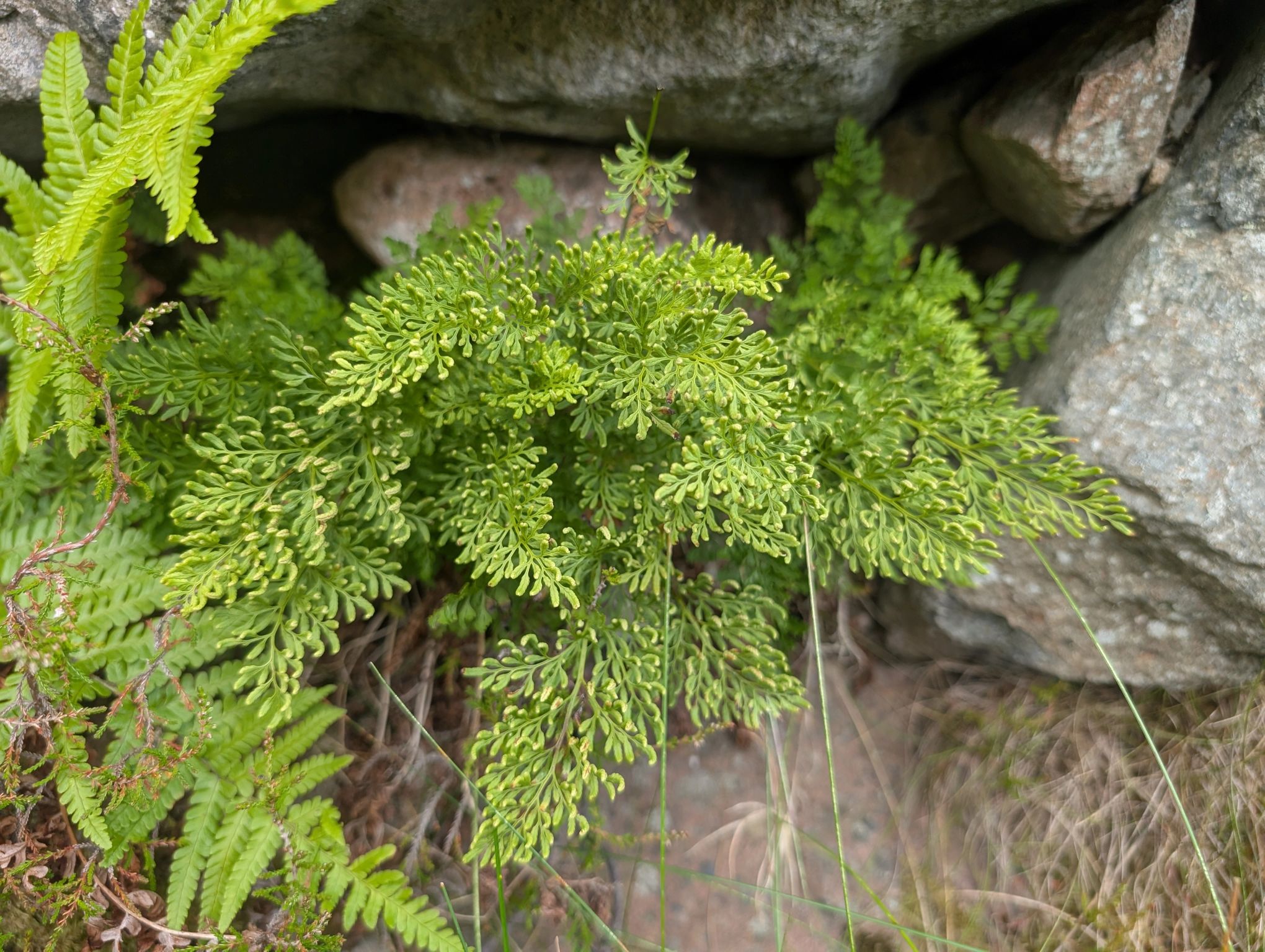
At the bridge at the foot of the trail leading up the Bizzle, another overhang held a somewhat desiccated example of what I believe to be Delicate Maidenhair Spleenwort Asplenium trichomanes subsp. trichomanes — a relatively rare relative of the more familiar Maidenhair Spleenwort commonly found on garden walls. A few Common Spotted-orchids Dactylorhiza fuchsii were also growing nearby, and a look at the riverside gravels revealed an interesting variety of willows. These included Purple Willow Salix purpurea, Osier Salix viminalis, Goat Willow Salix caprea, Eared Willow Salix aurita, and Grey Willow Salix cinerea.

Having passed the last vestiges of civilisation, we soon began our walk up the burn, initially passing through heather and areas of acid grassland before following the now stone-dry watercourse the rest of the way. It was tough going in places, and a near miss with a large female Adder certainly livened up proceedings. A few Common Lizards were also spotted along this stretch.

It was around this point that my camera began to malfunction, so photographic evidence is limited. Nevertheless, the plant life in the burn bed was typical for this part of the valley. The montane willowherbs were in full flower, with some attractive examples of Chickweed Willowherb Epilobium alsinifolium found alongside Alpine Willowherb Epilobium anagallidifolium and the non-native New Zealand Willowherb Epilobium brunnescens. Also of note was a lingering patch of Pale Forget-me-not Myosotis stolonifera, another local speciality. A suite of species more commonly associated with woodland was also encountered, including Opposite-leaved Golden Saxifrage Chrysosplenium oppositifolium, Wood Crane’s-bill Geranium sylvaticum, and Wood Sorrel Oxalis acetosella.

Befitting my newfound obsession with ferns, it was the pteridophytes that proved most interesting at these lofty heights. The day’s target species, Northern Buckler-fern Dryopteris expansa, was eventually located after considerable effort tucked among its preferred scree habitat. The diversity of other species present was impressive as well and, in no particular order, included common types such as Broad Buckler-fern Dryopteris dilatata, Narrow Male-fern Dryopteris cambrensis and Hard-fern Blechnum spicant, along with some altogether scarcer finds: Oak-fern Gymnocarpium dryopteris, Parsley Fern Cryptogramma crispa, and Borrer’s Male-fern Dryopteris borreri. The latter was a bit of a surprise, as I’ve always associated it with woodland – but who knows!

At the top of the burn, we eventually emerged into a vast, open corrie at the foot of Bizzle Crags. This is where many of the more interesting plants are known to grow, though oddly, we struggled to locate several of the anticipated targets – including Alpine Clubmoss and Fir Clubmoss – and some others were well past their best due to the heat, particularly the Mossy Saxifrage.

That said, Beech Fern Phegopteris connectilis was a pleasing find among the scree, and a scramble up to a damp ledge yielded some interesting discoveries, including Butterwort Pinguicula vulgaris and Viviparous Sheep’s-fescue Festuca vivipara. I had considered continuing higher, but by this point, my legs were beginning to protest. The 1970s record of Green Spleenwort will have to wait for another day…

We ended our hike at the corrie, opting not to follow the burn further on this occasion. A walk beyond that point will have to be saved for a cooler day, I think. Still, the descent via a slightly different route added plenty to the plant list and offered some truly stunning views.

In my opinion, this walk isn’t quite as botanically diverse as the Hen Hole, but it’s a beautiful route nonetheless and well worth doing if you find yourself with a day to spare.

Arctic-Alpine Plants in the Cheviots

Back in 2023, I was lucky enough to visit the Hen Hole for the first time, spending a riveting day exploring the rare arctic-alpine plants found in this spectacular gorge in the Cheviots. Although we saw a great deal during that visit, we missed many of the more elusive species that make this place so special. Ever since, I’ve wanted to return and and last week, the opportunity finally came.

Accompanied by Sacha Elliot, and having purchased a parking permit that allowed us to halve the otherwise long walk from Hethpool, we set out from the Mounthooley Bunkhouse in the College Valley. Our goal was to reach the Hen Hole and continue a bit further onto the montane slopes surrounding The Cheviot. We succeeded, spending an enjoyable five hours exploring the flora of this diverse, beautiful, and rugged corner of Northumberland with seven distinct target plants in mind.

The text below aims to summarise the visit – I’ll try not to let it get too long!


Setting out from Mounthooley, the first half-hour of the walk was fairly uneventful, at least until we reached the large open area about 0.5 km before the initial ascent into the Hen Hole. Just look for a sea of Hare’s-tail Cottongrass Eriophorum vaginatum and you can’t go far wrong here!

Here, the rocky banks of the College Burn held much of interest, as did the smaller, moss-strewn islands within the main channel – the plants in this area presumably comprising a mix of resident species and others washed down from higher up the valley. One notable find was Narrow Male-fern Dryopteris cambrensis, along with various commonplace heathland species that I encounter far too rarely in the lowlands: Heath Bedstraw Galium saxatile, Heath Milkwort Polygala serpyllifolia, Heath Rush Juncus squarrosus and others.

Even more exciting were the less frequent species shown below. The beautiful Starry Saxifrage Micranthes stellaris was abundant on the riverside rocks, while small pockets of Parsley Fern Cryptogramma crispa clung to areas of boulder and erosion. This is a species listed on the Rare Plant Register for North Northumberland. We even came across an entirely new plant for me (well, sort of) in the rarer subspecies of Thyme-leaved Speedwell Veronica serpyllifolia subsp. humifusa, growing among the moss. This is a plant largely confined to permanently moist upland habitats an differs markedly from the common form often seen in urban settings.

Nearby, the mossy islands in the channel were adorned with Opposite-leaved Golden Saxifrage Chrysosplenium oppositifolium.

Moving at a botanist’s pace towards the valley (in practice, only marginally quicker than a snail), another thing that quickly became apparent was the abundance of plants typically associated with older woodland. I have already mentioned Opposite-leaved Golden Saxifrage, but also present were Greater Wood-rush Luzula sylvatica, Bluebell Hyacinthoides non-scripta, Wood-sorrel Oxalis acetosella, Wood Sage Teucrium scorodonia and Bugle Ajuga reptans, alongside the pretty Wood Crane’s-bill Geranium sylvaticum shown below. All of these added a welcome touch of colour along the initial leg of our journey.

The Hen Hole walk truly becomes interesting once you begin your ascent into the gorge. Here, areas of scree, steep-sided cliffs and boulder fields conceal much of interest. Ferns are especially diverse and with some care, rarities can be found including Mountain Male-fern Dryopteris oreades and Northern Buckler-fern Dryopteris expansa. We succeeded in locating the former, identifiable by its sori which cover less than half of the pinnule surface. Despite our efforts, however, we were unable to find the buckler-fern. Not an ideal start, but a good reason to return.

Other ferns present among the scree included Beech Fern Phegopteris connectilis and Parsley Fern Cryptogramma crispa, alongside a range of more familiar species such as Male-fern Dryopteris filix-mas and Broad Buckler-fern Dryopteris dilatata. Areas within the splash zone of the waterfalls held more Starry Saxifrage, as well as Common Butterwort Pinguicula vulgaris and two notable willowherbs: the non-native New Zealand Willowherb Epilobium brunnescens and the rare native Alpine Willowherb Epilobium anagallidifolium. Also present were other attractive upland species including Goldenrod Solidago virgaurea and Bog Asphodel Narthecium ossifragum.

No trip to the Hen Hole would be complete without a moment to pause and admire the Three Sisters waterfall, a striking landmark popular with visitors and, for many, the end point of their walk.

Having passed the Three Sisters and clambered further up the valley, new plants began to appear thick and fast. Common species included Water Avens Geum rivale, Cowberry Vaccinium vitis-idaea and Crowberry Empetrum nigrum. Upon reaching the plateau, we found the Heath Spotted-orchids Dactylorhiza maculata we had observed two years earlier in full flower once again.

Further interest was found in rocky areas and atop boulders where several fine specimens of the curious Fir Clubmoss Huperzia selago were growing. This is another rare species in Northumberland, confined to a handful of remote upland settings. Nationally, it is typical of montane grasslands, and one I have encountered only a few times before in similarly inaccessible places.

After reaching the top of the corrie and taking in the impressive views back down the valley, we located the first of our target species: Alpine Clubmoss Diphasiastrum alpinum, by far the most unassuming of the day’s intended plants. One down, five to go!

The next plant on our hitlist was a real beauty, and another new species for me. Roseroot Rhodiola rosea is a perennial, succulent herb of sea cliffs and rock crevices on moist mountain ledges. As a native, it is confined entirely to such habitats, with the Hen Hole population being the only one in Northumberland. After breaking out the trusty GPS, it did not take long to find three plants growing in a series of rather inaccessible locations. As you can see from the photo below, it is quite a striking plant.

Nearby, we also noted another of our target species in Viviparous Sheep’s-fescue Festuca vivipara (not quite as striking, I admit) as well as more Beech Fern and higher up, a lovely patch of Mossy Saxifrage Saxifraga hypnoides – a plant that reminds me a little of fried eggs and was indeed the fourth of our target species for the day.

Having finished exploring along the burn, we set our sights a little higher, aiming to find what is easily the most exciting plant in the Cheviots – at least for keen botanists. With this in mind, we began to slip up the grassy slopes of the mountain, clambering to around 700 metres in 50 mph winds. Quite the experience, I tell you. Even though it was amusing to see Sacha literally blown to the ground, I would not recommend anyone attempt the same in such conditions.

The special plant in question is, of course, Alpine Foxtail Alopecurus magellanicus – a rather small but endearing grass of oligotrophic springs and flushes in upland areas. The population here is particularly important as it represents the only known site for the species in Northumberland, although the plant is somewhat more widespread in parts of Scotland. After some pained climbing, I am pleased to say that we found it.

Having spent an enjoyable yet windy ten minutes in the company of the foxtail, all that remained was to climb down the slope and retrace our steps down the valley. However, another surprise awaited us on the way: Globeflower Trollius europaeus. This is a species I am used to seeing in areas of County Durham, especially Upper Teesdale, but I had yet to lay eyes on it in my own home county. The species is known from the Cheviots, though it was last recorded here by the legendary George Swan back in 1975. After checking with my fellow recorder for North Northumberland, this sighting turned out to be an exciting refind of a special plant not seen in quite some time.

I admit it seems we found it purely by chance – there was only one flower on the entire hillside as far as we could see, growing near more Alpine Clubmoss and Fir Clubmoss.

Following the Globeflower, the walk back down the valley was fairly relaxed. We paused to admire a Peregrine, took another look at the burnsides, and explored a few new crags where we added two new species to the day’s list: Common Polypody Polypodium vulgare and Brittle Bladder-fern Cystopteris fragilis — both common on remote rock faces. We made it back to the car about an hour later, content with our haul and pleased that the trip had succeeded without any wind-related mishaps.

In total, we found five of the seven species we set out to locate at the start of the trip including Alpine Clubmoss, Alpine Foxtail, Roseroot, Viviparous Sheep’s-fescue and Mossy Saxifrage. The Northern Buckler-fern proved too much of a stretch on this occasion, and we also missed the rare Alpine Saw-wort Saussurea alpina, known here for many years. Oh well, that alone is reason enough to return soon.

For those looking to learn more about the Hen Hole and the special plants found in this part of the Cheviots, a helpful report by Chris Metherell can be found here.