Inspired by ongoing efforts to record the urban flora of Newcastle and North Tyneside, I wanted to make some of what has been discovered so far accessible to those interested in exploring the city for themselves. Cue a new series!
These blogs will explore some of the best botanical walks the conurbation has to offer – perfect for planning your next outing in the urban jungle. Here, we’ll explore Scotswood Road and Elswick Riverside.
This level 3.5-mile circular walk takes in what were once the industrial heartlands of Newcastle and travels through several key urban habitats. Your walk will begin at the Skinnerburn Road car park (cubs.camp.effort) from which you will set out West along the Hadrian’s Wall Path on the Northern bank of the Tyne. You will follow this for roughly 1.5 miles and for the first portion of your journey, much of the botanical interest will derive from the narrow band of scrub that fringes the river. Formed through the gradual colonisation of tidal defences and riverbank this habitat holds one of the richest neophyte assemblages in the city.
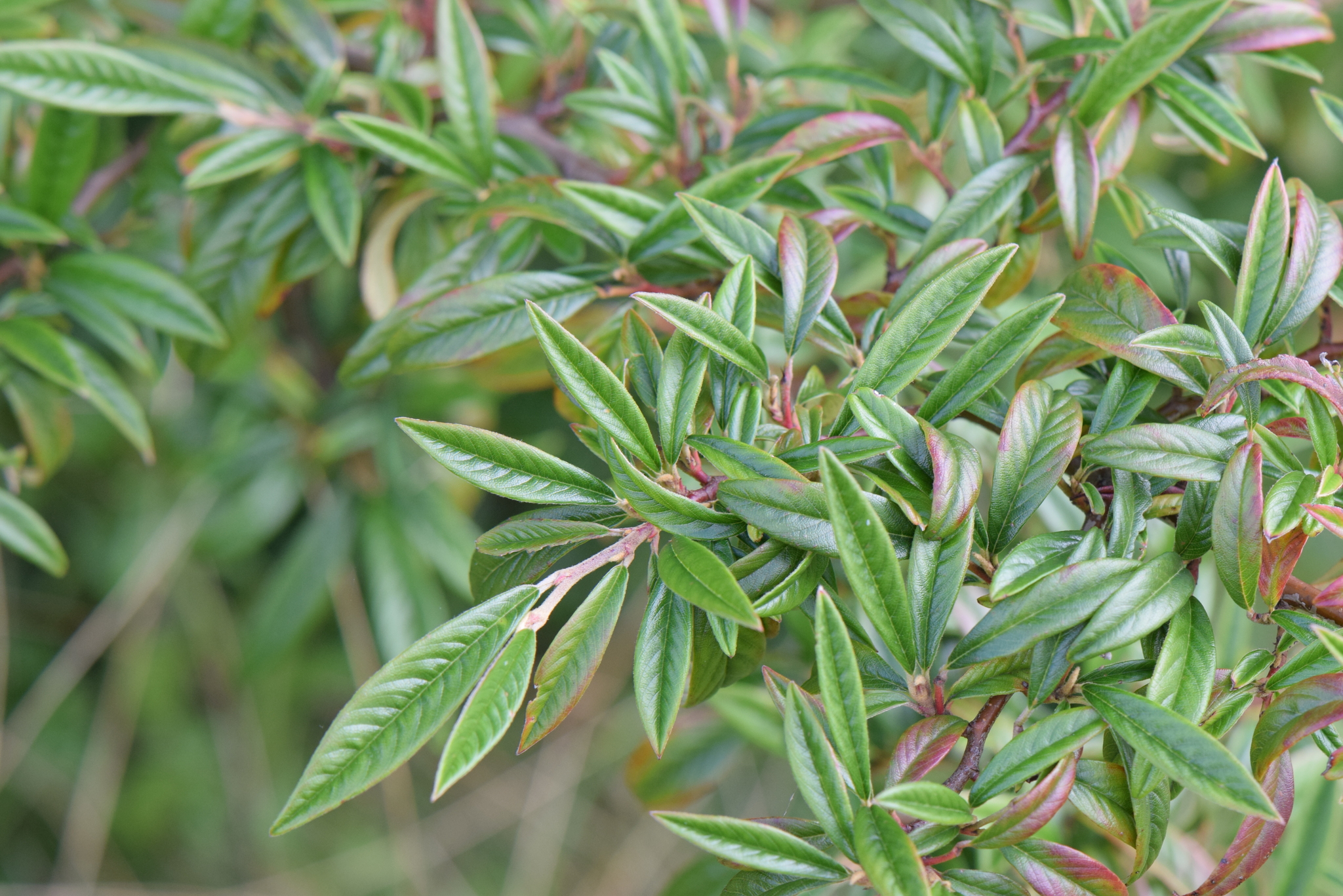
Almost immediately upon starting out (remind.dirt.entire) a look at this scrub community will reveal an assortment of bird-sown cotoneaster species. Late Cotoneaster (Cotoneaster lacteus) and Willow-leaved Cotoneaster (Cotoneaster salicifolius) are most obvious, but here too are Waterer’s Cotoneaster (Cotoneaster x watereri) and Wall Cotoneaster (Cotoneaster horizontalis). Among these, you should also note Chinese Barberry (Berberis julianae) at one of its only outposts in the city and interestingly, Stinking Hellebore (Helleborus foetidus) which, presumably having escaped nearby amenity planting, forms a unique understorey beneath the alien shrubs. Here too, closer inspection will reveal Spurge-laurel (Daphne laureola) and Wood Spurge (Euphorbia amygdaloides subsp. robbiae). A variety of self-sown alien trees also feature including Italian Alder (Alnus cordata), Swedish Whitebeam (Sorbus intermedia) and Common Whitebeam (Sorbus aria).
Late Cotoneaster (Cotoneaster lacteus)Spurge-laurel (Daphne laureola)Stinking Hellebore (Helleborus foetidus)
As you walk the riverside path, be sure to cast your eyes downward, through the scrub, to the walls and exposed mud closest to the Tyne. All along this stretch it is possible to observe relic saltmarsh flora consisting of Sea Aster (Tripolium pannonicum), Sea Plantain (Plantago maritima), Buck’s-horn Plantain (Plantago coronopus) and Common Saltmarsh-grass (Puccinellia maritima). Common Scurvygrass (Cochlearia officinalis) occurs much more scantly, and one of the highlights of the walk, Wild Celery (Apium graveolens) can be seen emerging from gaps in the riverside stonework.
Beyond these, the rest of until approximately rides.jets.solowill be spend admiring the scrub and tracksides. Low-growing plants to look out for along the way include Narrow-leaved Ragwort (Senecio inaequidens), Wood Sage (Teucrium scorodonia), False Brome (Brachypodium sylvaticum), Perennial Wall-rocket (Diplotaxis tenuifolia) and Cut-leaved Dead-nettle (Lamium hybridum). In the scrub, you will note an almost overwhelming variety of cotoneasters including, in addition to those mentioned already, Bearberry Cotoneaster (Cotoneaster dammeri), Hjelmvist’s Cotoneaser (Cotoneaster hjelmqvistii), Bullate Cotoneaster (Cotoneaster rehderi), Hollyberry Cotoneaster (Cotoneaster bullatus), Himalayan Cotoneaster (Cotoneaster simonsii) and Franchet’s Cotoneaster (Cotoneaster franchetii) – all of which make this a good place to look closer at this tricky group of plants. At placed.slower.wisdom, be sure to look out for Broad-leaved Whitebeam (Sorbus latifolia) growing on the banks where it is presumably bird-sown from planted populations in County Durham.
Atrides.jets.solokeep a watchful eye for Broad-leaved Helleborine (Epipactis helleborine) growing on the margins of the mown amenity grassland here and at belong.global.span for Glabrous Whitlowgrass (Erophila glabrescens) amid the pavements. Otherwise, the next point of interest comes at puns.noise.oddly where the path slopes upward towards William Armstrong Drive. Here, you will spot the city’s only example of Fig (Ficus carica) overhanging the river, perhaps even adorned with fruit. With a bit of careful meandering here, you can further explore the small area of bank here with the aim of finding two scarce natives: Downy Birch (Betula pubescens) and Spindle (Euonymus europaeus). Exploration of the little inlet here should turn-up more Wild Celery alongside Spear-leaved Orache (Atriplex prostrata) and Danish Scurvygrass (Cochlearia danica) on the tidal mud. You should also add another cotoneaster to your rapidly increasing tally with Small-leaved Cotoneaster (Cotoneaster microphyllus).
Fig (Ficus carica)Fig (Ficus carica)
From here, continue up Willam Armstrong Road until it merges with Scotswood Road. Cross the road and you will be presented with a long-neglected area of roadside shrubbery at orders.mint.plant.Most of the shrubs here are planted and are of little interest, but what grows beneath them is far more interesting. In summer, open areas and messy marginal zones here hold a thriving population of Bee Orchid (Ophrys apifera) growing alongside Yellow-wort (Blackstonia perfoliata) and Musk-mallow (Malva moschata).
A little further west, a larger expanse of grassland at the junction of the B1305 is worth exploring and holds many of the species associated with Tyneside’s re-seeded industrial plots. Expect Lady’s-bedstraw (Galium verum), Hedge Bedstraw (Galium album) and their hybrid Galium x pomeranicum; Chalk Knapweed (Centaurea debeauxii), Quaking-grass (Briza media), Yellow Oat-grass (Trisetum flavescens), Viper’s-bugloss (Echium vulgare), Small Scabious (Scabiosa columbaria), Field Scabious (Knautia arvensis), Greater Knapweed (Centaurea scabiosa) and Wild Marjoram (Origanum vulgare).
From here, all that remains is to travel back East on Scotswood Road. At cares.scare.shaky and slick.plant.glee, grassland areas hold more of the same calcareous species explored earlier, while roadsides and waste ground plots hold an interesting assortment of weeds. Along your way, look out for Eastern Rocket (Sisymbrium orientale),Great Lettuce (Lactuca virosa), Long-headed Poppy (Papaver dubium), Large-flowered Evening-primrose (Oenothera glazioviana), Squirreltail Fescue (Vulpia bromoides), and Water Bent (Polypogon viridis).
To return to the car park, turn off Scotswood Road down Dunn Street. Along the way, look out for Stern’s Cotoneaster (Cotoneaster sternianus) in the rail side scrub and yet more Cut-leaved Dead-nettle in any areas of disturbed ground. A final point of interest is the diverse willowherb community that develops atop any area of waste or derelict ground. Expect an abundance of Short-fruited Willowherb (Epilobium obscurum), Great Willowherb (Epilobium hirsutum), Hoary Willowherb (Epilobium parviflorum),Broad-leaved Willowherb (Epilobium montanum), American Willowherb (Epilobium ciliatum) and Square-stalked Willowherb (Epilobium tetragonum). It is worth looking for hybrids too – the hybrid between Great x Hoary Willowherb (Epilobium x subhirsutum) has been recorded nearby.
Other interesting plants to look for along the way…
Lesser Sea-spurrey (Spergularia marina), Darwin’s Barberry (Berberis darwinii), Swedish Cotoneaster (Cotoneaster x x suecicus), Hybrid Couch (Elymus x laxus), Reflexed Saltmarsh-grass (Puccinellia distans) and Wild Parsnip (Pastinaca sativa).
Inspired by ongoing efforts to record the urban flora of Newcastle and North Tyneside, I wanted to make some of what has been discovered so far accessible to those interested in exploring the city for themselves. Cue a new series!
These blogs will explore some of the best botanical walks the conurbation has to offer – perfect for planning your next outing in the urban jungle. Here, we’ll explore NHSN’s Gosforth Nature Reserve.
Managed by the Natural History Society since 1924, Gosforth Nature Reserve is perhaps the most fruitful and interesting green space in the city. Much of this is due to the presence of several key habitats condensed in what is a relatively small area. On this walk, you’ll explore areas of open water and reedbed, marshland and recent semi-natural woodland and smaller areas of meadow and relic heath. At just over 1 mile, this circular route takes about 2 hours with plenty of time to pause and enjoy the wildlife.
You’ll start at the reserve entrance (dollar.tile.scales) where before heading in, you may wish to spend a few moments scrutinising the species rich verge directly behind you. This holds populations of Musk Thistle (Carduus nutans), Betony (Betonica officinalis) and Viper’s-bugloss (Echium vulgare) among commoner plant life and is notable for the presence of Adder’s-tongue (Ophioglossum vulgatum) and some lovely displays of Cowslip (Primula veris) come spring. Southern Marsh-orchid (Dactylorhiza praetermissa) has also popped up in the near area of late is liable to expand further. Now head on in via the friendly volunteers at the Welcome Hut (paying the entry fee or showing a membership card) and through two sets of gates and into the woodland. Here, turn left towards the field boundary at winner.locals.fortunate.
The first portion of this walk is not all that interesting, in truth – the woodland here lacks many of the axiophytes associated with ancient woodland and instead, is dominated by common ferns such as Broad Buckler-fern (Dryopteris dilatata). Still, walking the boundary ride, you might note Zigzag Clover (Trifolium medium), Spurge-laurel (Daphne laureola), Wood Dock (Rumex sanguineous), Three-nerved Sandwort (Moehringia trinervia) and Stinking Iris (Iris foetidissima) and a little further on, a newly created woodland meadow. While in its infancy, this patch holds Pignut (Conopodium majus), Yellow-rattle (Rhinanthus minor) and select other titbits. Things will pick up when you reach a junction in the path and a trail leading through an area of willow carr. Take this path, pausing beneath the willows where the sodden ground holds Hairy-brome (Bromopsis ramosa) and Wood Meadow-grass (Poa nemoralis). In just a few paces, you’ll emerge into the reedbed – once said to be the largest in South Northumberland.
Sympathetic management mean that in places, the reedbed holds a diverse range of riparian and emergent plant species. In summer, you should note plenty of Wild Angelica (Angelica sylvestris), Water Mint (Mentha aquatica) and Common Valerian (Valeriana officinalis), often adorned with clambering Bittersweet (Solanum dulcamara). Beneath the taller herbs, the understory holds Tufted Forget-me-not (Myosotis laxa), Marsh-bedstraw (Galium palustre) and Water Forget-me-not (Myosotis scorpioides), as well as Water Horsetail (Equisetum fluviatile). Don’t get too distracted, however, for the best is still to come.
At undulation.such.visitsyou’ll find the reserve’s pond-dipping platform. This is far and away the best place at which to observe the site’s scarcer aquatic flora. Expect Water-plantain (Alisma plantago-aquatica), Greater Spearwort (Ranunculus lingua), Celery-leaved Buttercup (Ranunculus sceleratus), Broad-leaved Pondweed (Potamogeton natans) and Common Water-starwort (Callitriche stagnalis). Marsh Cinquefoil (Comarum palustre) is also present with this small platform being the best place to observe it in all the city. From here, head back on yourself and continue on the boundary ride, past the Beck Hide, until you reach the rear of the reserve at studio.riches.broad. Here you will find a rather lovely SuDS Pond and its associated plant life.
New species in the pond here will include Canadian Waterweed (Elodea canadensis), Blinks (Montia fontana), and Common Club-rush (Schoenoplectus lacustris) but the real focal point here comes at fans.remark.dine where you can enjoy a small colony of Melancholy Thistle (Cirsium heterophyllum). After seeing this, return across the pond and follow the path a short distance to the meadow lost.orchestra.mouth where there is a great deal more to see.
First, turn right and follow the path a few paces into a small, open area next to the reserve’s viewing screen. This is a productive spot with Common Spotted-orchid (Dactylorhiza fuchsii), Northern Marsh-orchid (Dactylorhiza purpurella) and their hybrid, Dactylorhiza x venusta. You can also enjoy Rough Hawkbit (Leontodon hispidus), growing alongside naturalised Fox-and Cubs (Pilosella aurantiaca), and in scrubby areas nearby, Bifid Hemp-nettle (Galeopsis bifida) – a rather rare plant in the conurbation. More noteworthy still are the ragworts present with both Marsh Ragwort (Jacobaea aquatica) and its hybrid with Common Ragwort (Jacobaea vulgaris), easily found. You may find that most of the plants encountered are in fact Jacobaea x ostenfeldii.
Jacobaea x ostenfeldii with parentsBifid Hemp-nettle (Galeopsis bifida)Betony (Betonica officinalis)
Now return the way you came, into the larger meadow. At shed.gallons.formacid soils give rise to a unique community of plants including Devil’s-bit Scabious (Succisa pratensis), Betony, Heather (Calluna vulgaris), Tormentil (Potentilla erecta) and rarely, Heath Spotted-orchid (Dactylorhiza maculata) growing alongside the abundant orchid species. Heath Wood-rush (Luzula multiflora) also persists here, as does Sneezewort (Achillea ptarmica). Look closely at this stage and you should easily find the only known example of Lemon-scented Fern (Oreopteris limbosperma) in all of Newcastle.
This is also a good spot to test your sedge identification skills with a representative suite of species including, by not limited to, Common Yellow-sedge (Carex demissa), Glaucous Sedge (Carex flacca), Carnation Sedge (Carex panicea), Hairy Sedge (Carex hirta), Brown Sedge (Carex disticha) and Common Sedge (Carex nigra).
Meadow flora changes as you near the next SuDS. Owing to a past seed mix, here groundcover is dominated by Bird’s-foot Trefoil (Lotus corniculatus var. sativus), Oxeye Daisy (Leucanthemum vulgare), Common Knapweed (Centaurea nigra) and other plentiful species. At frames.apples.tigers, a look in the pond should add Blue Water-speedwell (Veronica anagallis-aquatica), Small Pondweed (Potamogeton berchtoldii) and Brooklime (Veronica beccabunga) to the proceedings and perhaps Bladder-sedge (Carex vesicaria). More Bifid Hemp-nettle can also be found in marginal areas.
From this point, follow the path into the wood to a junction at mops.levels.agents. You know have two options: follow the path to your left for a longer walk through the woodland, or head straight on skirting the lake shore. We’ll do the latter, though taking the alternate route is worthwhile in spring for Bluebell (Hyacinthoides non-scripta), Primrose (Primula vulgaris), Greater Stitchwort (Stellaria holostea), Wild Daffodil (Narcissus pseudonarcissus subsp. pseudonarcissus) and other woodland species recently introduced on site. The margins of the clearings along this trail, where the felling of non-native Sitka Spruce (Picea sitchensis) has enabled select species to regenerate, offer plants such as Heath Groundsel (Senecio sylvaticus) and Common Hemp-nettle (Galeopsis tetrahit).
Following your chosen route, several notable plants can be found along the tracksides including Heath Speedwell (Veronica officinalis), Heath Bedstraw (Galium saxatile) and more Tormentil, along with some sizeable populations of Foxglove (Digitalis purpurea) that look delightful in late Spring. At share.tester.begindo pay attention to the wetland woodland where, among the trunks of Downy Birch (Betula pubescens) you may spot Marsh Pennywort (Hydrocotyle vulgaris), Remote Sedge (Carex remota) and other interesting plants.
At this stage, you will continue the track, over a rather scenic area of boardwalk, until you reach yet another junction in the trail. At this junction, look out for Broad-leaved Helleborine (Epipactis helleborine) by the path sides but otherwise, all that remains is to take the central path back to the reserve entrance.
Other interesting plants to look for along the way…
Hairy St. John’s-wort (Hypericum hirsutum), Common Fleabane (Pulicaria dysenterica), Mare’s-tail (Hippuris vulgaris), Quaking-grass (Briza media), Marsh Speedwell (Veronica scutellata), Slender St. John’s-wort (Hypericum pulchrum), Tuberous Comfrey (Symphytum tuberosum) and Mountain Currant (Ribes alpinum).
Inspired by ongoing efforts to record the urban flora of Newcastle and North Tyneside, I wanted to make some of what has been discovered so far accessible to those interested in exploring the city for themselves. Cue a new series!
These blogs will explore some of the best botanical walks the conurbation has to offer – perfect for planning your next outing in the urban jungle. Here, we’ll explore Silverlink which while not strictly within the city limits, sits just without and forms part of the wider conurbation.
This is a short, circular walk taking in one of the best botanical sites in North Tyneside. At just 1.2 miles and level throughout, it is very accessible and on a good day in June or July, may result in a tally of around 170 species.
The Biodiversity Park is a small but interesting nature reserve created in the late 1990’s with funding from nearby developers. It was meticulously designed by ecologists and architects to include ponds, woodland, hedgerows, meadows and an impressive piece of landscape art that we will discuss later, while also incorporating several small areas of existing natural land. Your walk begins in the small carpark opposite the Village Hotel (landowner.plants.tint) in Cobalt Business Park.
It is often joked that botanists seldom make it out of the carpark on their outings and here, that will surely be the case with areas of ornamental planting, untouched since 1997, left to develop and spread. Only the hardiest have survived with an impressive patch of Blue Globe-thistle (Echinops bannaticus) immediately visible, alongside a glut of Druce’s Crane’s-bill (Geranium × oxonianum). You should also note Purple-loosestrife (Lythrum salicaria) and Dotted Loosestrife (Lysimachia punctata), alongside a thriving population of Wild Parsnip (Pastinaca sativa). From the carpark, take the Northernmost of the three major pathways. By doing so, you will pass a small area of grassland to your immediate right which harbours Northern Marsh-orchid (Dactylorhiza purpurella) and Water Figwort (Scrophularia auriculata) and eventually on to another portion of path surrounded on both sides with trees. Walking this path, you will pass a large but mostly inaccessible pond, with viewing only possible at romantics.mixture.supposing.
Even with only some of the pond visible, you should note an interesting array of riparian and aquatic plants, most of which are said to have colonised the site naturally. Expect Water-plantain (Alisma plantago-aquatica), Amphibious Bistort (Persicaria amphibia), Floating Sweet-grass (Glyceria fluitans), Broad-leaved Pondweed (Potamogeton natans) and Greater Spearwort (Ranunculus lingua) among more abundant species. You will then need to backtrack a few meters until you re-join the trail, continuing your way until you pass a neglected interpretation panel and eventually, exit the park. Now you’ll find yourself on a section of Waggonway which you should follow south, skirting the park, for 200m or so.
Along the Waggonway you will note several uncommon plants growing in areas of disturbance. Among these, Bladder Campion (Silene vulgaris), Great Mullein (Verbascum thapsus) and Wild Mignonette (Reseda lutea). The shelterbelts contain many seedlings of alien trees and shrubs, including Late Cotoneaster (Cotoneaster lacteus), Mougeott’s Whitebeam (Sorbus mougeotii) and Hybrid Alder (Alnus x hybrida), while the Hybrid Willow (Salix × smithiana) and White Poplar (Populus alba) are spreading via runners. At proves.barn.reinstateyou will encounter a particularly bountiful patch of grassland home to Viper’s-bugloss (Echium vulgare), Blue Fleabane (Erigeron acris), Fairy Flax (Linum catharticum) and Yellow-wort (Blackstonia perfoliata). Immediately behind this area, ranker grassland holds Zigzag Clover (Trifolium medium).
Blue Fleabane (Erigeron acris)Viper’s-bugloss (Echium vulgare)
From here, look behind you and you will note a path leading back into the Biodiversity Park, located almost at the foot of prominent pylon. Taking this path, you will arrive in a small area of meadow. This expanse of grassland is particularly rich with the dominant plant life comprising Rough Hawkbit (Leontodon hispidus), Cat’s-ear (Hypochaeris radicata) and Lady’s-bedstraw (Galium verum) alongside Glaucous Sedge (Carex flacca) and various grasses.
In June, this is particularly productive spot for Bee Orchid (Ophrys apifera) but keen-eyed orchid hunters should also find Common Spotted Orchid (Dactylorhiza fuchsii), Northern Marsh-orchid (Dactylorhiza purpurella) and their hybrid, Dactylorhiza x venusta. More recently, Pyramidal Orchid (Anacamptis pyramidalis) and Common Twayblade (Neottia ovata) have colonised also. Equally of interest is the abundance of hypericum here with closer inspect revealing that most of the plants here are Des Etangs’ St. John’s-wort (Hypericum × desetangsii). Once you have explored the meadow, follow the obvious track back to the main footpath and head South until you hit a junction in the path, being sure to note Common Figwort (Scrophularia nodosa), Tall Melilot (Melilotus altissimus) and Meadow Crane’s-bill (Geranium pratense) along the way.
Turning right at the junction, you will emerge into a far larger open area marked by a sloping, grassy hill to your right and several small ponds to your left. These ponds are noteworthy in hosting Tufted Forget-me-not (Myosotis laxa), Water Forget-me-not (Myosotis scorpioides), Common Water-starwort (Callitriche stagnalis) and Ivy-leaved Duckweed (Lemna trisulca) but much more interesting is the slope immediately opposite. This represents all that remains of the impressive landscape sculpture created in 1997. Interestingly, this was constructed of one-half sandstone and one-half limestone meaning that in the years since, a sharply contrasting flora has formed across both areas of exposed rock consisting of seeded introductions and natural colonists.
Much of the sandstone area has been overtaken by scrub but look closely and you will note areas of Great Wood-rush (Luzula sylvatica), Heather (Calluna vulgaris), Wood-sage (Teucrium scorodonia) and Water Avens (Geum rivale). Beneath a solitary birch sites the conurbations only know specimen of Heath Fragrant Orchid (Gymnadenia borealis), perhaps imported as an happy accident among the substrate. Close to this area, you can also find Tyneside’s only population of the rare Pale St. John’s-wort (Hypericum montanum) growing atop parts of the former sculpture.
Atop calcareous areas, you will surely note Betony (Betonica officinalis), Small Scabious (Scabiosa columbaria), Quaking Grass (Briza media), Yellow-wort (Blackstonia perfoliata), Salad Burnet (Poterium sanguisorba subsp. sanguisorba) and Chalk Knapweed (Centaurea debauxii) while much more localised are Great Burnet (Sanguisorba officinalis) and Devil’s-bit Scabious (Succisa pratensis). Bare areas here hold too the only local population of typically coastal subspecies of Red Fescue, Festuca rubra subsp. juncea.
Taking the central path up the hill and towards the sun dial, you will pass through a large area of neutral grassland dominated by Common Knapweed (Centaurea nigra), Hedge Bedstraw (Galium album) and more abundant species before reaching a flight of ramshackle steps leading to the dial itself. Look, though the flora here is less interesting save for a fantastic display of Cowslips (Primula veris) in late spring. Much more interesting is the path downhill to the sites largest pond where you may note more Bee Orchids (Ophrys apifera). The pond itself is much more accessible and scrutiny will reveal Bogbean (Menyanthes trifoliata) and Coloured Water-lily (Nymphaea x marliacea) both introduced, and colonists in Spiked Water-milfoil (Myriophyllum spicatum) and Canadian Pondweed (Elodea canadensis). From here you have two options.
Taking the path your right will lead you through woodland and a few sizeable patches of Butterbur (Petasites hybridus) back to the carpark where you began your journey. Head left, however, and you emerge from the park intro Cobalt Business Park with its industrial units and associated amenity areas. Vacant lots here are worthy of exploration and can hold many of the plants commonly associated waste ground, with species such as Bristly Oxtongue (Helminthotheca echioides), Prickly Lettuce (Lactuca serriola), Common Cudweed (Filago germanica) and Common Centaury (Centaurium erythraea) occurring among more abundant weeds.
A final note for those with time to spare is the nearby Village Hotel Pond located just North East of your starting position. Older than the others on site, this has developed a rich riparian community consisting of Greater Spearwort (Ranunculus lingua), Gypsywort (Lycopus europaeus), Grey Club-rush (Schoenoplectus tabernaemontani), Bottle Sedge (Carex rostrata) and Bladder Sedge (Carex vesicaria), among other associated plants, and nearby ditches host Great Yellow-cress (Rorippa amphibia), Hybrid Horsetail (Equisetum × litorale), and False Fox-sedge (Carex otrubae).
Other interesting plants to look for along the way…
Inspired by ongoing efforts to record the urban flora of Newcastle and North Tyneside, I wanted to make some of what has been discovered so far accessible to those interested in exploring the city for themselves. Cue a new series! These blogs will explore some of the best botanical walks the conurbation has to offer – perfect for planning your next outing in the urban jungle. Here, we’ll explore Jesmond Dene.
Starting out at ancient woodland, the Ouse Burn valley at Jesmond Dene and Armstrong Park, has changed much over the years. In the 19th century, the valley was home major industrial workings including quarries, watermills, and an iron foundry – elements that have greatly contributed to its present-day aesthetic. In the the 1850s, William George Armstrong, later Lord Armstrong of Cragside, Northumberland, purchased the valley and alongside his wife, enclosed the land for use as private parkland. Managed as a naturalistic garden, Armstrong introduced many and more exotic plants to the dene during his tenure, before eventually gifting the site to the people of Newcastle in 1883.
Since Armstrong’s day, the dene has been managed as a public park, though many of these curious introductions remain, if you know where to look. Together with the site’s native flora, they make Jesmond Dene one of the most eclectic and interesting walks in all of the city, if one of the longer ones at around 3 miles circular.
Your walk begins at the entrance to Armstrong Park from Jesmond Vale Lane (hunt.sounds.pages). In spring, the grassy verge on the Northern most side of the lane is a sight to behold on account of the plentiful spring bulbs left to spread over the decades. The two most numerous are Early Crocus (Crocus tommasinianus) and Snowdrop (Galanthus nivalis), but Spring Crocus (Crocus neapolitanus) are plentiful and Greater Snowdrop (Galanthus elwesii) and Green Snowdrop (Galanthus woronowii) remain as relics. Heading into the park, you can also observe Snow Crocus (Crocus x hybridus) and Yellow Crocus (Crocus x luteus) dotted absent any obvious pattern, through wooded areas and glades, presumably having outlived their initial, formal arrangements.
Following either one of the paths through the park, either the mid-section or upper-most trail will do, you will notice a wide range of trees and shrubs associated with landscaped Victorian estates. Several of these such as Turner’s Oak (Quercus x turneri) and Portugal Laurel (Prunus lusitanica) have persisted absent spread. Others are now soundly naturalised with two of the more prominent being Rhododendron (Rhododendron ponticum) and Highclere Holly (Ilex x altaclerensis). Other curiosities here include Flowering Currant (Ribes sanguineum) and the curious holly cultivar Ilex aquilifolium ‘Ferox’. Points of interest in the understory during this initial leg include Great Forget-me-not (Brunnera macrophylla) and Hyacinth (Hyacinthus orientalis), both presumably of more recent garden origin.
Dependent on the season of your visit, highlights of this first parkland trail include an expansive area of Winter Heliotrope (Petasites pyrenaicus) at curl.rings.soils; Siberian Squill (Scilla siberica) adorning a rock ledge at live.spend.take and what was, until this flora at least, Newcastle’s only known population of Great Horsetail (Equisetum telmateia) at trial.mutual.encounter. However, the true highlight comes in the park’s latter reaches where, in a trend that will continue throughout your walk, a range of ancient woodland axiophytes begin to appear.
During this stretch, expect Lords-and-Ladies (Arum maculatum), Ramsons (Allium ursinum), Bluebell (Hyacinthoides non-scripta) and Wood Anemone (Anemone nemorosa), among commoner woodland fare. At quiet.brief.nature, be sure to keep a watchful eye for Cabbage Thistle (Cirsium oleraceum) in a damp flush – the origins of this curious plant are unclear, but it may well have persisted here, unnoticed, since Armstrong’s time. From here, all that remains to continue out of the park to Armstrong Bridge, before making the gradual descend into Jesmond Dene via the sloping path towards Red Walk. Along this trail, lookout for another relic, Blue Anemone (Anemone apennina), blooming in spring.
Once you reach the Red Walk, you will find yourself in a large open area named the Coalman’s Field, formerly planted as an arboretum and home to a great many exotic trees. Do play close attention to the wall by the nearby café, in recent years this has been colonised by Meadow Saxifrage (Saxifraga granulata) that has escaped the café’s ‘green roof’. From here, you have several options as to where to head next. You may need to zigzag slightly to catch all the highlights. First, head towards Pet’s Corner before turning left over small wooden bridge. At the bridge, look towards the burn for some interesting relics in Himalayan Honeysuckle (Leycesteria formosa), freely seeding itself in the banks, and Wilson’s Honeysuckle (Lonicera nitida), as well as several native ferns in Lady-fern (Athyrium filix-femina), Borrer’s Male-fern (Dryopteris borreri) and Hart’s-tongue (Asplenium scolopendrium).
Near the fenced compound, just over the bridge, both Green Snowdrop and Autumn Crocus (Crocus nudiflorus) are established in the wood; though needless to say this depends on timing. Follow the trail North past the compound until you reach employ.tricky.riders. Here, lookout for a sizeable stand of Salmonberry (Rubus spectabilis) with its splendid pink blooms and cast an eye towards the riverbank where you may see Opposite-leaved Golden Saxifrage (Chrysosplenium oppositifolium) and a modest population of Abraham-Issac-Jacob (Trachystemon orientalis) – more on that one later.
Following this short trail, you will eventually hit a T-junction. Take the stairs down towards the burn where, for a short while, you will skirt the margins of Pet’s Corner. Plants to look out for here include Spotted Laurel (Aucuba japonica), Himalayan Balsam (Impatiens glandulifera) and plenty of Pendulous Sedge (Carex pendula). Before long, you will remerge on to the Red Walk, having conveniently avoided the throngs at the petting zoo. Now, you will follow the main thoroughfare deeper into the dene.
At themes.cuts.nuns, or around about, you’ll notice a set of steps leading upward to the next tier of the dene. Do not take these but instead, loiter at there base where you’ll note expanding populations of Few-flowered Garlic (Allium paradoxum) and Three-cornered Garlic (Allium triquetrum), both beautiful but highly invasive colonists. Here too you may note the non-native form of Wood Spurge (Euphorbia amygdaloides subsp. robbiae) and the first of many suspect Carpet Box (Pachysandra terminalis) which seems to thrive here and may well be a hangover from Victorian times given Armstrong’s apparent penchant for Japanese gardening. Indeed, during the next leg of the Red Walk, you may note small areas of False-bucks-beard (Astilbe japonica) and Rodgersia (Rodgersia podophylla) nestled amid native plant species – both presumably introduced by Armstrong.
Continue on the path until you meet a derelict building at tiger.unfair.pipes noting along your way Yellow-flowered Strawberry (Potentilla indica), Tutsan (Hypericum androsaemum), Garden Yellow Archangel (Lamiastrum galeobdolon subsp. argentatum) and more lovely axiophytes including, on this occasion, Wood Speedwell (Veronica montana) and the locally scarce Giant Bellflower (Campanula latifolia), which while sporadic, frequently appears on the banks of the Ouse Burn.
Your next stop will be the Jesmond Dene Mill and nearby artificial waterfall. This is a scenic point at which to pause, and exploration of the nearby area will reveal several notable plants including seedlings of Oregon-grape (Mahonia aquifolium) and Wrinkled Viburnum (Viburnum rhytidophyllum) and interesting ferns in Golden-scaled Male-fern (Dryopteris affinis), Soft Shield-fern (Polystichum setiferum) and the first of many Hard Shield-ferns (Polystichum aculeatum) to be observed during your visit. Around the mill, sightings may also include self-sown Western Red-cedar (Thuja plicata) and Lawson’s Cypress (Cupressus lawsoniana), as well as Greater Celandine (Chelidonium majus) by the tracksides.
Continue on your way until you reach a solitary private home. Noting some patches of White-stemmed Bramble (Rubus cockburnianus) that have escaped the garden in recent years, cast your eyes back towards the burn where you will find the Ouse Burn Stepping Stones. A foray across is recommended but do be careful as they can be slippery in places.
Immediately over the river, you will encounter a permanently wet slope, perhaps created as a Victorian rockery, where you should encounter the Dene’s largest population of Kidney Saxifrage (Saxifraga hirsuta), another local speciality. Here it grows with Londonpride (Saxifraga x urbium), our native Opposite-leaved Golden-saxifrage and several fern species. This is also a good spot to look for Giant Bellflower, if you missed it earlier. Once satiated, head across the stepping stones and continue your way, crossing a small road into what is, by all accounts, the wildest part of the dene. You may wish to pause at signal.trying.composers to admire several plants of Bear’s-breech (Acanthus mollis) which were dumped from a nearby garden in 2022 and have since firmly established themselves on the bank.
The next stretch of trail takes you as far as the bridge at Castle Farm Road. Along the way, expect more of the same with interesting ferns and axiophytes. Of note along this stretch is a small population of Hard-fern (Blechnum spicant) at one of its only Newcastle outposts and in spring, the bluebells are worth investigating with both Blubell and Spanish Bluebell (Hyacinthoides hispanica) present alongside the much more numerous Hybrid Bluebell (Hyacinthoides x massartiana). Do look out for some interesting, pure white native Bluebells at this stage while at the foot of the bridge, you may catch site of the yellow flowers of Marsh-marigold (Caltha palustris), one of the few wetland plants to persist in the now heavily polluted Ouse Burn.
At this point, you may wish to turn back – this has been a rather long walk after all. For intrepid botanists, however, the upper reaches of Jesmond Dene still hold much of interest. Realistically, it may be better to do this walk in two stages but here, we will continue unabated up a flight of steps and through a tunnel, emerging on the opposite side of the bridge. Here you will find yourself surrounded by Abraham-Isaac-Jabob which seems to be doing rather well here of late.
Kidney Saxifrage (Saxifraga hirsuta)
This final short stretch of the dene receives little upkeep or footfall and as such, remains one of the better places to observe the city’s ancient woodland flora. Expect more of the axiophytes mentioned previous alongside Dog’s Mercury (Mercurialis perennis), Common Dog-violet (Viola riviniana), False-brome and better still, the rare Wood-melick (Melica uniflora) clinging on in areas of disturbance. The close proximity of gardens mean that a suite of other neophytes have colonised this part of the dene including reoccurring populations of Italian Lords-and Ladies (Arum italicum) and Spring Snowflake (Leucojum vernum). Indeed, new curiosities are appearing all the time as demonstrated by a burgeoning population of Balm (Melissa officinalis) discovered in 2024.
Emerging from the Dene at this point will allow you to easily catch a bus back to your starting point, but the walk back along the uppermost path offers and entirely new set of plants where the drier, more open conditions are perfect for Great Wood-rush (Luzula sylvatica), Wood Meadow-grass (Poa nemoralis), Wood-sage, Broom (Cytisus scoparius) and Greater Stitchwort (Stellaria holostea). Along your way, you should catch sight of several more of the denes unusual relics including Shallon (Gaultheria shallon), Martagon Lily (Lilium martagon) and Dusky Crane’s-bill (Geranium phaeum) but that, I fear, is more than enough for one day save for a pitstop where the path returns to Pet’s Corner.
While they are tricky to find, at video.stole.counts, a Spring visit may reward you with the exquisite flowers of Dog’s-tooth Violet (Erythronium dens-canis), said by local botanists to have grown in the Dene for 30 years or more. This is yet another highlight of this weird but wonderful part of the city.
Other interesting plants to look for along the way…
Inspired by ongoing efforts to record the urban flora of Newcastle and North Tyneside, I wanted to make some of what has been discovered so far accessible to those interested in exploring the city for themselves. Cue a new series! These blogs will explore some of the best botanical walks the conurbation has to offer – perfect for planning your next outing in the urban jungle. This week, we’ll take a trip to Walker Riverside.
This circular walk of 3.3 miles takes around 3 hours at the height of summer when most of the interesting plants are in bloom. Meandering through several diverse, if somewhat unsightly, urban habitats, it provides a fantastic introduction to the flora of Tyneside’s brownfield and former industrial plots.
Rather unceremoniously, the route begins on Glasshouse Street (occurs.tubes.goat) outside of the Newcastle Resource Recovery Centre or tip, to use more familiar terminology. Here, you may care to explore the closely-sheered verge for Field Madder (Sherardia arvensis), Blue Fleabane (Erigeron acris) and Small-flowered Crane’s-bill (Geranium pusilum) but otherwise, head East for approximately 100m along the Hadrian’s Wall path taking care to note the variety of naturalised alien shrubs present here. Several have gone on to run amuck since their introduction in decades past.
Here, you’ll note Franchet’s Cotoneaster (Cotoneaster franchetii), Late Cotoneaster (Cotoneaster lacteus), Diel’s Cotoneaster (Cotoneaster dielsianus) and Darwin’s Barberry (Berberis darwinii), all of which are well at home along the scrubby bridleway. Before long, you’ll notice a well-trodden throughfare to your right, from which you will emerge intro a small car park on St. Lawrence Road. Seldom sprayed with herbicides, this carpark holds a notable mix of Alexanders (Smyrnium olusatrum),Viper’s-bugloss (Echium vulgare) and Common Toadflax (Linaria vulgaris). Of these, the former is notable as a relatively rare species within the city limits.
Canadian Fleabane (Erigeron canadensis)Narrow-leaved Ragwort (Senecio inaequidens)
From here, cross the road to Dobson’s Crescent, following the road until you reach St. Peter’s Marina. About halfway down, you will notice yet another carpark dedicated in part to the storage of defunct boats. This unassuming patch of land is worthy of investigation as it is one of the few places you can note all three of the conurbation’s small-flowered fleabane species growing side-by-side. With ease, you should encounter Canadian Fleabane (Erigeron canadensis), Gurnsey Fleabane (Erigeron sumatrensis) and our native Blue Fleabane (Erigeron acris), alongside Narrow-leaved Ragwort (Senecio inaequidens), Atlas Poppy (Papaver atlanticum) and several other colonists.
At the marina, hug the banks of the Tyne and head East, over a wooden bridge along Hadrian’s Way. Of note here are Squirreltail Fecue (Vulpia bromoides), Water Bent (Polypogon viridis) and Glabrous Whitlowgrass (Erophila glabrescens) in paved areas, often alongside Greater Quaking-grass (Briza maxima) and Rock Crane’s-bill (Geranium macrorrhizum) that frequently escape nearby gardens.
Passing the final house on Hadrian’s Way, you will arrive on a narrow riverside path with dense scrub to your left and riverbank and eventually, the Tyne, to your right. From this point, you’ll enjoy a slow walk of approximately 0.7 miles towards Walker Riverside Park. The scrub is an interesting mix of native colonists and established relics. Of the latter, four are hard to miss with Persian Ivy (Hedera colchica), Many-flowered Rose (Rosa multiflora) and Himalayan Clematis (Clematis montana) dominant over their respective areas. The fourth, Wilson’s Honeysuckle (Lonicera nitida), is present throughout and is quickly becoming a pest. Somewhat harder to spot is the White-stemmed Bramble (Rubus cockburnianus) that persists in places.
Do not spend all your time gazing inland, however, as the tracksides and riverbanks along this stretch of the walk hold much of interest. Black Horehound (Ballota nigra), Wild Parsnip (Pastinaca sativa subsp. sylvestris) and Perennial Wall-rocket (Diplotaxis tenuifolia) are particularly prevalent along the path sides and amid the rubble strewn riverbank you’ll note plenty of naturalised Italian Alder (Alnus cordata) and coastal species such as Sea-aster (Tripolium pannonicum). But more on those seaside plants soon.
Two interesting plants that are much harder to see along this stretch are Black Spleenwort (Asplenium adiantum-nigrum), tucked away in the rubble heaps, and the hybrid horsetail, Equisetum x littorale, which can be found growing with Field Horsetail (Equisetum arvense) in select areas. Combing the riverside scrub should also produce Downy Birch (Betula pubescens) and much rarer, Spindle (Euonymus europaeus) while patches of Keeled Garlic (Allium carinatum) persist in places.
Hadrian’s Way will broaden when you reach the first of several parking bays frequented by local anglers – this marks the start of Walker Riverside Park, a sizeable area of restored brownfield managed by Urban Green Newcastle. The pavements at this point are delightfully messy and home to a great many interesting and, in some cases, rare ‘weeds’. Almost immediately, you will notice stands of Ribbed Melilot (Melilotus officinalis) and Tall Melilot (Melilotus altissimus), growing side-by-side for handy comparison; Hop Trefoil (Trifolium campestre), Great Lettuce (Lactuca virosa) and Common Mallow (Malva sylvestris).
Members of the dead-nettle family can be most diverse and in addition to the common species, one regularly finds Cut-leaved Dead-nettle (Lamium hybridum) and Henbit Dead-nettle (Lamium amplexicaule) growing amid the slabs. All of these can be noted as you continue Eastward along the Tyne; though do stop if you notice a blue flower atop the riverside wall. This will be Peached-leaved Bellflower (Campanula persicifolia) which has been established on-site for several years.
After around 100m (expect.stamp.plans) the path will narrow to such an extent to necessitate walking in single-file for a short distance. Along this stretch, the interesting weeds and alien shrubs continue with the addition of Red Valerian (Centranthus ruber), Willow-leaved Cotoneaster (Cotoneaster salicifolius) and Himalayan Cotoneaster (Cotoneaster simonsii). The real treat here, however, is a glimpse of the saltmarsh flora that would once have been far more widespread along the Tyne. Casting your eyes down the tidal defences you will note a clear transition from Sea-plantain (Plantago maritima) and Buck’s-horn Plantain (Plantago coronopus) in the upper reaches to Sea Aster (Tripolium pannonicum) in the splash zone and eventually Common Saltmarsh-grass (Puccinellia maritima) and the samphire lookalike, Purple Glasswort (Salicornia ramosissima) in the exposed mud. You can inspect all of these plants again on the remnants of St. Anthony’s Landing Stage further downstream (factor.reach.mice) so do not feel obliged to slide down the bank. At the stage, now well overtaken by nature, keep your eyes peeled too for Annual Sea-blite (Suaeda maritima), Hybrid Couch (Elymus x laxus) and Spear-leaved Orache (Atriplex prostrata).
After exploring the relic saltmarsh, continue Hadrian’s Way via a short flight of steps lined to each side by dense shrubbery, and plenty of established Wayfaring Tree (Viburnum lanata). Doing so, you’ll eventually emerge into an open area marked by bountiful grassland to left and again, the Tyne to your right. This is the site of the former St. Anthony’s Lead Works and is perhaps the most interesting portion of the walk.
The grassland, scrub and riverbanks here sit atop the former St. Anthony’s Quay are especially floriferous, though the origin of many species is uncertain. A seed mix was undoubtedly applied many years ago, and has introduced several curiosities, but ballast and natural colonisation may also have played a part. With ease, you will note copious Common Restharrow (Ononis repens), Wild Marjoram (Origanum vulgare), Musk-mallow (Malva moschata), Small Scabious (Scabiosa columbaria), Field Scabious (Knautia arvensis) and Chalk Knapweed (Centaurea debeauxii), all of which likely stem from strewn seed. With care, you should also pick out Lucerne (Medicago sativa subsp. sativa),Spiny Restharrow (Ononis spinosa), and Musk Thistle (Carduus nutans) while Wild Basil (Clinopodium vulgare) is increasingly common and Large-flowered Evening Primrose (Oenothera glazioviana) is a more recent colonist.
While it is possible to spend the entirely of your time along this stretch admiring the grassland, don’t – a look towards the river will not disappoint. The post-industrial banks here hold much of note including Hoary Mustard (Hirschfeldia incana), Traveller’s-joy (Clematis vitalba), Blue Fleabane (Erigeron acris), White Stonecrop (Sedum album) and Spreading Cotoneaster (Cotoneaster divaricatus). Perhaps most notable of all are healthy colonies of Flattened Meadow-grass (Poa compressa) which favours cracks and crevices in the stonework, and discrete patches of Keeled Garlic (Allium carinatum), presumably washed downstream from larger populations in Northumberland.
A final note here again centres on trees and shrubs and several of the species introduced in decades past have since gone on to seed or spread abundantly. Look out for Grey Alder (Alnus incana), False-acacia (Robinia pseudoacacia), Sea-buckthorn (Hippophae rhamnoides) and Japanese Rose (Rosa rugosa).
At this point, and you will begin the return leg of the trip. Doubling back along Hadrian’s Way you will notice a mud path (successes.shades.pretty) linking the riverside to an unexplored area up hill. Follow this and after around 40m, you will emerge into a clearing. This will instantaneously strike you as a demolition site and indeed it is with this small area of rubble and concrete representing all that remains of the lead works. This is another highlight of the walk and holds many plants that are altogether rare in the wider conurbation. Some such as Small Scabious (Scabiosa columbaria) and Field Scabious (Knautia arvensis) may have spread from nearby seeded areas, but others are trickier to explain. On a good day in summer, you should observe the bell-shaped blooms of Clustered Bellflower (Campanula glomerata), spreading patches of Sainfoin (Onobrychis viciifolia), Quaking-grass (Briza media), Des Etang’s St. John’s-wort (Hypericum x desetangsii) and a healthy population of Yellow-wort (Blackstonia perfoliata). Wild Thyme (Thymus drucei) has also colonised areas of exposed stone and Kidney Vetch (Anthyllis vulneraria) is dominant across the whole area – a rare sight in these parts.
From this area, head West, passed some bollards intended to deter fly-tippers and out on to Pottery Bank. Attention should be paid to the small area of now rather rank grassland (yarn.hung.gladiators) immediately adjacent to the road which in past years has held both Bee Orchid (Ophrys apifera) and Pyramidal Orchid (Anacamptis pyramidalis). A little uphill, you will rejoin the Hadrian’s Wall Path which you will follow for roughly 1.5 miles back to St. Peter’s. Travelling back on this higher plane, you will find yourself surrounded by planted amenity woodland. While the canopy is uninspiring, the shrub layer is rather eclectic.
In addition to several of the cotoneasters mentioned previously, look out for Chinese Bramble (Rubus tricolor), Blue Holly (Ilex x meserveae), Box-leaved Honeysuckle (Lonicera pileata) and rampant Chenault’s Coralberry (Symphoricarpos x chenaultii). In places, ground cover is dominated by another introduction, Atlantic Ivy (Hedera hibernica) – though at least this is native – and do take heed of the small electricity substation (device.files.lifted). Here, you will encounter Newcastle’s only established population of Balkan Spurge (Euphorbia oblongata). Eventually, you will emerge by the tip where you began your journey.
Other interesting plants to look for along the way…
Fern-grass (Catapodium rigidum), Field Bindweed (Convolvulus arvensis), Swedish Cotoneaster (Cotoneaster x suecicus), Borrer’s Male-fern (Dryopteris borreri), Sheep’s-fescue (Festuca ovina), Meadow Crane’s-bill (Geranium pratense), Slender St. John’s-wort (Hypericum pulchrum), Wild Privet (Ligustrum vulgare), Hoary Ragwort (Jacobaea erucifolia), Salad Burnet (Poterium sanguisorba subsp. sanguisorba), Horse-radish (Armoracia rusticana), Green Field-speedwell (Veronica agrestis) and Hybrid Alder (Alnus x hybrida).
I must confess that although I have been botanising for some time now, ferns have proven a difficult group to master. Indeed, master is probably the wrong word as despite countless trips in search of the species found across North East England, I am still but a novice. Or perhaps an improver!
Despite the difficulties associated with telling many of them apart, August is a great month to look closer at ferns and last week, I decided it was high time I bit the bullet and factored them into the programme of ‘Botanists Year’ trips I am currently leading for the Natural History Society. Knowing the perfect place, with 10 botanists in toe, we decided on a visit to the pteridologist’s paradise that is Hareshaw Linn in Northumberland.
Starting out, a variety of common and widespread ferns were easy to find as we made our way into the wooded valley. Broad Buckler-fern (Dryopteris dilatata), Bracken (Pteridium aquilinum) and Male-fern (Dryopteris filix-mas) came first, followed by the distinctive Hard-fern (Blechnum spicant) and later, some rather nice stands of Polypody (Polypodium vulgare). Upon scrutiny when I returned home, these were confirmed to the be common sort.
In the initial stages of our walk at Hareshaw Linn, several other interesting plants were noted too including Wood Melick (Melica uniflora), Giant Fescue (Schedonorus giganteus) and a sizeable patch of Good-king-henry (Blitum bonus-henricus) but ferns soon rose to the fore once more with new additions in Lady-fern (Athyrium filix-femina), with it’s lovely j-shaped sori, and the first of the day’s scaly male-ferns. After a closer look, this was revealed to be Golden-scaled Male-fern (Dryopteris affinis) on account of the rounded, toothed lower pinnule.
In my experience, most of the scaly male-ferns I check near Newcastle turn out to be Borrer’s Male-fern (Dryopteris borreri) but this did not appear to be the case at Hareshaw. Indeed, checking dozens of ferns along the initial leg of our walk, almost all proved to be affinis. We did, however, find a nice example of Borrer’s Male-fern a little further into the Linn, spending some time ogling its distinctive, square pinnules.
This aside, other new ferns included Soft Shield-fern (Polystichum setiferum), likely a new colonist at this site, and Hard Shield-fern (Polystichum aculeatum) which provided a nice opportunity for comparison. Other notable plants included Wood Horsetail (Equisetum sylvaticum) and Marsh Hawk’s-beard (Crepis paludosa).
The first true highlights came after crossing a small bridge in a deeper part of the Linn where we encountered an entirely new species for me in Beech Fern (Phegopteris connectilis). A rather rare species in our area, this fern is much more numerous in parts of Scotland, Cumbria and Wales were it favours woodlands dominated by Oak. It proved to be quite the lovely little plant.
Pausing for lunch about midway into the wood, we were pleased to stumble across a bankside strewn with Oak Fern (Gymnocarpium dryopteris) – a species I see very infrequently in the North East. This proved ample compensation for failing to find even a single example of Lemon-scented Fern (Oreopteris limbosperma) which I know from past walks inhabits the site also. Keen to add a few more species to our swelling tally, from here it was a straight hike to the site’s famed waterfall where a few more species awaited.
Arriving at the waterfall, we were pleased to note several examples of Hart’s-tongue (Asplenium scolopendrium), a typically common fern that had proved conspicuously absent thus far during our trip. The real excitement here was to be found in the walls of the ravine however, where, alongside some nice examples of Brittle Bladder-fern (Cystopteris fragilis) the group found many examples of Lobed Maidenhair Spleenwort (Asplenium trichomanes subsp. pachyrachis) – this being the only place you can see this lovely little fern in all of Northumberland. The subspecies of Maidenhair Spleenwort differs from that we see in garden walls in having scalloped margins to the leaflets and grows mainly on limestone outcrops, typically where conditions are very humid.
Interestingly, I had also expected to find Green Spleenwort (Asplenium viride) on this outcrop also, having noted it on trips in 2020 and 2022. Hopefully it is still kicking about there somewhere…
I make that 15 fern species in just a few hours – not bad going at all. In reality, the total was 18 including Wall-rue (Asplenium ruta-muraria), Maidenhair Spleenwort (Asplenium trichomanes subsp. quadrivalens) and Black Spleenwort (Asplenium adiantum-nigrum) observed as we departed from Newcastle. All in all, the trip was a success and I would strongly recommend that anyone with a penchant for ferns pay Hareshaw Linn a visit. You will not leave disappointed.
In keeping with similar posts in this series exploring the plants uncovered during efforts to record the Urban Flora of Newcastle and North Tyneside, this week I wanted to take a look at a slightly more modest group of plants familiar from urban spaces nationwide: Speedwells.
So far, I have recorded 16 species of Veronica in Newcastle and North Tyneside, a much more manageable number than the 72 grasses covered here. With their cheerful blue flowers and propensity to bloom for most of the year in urban settings, Speedwells are a charming family and more so than many other plants encountered locally, are associated with highly anthropogenic habitats. Flowerbeds, roadworks, path sides, pavements, and other areas of disturbed ground, all are worth a look.
As always, a big thank you to the iRecorders who have made their photos available for use in articles such as this. In this case, Chris Barlow, Pru Hamed, and David Jarema.
Native Speedwells
Of the speedwells encountered so far in the conurbation, only eight are British natives. The rest are either neophytes—recent human introductions—or archaeophytes introduced many years ago. Of the native species, only a handful can be described as ‘common’ throughout the area.
Foremost among these abundant species is Wall Speedwell (Veronica arvensis), recorded from 42 (25.6%) of monads so far. An annual of disturbed and cultivated habitats, this species is most often encountered growing within the hard, free-draining surfaces of walls, pavements, and wasteground but is equally at home in neglected flowerbeds and on the margins of amenity grasslands. Anecdotally, it is more abundant in suburban neighborhoods where the spraying of weeds is less common.
The next two species, Germander Speedwell (Veronica chamaedrys) and Thyme-leaved Speedwell (Veronica serpyllifolia), are grassland plants. The former, recorded from 31 (18.9%) monads, is still greatly under-recorded but has defied expectations somewhat by proving scarcer than anticipated across the area. Typically, it is found either in good-quality neutral grassland, often that of road verges, or as a weed in garden lawns. However, it also occurs on the edges of amenity woodland and within urban hedgerows. Thyme-leaved Speedwell, recorded from 24 (14.6%) monads, inhabits much the same habitat but appears genuinely scarcer. It seems to favor long-established grasslands in churchyards and parks but may pop up in any suitable grassland area. It should be noted that all plants encountered so far are of the subspecies Serpyllifolia. I would not expect to see subsp. humifusa here, nor have I.
Similar in appearance to Germander Speedwell, at least at first, Wood Speedwell (Veronica montana) is a real rarity in the conurbation with fewer than 10 records since 1990. The majority of these are centered on Newcastle’s wooded denes at Jesmond, Throckley, and Walbottle, with a few records from other older woodlands. So far, this species has been recorded from 5 (3%) monads, all of which, except for a small patch at Heaton Park, come from these areas. Even where present, this plant is rather scarce and seldom forms the extensive colonies seen elsewhere in the county—a result of habitat degradation?
While a common plant of acidic soils elsewhere in the country, Heath Speedwell (Veronica officinalis) is likewise rare in Newcastle and its surrounds, recorded from 3 (1.8%) monads so far. Since 2000, there have only been eight records of this attractive little plant, predominantly from land close to Gosforth Park, much of which was once heathland. It is also present within relic lowland heath at Havannah Nature Reserve, though the greatest densities can be found within Gosforth Nature Reserve.
The final three native speedwells recorded so far are all plants of wetland habitats. Two are very scarce indeed, with Marsh Speedwell (Veronica scutellata) recorded from just 2 (1.2%) monads around established wetlands at Gosforth and Havannah, and Blue Water-speedwell (Veronica anagallis-aquatica) noted from just 1 (0.6%) monad at Gosforth Nature Reserve, where it grows on the muddy margins of recent SUDS.
Thankfully, Brooklime (Veronica beccabunga) is more abundant, recorded from 13 (7.9%) monads so far. This species can be encountered in a variety of wetland habitats ranging from the edges of lakes and ponds, SUDS, and streamsides to ditches and small wet depressions in built-up areas. It also appears to be one of the first riparian species to colonise new ponds, as seen at Kingston Park and Great Park.
Thus far, I have only encountered two archaeophyte speedwells during the survey, and both are rather common within urban habitats. Ivy-leaved Speedwell (Veronica hederifolia) is a prolific colonist of cultivated land, found just about anywhere the ground has been disturbed but most often as a weed of pavements, flowerbeds, wall bases, and allotment plots. Examples in urban habitats tend to be of subsp. hederifolia, which tolerates more open habitats than subsp. lucorum, which thus far has only convincingly been recorded from shaded woodland and parks. Together, these have been recorded from 61 (37.2%) monads.
Green Field-speedwell (Veronica agrestis), recorded from 28 (17.1%) monads, is much more abundant than it ought to be given its inclusion on the Rare Plant Register for South Northumberland. Indeed, despite only being recorded about ten times between 2000 and 2018, it is proving to be a frequent plant of disturbed habitats, though notably those with drier, freer-draining substrates than similar species. It may well warrant downgrading from the register in due course.
Non-native speedwells now, and we’ll start with the simplest one: American Speedwell (Veronica peregrina), recorded from just 1 (0.6%) monad. A weed of cultivated and urbanised land, this attractive little plant was found growing in long-forgotten planters outside the Tyne Pedestrian Tunnel in North Tyneside. How long it has been there is unclear, but this seems to be a new population of what is, by all accounts, a rather rare neophyte locally.
Other alien speedwells are far more numerous. Take Common Field-speedwell (Veronica persica), for example, which genuinely seems to be the most abundant Veronica within the conurbation, recorded from 89 (54.3%) monads thus far. An annual of cultivated and disturbed soils, this species has an uncanny knack for popping up just about anywhere, from flowerbeds and pavements to arable fields and the margins of amenity grasslands. It will surely prove to be much more abundant still.
The same cannot be said for a similar species, Grey Field-speedwell (Veronica polita), which, while sharing the same habitats, appears altogether rare, recorded from just 4 (2.4%) monads to date. Past records of this species within the city are very scarce indeed, and befitting this, it has been recorded only scantly from a wall in Wallsend, a trodden path-side at Walker, and a few other locations.
Last but not least, we have Slender Speedwell (Veronica filiformis), recorded from 19 (11.6%) monads. Given its status as a successful weed of mown and amenity grassland, this one really ought to be more widespread, and I suspect it is significantly under-recorded due to my inability to access private gardens. Indeed, so far, it has predominantly been recorded from front lawns, churchyards, playing fields, and odd scraps of grassland left undeveloped within housing estates. Where present, it can be terribly abundant.
The final two Veronicas worthy of mention are not speedwells at all but Hebes. As they fall within the same family, they warrant inclusion here. Both Narrow-leaved Hebe (Veronica salicifolia) and Hedge Veronica (Veronica x franciscana) are rare escapes from cultivation in the conurbation, recorded from 3 (1.8%) and 2 (1.2%) monads, respectively. In the case of the former, where present, it appears to seed readily from older amenity plantings, while the latter seems to derive from planted garden hedges and is most commonly encountered within cracks in walls.
And there we have it, a round-up of the various speedwells encountered so far within Newcastle and North Tyneside. I have no doubt the numbers included here will change as the survey progresses, but at the very least, the results so far point to a few interesting trends.
Upper Teesdale is one of the UK’s premier botanical hotspots and a place to which I return regularly having experienced the area for the first time in 2020. The Teesdale Assemblage, a delightful mix of rare arctic-alpine and Southern plants, is a thing of beauty and makes for some of the best botanising in Britain. Much to my delight, the past fortnight has presented two opportunities to visit Teesdale, with two visits to Widdybank Fell and Cow Green, stopping briefly at Falcon Clints, and another shorter outing to Low Force and the Tees banks. A condensed round-up of what we encounter follows.
Early May
Stopping by Cow Green in early May, Matt and I had hoped to get our annual fix of everyone’s favourite alpine – Spring Gentian (Gentiana verna). I am pleased to report that we succeeded with hundreds of vivid blue marvels blooming along the nature trail from Cow Green to the nearby dam. Little needs to be said about these remarkable little plants so instead, I’ll let the photos do the talking. They are startlingly pretty!
Spring Gentian (Gentiana verna)Spring Gentian (Gentiana verna)Spring Gentian (Gentiana verna)
Gentians aside, Widdybank Fell felt rather bleak early in the month, the sward at first glance punctuated only by dots of blue and flashes of lilac courtesy of the many Common Dog-violets (Viola riviniana) to be seen across the site. The prolific Mountain Pansies (Viola lutea) that adorn the site later in the month had yet to get going, though we did find a handful in sheltered spots. More interesting, however, were the less obvious plants. Glancing over the grassland, the blooms of Blue Moor-grass (Sesleria caerulea) were easy to make out and around a flush, we were pleased to spot several examples of Variegated Horsetail (Equisetum variegatum) – a curious little equisetum that I have only ever encountered here and on Lindisfarne in Northumberland. Definitely a plant of nice places…
Here too, we also noted a smart Common Lizard (Zootoca vivipara) and after a bit of searching, came up trumps with Rare Spring Sedge (Carex ericetorum). Nearby, a large colony of Bird’s-eye Primrose (Primula farinosa) provided a welcome dash of colour against the greys and greens of the fell. A special plant indeed.
Having had our fill of gentians and windswept moorland, we soon opted to head somewhere different. Deciding on a trip to Bowlees (via some rather nice scones) we soon set off for a walk up the Tees between Low Force and High Force. I am pleased we did as there was much to enjoy along the riverbanks. At Low Force itself, Early-purple Orchids (Orchis mascula) were in full bloom and the woodlands looked fantastic adorned with Bluebell (Hyacinthoides non-scripta) and other typical species. Somewhat more exciting were sightings of Bitter-vetch (Lathyrus linifolius) – not a species I see often at all marooned in urban Tyneside – and Tea-leaved Willow (Salix phylicifolia) growing along the banks. A little further upstream, a sizable patch of False Oxlip (Primula x polyantha) gave cause for pause and we spotted the first of the day’s Shrubby Cinquefoil (Dasiphora fruticosa) plants nestled among a crevice.
Further upstream, things began to pick up. First came some large patches of Globeflower (Trollius europaeus), another species characteristic of this special place, growing at the waterside and later, the early growth of Northern Bedstraw (Galium boreale). Growing beneath a mixed stand of Downy Birch (Betula pubescens) and the aforementioned willow, our attention was also drawn to a curious horsetail with a distinctly one-sided appearance. Remembering that this is a slightly unreliable feature of another rare plant, Shady Horsetail (Equisetum pratense), we decided on a closer look. I’m glad we did and sure enough, the ID was confirmed. Not exactly a standout plant but a nice one to see nonetheless.
Post horsetail, things quieted down a little but there were still interesting plants to be found (just about everyone at Teesdale is interesting if you look closer). Stone Bramble (Rubus saxatilis) came next, crawling across an area of riverside gravel, and it was nice to see more Shrubby Cinquefoil. Young examples of Juniper (Juniperus communis) were observed in the river banks and a few more Bird’s-eye Primrose enjoyed. As the rain began, we decided to head up knowing we would be back soon with some reinforcements in toe.
My word, what a difference a fortnight makes. Revisiting Upper Teesdale again last weekend, this time as part of the Botanist’s Year course I’m leading for the Natural History Society of Northumbria, Cow Green couldn’t have looked more different. The Spring Gentians had all but vanished besides a few tucked away on North-facing banks and even the Blue Moor grass had passed its best. Instead, what we saw was a different set of plants beginning to appear. Mountain Pansy and Bird’s-eye Primrose, both scarce on our previous visit, were now commonplace and it was nice to stumble across an intriguing white population of the former – not something I knew existed, I confess.
Besides these welcome flowers, other plants had begun to appear. I was beyond thrilled to encounter Moonwort (Botrychium lunaria) in two areas, having failed to find this inconspicuous little fern on several previous visits. In damper areas, Marsh Arrow-grass (Triglochin palustris) could be seen in flower and the rosettes of Butterwort (Pinguicula vulgaris) were clearly visible among a good cast of common sedge species and the leaves of Alpine Meadow-rue (Thalictrum alpinum).
In one of the fenced-off compounds, a single plant of Alpine Bistort (Bistorta vivipara) was noted in bloom and the first signs of Mountain Everlasting (Antennaria dioica) could be seen – I must remember to come back to see these later in the year. Otherwise, additional highlights here included Spring Sandwort (Sabulina verna) atop exposed patches of the sugar limestone and yet more Variegated Horsetail in soggy patches.
Concluding our time at Cow Green, the group opted for a short trip down to Falcon Clints. This wonderful gorge is about as rugged and beautiful as they come but isn’t for the faint-hearted. Indeed, even the ‘steps’ down from the fell are rather challenging. With little time on our hands, we did not have long to explore but in just a short while, encountered two of our target ferns: Parsley Fern (Cryptogramma crispa) and Green Spleenwort (Asplenium viride), both of which are rather common in rocky areas around Teesdale. The latter was tucked away on a ledge in the company of what looked like Lobed Mainhair-spleenwort (Asplenium trichomanes subsp. pachyrachis). Here too, it was nice to observe some cliff-dwelling Juniper (Juniperus communis) and Aspen (Populus tremula) shrubs and take stock of the more familiar fern species present including Hard Shield-fern (Polystichum aculeatum), Polypody (Polypodium vulgare) and Hard Fern (Blechnum spicant). A successful little detour and one I intend to make again later in the year.
All in all, the last few weeks have offered two fantastic opportunities to explore Teesdale’s special flora. With plenty more targets in mind, I’ll be back again very soon. In the meantime, here are just a few more photos from our second outing. Look out for more Teesdale updates soon!
Parsley Fern (Cryptogramma crispa)Ogling ferns at Falcon ClintsScrutinising a sandwortBird’s-eye Primrose (Primula farinosa)Investigating a crag
Newcastle, my hometown, is a haven for wildlife enthusiasts. While it might not seem obvious at first, the city’s streets, parks, nature reserves, and even industrial zones offer plenty to enjoy throughout the year. In the next instalment of a new series on this blog, I’ve put together a curated list of ten places in Newcastle you should visit to enjoy wildlife. Some are well-known, while others might surprise you. And don’t worry, I promise there won’t be a Kittiwake in sight – they already get plenty of attention elsewhere!
1: Jesmond Dene
Jesmond Dene, a picturesque park located in the heart of Newcastle, has a rich history that can be traced back to the 19th century. The park owes much to industrialist and businessman Lord Armstrong, who, in the mid-1800s, transformed the previously private estate into a public park for the enjoyment of the local community. Armstrong’s vision was to create an urban escape that harmoniously blended natural beauty with innovative landscaping. I’d like to think he succeeded…
Much of the interest in the dene centres on its birds. Kingfishers are a firm fixture of the Ouse Burn here and Grey Wagtail and Dipper can also be found. Add to these a typical mix of woodland birds, and treats like Tawny Owl and Sparrowhawk and you have the makings of a great day’s birding. There are mammals here too, though they are more elusive. Local people often report Roe Deer and Otters are occasionally sighted on the burn. Wander at dusk, and you’re also likely to encounter bats.
What about plants I hear you say? Owing to its roots as a naturalistic garden, the dene is quite eclectic. As well as host of woodland indicator species – Bluebell, Wood Anemone, Dog’s-mercury and the like – you can also expect to see a whole host of modern colonists, from White-stemmed Bramble and Autumn Crocus to Italian Lords-and-Ladies. These aside, a personal favourite of mine has to be the North American Salmonberry, a relative of the Raspberry, that blooms in the Dene each spring. While non-native plants aren’t always to be celebrated, here they add another layer of complexity to an already interesting site.
Established as a nature reserve in 1998, Havannah and Three Hills, formerly the site of a drift mine and slag heaps linked to the Hazelrigg Colliery, is designated as a Site of Local Conservation Interest. This urban oasis is notable for its diverse range of habitats, a relative rarity in Newcastle. Notably, it holds one of only two remaining areas of lowland heath in the city, marked by extensive areas of Heather. Elsewhere, the landscape comprises restored woodlands, grasslands, and small ponds.
Havannah is important for its wildlife, especially as the last known spot in Newcastle where Red Squirrels can be found. Though their numbers have declined recently, sightings from 2024 confirm they’re still around. Other mammals like Weasel, Brown Hare, Roe Deer, and Red Fox can also be seen from time to time and birdwatchers will enjoy the site too thanks to species such as Yellowhammer and Linnet, typically rare in the city. The pond attracts various birds, with the occasional visit from a Little Egret.
Invertebrates add to Havannah’s ecological significance. The heathland supports Dingy Skipper, alongside other specialists like Mother Shipton, while the varied habitats contribute to a thriving community of ladybirds, notably featuring species such as Striped and Heather Ladybirds.
Plants can be interesting too with seasonal highlights including the fluffy heads of Common Cottongrass, the flowers of Northern Marsh Orchid, and the yellow blooms of the scarce Dyer’s Greenweed during the summer months.
Scrub habitat at HavannahIt is worth checking the noticesStriped Ladybird (Myzia oblongoguttata)18-spot ladybird (Myrrha octodecimguttata)
3: Walker Riverside Park
Nestled on the banks of the Tyne River adjacent to Walker, this diverse site encompasses a popular yet somewhat overlooked riverside park under the management of Urban Green Newcastle. The landscape here includes calcareous grassland atop abandoned industrial ground, amenity woodland, intertidal mudflats, and various disturbed habitats. Within the park, remnants of the former St. Anthony’s Tar Works are rich in wildflowers like Wild Basil, Greater Knapweed, Small Scabious, Clustered Bellflower, and Sainfoin. Along the riverside walls, one can find Musk Thistle, Perennial Wall-rocket, and other noteworthy species. Additionally, areas of relic saltmarsh offer a glimpse of coastal flora, including Purple Glasswort, Sea-aster, and other salt-loving species.
The abundance of wildflowers at Walker is mirrored by a diverse insect community. Similar to Havannah, Dingy Skipper butterflies inhabit the area, accompanied by Common Blue, Small Skipper, and Small Copper. The bee, hoverfly, and moth communities add interest too, while the location recognised as the sole local outpost of the Speckled Bush-cricket. A new arrival in the city!
Located close to the River Tyne, sightings of Grey Seal, Common Seal, and even Otter are not uncommon here either.
Managed by the Natural History Society of Northumbria, Gosforth Nature Reserve is perhaps the oldest nature reserve in North East England. An urban oasis, it features many habitats altogether rare in the wider city including fen, wet woodland, expansive reebeds and even some vibrant meadow areas.
The reserve’s larger wildlife is its greatest draw with visitors regularly reporting sightings of Otter, Red Fox, Roe Deer, Weasel and Stoat. More secretive are the Badgers and several bats species, while birds too are diverse. Depending on the season, highlights may include Bittern, Water Rail, Little Egret, Barn Owl and Green Woodpecker. In the warmer months, large numbers of Swallows and martins can be seen and far rarer visitors appear on occasion, among them Marsh Harrier and Hobby.
Gosforth Nature Reserve is similarly noteworthy for its smaller inhabitants. Insects can be exceptionally diverse with a great many dragon and damselflies and of course, a wide-range of butterflies. The latter includes Purple Hairstreak and White-letter Hairstreak and often, Holly Blue. In Spring, look out for Clarke’s Mining Bee on willow flowers and in high summer, Oak Bush-crickets adorning the trunks of trees in the wood.
Finally, if flowers are your forte, the reserve supports its fair share. Look out for the pompon-like flowers of Devil’s-bit Scabious, the tall yellow blooms of Greater Spearwort and several species of orchid among others.
The Lower Ouseburn Valley is a thing of beauty. An amalgamation of industry, dereliction and rejuvination, it perfectly demonsrates the value human centric habitats can hold for biodiversity. Local CIC, Wild Intrigue, share so much lovely content on the the Ouse Burn and the surrounding area that expansion seems unecessary but suffice to say, for the budding botanist, it is a very interesting site. There a few places locally where you can see scarce natives and archaeophytes such as Gypsywort, Water Figwort, Green Field-speedwell and Small Nettle growing side-by-side with such well established recent escapes. Hjelmqvist’s Cotoneaster, Tall Melilot, Giant Hogweed, and so much more, there is no better place to experience the ‘new’ flora of Newcastle.
For those not so fascinated by botanicals, there is a great deal to see. The Ouse Burn itself holds Otter (check out these AMAZING images), Kingfisher, Grey Wagtail, Dipper and resident pair of Mute Swans that insist on breeding in awkward positions each year, much to the delight of residents.
Insect wise, look out for large gatherings of ladybirds on the Ouseburn’s ornamental shrubs. Sure, most will be the non-native Harlequin Ladybird but recent records show Cream-spot, Orange, 7-spot, Pine and so many other species.
As someone who visits the Ouseburn area regularly, I must confess, this site is my guilty pleasure. Jampacked with wildlife and people too, it shows how both can live together in relative tranquility.
Fiddleneck (Amsinckia micrantha)Yellow-wort (Blackstonia perfoliata)A typical view of the Ouse Burn
6: Big Waters Country Park
I love this one. A Northumberland Wildlife Trust reserve shared with Urban Green Newcastle, it is one of the best places in Newcastle to observe our native flora. The ponds are wonderfully diverise with Rigid Hornwort and Fennel Pondweed and the grasslands packed with scarcities such as Fairy Flax and Agrimony. Alas, this isn’t a botanical blog so I will endevor to delve deeper…
Big Waters is most notable for its birdlife. In Winter, you can expect to see an eccelctic mix of wildfowl including Pochard, Teal, Wigeon, Shovler and Goleneye, even the odd Pintail and Whooper Swan. In fact, the site is well known for attracting local rarities including a returning American Wigeon which routinely delights crowds come Autumn and Winter.
Beyond birdlife, this is a phenominal site to observe insects. Bees include Tawny Mining Bee, Buffish Mining Bee, Vestal Cuckoo Bee and more, while ladybirds include the rare 18-spot, a specialist of conifer trees. There are too many records to summarise here but it is worth checking out iRecord for the records of Chris Barlow who has shared much about the site.
A botanical montage from a Summer’s day at Big Waters
7: Scotswood Road
Positioned along Scotswood Road, a significant thoroughfare leading into the city from the west, lies an unexpected haven for wildlife enthusiasts. Despite their urban location, the grasslands, scrub, and wooded areas along the road are rather diverse, providing a home for various species.
An abundance of wildflowers in the grasslands here attracts many insects, especially butterflies. Dingy Skipper, uncommon in the nearby area, are plentiful in spring and later, other butterfly species like Common Blue, Small Skipper, Large Skipper, Meadow Brown, and Ringlet can be seen. Bees are also plentiful here, including Buffish and Chocolate Mining Bees, along with seven species of bumblebees. Lucky observers might even spot the Mother Shipton moth – a grassland specialist with at first, may appear more like a butterfly in flight.
Insects aside, Scotswood Road boasts a variety of wild plants, particularly species associated with calcareous grassland. In the summer, visitors can enjoy sepcies such as Small Scabious, Greater and Chalk Knapweed, Hoary Plantain, Wild Basil, and Kidney-vetch. Bee Orchids are also thriving in the area, with hundreds spotted nearby in 2023.
Surprisingly, an industrial estate well and truly earns its place among the city’s top spots for wildlife enthusiasts. Despite its somewhat neglected appearance, this area offers a remarkable experience throughout the year. Its main allure lies in the fact that it is one of Newcastle’s premier locations to observe wild orchids. During summer, visitors can easily spot varieties such as Bee Orchid, Common Spotted Orchid, Northern Marsh Orchid, and Broad-leaved Helleborine. However, the real gem is the flourishing populations of Dune Helleborine, an rather rare plant with some of its densest concentrations found along the River Tyne. The little video below should give a flavour of what to expect…
But orchids aren’t the only floral treasures here. Newburn boasts an array of local specialties including Nettle-leaved Bellflower, Marsh Pennywort, Viper’s-bugloss, and the delicate Blue Fleabane, thriving in the chalky remnants of former industrial sites.
This site is also an underappreciated haven for urban birdwatchers. Green Woodpecker, a rarity in Newcastle, is a frequent visitor, alongside Kestrel, Sparrowhawk, and Peregrine. In winter, Jack Snipe can be found amidst rushes, while the numerous Alders attract sizable flocks of Siskin and Lesser Redpoll. Gazing across the Tyne towards Gateshead, one might even catch sight of a majestic Red Kite on the wing.
Another park managed by Urban Green Newcastle, and perhaps my favorite of them all, is Iris Brickfield. Despite its small size, this small, green island showcases the rich variety of life that can thrive in tiny spaces.
Thanks to careful management, the park boasts an abundance of wildflowers, with around 220 species recorded in the past year alone. Some notable ones include Sweet Violet, Yellow-rattle, Green Field-speedwell, Field Scabious, and Wood Anemone, among many others. The park also features a lovely small pond, where you can spot Bog Bean, Purple Loosestrife, Mare’s-tail, and other wetland plants not often encountered in the city. Somewhat outdated now, I previously shared a post detailing the flora of this park.
Where there’s water, there’s wildlife. From amphibians like Common Frog and Smooth Newt to dragonflies like Broad-bodied Chaser, there’s plenty to see.
Insects are abundant too, with thriving colonies of several solitary bees such as the Tawny Mining Bee, Buffish Mining Bee, and Gooden’s Nomad Bee. Holly Blue butterflies grace the park in spring, while ladybirds are a year-round highlight. The pond is known to harbor Water Ladybirds, and you might spot 10-spot, Pine, and 2-spot Ladybirds among the trees on site.
Sugley Dene is a new discovery for me, one I started exploring in 2023. It’s one of the few remaining areas of ancient semi-natural woodland in Newcastle, offering a glimpse into the landscape of times past.
The woodland is thriving with ancient woodland wildflowers like Great Wood-rush, Wood Anemone, and Bluebell. If you look closely, you’ll also find two grasses typical of older woodlands: Wood Melick and Wood Millet. Thanks to its damp and shady environment, Sugley Dene is a haven for ferns, including Lady-fern, Hard Shield-fern, Hart’s-tongue, Hard-fern, and Soft Shield-fern.
Since it’s visited by few people and quite distant from nearby roads, Sugley Dene is an ideal spot to experience the dawn chorus. The melodies of birds like Chiffchaff, Blackcap, Willow Warbler, and Song Thrush create a beautiful symphony each spring, making it a perfect place to unwind and enjoy the early morning tranquility.
As many of you may be aware, since 2022, I’ve devoted a significant portion of my spare time to documenting what I affectionately terming an ‘Urban Flora’ for Newcastle and the adjacent areas of North Tyneside. With spring fast approaching and activities set to pick up, I wanted to provide an update on progress so far. To give you a sneak peek: this winter has proven unexpectedly eventful, with numerous exciting discoveries and some intriguing trends starting to emerge.
Supposedly ‘Rare Plants’
One of the most interesting aspects of undertaking a survey such as this is the trends beginning to take shape for specific plants. Some, for example, are revealing themselves to be far rarer than expected while others are unexpectedly common. So far, several species featured on the Rare Plant Register for South Northumberland have fallen into the latter camp. Green Field-speedwell (Veronica agrestis) is a good example, listed as a regional rarity yet occurring in 23 (13%) of all squares surveyed so far, usually in flowerbeds, pavements or on the edge of lawns. The story is similar for Cut-leaved Dead-nettle (Lamium hybridum) at 15 (8.8%) squares and Great Lettuce (Lactuca virosa) at 17 (10%).
Several other plants, while not covered by the Registar, have also proven more abundant than anticipated. Among these, Bee Orchid (Ophrys apifera) has now been recorded from 17 (10%) of squares and interestingly, Glabrous Whitlowgrass (Erophila glabrescens) which while only found in 7 (4%) squares so far, is turning up wherever purposely searched for. I suspect most of this is down to the historic neglect of our urban spaces when it comes to botanical recording, but it is nice to see my recording efforts beginning to make a difference.
Great Lettuce (Lactuca virosa)Bee Orchid (Ophrys apifera)
The Spring Bulb Conundrum
Spring bulbs pose an interesting challenge when recording the urban flora. Commonly introduced in great drifts along roadsides, hurled over garden fences and left to run wild in churchyards, it can be quite difficult to determine what exactly to record. For the purposes of this flora, a subjective judgement has been made wherein relic or seemingly naturalised populations have been recorded and newer introductions not. This has yielded some interesting results so far.
Snowdrops have been a real flavour of 2024 so far and it has been interesting to note both Greater Snowdrop (Galanthus elwesii) and Green Snowdrop (Galanthus woronowii) at several sites. Equally crocuses, easily the most abundant spring bulb, have recieved quite a bit of attention. Spring Crocus (Crocus neapolitanus) genuinely seems the most abundant in all habitats, whether as a relic or escape, but it has been nice to note Snow Crocus (Crocus x hybridus) and Yellow Crocus (Crocus x luteus) among others.
Add to these a suite other species in Siberian Squill (Scilla siberica), Alpine Squill (Scilla bifolia), Summer Snowflake (Leucojum aestivum) and most recently, Broad-leaved Grape-hyacinth (Muscari latifolium) and the late winter months have been most enjoyable. A nice warm-up for things to come in summer!
Greater Snowdrop (Galanthus elwesii)Siberian Squill (Scilla siberica)Green Snowdrop (Galanthus woronowii)Alpine Squill (Scilla bifolia) on some rough ground within a Jesmond cemetery
The Perks of New-Build Developments
Not something I thought I would write any time soon but I am quickly becoming enamoured with new-build developments. Particularly those under construction or only very recently completed. These estates with their copious areas of disturbed ground routinely yield some of the most diverse annual assemblaages in the city and so far this year, I have visited six. Parsley-piert (Aphanes arvensis), would appear rather rare in the city upon a glance at the distribution maps, but can be incredibly plentiful within these estates. Indeed, out of the five squares from which I have recorded it so far, four have been new-builds.
Other examples of plants strongly associated with these developments include Common Ramping-fumitory (Fumaria muralis), Bristly Oxtongue (Helminthotheca echioides), Field Pansy (Viola arvensis) and Great Lettuce (Lactuca virosa) while to a lesser extent, the same also applies to commoner plants like Charlock (Sinapis arvensis), Common Poppy (Papaver rhoeas) and Weld (Reseda luteola). I suspect some of these estates will yield further discoveries as the survey goes on and sadly for plants not reliant on disturbance, more land is dug up.
One of the true delights of surveying urban plants is stumbling across something unexpected. Since my last update, there have been plenty of exciting discoveries some of which are summarised here.
Back in Autumn, two county firsts were recorded from the West of the city in Rescue Brome (Ceratochloa cathartica), over-taking a small area of verge and nearby gardens, and Henry’s Honeysuckle (Lonicera henryi), bird-sown in a patch of relic scrub. Both are neophytes. Succulents too have proven interesting this winter with a county-second record of Tasteless Stonecrop (Sedum sexangulare) growing beneath a hedge in Gosforth and several records of Rock Stonecrop (Petrosedum forsterianum) from atop graves in local cemeteries. Speaking of cemeteries, a local botanist also brought my attention to a self-sown specimen of Noble-fir (Abies procera) in Jesmond – not one I was necessarily expecting.
Many of the more recent ‘new’ plants have been neophytes and more precisely, garden or amenity escapes. In Woolsington, Argentine Needle-grass (Nassella tenuissima) was noted sowing itself away from planted amenity beds, and recent walks have yielded records of other oddities in Virginia Stock (Malcolmia maritima), Western Red-cedar (Thuja plicata) and a plausible patch of Japanese Honeysuckle (Lonicera japonica) which will need revisiting later in the season.
Non-natives aside, however, there have been some interesting finds on the native front too. On Sunday, I was pleased to encounter what appears to be the areas only patch of Bilberry (Vaccinium myrtillus) growing on a bank at Willington and chasing a record from five years back, finally noted Whorled Water-milfoil (Myriophyllum verticillatum) at Havannah Nature Reserve. Also worthy of note are the Early Dog-violets (Viola reichenbachiana) discussed in this blog post.
Spurred on by a conversation with botanist, Trevor Dines, I have been looking a little closer at the split between natives and neophytes (and archaeophytes too for that matter) in Newcastle and neighboring areas. Interestingly, of the plants recorded so far, 470 are native species vs 322 introductions. Just 52 are archaeophytes, meaning an almost equal split between natives and ‘aliens’ in the city.
This would appear to be substantially higher than several of the similar studies I’ve read and the reason for this remains unclear. Perhaps Newcastle genuinely is home to more alien plants or more likely, I am yet to record a great many of the native species lurking out there. Having excluded all dubious trees and shrubs, as well as mass plantings of bulbs and any species even suspected of having been recently planted, I’d like to think I haven’t over-estimated the neophytes too much.
Springbeauty (Claytonia perfoliata)
Challenges this year
With most of the 169 squares included in the survey now surveyed at least once, 2024 looks set to be a year of gap-filling. Specifically, relating to plants appearing scant in the dataset so far. Grasses need a concerted effort during peak flowering season, specifically to map the common species that are most visible at this time, and aquatics need dedicated surveying at key wetland sites. Some willowherbs too are oddly lacking, though this is largely because they flower for but a short period and surveying them comprehensively is proving a pain!
Furthermore, there are a fleet of ‘missing plants’ still to find, or not. Looking at records post-2011, there are still a great many species lacking from the present dataset – Good-King-Henry (Blitum bonus-henricus), Small Melilot (Melilotus indicus), Small Teasel (Dipsacus pilosus) and Hungarian Brome (Bromopsis inermis) to name but a few. Whether these plants are still out there or not remains to be determined but I am certainly not above a spot of twitching to find out.
Beyond that, though I dread to think it, it am going to have to start learning my hybrid flora. Beyond the 10-15 recorded so far, there are many more that *should* be out there in the city. Broad-leaved x American Willowherb (Epilobium x interjectum), Oxford Ragwort x Common Groundsel (Senecio x baxteri), Field Horsetail x Water Horsetail (Equisetum x litorale), etc. There are even several historic records of interesting hybrid Oraches (Atriplex spp.) by the Tyne which may still pop up during the survey. All of this considered, 2024 looks set to be a fun year!
A few Thank yous
Surveying an area of this magnitude by ones self is a rather daunting task. For this reason, I am incredibly grateful to the various local botanists, and more general naturalists, sharing records too. It is wonderful to see more people looking closer at our urban plants and, in no particular order, thanks are offered to John Durkin, Chris Barlow, Philip Griffiths, Lydia Koelmans, Pru Hamed, Philip Shorrock and Joe Dobinson for their contributions so far. They really have been a big help.
It’s no secret that I’m a big fan of snowdrops. These delicate flowers, signaling the arrival of spring, have become an obsession of mine in recent years. So much so that I spend a lot of my free time exploring the Northumbrian countryside, looking for new varieties, and browsing the internet for more options to add to our tiny yarden – much to Matt’s annoyance!
Although February is winding down and the peak snowdrop season is almost over, there are still plenty to be found in different parts of my home county. In this week’s blog post, I’ll share some of the snowdrops I’ve spotted recently on jaunts around the county. Let’s start with a new discovery for me – a snowdrop I stumbled upon while walking through rough terrain in Monkseaton last week. With it’s pleated green leaves with a distinct glaucous central band, and after some research, it seems to be the Pleated Snowdrop (Galanthus plicatus), a species not often encountered in these parts, at least according maps held by the BSBI.
Also known as the Crimean Snowdrop, this species is indigeonous to Türkiye, Romania, and Crimea and is thought to have been brought to the UK by British soldiers fighting in the 1850s Crimean war. It is widely grown in gardens but far less common in a wild state than the plentiful Common Snowdrop (Galanthus nivalis).
Churchyards are great places to find snowdrops, as they’re often planted in large numbers and left to spread naturally. Some of the best spots I know locally are in churchyards, and they often have surprises in store. After a meeting with our wedding venue a couple of weeks ago, Matt and I visited two such sites in quick succession, specifically to look for a local specialty: yellow snowdrops, also known as Galanthus nivalis ‘Sandersii Group’.
These yellow snowdrops occur naturally, though not abundantly, within populations of Common Snowdrop in parts of Northumberland. They’re named after James Sanders, who first identified them at Chillingham. While they’re not as common nowadays due to enthusiasts collecting them, they can still be found if you know where to look.
During our visit, we managed to find a few isolated patches of them, alongside plenty of the double-flowered variant of Common Snowdrops, Galanthus nivalis ‘Flore Pleno’. It was a successful trip!
Fast forward to last weekend, and once again, I found myself exploring another remarkable churchyard, this time as part of a course I’m leading for the Natural History Society of Northumbria. This site proved to be quite fascinating, yielding more of the exquisite Sandersii snowdrops along with two interesting snowdrop hybrids: Galanthus x hybridus, a cross between Pleated and Giant Snowdrops (Galanthus elwesii), and Galanthus x valentini, a hybrid of Common and Pleated Snowdrops.
Interestingly, despite our thorough search, we completely failed to find any pure Pleated Snowdrops in the entire cemetery. It left us pondering whether they had bred out of existence in this particular location. Nonetheless, we were treated to large patches of pure Greater Snowdrops, characterised by their broad, glaucous leaves and the variable green markings on their flowers.
Galanthus nivalis ‘Sandersii Group’Galanthus nivalis ‘Sandersii Group’Half way to Galanthus nivalis ‘Flore Pleno’Common Snowdrops (Galanthus nivalis)Greater Snowdrops (Galanthus elwesii)
Howick Hall Gardens
Howick Hall Gardens has become a go-to destination for my Sunday strolls. With its expansive grounds and rich history, it’s especially charming during “snowdrop season.” The dedicated Snowdrop Trail they offer is definitely worth checking out.
While the gardens may not feature a wide variety of snowdrop species, the sheer number of Common Snowdrops blanketing the woodland is quite remarkable. There are millions of them scattered throughout, creating a breath-taking sight.
Of course, it wasn’t just snowdrops in flower at Howick and fabulous scones aside, we also enjoyed the sight of several crocus species, well naturalised at this point, our first Buff-tailed Bumblebee (Bombus terrestris) of the year and even
Early Crocus (Crocus tommasinianus)The year’s first daffodilsBuff-tailed Bumblebee in White Crocus (Crocus vernus)Yellow Crocus (Crocus x luteus)Spring Crocus (Crocus neapolitanus)Snow Crocus (Crocus x hybridus)
And there we have it, a hopefully not too tedious account of a wonderful few weeks spent hunting for these endearing little flowers. To finish on a high, I should say that another snowdrop species, the Green Snowdrop (Galanthus woronowii) is once again flowering in a handful of wilder spaces close to home in Newcastle. A favourite of mine, I am ashamed to admit that I completely forgot to take photos. Instead, you’ll need to make do with this one from 2022.
Northumberland, my home county, is a haven for botanists, offering a rich tapestry of landscapes that range from windswept hills and expansive moors to coastal dunes, wetlands, and impressive woodlands. As a lifelong resident, I may be a tad biased, but the flora here truly spoils enthusiasts for choice.
To help inspire your next stroll in nature, I thought I’d share a curated list of ten great places to enjoy wildflowers in Northumberland. While some may be familiar, a couple might just surprise you, hopefully adding an extra layer of discovery to your next botanical adventure.
As a quick disclaimer, I should add now that list is not exhaustive. There are many other great places out there to be explored…
1: The Snook, Holy Island
Lindisfarne, a part-time island off the North Northumberland coast, needs little introduction. Revered for its religious significance, rich history, and breathtaking scenery, the island is undoubtedly Northumberland’s premier botanical hotspot, offering an abundance that exceeds the scope of a single visit.
Among Lindisfarne’s diverse habitats, ‘The Snook’ stands out with its slacks, grey dunes, and saltmarsh. This peninsula, distinguished by a solitary house famous for its role in the ITV series Vera, is home to botanical treasures too numerous to detail here.
For orchid enthusiasts, early summer unveils a spectacular display of Common Spotted Orchid, Early and Northern Marsh Orchids, alongside various hybrids, Common Twayblade, and a profusion of Marsh Helleborine. Recently demoted to a sub-species but still rather species, drier spots also hold populations of Lindisfarne Helleborine – once thought of as a Northumbrian endemic.
Beyond orchids, The Snook boasts exceptional diversity. Highlights include the rare Seaside Centaury, the delicate Bog Pimpernel, and Scots Lovage, teetering on the southern edge of its range in Northumberland. Brookweed, an unassuming yet notable plant, thrives here, alongside Autumn Gentian and smaller wonders like Lesser Clubmoss, Variegated Horsetail, and Black Bog-rush (okay, these aren’t wildflowers but they are interesting!).
While visiting the Snook, you may also like to pop into the nearby dunes where species like Pyramidal Orchid, Bee Orchid, Blue Fleabane and Viper’s-bugloss also await.
East Chevington, a Northumberland Wildlife Trust reserve perched atop a former mine overlooking scenic Druridge Bay, is well worth a visit. Featuring expansive wetlands, reedbeds, dunes, and grassland, the site is a haven not only for more obvious wildlife but also for a diverse array of plants which we’ll explore here.
As one of the rare pockets of high-quality coastal grassland in South Northumberland, the reserve has an intriguing flora. Standouts include Lesser Butterfly-orchid, Dyer’s Greenweed, Pyramidal Orchid, not to mention Marsh Helleborine and Sea Bindweed, rediscovered at the site in 2023. And, of course, one can’t easily overlook expanses of Bloody Crane’s-bill, Northumberland’s county flower, adorning pathsides and grassy areas.
Beyond the more prominent blooms, attentive visitors will be rewarded with sightings of Zigzag Clover, Fairy Flax, Celery-leaved Buttercup, Long-headed Poppy, and a myriad other plants. For an extra treat, a brief detour to the nearby beach unveils the hardy coastal flora of the county, featuring Prickly Saltwort and other specialists like Sea-rocket and Sea Sandwort.
Accessible to all, like many Wildlife Trust reserves, East Chevington invites exploration.
The town of Warkworth, nestled close to Amble on the Northumberland coast, is picturesque in its own right. However, the nearby dunes, saltmarsh and coastal grasslands, somewhat overlooked compared to more famous sites like Holy Island, possess much more to be admired.
In late spring, the dune slacks come alive with the countless flowering spikes of the Early Purple-orchid and as summer unfolds, visitors can delight in another local specialty, Maiden Pink, as its diminutive flowers peek out amidst a tapestry of interesting, albeit less vibrant, grasses and sedges.
A close inspection of the sward at Warkworth reveals a miniature world with species like Little Mouse-ear, Mouse-ear Hawkweed, Common Stork’s-bill, and an assortment of delicate eyebrights. Yet, larger blooms are equally abundant. Keep an eye out for Viper’s-bugloss, the frothy flowers of Hoary Cress, and treats like Wild Basil and Burnet Rose.
The strandline and saltmarsh at Warkworth add another layer of interest with a rich community of salt-loving plants. Among these, Sea Sandwort, Sea Purslane, Spear-leaved Orache, and the ever-charming Thrift. Undoubtedly, Warkworth is a special place and there undoubtedly new species to be found.
Maidan Pink (Dianthus deltoides) at Warkworth
4: Embleton Quarry Nature Reserve
Embleton Quarry Nature Reserve, a hidden gem often overshadowed by more well-known sites on this list, boasts a quiet charm. Managed with dedication by local volunteers, this small but tranquil reserve has much to offer visiting botanists.
Orchids take center stage at Embleton (don’t they always?) and are represented by Common Spotted, Northern Marsh, and, notably, Bee Orchid. Beyond these fan favorites, the site stands out for harboring populations of Purple Ramping-fumitory and White Ramping-fumitory, alongside a cheery array of familiar species such as Wild Teasel, Red Bartsia, Salad Burnet, and Weld.
Much of Embleton’s interest lies its close proximity to residential areas, responsible for introducing a mix of garden escapes. While none have become invasive, the reserve hosts several botanical oddities like Lamb’s-ear, Garden Peony, Poet’s Daffodil, and Hidcote Comfrey, among a plethora of other aliens.
For those with a penchant for exploration, a visit to the nearby Embleton Churchyard unveils another fascinating plant — Deadly Nightshade, thriving as one of its only Northumberland strongholds.
White Campion (Silene latifolia)Hidcote Comfrey (Symphytum x hidcotense)Poet’s Daffodil (Narcissus poeticus)Scarlet Pimpernel (Lysimachia arvensis)Northern Marsh-orchid (Dactylorhiza purpurella)Garden Star-of-Bethlehem (Ornithogalum umbellatum)
5: Newbiggin-by-the-Sea
Newbiggin and its surrounds stand out as an ecologically rich area that might just surprise visitors. A northward walk from Church Point reveals a varied landscape encompassing sandy shoreline, relic dunes, and the rough grassland of the golf course. Here, several notable wildflower species can be found including the diminutive Bird’s-foot, a member of the pea family, the coastal specialist Purple Milk-vetch, and just occasionally, Bee Orchids. The Church Point car park itself is noteworthy, teeming with Hoary-cress, Thrift, Dwarf Mallow, and other interesting plants.
Exploring the sandy shoreline may yield four species of Orache, among them Frosted Orache and Babbington’s Orache. Additionally, common coastal plants such as Buck’s-horn Plantain and Sea Milkwort are abundant. Heading higher up, the cliffs offer Sea Campion, while the golf course holds rarer species such as Good-King-Henry, Northern Marsh-orchid, Burnet Rose, and Pencilled Crane’s-bill — a notable escapee at the site.
Managed by the National Trust, Allen Banks boasts a distinctive blend of ancient woodland and ornamental planting, reflecting the influence of the past custodians on the estate. Renowned as one of the premier locations in Northumberland to investigate our ancient woodland flora, the site offers much of interest with highlights of Bird’s-nest Orchid, Early-purple Orchid, and the peculiar-looking Toothwort.
A stroll along the wooded banks of the Allen introduces visitors to other indicators of ancient woodland, including Goldilock’s Buttercup, Bitter Vetch, Wood Crane’s-bill, and Great Horsetail. The presence of Calaminarian Grassland, characterised by its soil polluted with industrial metals, adds another layer of interest. In this area, delicate Mountain Pansies flourish.
For those seeking a longer walk, a well-signposted trail to Morralee Tarn is recommended. Once a Victorian boating lake, it has transformed into a rich wetland habitat. Timing your visit right may reward you with sightings of White Water-lily, Mare’s-tail, and the intriguing Marsh Cinquefoil.
Letah Wood, believed to be Northumberland’s last surviving ‘Daffodil wood,’ offers a spectacular display with its abundant Wild Daffodils blanketing the woodland floor each spring.
Beyond the captivating display of Daffodils, the wood boasts a rich diversity of woodland wildflowers. Visitors can expect to encounter Giant Bellflower, Wood Anemone, Pignut, Lords-and-Ladies and the iconic English Bluebell. A special highlight for those exploring the woodland is the much rarer Herb-paris.
Additionally, Letah Wood is a haven for those interesting in trees, ferns and bryophytes. While these aspects are beyond the scope of this post, they contribute to the overall richness of the wood.
Wild Daffodiils (Narcissus pseudonarcissus subsp. pseudonarcissus) at Letah Wood
8: Hen Hole, College Valley
The Hen Hole stands out as arguably the most spectacular gorge in Northumberland, and earns its place as one of the county’s top botanical sites. While its remoteness may pose a challenge, the awe-inspiring scenery and diverse flora make it well worth the effort. Before embarking on the journey, be sure to pack sturdy walking boots and ample snacks for the hike that awaits!
Hen Hole has been visited by many notable botanists over the years, from Baker & Tate to George Swan, and is celebrated for its rare arctic-alpine plants, including Alpine Saw-wort and Roseroot. While these flowers are elusive, the journey toward the gorge from Mounthooley offers more obvious specialities such as Alpine Willowherb, Pale Forget-me-not, Starry Saxifrage, and Butterwort. Be sure to stick close to the College Burn – most of the more interesting plants seldom grow far from water.
The more abundant flora of Hen Hole includes familiar species like Heath Bedstraw, Goldenrod, Heath Spotted-orchid, Wild Thyme, and Wood Crane’s-bill. Beyond those, however, the gorge treats visitors to superb views, scenic waterfalls, and a plethora of other wildlife, ensuring that the journey is rewarding in any season.
Cullernose Point, located between Craster and Howick, is a relatively small but ecologically significant coastal site. As part of the Northumberland Coast Path, it provides easy access for visitors interested in exploring its clifftop grasslands, which boast noteworthy populations of Purple Milk-vetch and Spring Squill – a charming little bulb with bright blue, starry flowers.
Beyond these botanical highlights, the clifftop grasslands support additional plants including Sea Mouse-ear, Thrift, Wild Thyme, Heath Milkwort, Heath Groundsel, and other flora characteristic of coastal environments.
The small size of this site mean it is often better suited as a pitstop, perhaps on route to more floriferous sites further North?
Spring Squill (Scilla verna)
10: Scotch Gill Wood, Morpeth
Scotch Gill Wood, situated just outside the market town of Morpeth, stands out as a prime example of semi-natural ancient woodland. Notably, this woodland offers a much more accessible destination for those interested in exploring our woodland flora.
The wood is home to a variety of plant species characteristic of older woodlands. Careful exploration might reveal Toothwort, Goldilocks Buttercup, Spurge-laurel, Yellow Star-of-Bethlehem, and the intriguing Mochstatel, among others.
In addition to the vibrant species listed above, Scotch Gill Wood hosts several less colorful but equally interesting plants, notably the Rough Horsetail. Damp areas within the wood add another layer of botanical interest with the occurrence of Hemlock Water-dropwort, Brooklime, and Large Bittercress.
The accessibility of Scotch Gill Wood makes it an ideal destination for those seeking a woodland walk without venturing too far from civilisation.
Yellow Star-of-Bethlehem (Gagea lutea)
Planning a trip in search of wildflowers? Remember to record them. Doing so helps conservationists monitor populations and protect rich and important sites like those mentioned in this post.
For a little more information on logging your finds, please see below.
It seems to have become customary on this blog for me to share a round-up of the year’s highlights, discoveries and magical moments. As 2023 draws to close, and before the obligatory New Year’s fizz gets opened, why stop now?
Before we get going, however, a huge thank you to the friends, local naturalists and complete strangers who have helped make 2023 such a fantastic year. If you have shared a tip, nugget of wisdom, location, or have spent an afternoon rummaging around in shrubbery with me, this means you!
Lindisfarne
I’ve always loved Lindisfarne. Largely for the plants, of course, but also for its remoteness, landscape, beauty and fascinating history. This year, I have been blessed to spend more time than ever before on the island and have enjoyed some truly delightful sights. From early-summer botanisting and treasures in Seaside Centaury (Centaurium littorale) and Lindisfarne Helleborine (Epipactis sancta) to hunting Frog Orchids (Dactylorhiza viridis) later in the season, it has been a real treat.
A high for me had to be finding Parsley Water-dropwort (Oenanthe lachenalii), a new plant for me, that had remained unrecorded on the island for a few years but being marooned in a spectacular lightening storm comes a close second. What a place!
A selection of Holy Island delightsSand Cat’s-tail (Phleum arenarium)Admiring some Club-rushesAnd againFrog Orchid (Dactylorhiza viridis)
Upper Teesdale
Like Lindisfarne, Upper Teesdale is one of those places I simply adore. Thanks to some lovely trips with work, and a few jaunts with friends, this year I’ve been able visit five times throughout the season enjoying all the wonderful plants you might expect. Spring Gentian (Gentiana verna) and Bird’s-eye Primrose (Primula farinosa) aside, it was great to finally see wild Shrubby Cinquefoil (Dasiphora fruticosa) and Rock Whitebeam (Sorbus rupicola), both of which had eluded me on previous visits. This year, it was also nice to be joined by some seasoned entomologists for a closer look at Teesdale’s bees. The sight of quite literally thousands of Ashy Mining Bees (Andrena cineraria) was a delight for sure!
Hen Hole is one of the most remote spots in Northumberland – the reason I had been unable to visit this scenic part of the College Valley until 2023. With some careful planning and lots of patience on Matt’s part, this year I finally ticked this off the botanical ‘bucket list’ making the long walk up the gorge to see what could be found. In short, we had an incredible day. The scenery was superb but the plants were even more exciting. In a few hours, we found several of the hole’s specialities including Alpine Willowherb (Epilobium anagallidifolium), Pale Forget-me-not (Myosotis stolonifera), Starry Saxifrage (Micranthes stellaris) and lots of Parsley-fern (Cryptogramma crispa). I am definitely excited to organise a return visit to 2024.
For those interested, a more complete write-up can be found here.
Matt taking in the sceneryParsley-fern (Cryptogramma crispa)One of several beautiful waterfallsThe view
Surveying our Urban Flora
It is no secret that much of my time this year has been occuipied surveying Newcastle’s urban flora – i’ve written about it here and here. Since beginning work on ‘The Plants of Newcastle’ almost all of my free time has been spent exploring alleys, car parks, pavements, walls and a host of other man-made habitats to record what grows there. It has been great fun and already, has turned up an outstanding 830 species within the city limits, including a dozen or so county firsts. It really is amazing what can be found growing in our urban spaces…
The recording phase will take a while yet (we have to be thorough now, don’t we) but I have now at least begun to put pen to paper. 30,000 words later, I am now more optimistic that I’ll be able to publish a physical book in due course. Do bear with me!
As a new BSBI Vice-County Recorder, this year, much of my time has been spend aquainting myself with some of North Northumberlands rarer plants. Particularly those that have gone un-recorded for a short while. This year, I have tried where I can to fit in expeditions to search for some of these treasures. I have already mentioned Lindisfarne and Hen Hole, but other highlights include Rustyback (Asplenium ceterach) at a rural train station and of course, an encounter with Lady Clermont’s Spleenwort (Asplenium x Clermontiae). Others include Annual Knawel (Scleranthus annuus), Sea Spleenwort (Asplenium marinum) and Spring Squill (Scilla verna).
In South Northumberland, it was particularly exciting to rediscover a population of Sea Bindweed (Calystegia soldanella) that was thought lost. This is a terribly rare plant locally and so its remergence is definitely something to celebrate.
Lady Clermont’s Spleenwort (Asplenium x Clermontiae)Sea Bindweed (Calystegia soldanella)Rustyback (Asplenium ceterach)
So Many Events and Courses
Working for the Natural History Society of Northumbria, this year, I’ve been lucky enough to spend an increasing amount of time out and about across the North East. Guided walks, bioblitzes, identification sessions and more, there have been so wonderful opportunities. For me, a highlight has to be creating and delivering several new, rather lengthy, botany courses.
Now, anyone who knows me will know that I am not a natural public speaker, nor particularly good at explaining things, so for me it has been wonderful to see these to fruition and extra great to hear that attendees enjoyed themselves. I definitely feel like my confidence is growing in this regard and look forward to delivering even more this year.
A huge thank you to everyone who has joined me on these, it means so much, and is one of the main reasons I love my job so much.
Identifying trees in NewcastleScrutinising ferns in Upper TeesdaleExploring urban plants in County DurhamChasing ladybirds at Newbiggin
Discovering New Places
While getting out and about on the aformentioned trips, it has been wonderful to spend time at a host of new sites – places which that for one reason or another, I hadn’t explored previously. There really are too many to count in this regard but for me, Scotch Gill Wood in Morpeth is a standout. I seem to have spent a disproportionate amount of time here in 2023 enjoying Goldilocks Buttercup (Ranunculus auricomus), Yellow Star-of-Bethlehem (Gagea lutea), Rough Horsetail (Equisetum hyemale) and a plethora of other treasures. Other new favourites include Cullernose Point, near Craster, and of all places, Scotswood Road in Newcastle where much to my surprise, visitors can find a whole host of interesting plants and insects. I suspect you’ll be reading lots more about these in 2024…
Yellow Star-of-Bethlehem (Gagea lutea)
Exploring Cotoneasters
Including a complicated group of (at times) invasive plants in a round-up of the year’s highlights seems an odd thing to do but alas, here we are. I seem to have fallen down the rabbit hole when it comes to these tricky shrubs in 2023 – wrapping my head around identifying them, recording them everywhere I go, and *trying* to share some of this learning with others. This year, there have also been workshops, trips to distant botanical gardens to scrutinise rarer species and even some garden redesigning to accomodate a living library of reference plants.
Some of you reading this might think me a little mad but this is an interesting and increasingly familiar group of plants. I am quite enjoying learning more about them!
Chris and Hazel Metherell examing a specimenCotoneaster workshopMatt gathering specimens at Ouseburn
And thats about that really. Despite an ever-decreasing amount of free time, 2023 has been another exciting year. Continued learning and new opportunities aside, it has been wonderful to spend so much time exploring the natural history of our region, often in great company. I count myself very, very lucky to be able to spend so much time doing what I love. Thank you to everyone who makes this possible.
PS. I am blogging far less frequently these days but am trying to get into the habit of sharing shorter updates to my new Facebook page. If anyone would like to keep in touch, you’ll find me there 🙂
Cotoneaster salicifolius forms a few-stemmed, tree-like shrub to a maximum of 6-8 metres. Named for its willow-like leaves, it is native to South and central China where it inhabits mountainous areas and mixed forests but has been widely introduced across the globe as an ornamental plant on account of its attractive foliage and fruits. The type specimen was collected in 1869 by A. David and first published in 1888.
The status of Cotoneaster salicifolius in cultivation remains somewhat unclear. Some sources state that the species is popular in cultivation (1) while others claim that true C. salicifolius is in fact rare in horticulture and perhaps confused with the very similar Cotoneaster flocossus (2). However, Fryer and Hylmo (2009) suggest that the name C. flocossus is often erroneously applied to specimens of C. salicifolius, meaning that the plants grown in gardens and as components of amenity planting schemes are indeed the true species (3).
Cotoneaster salicifolius is widely naturalised outside of its native range, largely as a bird-sown alien. This includes much of Western and central Europe, parts of Scandinavia and areas of North America. In Britain, it is one of our more widespread naturalised cotoneasters.
In my experience of C. salicifolius, it is almost always found in dry, stony and sunny habitats, usually atop calcareous substrates. Typically, this includes walls, pavement cracks, post-industrial areas, rail sidings and riverside masonry. It is also known from woodland, scrub, dunes and hedgerows.
Identifying Cotoneaster salicifolius
Cotoneaster salicifolius and indeed, other cotoneasters within the Salicifolii Series differ from other species in having elongate, lanceolate leaves with veins which are often deeply impressed. In some cases, the leaf undersides are also hairy. They tend to form mid-sized shrubs to small trees and typically, possess erect branches with branchlets that are mostly villous-strigose. Glabrous petals and nutlets ranging in number from 2-4 are also a good indicator (3).
C. salicifolius itself typically forms a large shrub or small tree. It sports evergreen, coriaceous leaves which are distinctly lanceolate, and measure 4o-90 x 13-23mm. The upper leaf surface is noticeably rugose, dark green and shiny, and initially at least, tends to be sparsely pilose. The number of veins (covered below) may also be useful. The lower leaf surface tends to be greyish-green and densely villous at first; though these hairs wear off in time.
This species sports large and attractive flower clusters, sporting 10-50 individual flowers. Individual flowers measure 5-6mm and possess white, glabrous petals. The fruits of C. salicifolius are globose, measure 5-7mm and are bright red and sparsely pilose. Inside, the number of nutlets is typically 2 but may number 4-5 on occasion. For more detailed notes, please see Fryer & Hylmö (2009).
While C. salicifolius is distinguished from most other naturalised cotoneasters on account of its lanceolate, willow-like leaves, it does resemble several other closely related species. The shiny upper-leaf surface is a good separating factor here but to be sure, other features should be examined. Included below are comparisons between this species and several others known to occur in the UK.
Willow-leaved Cotoneaser may also closely resemble the cultivated hybrid, Cotoneaster x watereri. A cross between C. salicifolius and the Tree Cotoneaster (Cotoneaster frigidus), this one readily escapes and is equally as likely to turn up in a naturalised state. A handy comparison of the two can be found here thus there is little point duplicating this here but it may be useful to note that C x watereri is the one more likely to be found in shade.
C. salicifolius is one of the more widespread naturalised cotoneasters in the UK; particularly so in England where it can be found nationwide with noticeable clusters around urban centres. It is scarcer in Scotland but again, is plentiful in urban areas of the central belt. It was first recorded in the wild in 1966 from North Hampshire (4). For more information, see here.
References
Dickoré, W.B. & Kasperek, G. (2010). Species of Cotoneaster (Rosaceae, Maloideae) indigenous to, naturalising or commonly cultivated in Central Europe. Willdenowia 40: 13-45
Verloove, Filip. (2014). Het genus Cotoneaster in België. Dumortiera. 103. 3-29.
Fryer, J.; Hylmö, B. (2009). Cotoneasters: a comprehensive guide to shrubs for flowers, fruit, and foliage. Timber Press, Portland.
Cotoneaster salicifolius Franch. in BSBI Online Plant Atlas 2020, eds P.A. Stroh, T. A. Humphrey, R.J. Burkmar, O.L. Pescott, D.B. Roy, & K.J. Walker. https://plantatlas2020.org/atlas/2cd4p9h.pw4 [Accessed 29/10/2023]