Motivated by last year’s fern forays and spurred on by my new membership of the British Pteridological Society, I have decided to try something different this year: a personal challenge to see as many of Britain’s fern species as possible in a single year. The idea being that, by seeking out our ferns, I’ll learn more about them, their habitats, and the subtleties involved in identifying them. This blog will be part #4.
My First Filmy-fern – 19 March
I’ve been rather forgetful of late and haven’t got round to writing one of these posts for a while, but I am, of course, still fern hunting.
On Friday, a rare shared day off gave Matt and me the perfect excuse for a short trip north in search of a plant I’ve wanted to see for many years: Tunbridge Filmy-fern Hymenophyllum tunbrigense.
This is a fern with very particular tastes. It depends on constant humidity and is highly vulnerable to drying out, growing only where cool, damp, shaded microclimates persist – deep rock fissures, caves, or permanently wet stone. Such conditions are in short supply in the North East, which goes some way to explaining its rarity here. By contrast, it is much more frequent in the humid Atlantic woodlands of western Scotland and parts of Cumbria. Even so, it does occur in a handful of quiet corners of our region.
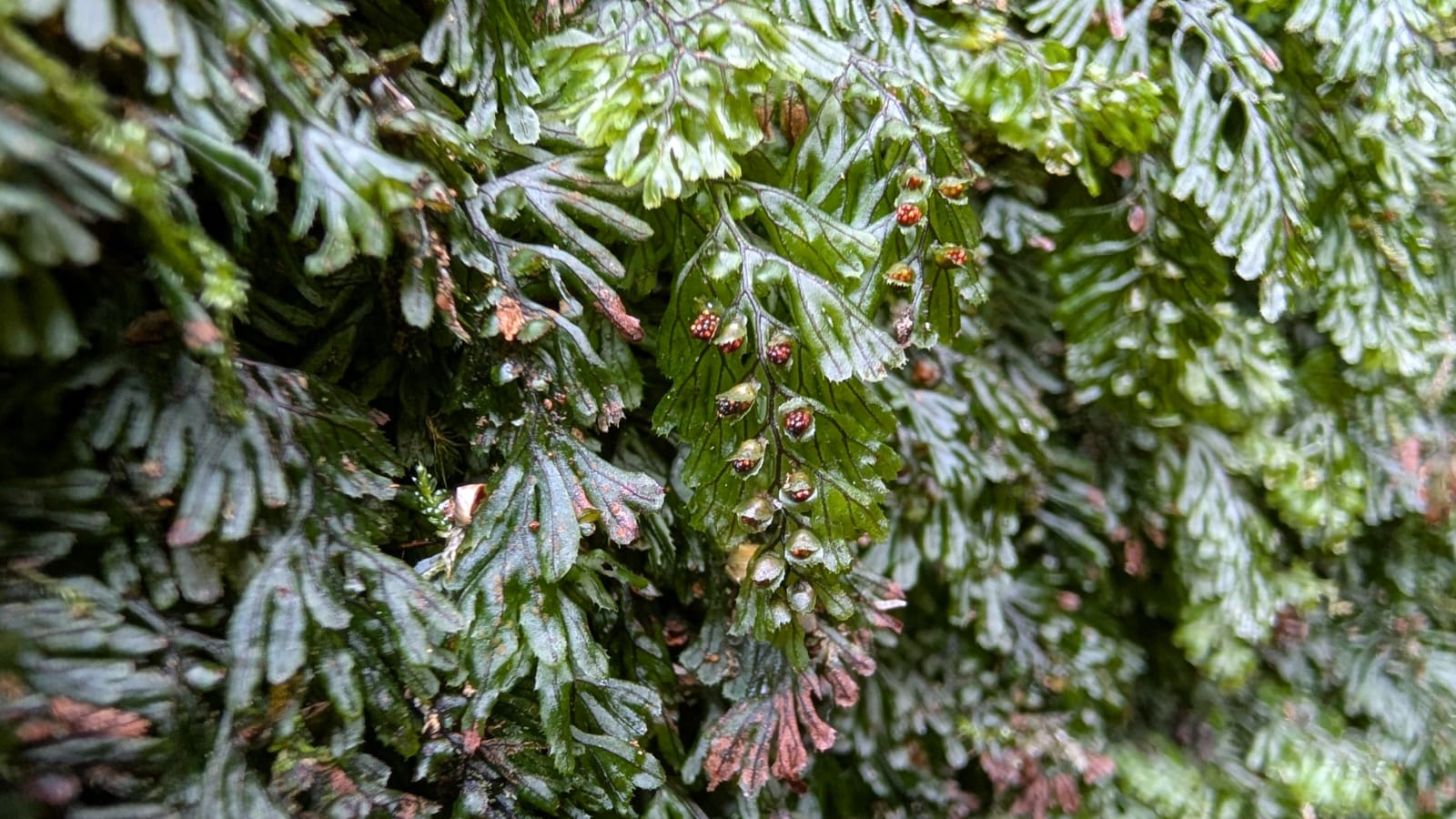
As ever with rare species, I won’t be sharing precise details. Suffice it to say that, after a little searching, we were rewarded with a thriving colony. The plants here were confirmed as Tunbridge Filmy-fern by the irregularly toothed margins of the indusia, visible in the first image below.


When we think of ferns, we tend to picture the large, arching fronds of Dryopteris, rising in characteristic shuttlecocks from the woodland floor. Tunbridge Filmy-fern could scarcely look more different. At a glance, it could easily be mistaken for a moss or liverwort and overlooked entirely.
Look closer, however, and it is unmistakably a fern, and a rather beautiful one at that. The fronds are thin and delicate, twice-divided and almost translucent, with a subtle glaucous, bluish cast. That translucence comes from their structure: each frond is just a single cell thick, giving rise to the distinctive “filmy” appearance.
It is a quietly remarkable plant and a real treat to see at long last. Another species ticked off the botanical bucket list…
Running Total
Seeing as I rarely carry a notebook, we’ll log our running total for the year here…
| #1 Wall-rue | Asplenium ruta-muraria | 16 January, Newcastle |
| #2 Maidenhair Spleenwort | Asplenium trichomanes subsp. quadrivalens | 16 January, Newcastle |
| #3 Hart’s-tongue | Asplenium scolopendrium | 16 January, Newcastle |
| #4 Black Spleenwort | Asplenium adiantum-nigrum | 16 January, Newcastle |
| #5 Broad Buckler-fern | Dryopteris dilatata | January, Newcastle |
| #6 Male-fern | Dryopteris filix-mas | January, Newcastle |
| #7 Soft Shield-fern | Polystichum setiferum | January, Newcastle |
| #8 Japanese Lace Fern | Polystichum polyblepharum | January, Newcastle |
| #9 Hard Shield-fern | Polystichum aculeatum | January, Newcastle |
| #10 Hard Fern | Blechnum spicant | January, Newcastle |
| #11 Western Scaly Male-fern | Dryopteris affinis subsp. affinis | January, Newcastle |
| #12 Borrer’s Scaly Male-fern | Dryopteris borreri | January, Newcastle |
| #13 Lady Clermont’s Spleenwort | Asplenium x clermontiae | January, Northumberland |
| #14 Rustyback | Asplenium ceterach | January, Northumberland |
| #15 N/A | Dryopteris borreri morph. robusta | February, County Durham |
| #16 N/A | Dryopteris borreri forma foliosum | February, County Durham |
| #17 Greater Scaly Male-fern | Dryopteris affinis subsp. paleaceolobata | March, Newcastle |
| #18 Tunbridge Filmy-fern | Hymenophyllum tunbrigense | March, Northumberland |




Leave a Reply