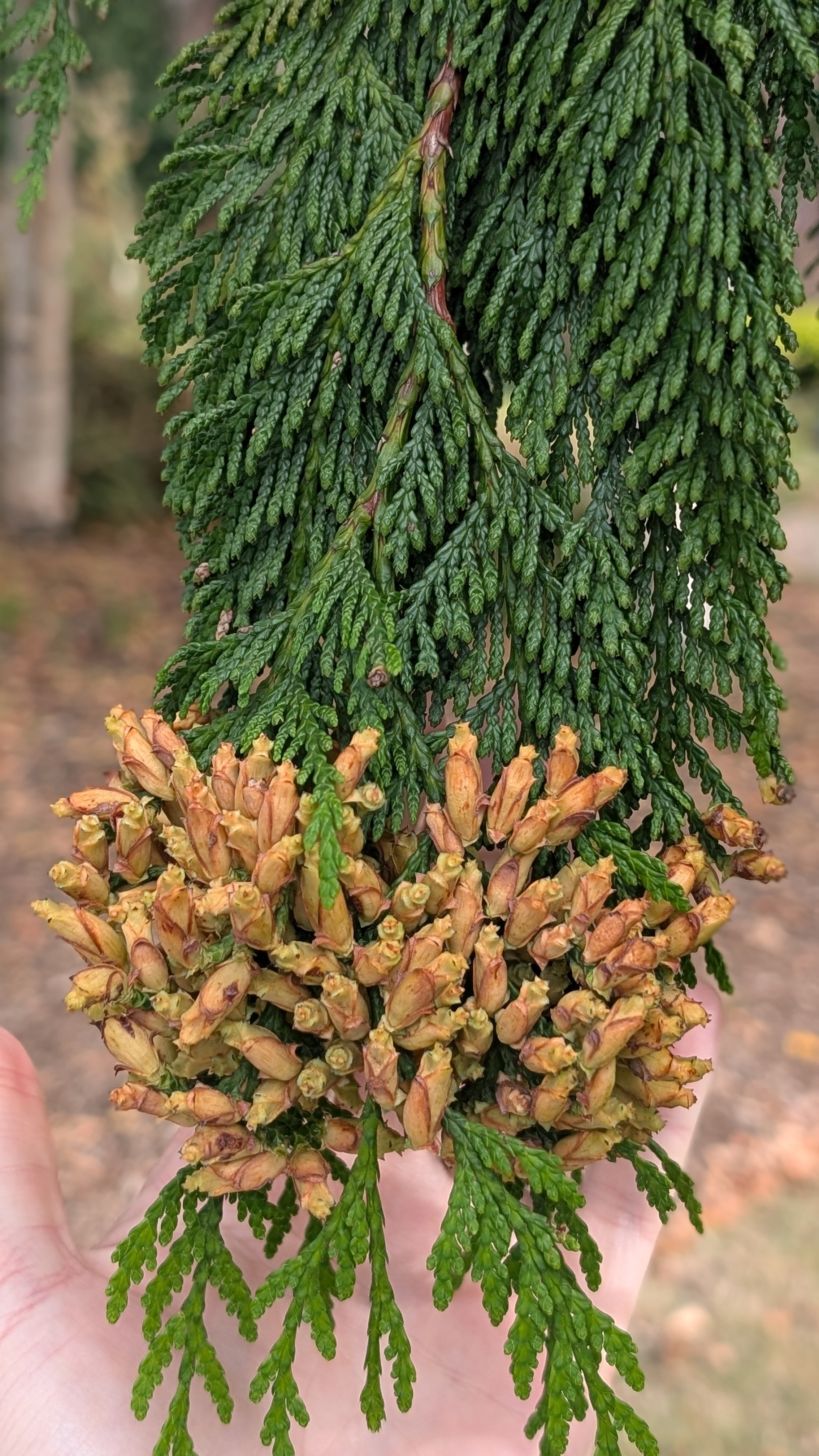
I don’t know about other botanists, but I’ve always struggled with conifer identification, especially the flat-needled, bushy ones so common in parks, gardens, arboretums, and, increasingly, the wider countryside. Historically, I may even have been guilty of adopting the rather unscientific approach of “hey, that looks like Leylandii“. How wrong I was!
Recently, I’ve been trying my utmost to improve my knowledge of this particular group. So much so, in fact, that I thought a little blog was in order.
Cypresses, red cedars, and their lookalikes are an acquired taste, with many looking remarkably similar at first glance. However, there are ways to tell them apart, and a closer look at their foliage, cones and growth habits can reveal some useful clues. This rather amateur take on conifer identification will attempt to share a few of those tips, focusing on some of the commonly planted trees you’re likely to encounter in parks, gardens and beyond. If, like me, you’re just starting with conifer identification, I hope it helps, but I will caveat this by saying that mistakes are possible.
Leyland Cypress
Cupressus x leylandii
Exceptionally common as a garden, parkland and hedging tree, Leyland Cypress has flattened sprays of foliage, which can be held upright or slightly droop from the branches. The leaves are typically green to blue-green, with a slightly glossy appearance and without narrow white seams on their undersides. Compared with Lawson’s Cypress, the foliage tends to be more tightly packed, forming somewhat three-dimensional sprays. Look closely, and you may also spot an oval resin gland on the leaves.
Female cones are rounded, measuring around 15–20 mm across, and often hang in clusters from the branches. As they mature, they split open from the centre, and the individual scales bear broad, triangular umbos, or points. These are noticeably shorter than those of Nootka Cypress, one of its parents.
Alongside Lawson’s Cypress, Leyland Cypress is probably one of the most frequently encountered members of this group.


Lawson’s Cypress
Cupressus lawsoniana
Almost as common in urban plantings as Leyland Cypress, Lawson’s Cypress is also probably the species most likely to be encountered growing in a naturalised state. At first glance, it looks similar to Leylandii.
Compared with Leyland, the foliage sprays are distinctly flattened, with the shoots and twigs arranged in a single plane. Turn a branchlet over, and you’ll find a distinctive white, X-shaped seam on the undersides of the leaves. The terminal leader, at the very top of the tree, also typically droops or nods.
The foliage can also help distinguish it from Nootka Cypress. Lawson’s has less sharply keeled scale leaves, with much more conspicuous white markings along their undersides and a more prominent resin gland. Its small, often wrinkled seed cones have only very short projections, rather than the prominent, thorn-like points of Nootka. When crushed, the foliage also releases a noticeable resinous scent.


Cultivars of Lawson’s Cypress
Just to add to the confusion, Lawson’s Cypress comes in a great many cultivated forms, some of which, in my limited experience, look very little like the typical tree. I couldn’t tell you the names of the specimens pictured below, but blue- and yellow-foliaged forms seem particularly common, while fastigiate varieties are also frequent. It’s a rather bewildering range, and certainly keeps identification interesting…


Nootka Cypress
Cupressus nootkatensis
One of the parents of Leyland Cypress, Nootka Cypress is occasionally planted as an ornamental in gardens and parkland, although it is somewhat less frequent than its relatives.
At first glance, Nootka Cypress can look remarkably similar to Lawson’s Cypress. However, there are a few useful differences to look out for. The scale leaves have a very faint resin gland, if visible at all, and usually lack the silvery-white seams found along the undersides of Lawson’s Cypress foliage. They are also more sharply keeled above and the scales more sharply pointed.
There are further differences when it comes to their cones. The pollen cones of Nootka Cypress are yellow, compared with the reddish pollen cones of Lawson’s Cypress. Their cones are helpful too: Nootka has elongated, thorn-like projections, whereas those of Lawson’s Cypress have much shorter.


Monterey Cypress
Cupressus macrocarpa
Monterey Cypress is a fairly common amenity tree and can often be spotted from a distance thanks to its broad, bushy habit. Its foliage is particularly useful for identification: the shoots are conspicuously three-dimensional, quite different to the flattened sprays seen in Lawson’s and Leyland Cypress. Crush a few branchlets, and you’ll also notice a lemon-like scent.
The seed cones are another useful feature. Relatively large, typically around 25–40 mm across, they have thick, woody scales with only weakly developed central projections.
An incredibly popular cultivar, ‘Goldcrest’ with bright, almost neon-yellow foliage, is a familiar sight in front gardens across the country. Despite looking quite different from the usual green form, it retains the same distinctive 3D foliage.


Western Red-cedar
Thuja plicata
A very common tree, particularly in ornamental plantings around churchyards and parks, Western Red-cedar is also occasionally found naturalised in plantations. It’s one of the easier members of this group to recognise, thanks in part to its distinctive seed cones, which are held in clusters towards the tips of the branches, rather than being scattered along the shoots as in many cypresses.
The foliage is another useful giveaway. The flattened sprays have glossy, dark green leaves above, while the undersides bear conspicuous white, butterfly-shaped markings. Crush a few branchlets, and you’ll also be rewarded with a sweet, pineapple-like aroma.
Separating it from Northern White-cedar is a little trickier, but take a closer look at the leaves. In Western Red-cedar, the resin glands are barely raised from the leaf surface, while the white markings on the undersides are generally much more conspicuous.


Eastern White-cedar
Thuja occidentalis
Eastern White-cedar is a fairly familiar garden conifer. The leaves are a fairly uniform yellowish-green on both sides, lacking the conspicuous white markings found beneath Western Red-cedar. If present, the resin glands in this species are far more pronounced than in T. plicata.
Crush a few branchlets, and you’ll notice a pleasant but relatively indistinct fruity scent, rather less pronounced than the pungent smell of its western relative.
There are numerous cultivated forms of Eastern White-cedar, many of which look quite different from the typical species. Indeed, I see it more as a dwarf garden shrub than I do as a full-size tree!


Hiba
Thujopsis dolabrata
Hiba is a rather lovely little tree, although only occasionally encountered in churchyards, parks and other recreational spaces. This particular specimen happens to be growing in a garden!
It’s relatively easy to recognise thanks to its broad, spreading sprays of glossy, scale-like leaves, with particularly prominent white markings on their undersides. These conspicuous white patches are unmistakable, as is the rather unusual, crocodilian appearance of the leaves, with their broad, overlapping scales.


Chinese Thuja
Platycladus orientalis
I typically encounter Chinese Thuja as a garden shrub, although it is occasionally planted in public parks. It’s particularly distinctive among the flat-foliaged conifers, with its foliage held in unusual, upright sprays rather than the more familiar horizontal or spreading arrangements. The scale-like leaves are much the same colour on both sides and, when crushed, produce no particularly noticeable scent.
The seed cones are also relatively large and worth examining. Initially blue-green and somewhat fleshy, they become woody and brown as they mature. The tips of the cone scales curl backwards, eventually opening out to form a rather attractive, star-shaped rosette.


Sawara Cypress
Chamaecyparis pisifera
Sawara Cypress isn’t a tree I seem to encounter very often, although perhaps I simply haven’t been looking hard enough. Originally from Japan, it is widely planted in churchyards, parks and other municipal spaces, with numerous cultivated forms available.
The foliage of the typical form is rather stiff and spiky compared with some of the other commonly planted cypresses, held in flattened sprays. The scale-like leaves are slightly glossy green, with narrow white markings on their undersides. The female cones are globular and relatively small, noticeably less substantial than those of Lawson’s Cypress.


Californian Incense-cedar
Calocedrus decurrens
And finally, a rather handsome tree. Californian Incense-cedar is quite distinctive, with its columnar growth habit and glossy, richly emerald-green foliage. The scale-like leaves are tightly packed into narrow strands, grouped into distinctive, flattened, fan-like sprays. Crush a few branchlets, and you’ll notice a pleasant, sweet aroma.
Its cylindrical seed cones are another useful identification feature, quite unlike the rounded cones of many other commonly planted conifers. They are particularly distinctive, with long, protruding bracts that give them a rather unusual appearance. All in all, this is a difficult tree to confuse with the other conifers featured here.


Italian Cypress
Cupressus sempervirens
Italian Cypress is best known for its tall, narrow, almost pencil-like growth habit, which has become such a familiar feature of Mediterranean landscapes. Although less frequently encountered here in the North East, it is occasionally planted in parks, gardens and churchyards.
The foliage consists of tiny, dark green, scale-like leaves, tightly packed around slender branchlets. Unlike Lawson’s and Sawara Cypress, the shoots are more three-dimensional, spreading out around the branches. The cones are particularly useful for identification: rounded, woody and relatively large, typically 2–3 cm across, with thick scales bearing small central projections.
There are several cultivated forms, although the familiar narrow, columnar variety is by far the most recognisable.


Japanese Red-cedar
Cryptomeria japonica
Japanese Red-cedar is a rather distinctive conifer, and one that shouldn’t be too easily confused with the other species featured here. Although occasionally planted in parks and larger gardens, it is perhaps more familiar as a substantial specimen in arboreta and ornamental woodland. Originally from Japan, it is a tall, elegant tree with characteristically reddish-brown bark that peels away in long, fibrous strips.
The foliage is particularly unusual, with short, sharply pointed needles arranged spirally around the shoots, giving the branchlets a rather bristly appearance. These are quite unlike the flattened, scale-like sprays of the true cedars and cypresses covered elsewhere. The seed cones are another useful feature: rounded, woody and around 1.5–2 cm across, with conspicuous scales.



Leave a Reply