Walks Through the Flora of Newcastle – Walker Riverside

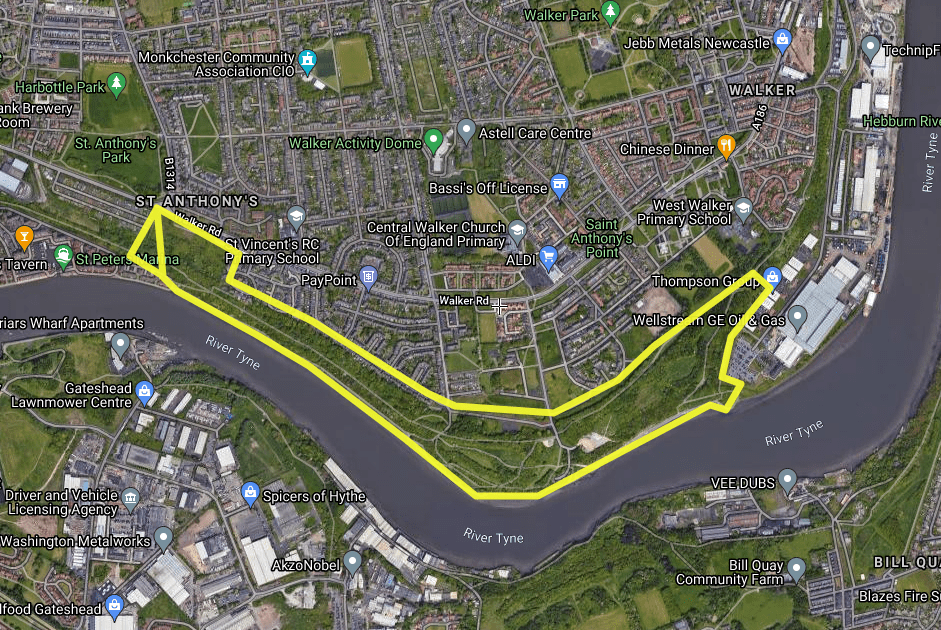
This circular walk of 3.3 miles takes around 3 hours at the height of summer when most of the interesting plants are in bloom. Meandering through several diverse, if somewhat unsightly, urban habitats, it provides a fantastic introduction to the flora of Tyneside’s brownfield and former industrial plots.

Rather unceremoniously, the route begins on Glasshouse Street (occurs.tubes.goat) outside of the Newcastle Resource Recovery Centre or tip, to use more familiar terminology. Here, you may care to explore the closely-sheered verge for Field Madder (Sherardia arvensis), Blue Fleabane (Erigeron acris) and Small-flowered Crane’s-bill (Geranium pusilum) but otherwise, head East for approximately 100m along the Hadrian’s Wall path taking care to note the variety of naturalised alien shrubs present here. Several have gone on to run amuck since their introduction in decades past.

Here, you’ll note Franchet’s Cotoneaster (Cotoneaster franchetii), Late Cotoneaster (Cotoneaster lacteus), Diel’s Cotoneaster (Cotoneaster dielsianus) and Darwin’s Barberry (Berberis darwinii), all of which are well at home along the scrubby bridleway. Before long, you’ll notice a well-trodden throughfare to your right, from which you will emerge intro a small car park on St. Lawrence Road. Seldom sprayed with herbicides, this carpark holds a notable mix of Alexanders (Smyrnium olusatrum), Viper’s-bugloss (Echium vulgare) and Common Toadflax (Linaria vulgaris). Of these, the former is notable as a relatively rare species within the city limits.

From here, cross the road to Dobson’s Crescent, following the road until you reach St. Peter’s Marina. About halfway down, you will notice yet another carpark dedicated in part to the storage of defunct boats. This unassuming patch of land is worthy of investigation as it is one of the few places you can note all three of the conurbation’s small-flowered fleabane species growing side-by-side. With ease, you should encounter Canadian Fleabane (Erigeron canadensis), Gurnsey Fleabane (Erigeron sumatrensis) and our native Blue Fleabane (Erigeron acris), alongside Narrow-leaved Ragwort (Senecio inaequidens), Atlas Poppy (Papaver atlanticum) and several other colonists.

At the marina, hug the banks of the Tyne and head East, over a wooden bridge along Hadrian’s Way. Of note here are Squirreltail Fecue (Vulpia bromoides), Water Bent (Polypogon viridis) and Glabrous Whitlowgrass (Erophila glabrescens) in paved areas, often alongside Greater Quaking-grass (Briza maxima) and Rock Crane’s-bill (Geranium macrorrhizum) that frequently escape nearby gardens.

Passing the final house on Hadrian’s Way, you will arrive on a narrow riverside path with dense scrub to your left and riverbank and eventually, the Tyne, to your right. From this point, you’ll enjoy a slow walk of approximately 0.7 miles towards Walker Riverside Park. The scrub is an interesting mix of native colonists and established relics. Of the latter, four are hard to miss with Persian Ivy (Hedera colchica), Many-flowered Rose (Rosa multiflora) and Himalayan Clematis (Clematis montana) dominant over their respective areas. The fourth, Wilson’s Honeysuckle (Lonicera nitida), is present throughout and is quickly becoming a pest. Somewhat harder to spot is the White-stemmed Bramble (Rubus cockburnianus) that persists in places.

Do not spend all your time gazing inland, however, as the tracksides and riverbanks along this stretch of the walk hold much of interest. Black Horehound (Ballota nigra), Wild Parsnip (Pastinaca sativa subsp. sylvestris) and Perennial Wall-rocket (Diplotaxis tenuifolia) are particularly prevalent along the path sides and amid the rubble strewn riverbank you’ll note plenty of naturalised Italian Alder (Alnus cordata) and coastal species such as Sea-aster (Tripolium pannonicum). But more on those seaside plants soon.

Two interesting plants that are much harder to see along this stretch are Black Spleenwort (Asplenium adiantum-nigrum), tucked away in the rubble heaps, and the hybrid horsetail, Equisetum x littorale, which can be found growing with Field Horsetail (Equisetum arvense) in select areas. Combing the riverside scrub should also produce Downy Birch (Betula pubescens) and much rarer, Spindle (Euonymus europaeus) while patches of Keeled Garlic (Allium carinatum) persist in places.

Hadrian’s Way will broaden when you reach the first of several parking bays frequented by local anglers – this marks the start of Walker Riverside Park, a sizeable area of restored brownfield managed by Urban Green Newcastle. The pavements at this point are delightfully messy and home to a great many interesting and, in some cases, rare ‘weeds’. Almost immediately, you will notice stands of Ribbed Melilot (Melilotus officinalis) and Tall Melilot (Melilotus altissimus), growing side-by-side for handy comparison; Hop Trefoil (Trifolium campestre), Great Lettuce (Lactuca virosa) and Common Mallow (Malva sylvestris).

Members of the dead-nettle family can be most diverse and in addition to the common species, one regularly finds Cut-leaved Dead-nettle (Lamium hybridum) and Henbit Dead-nettle (Lamium amplexicaule) growing amid the slabs. All of these can be noted as you continue Eastward along the Tyne; though do stop if you notice a blue flower atop the riverside wall. This will be Peached-leaved Bellflower (Campanula persicifolia) which has been established on-site for several years. 

 After around 100m (expect.stamp.plans) the path will narrow to such an extent to necessitate walking in single-file for a short distance. Along this stretch, the interesting weeds and alien shrubs continue with the addition of Red Valerian (Centranthus ruber), Willow-leaved Cotoneaster (Cotoneaster salicifolius) and Himalayan Cotoneaster (Cotoneaster simonsii). The real treat here, however, is a glimpse of the saltmarsh flora that would once have been far more widespread along the Tyne. Casting your eyes down the tidal defences you will note a clear transition from Sea-plantain (Plantago maritima) and Buck’s-horn Plantain (Plantago coronopus) in the upper reaches to Sea Aster (Tripolium pannonicum) in the splash zone and eventually Common Saltmarsh-grass (Puccinellia maritima) and the samphire lookalike, Purple Glasswort (Salicornia ramosissima) in the exposed mud. You can inspect all of these plants again on the remnants of St. Anthony’s Landing Stage further downstream (factor.reach.mice) so do not feel obliged to slide down the bank. At the stage, now well overtaken by nature, keep your eyes peeled too for Annual Sea-blite (Suaeda maritima), Hybrid Couch (Elymus x laxus) and Spear-leaved Orache (Atriplex prostrata).

After exploring the relic saltmarsh, continue Hadrian’s Way via a short flight of steps lined to each side by dense shrubbery, and plenty of established Wayfaring Tree (Viburnum lanata). Doing so, you’ll eventually emerge into an open area marked by bountiful grassland to left and again, the Tyne to your right. This is the site of the former St. Anthony’s Lead Works and is perhaps the most interesting portion of the walk.

The grassland, scrub and riverbanks here sit atop the former St. Anthony’s Quay are especially floriferous, though the origin of many species is uncertain. A seed mix was undoubtedly applied many years ago, and has introduced several curiosities, but ballast and natural colonisation may also have played a part. With ease, you will note copious Common Restharrow (Ononis repens), Wild Marjoram (Origanum vulgare), Musk-mallow (Malva moschata), Small Scabious (Scabiosa columbaria), Field Scabious (Knautia arvensis) and Chalk Knapweed (Centaurea debeauxii), all of which likely stem from strewn seed. With care, you should also pick out Lucerne (Medicago sativa subsp. sativa), Spiny Restharrow (Ononis spinosa), and Musk Thistle (Carduus nutans) while Wild Basil (Clinopodium vulgare) is increasingly common and Large-flowered Evening Primrose (Oenothera glazioviana) is a more recent colonist.

While it is possible to spend the entirely of your time along this stretch admiring the grassland, don’t – a look towards the river will not disappoint. The post-industrial banks here hold much of note including Hoary Mustard (Hirschfeldia incana), Traveller’s-joy (Clematis vitalba), Blue Fleabane (Erigeron acris), White Stonecrop (Sedum album) and Spreading Cotoneaster (Cotoneaster divaricatus). Perhaps most notable of all are healthy colonies of Flattened Meadow-grass (Poa compressa) which favours cracks and crevices in the stonework, and discrete patches of Keeled Garlic (Allium carinatum), presumably washed downstream from larger populations in Northumberland.

A final note here again centres on trees and shrubs and several of the species introduced in decades past have since gone on to seed or spread abundantly. Look out for Grey Alder (Alnus incana), False-acacia (Robinia pseudoacacia), Sea-buckthorn (Hippophae rhamnoides) and Japanese Rose (Rosa rugosa).

At this point, and you will begin the return leg of the trip. Doubling back along Hadrian’s Way you will notice a mud path (successes.shades.pretty) linking the riverside to an unexplored area up hill. Follow this and after around 40m, you will emerge into a clearing. This will instantaneously strike you as a demolition site and indeed it is with this small area of rubble and concrete representing all that remains of the lead works.  This is another highlight of the walk and holds many plants that are altogether rare in the wider conurbation. Some such as Small Scabious (Scabiosa columbaria) and Field Scabious (Knautia arvensis) may have spread from nearby seeded areas, but others are trickier to explain. On a good day in summer, you should observe the bell-shaped blooms of Clustered Bellflower (Campanula glomerata), spreading patches of Sainfoin (Onobrychis viciifolia), Quaking-grass (Briza media), Des Etang’s St. John’s-wort (Hypericum x desetangsii) and a healthy population of Yellow-wort (Blackstonia perfoliata). Wild Thyme (Thymus drucei) has also colonised areas of exposed stone and Kidney Vetch (Anthyllis vulneraria) is dominant across the whole area – a rare sight in these parts.

From this area, head West, passed some bollards intended to deter fly-tippers and out on to Pottery Bank. Attention should be paid to the small area of now rather rank grassland (yarn.hung.gladiators) immediately adjacent to the road which in past years has held both Bee Orchid (Ophrys apifera) and Pyramidal Orchid (Anacamptis pyramidalis). A little uphill, you will rejoin the Hadrian’s Wall Path which you will follow for roughly 1.5 miles back to St. Peter’s. Travelling back on this higher plane, you will find yourself surrounded by planted amenity woodland. While the canopy is uninspiring, the shrub layer is rather eclectic.

In addition to several of the cotoneasters mentioned previously, look out for Chinese Bramble (Rubus tricolor), Blue Holly (Ilex x meserveae), Box-leaved Honeysuckle (Lonicera pileata) and rampant Chenault’s Coralberry (Symphoricarpos x chenaultii). In places, ground cover is dominated by another introduction, Atlantic Ivy (Hedera hibernica) – though at least this is native – and do take heed of the small electricity substation (device.files.lifted). Here, you will encounter Newcastle’s only established population of Balkan Spurge (Euphorbia oblongata). Eventually, you will emerge by the tip where you began your journey.

Other interesting plants to look for along the way…

Fern-grass (Catapodium rigidum), Field Bindweed (Convolvulus arvensis), Swedish Cotoneaster (Cotoneaster x suecicus), Borrer’s Male-fern (Dryopteris borreri), Sheep’s-fescue (Festuca ovina), Meadow Crane’s-bill (Geranium pratense), Slender St. John’s-wort (Hypericum pulchrum), Wild Privet (Ligustrum vulgare), Hoary Ragwort (Jacobaea erucifolia), Salad Burnet (Poterium sanguisorba subsp. sanguisorba), Horse-radish (Armoracia rusticana), Green Field-speedwell (Veronica agrestis) and Hybrid Alder (Alnus x hybrida).

Weekend Botany at Walker

This weekend provided a nice opportunity for our new local botany group to visit Walker Riverside. Here’s what we encountered.

Botany (and wildlife recording in general) can often be a solitary affair. For many of us, I suspect, myself included, that suits us just fine. At least most of the time. Sometimes, however, it is nice to do things as a group. Not least only for the company but also for the support and increased brainpower that comes with combining noggins!

It is for the reasons listed above that a few friends and I wanted to get the ball rolling on a new informal group for botanists North of the Tyne. Both to make things a little more social and support one another and to ensure that we’re working with local experts to capture important plant records. I am pleased to say that this weekend, this came to fruition with our merry band meeting for the first time at Walker Riverside in Newcastle.

As you’ll see from the photos below, we had a jolly good day and learned a lot. A big thank you to those who came along! Now, what about the plants?

Walker is a very diverse site I have written about several times. What never fails to surprise here is the tendency for it to throw up new and unusual discoveries, several of which were made during our visit. Atlantic Ivy (Hedera hibernica) was a particularly interesting one and nice to compare with some nearby Common Ivy (Hedera helix) and Persian Ivy (Hedera colchica). Megs Rogers, VCR for South Northumberland, also came up trumps with a candidate for Small Gorse (Ulex minor) and last month’s county first Balkan Spurge (Euphorbia oblongata) was also admired. The latter ID may well change now someone more knowledgeable than I has taken a look…

As a group, we also noted several other interesting plants between St. Peter’s Basin and Walker Riverside Park. Clustered Bellflower (Campanula glomerata) was still in bloom, as was Cut-leaved Dead-nettle (Lamium hybridum) and Green Field-speedwell (Veronica agrestis). Alexanders (Smyrnium olusatrum) was a nice find on the cycleway, and rare locally, and it was nice to note Blue Fleabane (Erigeron acer) still clinging on. A few other finds are mentioned alongside some excellent photography in Ho-Yin Wong’s tweet below.

Adventives and Invaders at Walker Riverside

A short round-up of a glorious Saturday morning spent botanising one of my favourite local sites.

It is no secret that I am a big fan of the messy, post-industrial yet incredibly diverse riverside park at Walker. Visiting for a few years now, I’ve already amassed a fairly respectable plant list for the site yet somehow, each visit continues to turn up something new. Things were no different on a visit this weekend with local botanist, Ho-Yin Wong.

Heading first for the marina at St. Peter’s Basin and it wasn’t long before colossal fleabane caught my eye growing in no-mans-land by the side of the road. Up here, Canadian Fleabane (Erigeron canadensis) tends to be the common species, so much so that I often walk past them without checking. That’ll teach me, this one turned out to be Gurnsey Fleabane (Erigeron sumatrensis) identified by its hairy phyllaries.

Reaching the basin itself, it was pleasing to see that the various areas of pavement and wasteground here had not been ‘tidied’ as so many places around here often are. Lots more Guernsey Fleabane was found, alongside two more invaders: Russian Vine (Fallopia baldschuanica) and Narrow-leaved Ragwort (Senecio inaequidens).

Rummaging around further, Canadian Fleabane (with glabrous phillaries) was eventually observed, alongside Oxford Ragwort (Senecio squalidus) with its conspicuous black bracts. As for the highlight among the native species, it was nice to catch Small-flowered Crane’s-bill (Geranium pusillum) still in bloom.

Making our way down to the track that runs along the North bank of the Tyne, the usual riverside flora remained conspicuous. Here, Black Horehound (Balotta nigra) remained in flower and several self-sown Italian Alder (Alnus cordata) were seen. Much more interesting, however, were two new additions to the ‘Walker list’ in Alexanders (Smyrnium olusatrum) and better still, White-stemmed Bramble (Rubus cockburnianus). The latter a Chinese endemic long known from the riverside here yet annoyingly, one which I have struggled to find, until now.

Moving on to the site of the old tar works and a real hotchpotch of interesting plants appeared in quick succession. Clustered Bellflower (Campanula glomerata) remained in bloom, as did Wild Thyme (Thymus drucei), though sadly, the same could not be said for the Sainfoin (Onobrychis viciifolia) which grows here too. The Nasturtiums (Tropaeolum majus) dumped on site last summer also appear to be thriving, much to my surprise, and it was interesting to note Grey Alder (Alnus incana). Slightly further on we also encountered Hoary Ragwort (Jacobaea erucifolia).

Back down by the riverside and it was exciting to record both Hoary Mustard (Hirschfeldia incana) and Flattened Meadow Grass (Poa compressa) – both scarce species locally. As a matter of fact, it was thanks to the aforementioned grass that we chanced upon what would turn out to be the highlight of the day – a great clump of Blue Fleabane (Erigeron acris). More on that one in an upcoming post.

Soon it was head off, though not before a quick excursion along the wooded cycleway further up the bank. Here, Chinese Bramble (Rubus tricolor) was a bit of a curiosity as was what I think is Box-leaved Honeysuckle (Lonicera pileata). Having watched it with frustration for two years now, I was also happy to make some headway with the ‘unusual’ spurge that grows here. Looking closer, it appears this might be Balkan Spurge (Euphorbia oblongata), identification made easier by the presence of fruit on this occasion.

The flora of Walker Riverside

Walker Riverside Park is a funny old place. Created in the 1980s, it sits atop former industrial land and boasts an intriguing mix of habitats, from grassland and woodland areas to salt-strewn riverbanks and disused industrial plots. Overgrown, tangled and messy in places, the species mix here suggests the site was once tended, though now, ornamentals have merged with native flora to create a really interesting site. Truthfully, it doesn’t resemble a park at all.

This year, I have been making a concerted effort to record as many plants as possible here, focusing on plants growing in a wild or naturalised state. Plants that have been planted have been ignored, though long-established street trees and hedgerow plants have been recorded per guidance from the BSBI.

Slightly more challenging in scope than Iris Brickfield covered previously, the list below is almost certainly missing several species. I have not yet brought myself to look at grasses and yellow composites, and there are certainly other shrubs and saline-loving species to be discovered. Still, I hope this post gives a flavour of what you might encounter when visiting this rough and ready but highly interesting city reserve.

All records will (or have already been) submitted to BSBI recorders through iRecord.

Species list

In total, I have recorded 190 plant species in the park. A good count but almost certainly an understatement. Given the mix of habitats here, I wouldn’t be surprised if the actual number was closer to 250.

For the sake of simplicity, I have not broken this down into grid squares or habitats on this occasion but have aimed to indicate as to whether a particular species is historically planted or not. I have also aimed to highlight species brought to the site via seed mixes designed to boost butterfly numbers on site.

The full species list can be viewed below.

Trees at Walker Riverside

The trees of Walker Riverside are reasonably diverse. Native species including Ash (Fraxinus excelsior), English Oak (Quercus robur) and Field Maple (Acer campestre) are common and Aspen (Populus tremuloides) and White Poplar (Populus alba) exist in smaller patches across the site. Both Swedish Whitebeam (Sorbus intermedia) and Common Whitebeam (Sorbus aria) exist as relics of historic planting and in places, a good number of willow species can be seen. Among these, White Willow (Salix alba), Grey Willow (Salix cinerea) and Goat Willow (Salix caprea).

Slightly more unusual trees include False Acacia (Robinia pseudoacacia), Turkey Oak (Quercus cerris) and what I think might be Hybrid Black Poplar (Populus × canadensis), while the site provides a nice opportunity to compare alder species with Grey Alder (Alnus incana), Common Alder (Alnus glutinosa) and Italian Alder (Alnus cordata) all present. The latter clearly spreading along the riverbanks.

Perhaps most unusual of all is the presence of an American species, the Red Oak (Quercus rubra); though Sweet Chestnut (Castanea sativa) is another species seldom encountered in the local area.

Red Oak , Quercus rubra
Grey Alder, Alnus incana

Shrubs and climbers

The shrubs occupying the understory of the park are an interesting bunch and many formerly planted species seem to be spreading. Among these, the two most prominent are Wilson’s Honeysuckle (Lonicera nitida), Snowberry (Symphoricarpos albus) and Coralberry (Symphoricarpos orbiculatus). The same likely applies to various species of cotoneaster present on site but alas, the only one I can identify with any confidence is Willow-leaved Cotoneaster (Cotoneaster salicifolius).

By the river, Shrub Ragwort (Brachyglottis x jubar) appears to have escaped what was likely a former flowerbed and is slowly spreading and Japanese Rose (Rosa rugosa) has a habit of popping up in odd places.

Elsewhere, more familiar species include Guelder Rose (Viburnum opulus), Privet (Ligustrum vulgare), Dogwood (Cornus sanguinea), Sea Buckthorn (Hippophae rhamnoides) and plenty of Broom (Cytisus scoparius). The riverbanks here are also a great place to see Wayfaring Tree (Viburnum lantana) and odd shrubs dotted around the site include both Darwin’s Barberry (Berberis darwinii) and Chinese Barberry (Berberis julianae).

As for climbers, Russian Vine (Fallopia baldschuanica) can be found in a single spot and, by the river, a garden variety of clematis (Clematis sp.) appears to be running amock. While the brambles on-site were impossible to identify, the great, thick stems of Armenian Blackberry (Rubus armeniacus) are conspicuous in places.

Darwin’s Barberry, Berberis darwinii
Wayfaring Tree, Viburnum lantana

Grasslands

The grassland areas of Walker can be split roughly into two types: seeded and seemingly natural. The seeded areas contain several interesting species including Musk Mallow (Malva moschata), Lucerne (Medicago sativa), Greater Knapweed (Centaurea scabiosa), Wild Basil (Clinopodium vulgare) and both Small Scabious (Scabiosa columbaria) and Field Scabious (Knautia arvensis). Common Restharrow (Ononis repens) is plentiful here too and Spiny Restharrow (Ononis spinosa) has a toehold.

Where the boundaries between sown and natural become a little fuzzy, Wild Carrot (Daucus carota) and Salad Burnet (Sanguisorba minor) are especially numerous and plenty of Wild Teasel (Dipsacus fullonum) and Perennial Wall-rocket (Diplotaxis tenuifolia) can be seen.

More natural-looking grassland areas at Walker hold Meadow Crane’s-bill (Geranium pratense), Wild Mignonette (Reseda lutea) and Wild Parsnip (Pastinaca sativa), among others.

Non-natives and adventives

Besides the shrubs and climbers mentioned previously, I am yet to stumble across any of the really obvious non-natives. Michaelmas Daisy (Aster agg.) can be found from time to time along the river and a small patch of what I think is Common Evening Primrose (Oenothera biennis) can be seen. Hybrid Bluebells (Hyacinthoides x massartiana) can be found in a few spots and a single patch of Horseradish (Armoracia rusticana) exists close to the boundary with Walker itself.

These aside, the usual array of globetrotters can be seen, including Oxford Ragwort (Senecio squalidus), Red Valarian (Centranthus ruber), Canadian Fleabane (Erigeron canadensis) and of course, Butterfly Bush (Buddleja davidii).

Abandoned industrial plot

At the centre of the site, an interesting former industrial plot can be seen. With lots of exposed concrete, rubble mounds and some seriously shallow soil, this plays host to a number of species absent from the wider site. To date, this is the only place in Newcastle where I have observed Sainfoin (Onobrychis viciifolia) and Clustered Bellflower (Campanula glomerata).

Here too, large expanses of Kidney Vetch (Anthyllis vulneraria) can be seen and lurking atop the crumbling concrete, Wild Thyme (Thymus drucei) was a surprising addition.

Riverbanks and rocky places

The rocky walls that line the river at Walker are largely dominated by a mix of common and widespread species, with a few exceptions. Peached-leaved Bellflower (Campanula persicifolia) was an odd addition here earlier in the year and Black Horehound (Ballota nigra) can be seen in a few patches.

A major exception to this rule comes where what I assume was once some sort of boating ramp allows usually coastal species to grow in close proximity to the salty waters of the Tyne. Here, Buck’s-horn Plantain (Plantago coronopus) and Sea Plantain (Plantago maritime) can be seen, as can Annual Sea-blite (Suaeda maritima). Sea Aster (Tripolium pannonicum) is another nice addition while in places, at least one Glasswort (Salicornia sp.) species can be seen.

Pavement cracks in the car parks and along the main footpath are worthy of investigation too and include species such as Henbit Dead-nettle (Lamium amplexicaule) and plenty of Common Mallow (Malva sylvestris). These areas can occasionally throw up something interesting too with Great Lettuce (Lactuca virosa) and Beaked Hawk’s-beard (Crepis vesicaria) being two recent additions.

Notable and unusual

While plants such as Sainfoin and Clustered Bellflower are scarce in the North East, their suspect origins mean I have not included them here. Instead, two other species have made the cut, both found growing in pavement cracks along the main riverside walkway.

The first, Cut-leaved Dead-nettle (Lamium hybridum)has very few records in VC67 and made for a nice surprise earlier in the year. This species is almost certainly under-recorded, however.

The second, Musk Thistle (Carduus nutans), is another scarce species in the region and with its distinctive, nodding flowerheads is a real delight to see come summer.

Wildlife at Walker Riverside

Of all of the places I regularly visit in Newcastle, Walker riverside has to be my favourite. Owing to a mix of abdanonment and neglect, it just about the most diverse local site I know of for plants and insects, and is well worth a visit if you’re able to look past the disgarded beer bottles and other unsavory items.

Heading to Walker last Thursday morning, a four-hour rummage on the South-facing banks of the Tyne yielded a number of interesting sightings – the riverside (seeded) meadows and forgotton corners alive with wildflowers.

Starting out to the West, and I was immediately struck by the abundance of Common Mallow in bloom along the riverbanks, pink flowers mixing nicely with the similarly abundant blooms of Oxford Ragwort and Purple Toadflax – both attractive non-natives. It was nice to find a new stand of Black Horehound in flower here too, and attention turned breifly to the trees here with Italian Alder and Wayfaring Tree both notable on the river banks.

Further along, towards the carpark, Hedgerow Crane’s-bill and Common Toadflax were observed too. The highlight here, however, was surely a rather striking bellflower found growing in the stone walls that line the riverbank. This was later revealed to be Peach-leaved Bellflower, a new species for me.

Walking East along the Tyne, you soon come to a striking stretch of riverside grassland adorning the former site of the St. Anthony’s Tar Works. Seeded at some point in the past to aid in it’s restoration, this particular stretch is incredibly diverse and never fails to reveal something new.

The plant community here is dominated by a number of particularly abundant species including Wild Carrot, Common Restharrow, Common Knapweed, Birds’-foot Trefoil and Wild Mignonette but look closer, and a host of other species reveal themselves. Today, interesting discoveries included Musk Mallow, Small Scabious, Field Bindweed and Lucerne. The small expanse of Greater Knapweed discovered last year was also in ful bloom, though I failed to find the Wild Basil noted previously.

With so many wildflowers in full bloom, insects were incredibly numerous. Ringlet and Meadow Brown represented the most numerous butterflies, closely followed by Small Skipper and Common Blue, while freshly emerged Six-spot Burnets were plentiful and myriad unidentified grasshoppers lept from the vegatation. Slightly more surprising, a beautiful Broad-bordered Yellow Underwing was observed roosting on the underside of an Aspen leaf.

Bumblebees were too numerous to count here, the bulk of these comprising Common Carder, White-tailed, Buff-tailed and Red-tailed, with a few Early Bumblebees thrown in for good measure. A fleeting glimpse of what was likely a male Red-tailed Cuckoo Bee was exciting; though I was unable to get any closer. Whereas the mining bees abundant here in May have now vanished, they have been replaced with leafcutters. Patchwork Leafcutter Bee was spotted first, followed by six female Willughby’s Leafcutter Bee feeding on restharrow. A male Fork-tailed Flower Bee whizzed past breifly and a small bee potted on Wild Carrot was likely a male Orange-legged Furrow Bee.

Set back slightly from the river and connected by a steep muddy path, a small area of wasteground marks the site of what was likely a former building. Despite being used (frequently, it would seem) as a site at which to dump unwanted waste, it does make for an interesting pitstop.

Here, Kidney-vetch was incredibly numerous and was popular with the local bees. More interesting discoveries included farely large areas of Sainfoin and mutilple plants of Clustered Bellflower. Both plants I’d never seen before. A slightly surprise came from a rather large patch of garden Nasturtiums – clearly having thrived after being turfed out in someone’s garden waste.

Here too, small patches of Wild Thyme clung to rubble heaps and Slender St. John’s-wort was also observed. Small Tortoiseshell and Speckled Wood were noted too, whereas just across the road, another area of grassland turned up Field Scabious and Meadow Crane’s-bill. The former of which appeared popular with the Narrow-bordered Five-spot Burnets which, like their six-spotted cousins, were out in force during the visit.