A few weeks ago, I had the pleasure of delivering my first ever talk to a room full of botanists (eek!) at the BSBI British and Irish Botanical Conference in Newcastle. The subject? Our fantastic urban flora, of course, and specifically, my findings so far while recording for what I am loosely coining ‘The Plants of Newcastle’.
All in all, it was lovely (if tad scary) to share my work recording Newcastle’s urban plants with around 200 delegrates. Due to some technical issues on the day, live recording was not possible but thankfully a digital recording is now available on the BSBI YouTube channel. Do check it out below if of interest.
I’ll be using the winter to carry out a few more surveys as part of the flora, and to start writing. I hope I’ll be able to share a finished product with you in due course.
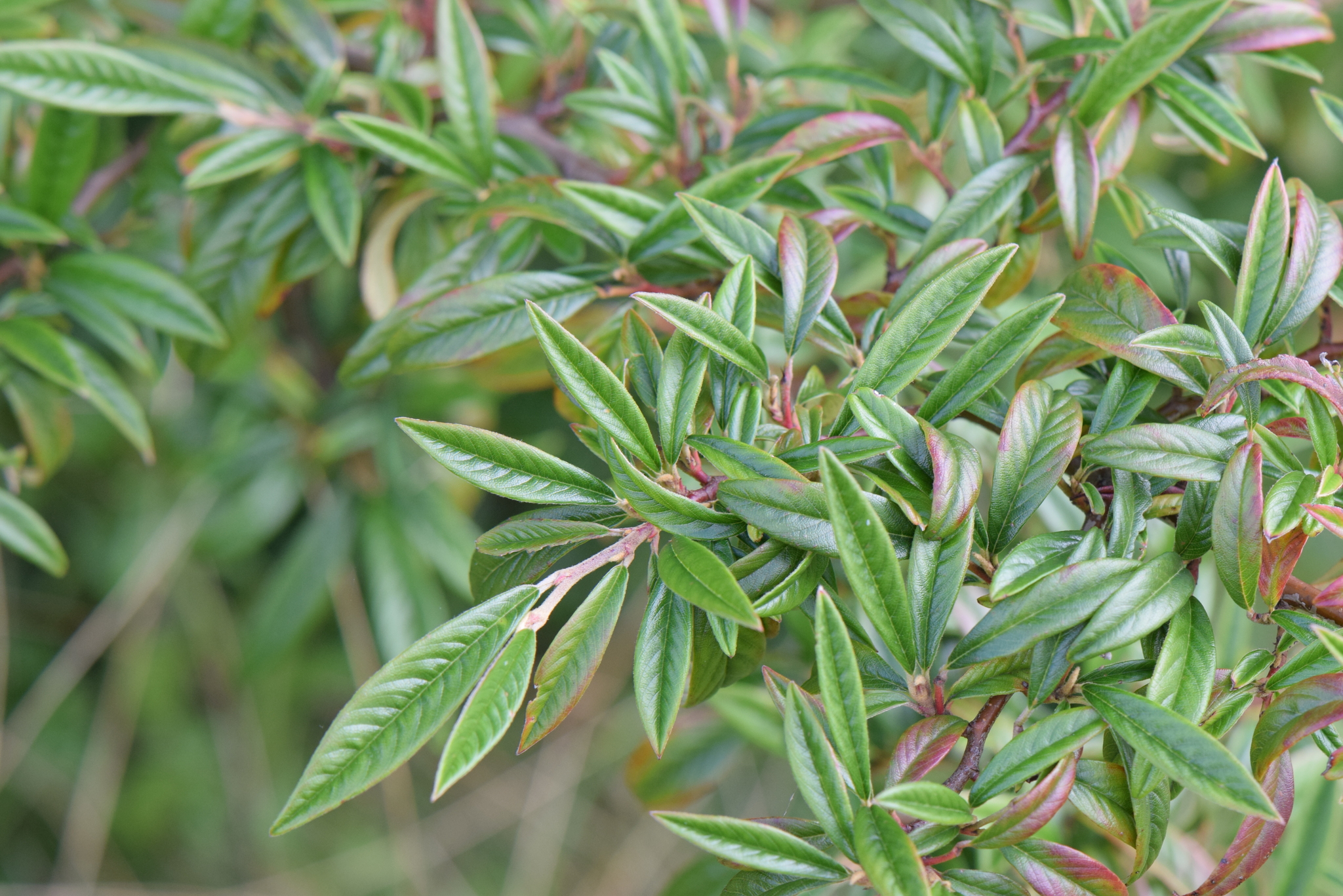
Cotoneaster salicifolius forms a few-stemmed, tree-like shrub to a maximum of 6-8 metres. Named for its willow-like leaves, it is native to South and central China where it inhabits mountainous areas and mixed forests but has been widely introduced across the globe as an ornamental plant on account of its attractive foliage and fruits. The type specimen was collected in 1869 by A. David and first published in 1888.
The status of Cotoneaster salicifolius in cultivation remains somewhat unclear. Some sources state that the species is popular in cultivation (1) while others claim that true C. salicifolius is in fact rare in horticulture and perhaps confused with the very similar Cotoneaster flocossus (2). However, Fryer and Hylmo (2009) suggest that the name C. flocossus is often erroneously applied to specimens of C. salicifolius, meaning that the plants grown in gardens and as components of amenity planting schemes are indeed the true species (3).
Cotoneaster salicifolius is widely naturalised outside of its native range, largely as a bird-sown alien. This includes much of Western and central Europe, parts of Scandinavia and areas of North America. In Britain, it is one of our more widespread naturalised cotoneasters.
In my experience of C. salicifolius, it is almost always found in dry, stony and sunny habitats, usually atop calcareous substrates. Typically, this includes walls, pavement cracks, post-industrial areas, rail sidings and riverside masonry. It is also known from woodland, scrub, dunes and hedgerows.
Identifying Cotoneaster salicifolius
Cotoneaster salicifolius and indeed, other cotoneasters within the Salicifolii Series differ from other species in having elongate, lanceolate leaves with veins which are often deeply impressed. In some cases, the leaf undersides are also hairy. They tend to form mid-sized shrubs to small trees and typically, possess erect branches with branchlets that are mostly villous-strigose. Glabrous petals and nutlets ranging in number from 2-4 are also a good indicator (3).
C. salicifolius itself typically forms a large shrub or small tree. It sports evergreen, coriaceous leaves which are distinctly lanceolate, and measure 4o-90 x 13-23mm. The upper leaf surface is noticeably rugose, dark green and shiny, and initially at least, tends to be sparsely pilose. The number of veins (covered below) may also be useful. The lower leaf surface tends to be greyish-green and densely villous at first; though these hairs wear off in time.
This species sports large and attractive flower clusters, sporting 10-50 individual flowers. Individual flowers measure 5-6mm and possess white, glabrous petals. The fruits of C. salicifolius are globose, measure 5-7mm and are bright red and sparsely pilose. Inside, the number of nutlets is typically 2 but may number 4-5 on occasion. For more detailed notes, please see Fryer & Hylmö (2009).
While C. salicifolius is distinguished from most other naturalised cotoneasters on account of its lanceolate, willow-like leaves, it does resemble several other closely related species. The shiny upper-leaf surface is a good separating factor here but to be sure, other features should be examined. Included below are comparisons between this species and several others known to occur in the UK.
Willow-leaved Cotoneaser may also closely resemble the cultivated hybrid, Cotoneaster x watereri. A cross between C. salicifolius and the Tree Cotoneaster (Cotoneaster frigidus), this one readily escapes and is equally as likely to turn up in a naturalised state. A handy comparison of the two can be found here thus there is little point duplicating this here but it may be useful to note that C x watereri is the one more likely to be found in shade.
C. salicifolius is one of the more widespread naturalised cotoneasters in the UK; particularly so in England where it can be found nationwide with noticeable clusters around urban centres. It is scarcer in Scotland but again, is plentiful in urban areas of the central belt. It was first recorded in the wild in 1966 from North Hampshire (4). For more information, see here.
References
Dickoré, W.B. & Kasperek, G. (2010). Species of Cotoneaster (Rosaceae, Maloideae) indigenous to, naturalising or commonly cultivated in Central Europe. Willdenowia 40: 13-45
Verloove, Filip. (2014). Het genus Cotoneaster in België. Dumortiera. 103. 3-29.
Fryer, J.; Hylmö, B. (2009). Cotoneasters: a comprehensive guide to shrubs for flowers, fruit, and foliage. Timber Press, Portland.
Cotoneaster salicifolius Franch. in BSBI Online Plant Atlas 2020, eds P.A. Stroh, T. A. Humphrey, R.J. Burkmar, O.L. Pescott, D.B. Roy, & K.J. Walker. https://plantatlas2020.org/atlas/2cd4p9h.pw4 [Accessed 29/10/2023]
Take a closer look at the coastal plants or halophytes spreading along roadsides to colonise the city.
The term ‘halophyte’ refers to a plant tolerant of higher than usual salt levels. Typically, this means coastal plants that are regularly exposed to sea spray, submersion by saline water or soils saturated with salt.
As you might imagine, the distribution of these hardy plants would once have been limited to salt marsh, cliffs and other habitats by the sea though now, this is changing. Owing to the large quantities of salt spread to ward off ice along our roads, several of these typically coastal plants have now made the jump inland to occupy inhospitable margins of roads in our towns and cities.
While recording for ‘The Plants of Newcastle‘ it has become increasingly clear that our urban halophytes are not restricted to the few familiar species so many of us encounter on a daily basis. In this blog, I thought we’d take a closer look at some of the most frequent.
Buck’s-horn Plantain (Plantago coronopus)
A perennial of short-cropped often trambled habitats, Buck’s-horn Plantain has historically been associated with two distinct habitats. It occurs widely around Britain’s coastline where it inhabits sea walls, dunes and shingle but is also known from heathland and other inland habitats in the South. In Northern England, it is very much a coastal plant but now, is occurring more widely as a colonist of urban habitats close to roads.
Across Newcastle, I am now seeing this plant pop up on roadside verges close to major transport links, typically where grassy areas are subject to regular mowing. It is most often encountered on the margins of such places where dominant grasses have been killed off by regular salting.
Buck’s-horn Plantain is best identified by its distinctive rosettes of lanceolate, lobed leaves.
The aptly named Sea Plantain is another typically coastal species. Here, you’ll most often spot it on the upper reaches of salt marsh, atop sea walls or strewn across shingle beaches. It also occurs in upland areas of Scotland and Northern England where it inhabits species-rich pasture and streambanks. Traditionally, it was absent from much of the lowlands but this again is changing.
Like Buck’s-horn Plantain, this one does well on short-cropped grassy verges regularly exposed to salt kicked up by passing vehicles. Locally, it remains scarcer than the former species but in Newcastle at least, is showing signs of colonisation in several areas including Gosforth and Heaton, typically a stone’s throw from major roads.
Sea Plantain can be separated from other plantago species by its long, smooth strap-like leaves.
An annual grass of dry, bare places by the sea, Sea Fern-grass is a pretty scarce plant in North East England, even on the coast. Like the other plants on this list, however, across the UK it appears to be colonising inland sites along salt-treated roads, particularly in Southern England.
In Newcastle, a sizeable population of this coastal grass can be found on the concrete sidings of the aptly named Coast Road in Heaton, as well is in nearby pavements and the bare margins of grass verges. Due to the similarities between this and Catapodium rigidum, it may well be under-recorded and is one worth searching for while botanising the city.
Sea Fern-grass can be separated from the far commoner Fern-grass (Catapodium rigidum) by its larger spikelets.
Another coastal grass and one which is rapidly colonising our urban spaces. As its name suggests, Reflexed Saltmarsh-grass is most commonly encountered in muddy habitats on the coast, typically on the upper edges of saltmarsh. Inland, it favours stonework, pavements and areas of heavy soil close to salt-treated roads.
In Newcastle, at least, this is one of the more abundant halophytes and can be found right across the city, typically along major roads which are subject to the most intensive treatment in winter.
Interestingly, a close relative, Common Saltmarsh-grass (Puccinellia maritima), remains largely restricted to coastal habitats, both here and further afield across the UK. I wonder why?
A rather beautiful member of the daisy family, Sea-aster is most commonly associated with grazed salt marshes and coastal creeks. It is known to be reluctant to spread inland via salt-treated roads but has been observed to do so in isolated parts of the country.
Locally, I have observed this plant growing in gutters and roadside depressions close to busy main roads, presumably where water saturated with salt gathers for extended periods of time. It is far from the commonest halophyte in the city but does pop up from time to time, though seldom in large quantities.
Vying with Danish Scurvygrass for the title of our commonest urban halophyte, Lesser Sea-spurrey is an incredibly common sight in urban pavements, roadsides and verges. A sprawling plant with attractive pink and white flowers, it would once have been associated solely with muddy shingles and grassland by the sea.
In Newcastle, this one can occur almost anywhere. The greatest concentrations are likely to be spotted along roads but I have also observed in alleys, side streets, garden walls and occasionally, on driveways – presumably where residents apply salt.
Of all the coastal plants on the march in our towns and cities, this one has undergone perhaps the most remarkable expansion over recent years.
The standout urban halophyte and a plant which needs very little introduction, Danish Scurvygrass has undergone a remarkable expansion since the 1970s to colonise most towns and cities across the UK.
A member of the cabbage family with chubby, heart-shaped leaves and attractive lilac flowers, this plant flowers from February onwards adding a touch of colour to pavements and roadsides at a time when little else is in bloom.
Hinted at in its name, Danish Scurvygrass, alongside Common Scurvygrass (Cochlearia officinalis), was once used to prevent scurvy aboard ships due to its high Vitamin C content.
Historically a plant of beaches, shingle and saltmarshes, Spear-leaved Orache is now a very common sight inland. For quite some time, it has occurred as a ‘weed’ of agricultural land, refuse tips and wasteground plots but in recent years has also spread along our urban roadsides.
A tad more abundant than another orache featured later in this list, this one is still very much in the process of colonising our cities. Data from the BSBI now shows it occurring in almost all 10km squares across England, with notable increases in Ireland and Wales.
In Newcastle, Spear-leaved Orache is a prominent sight in gutters and concrete sidings within the ‘spray zone’ of most major roads.
A second orache now and one which is rapidly colonising a plethora of urban habitats both in Newcastle and further afield.
With distinctive, slender leaves, Grass-leaved Orache is one Atriplex that shouldn’t confuse passing botanists and typically inhabits silty habitats by the sea. Like the others on this list, it is increasing inland most notably along our roads. This spread has been most pronounced since the 1980s and now, it is a fairly common sight in urban areas; though in in experience, it remains scarcer than the aforementioned Spear-leaved Orache.
A rarer one now and a plant which remains very scarce indeed in urban habitats. So much so that it barely warrants inclusion on this list!
Annual Sea-blite is a succulent plant typically encountered in the upper and middle zones of salt marshes. It seldom occurs inland and unlike the other halophytes on this list, is reluctant to colonise salt-treated roadsides. That said, it does occur in the city.
While recording for the Plants of Newcastle I was genuinely surprised to encounter S. maritima in walls and stonework at several points along the River Tyne. Most notably on the Newcastle/Gateshead Quayside. Now, the Tyne remains fairly saline here so perhaps this should come as little surprise but it is included nevertheless due to its occurrence some distance from ‘typical’ habitat. Indeed, where I have observed it, it has been growing well out of reach of the Tyne’s saline waters. I do wonder if it may appear at further sites in the near future.
Just for fun, take a quick look at 10 urban plants currently on the increase across Newcastle-upon-Tyne.
Our urban habitats are dynamic ones and when it comes to wildlife, things are always changing. This is perhaps most obvious in our wild and naturalised plants as new species arrive, others decline and our alteration of the landscape provides new opportunities for colonisation. While recording for ‘The Plants of Newcastle‘, it is becoming increasingly clear to me that certain plants are doing far better than others, and for a variety of reasons. Many of these are non-natives (neophytes) perfectly suited to the urban environment, while others are a tad more surprising. Just for fun, I thought we would take a look at ten of the most obvious examples here.
Guernsey Fleabane (Erigeron sumatrensis)
A tall, annual herb of well-drained, disturbed soils in gardens, along roadsides and in paved areas, this conspicuous plant is doing really well at present. A native of South America, it was first recorded in the UK from Guernsey in 1961 and has since spread across much of Southern England. Currently marching North, it is now fairly widespread in areas of the midlands and along the West coast but until recently, was rather rare this far North. This now appears to be changing and, since the first Newcastle record in 2009, appears to be expanding rapidly.
So far, I have observed Guernsey Fleabane from several city centre squares, as well as multiple suburban areas. In places such as Heaton and Walker, it even appears to be overtaking Canadian Fleabane (Erigeron canadensis) as the most numerous small-flowered species present.
Like Canadian Fleabane, Guernsey Fleabane has very small seeds which as easily dispered on the wind. If trends in the South are anything to go by, I suspect it will go on to become one of our most familiar urban plants.
First recorded in Newcastle in 2012 by Quentin Groom, Narrow-leaved Ragwort shares a similar story to Guernsey Fleabane. First recorded on our shores in 1836, for a long time, this attractive plant remained a scarce casual occurring as a contaminant of wool shoddy. Since 1999, however, it has rapidly expanded along transport links (much like the story of Oxford Ragwort) and is now a familiar sight across much of Southern England and the Midlands.
Like the former species, this plant becoming increasingly prominent in the North at present and in Newcastle, is now appearing in a range of urbanised habitats, from recently disturbed roadsides to neglected front gardens. Interestingly, Narrow-leaved Ragwort appears most abundant in squares adjacent to the River Tyne; though for how long this will last I am unsure.
Now this is an interesting one. A native of Australia and New Zealand Pirri-pirri-bur has been known from the Northumberland coast for many years. Here, it’s tenacious seed heads cause havoc for people and wildlife alike and are much maligned by land managers. While it is known to inhabit inland sites locally, most notably forestry tracks in the uplands, it is seldom thought of as an urban plant. Indeed, with only two recent records from Newcastle, we seem to have escaped it thus far.
Fast forward to the present day and this appears to be changing. I have now recorded Pirri-pirri from several habitats vastly different to the dunes in which I am accustomed to seeing it. Among these, relic heathland, wooded tracks, a church lawn in Gosforth and even on gravel driveways in High Heaton. While it is far from abundant, yet, I suspect this one may continue to increase in the future.
I do wonder if these initial colonies have their roots in populations on the coast, perhaps brought in by a passing dog or unsuspecting hiker? Either way, Pirri-pirri may go on to become one of our most unwelcome urban plants.
An attractive tree from Corsica and Southern Italy, Italian Alder was first introduced to the UK in 1820. To this day, this species remains a popular plant in landscaping and municipal planting schemes, a factor very much evident in Newcastle with rows of planted trees present on high streets and roadsides in various corners of the city.
Italian Alder is known to set prolific quantities of seed. This, coupled with a tolerance of dry, low-nutrient soils, means it is able to colonise a range of disturbed habitats in the city. Presently, it is particularly numerous along rail links and across areas of brownfield land in the city but increasingly, is also appearing as a weed in residential areas. In Heaton alone, I have noted this tenacious tree growing in pavements, gutters and even garden lawns, and the same appears to be true in Walker, Shieldfield and other districts.
As one of my favourite groups of plants, I had to include a cotoneaster on this list somewhere. Now, several species of alien cotoneaster are already rather widespread in Newcastle but until recently, Hjelmqvist’s Cotoneaser was not one of them. With just a single 2012 record from Ouseburn, it appears that it was historically quite scarce. This is certainly not the case now and this year alone, I have recorded this attractive species from eleven separate city monads, in a whole host of habitats. Like most cotoneasters, this one does well in stonework, walls and structures but also occurs in urban hedges, rail sidings, woodland and derelict land.
Like many cotoneasters, this species is popular cultivation and owing to the copious fruits it produces in autumn, is a draw to passing birds. It is for this reason that it has been able to spread so widely in Newcastle and is why it is usually observed as isolated plants. As I write this, a fine example of Hjelmqvist’s Cotoneaser is also growing under my garden bird feeders. Not planted, it surely must have arrived with a visiting thrush or pigeon.
The first birdseed alien on this list and one which represents perfectly a group of plants on the increase as a result of bird feeding.
A native of North America, Ragweed has been recorded as a casual in the UK since 1829 and is known to occur predominately as a contaminant of arable produce including animal feed, grain and oil seed. Nationwide, it occurs in a whole manner of habitats where its spread is limited only by harsh frosts.
With just a single record in Newcastle prior to the current survey at Walker Riverside in 2006, it seems this species has always been somewhat scarce locally. Is this changing? Well, in 2023 alone I have recorded it from four separate locations, three of which were urban parks where it finds a home in lakeside stonework close to where locals feed waterfowl. I have also observed it growing within pavements in Heaton, albeit close to bird feeders.
Interestingly, I first observed Ragweed in Leazes Park, one of the three sites mentioned above, in 2021. It has occurred there every year since but whether this is the result of continued introductions or evidence of a self-sustaining population, I am uncertain. Either way, it seems to be on the rise.
The first alien grass on our list now with Greater Quaking-grass, a striking species native to the Mediterranean.. This annual grass is a fairly common sight in gardens and, seeding prolifically, is now common in Southern parts of the UK where it inhabits a variety of dry, bare habitats from pavements to arable margins. The naturalised range of this species does not extend into Northern England and, in my limited experience, populations here tend to be isolated and located close to gardens.
Prior to 2020, there were just three records of Greater Quaking-grass in Newcastle, notably coming from Jesmond and Heaton. In the latter of these, this grass is now a common component of our urban flora occurring on wall-tops, within gardens and across areas of pavement. Furthermore, it is now showing signs of spread with records from roadsides in High Heaton, Walker and St. Peter’s Basin. Given the trend elsewhere in the UK, I suspect we’ll be seeing much more of it in the future.
If the story of Briza maxima is a successful one, that of Water Bent is one of rampant success. Known as one of the ‘fastest spreading’ plants in the UK, this native of Southern Europe first arrived on our shores, or at least Guernsey’s, in 1860. For quite some time, it failed to move beyond the Channel Islands but in recent years, has undertaken a rapid advance North through Britain. It first reached Newcastle in 1981 but was not recorded again until 2022. In the time since (a mere two years), it has gone on to colonise several parts of the city and is now a familiar site along roads, wall bases and paved areas in Heaton, Jesmond, Manors and even in the heart of the city centre.
With isolated records now from Scotland, this plant is still very much on the move; though it still has some consolidating to do in Newcastle. Still, if the last two years are anything to go by, numbers can only go up.
Now, given that neophytes have dominated this list so far, you would be forgiven for thinking that alien species were the only ones doing well in our urban species. This is definitely not the case and several native species are also on the increase, including those introduced for their aesthetic value. Foremost among these in Newcastle seems to be Small Scabious, a species associated with hills, slopes and banks on calcareous soils elsewhere in the country. In South Northumberland, it is a rather rare plant, so much so that it warrants a place on the county’s Rare Plant Register; though in Newcastle at least, this is changing.
Small Scabious appears to be a regular component of seed mixes used by councils on derelict ground and poor soils. It has been introduced to several sites locally including Walker, Scotswood and Gosforth in this exact fashion. All of this means that its natural distribution, if indeed it was present locally, has been greatly masked. In total, I have now recorded this species from around a dozen squares where it seems to persist and spread quite readily on former industrial soils.
A nice one to finish on and an example of a native species exhibiting a welcome spread into Newcastle’s urban habitats. Formerly a very rare plant, Bee Orchid is becoming increasingly abundant in a whole host of habitats across the city, from urban lawns and roadside verges to brownfield. It has now spread to such an extent that it is the orchid most likely to be encountered in built-up habitats.
Formerly a species of Southern counties, Bee Orchid was first recorded within the city in 2002. Since then, records have grown in frequency, reaching a peak in 2023 wherein it was encountered city-wide, including on a city centre lawn. This spread is thought to be a result of favourable climatic conditions and if this year is anything to go by, Bee Orchids will be brightening up our city’s greenspaces for many years to come.
An account of a busy season recording for what I’m loosely calling an ‘Urban Flora of Newcastle‘.
As many of you will know, over the past year, I’ve been working on a project to map the urban flora of Newcastle-upon-Tyne – a personal endeavor that I hope at some stage to publish.
With 82 out of 105 monads (1km grid squares) across the city now visited, often several times, some 200+ hours of time, and 32,000 words written, now seemed like the perfect time to give a wee update. Spoiler: with some 760 plant species, hybrids or subspecies now recorded this is quickly shaping up to me a mammoth task!
Common plants
Visiting so many sites across Newcastle, it is quickly becoming apparent which are our most successful urban species – the true city specialists! So far, some 15 species have been recorded in each and every square and none of these have come as a suprise. Cleavers (Galium aparine), Smooth Sow-thistle (Sonchus oleraceus), Groundsel (Senecio vulgaris) and Daisy (Bellis perennis) are some familiar examples present in just about every pavement crack, rough patch or lawn if time is taken to look.
Other examples include Creeping Buttercup (Ranunculus repens), Yarrow (Achillea millefolium) and of course, Annual Meadow-grass (Poa annua). The omipresent city plants!
Totting up the ‘top 25’ most recorded plants hasn’t revealed many suprises, in truth. Hawthorn (Crataegus monogyna) and Wild Cherry (Prunus avium) are a little more abundant than anticipated and Meadow Buttercup (Ranunculus acris) has surpassed expectations, but that’s about it. But we knew this already…
Rarities and Surprises
On the reverse, while many plants are terribly common in the city, others are not. I’ve found my far share of rarities and neophyte oddities while recording so far but what is more suprising is that they just keep coming.
Just yesterday, while grubbing around Scotswood I encountered several species new to me – Perfoliate Alexanders (Smyrnium perfoliatum), Straw Foxglove (Digitalis lutea), Upright Spurge (Euphorbia stricta) and Wild Madder (Rubia peregrina). Each somewhat out of place but interesting nontheless.
Other interesting records of late include the white form of Dark Mullein (Verbascum nigrum) on a messy city verge, a new population of Hairy Bindweed (Calystegia pulchra) engulfing a city cemetery and even House Holly-fern (Cyrtomium falcatum) growing in a gutter in Gosforth. Our urban flora if nothing if not diverse. I do wonder what else might pop up during the remainder of the survey?
It isn’t just hortals and neophytes surprising however, and some of our scarcer native species are actually proving rather abundant. Cut-leaved Dead-nettle (Lamium hybridum) is a good example, popping up just about anywhere, while Hare’s-foot Clover (Trifolium arvense) seems more widespread than anticipated in neglected carparks and building sites.
Hoary Mustard (Hirschfeldia incana), rare? Nope. Bee Orchid (Ophrys apifera)? More abundant than you might think. What about Great Lettuce (Lactuca virosa), a Rare Plant Register species? Everywhere! The mind boggles.
Embarking on a project such as this, there were always going to be groups which were under-recorded, either due to ‘recorder blindness’ or simply the effort needed to check many plants that superfisially look the same. Willowherbs (Epilobium sp) and yellow composites are good examples of the former – how often do simply walk past these? Cotoneasters an great example of the latter. Recently, I’ve been trying to counteract this by focusing on these groups in greater detail.
The willowherbs have proven particularly eye-opening. Close to home in Heaton, a single stretch of pavement held six species including some less common ones in Pale Willowherb (Epilobium roseum) and Square-stalked Willowherb (Epilobium tetragonum). I’ve also been somewhat suprised to see just how abundant American Willowherb (Epilobium ciliatum) is but honestly, I’ve probably been ignoring it until now.
Notable sites
Another thing I’ve been keeping a close eye on as part of the project in the overall botanical diversity of specific squares – hopefully to create some sort of heat map when the time comes. Doing this is helping paint a clearer picture of Newcastle’s botanical hotspots, in my head atleast.
In many cases, the results of this have been unsurprising and those squares featuring a mix of relic natural or at least semi-natural habitats have come out on top. Jesmond Dene (193 species), the lower Ousburn (213 species) and Walker Riverside (171 species) are clearly rather diverse. Green spaces aside however, there have also been suprises here too. Not least the 183 species recorded in an unassuming patch of Heaton where terraced gardens provide a haven for weeds of all sorts and the square surrounding St. James’ Park stadium (193 species) where neglected building sites are rather floristically diverse. Tracking this, I definitely feel I am getting to grips with the different urban ‘microhabitats’ that matter for our plants.
Botanical recording in the city has been patchy over the years and Newcastle has only been selectively surveyed. Nathaniel John Winch was the first to begin truly mapping the flora here and many interesting records made within the city limits feature in his Flora of Northumberland Durham, 1831. In 1868, A New Flora of Northumberland and Durham, authored by John Gilbert Baker and George Tate, paid much greater heed to the neophyte flora that so often define our urban spaces, though mention of the Newcastle area is lacking.
George Swan went much further while preparing his the Flora of Northumberland (1993). Since then, however, most records have come from a few familiar names: from John Durkin, who incidentally has contributed immensely to the current project, Quentin Groom, Gordon Young etc. It is the records made by the latter recorders that I’ve been digging into recently – checking to see if the interesting plants noted 10-20 years back are still present. In several cases, they are!
I was excited to note Groom’s Common Blue Sow-thistle (Cicerbita macrophylla) at Jesmond Vale and Young’s Fragrant Agrimony (Agrimonia procera) at Scotswood. The list goes on and following in the footsteps of these recorders is helping develop a firmer pictures of our urban flora. It is also to see what has persisted and what has vanished.
More to do
Starting out, I think I had naively assumed that copiling a flora for a lone city – a relatively small geographial area – would be an easy task. I was wrong! There is just so much still to explore and plenty of rabbit holes still to venture down – duckweeds, sedges, hunting hybrid oaks. Add to this variation in flowering times, the human tendency to miss things first time around, and the need to learn new groups and I can see I’ll be busy for quite some time. Still, I’ve made a good start…
Fitting this in around a full-time job means I’ll likely run into 2025 before I can produce anything near complete. Still, better to do it right. Hopefully, when the time comes, I’ll be able to attract enough support to publish something in hard copy but we’ll cross that bridge when we come to it! Something similar to this would be nice – we’ll see if an ‘Urban Flora of Newcastle’ makes it to fruition!
Last weekend, I decided to take a closer look at wild and naturalised spring bulbs. From snowdrops to crocuses, here are a few spotted on recent walks.
Daffodils, crocuses and of course, snowdrops are some of our most iconic and beautiful spring flowers. Despite this, they can be a tricky bunch to tell apart with a great many species out there and in the case of the daffodils, many confusing and largely similar cultivars. Recording for the Urban Flora, this spring, I’ve made it my mission to learn the most abundant species and varieties growing in my local area. It will take a while, for sure, but a few initial discoveries are shared below.
Crocuses
I’ve always assumed that crocuses would be a difficult bunch to learn. I’m not sure why. That said, there doesn’t appear to be as much diversity locally as I had assumed the commonest naturalised (and dumped) varieties inevitably turn out to be one of the three below. This website is a great help when identifying them.
Early Crocus (Crocus tommasinianus)
With its vivid, lilac petals and tendency to bloom in great drifts, Early Crocus is a lovely little plant. Introduced from South-East Europe, this species is commonly planted in parks and churchyards. It readily naturalises and can form large colonises where conditions are right, as seen below on the approach to Jesmond Dene.
Early Crocus is told apart from the rest by its pale lilac-coloured petals, white petal tube and narrow leaves.
Spring Crocus is a burly plant and comes in a host of colours. It is the species most likely to be planted in gardens and along roadsides and for this reason, is often the one that makes its way into the wild via waste or deliberate introductions. A native of Southern Europe, it was only recently split from White Crocus (Crocus vernus) which I am yet to see locally.
This one can be identified by the purple petal tube at the base of the flower and its large size. Looking closer, you’ll also notice that its branched stigma is longer than the three stamens that surround it. In White Crocus, this is noticeably shorter.
Spring Crocus (Crocus neapolitanus)Spring Crocus (Crocus neapolitanus)
Yellow Crocus (Crocus x luteus)
A garden hybrid, Yellow Crocus is very popular in cultivation and is often planted in gardens, parks and areas of community planting. It will persist in the wild from garden throw-out but can also be found as an introduced plant in a variety of habitats. Those below were spotted on a parkland bank and urban playing field.
Yellow Crocus has vibrant, golden-yellow petals with a variable amount of brown smudging on the exterior. Usually, this is less prominent than in Golden Crocus (Crocus chrysanthus) but not always and the only surefire way to separate them is to look at the corm. In Yellow Crocus, this divides vertically.
Yellow Crocus (Crocus x luteus)Yellow Crocus (Crocus x luteus)
Snowdrops
Ah, snowdrops. Cheery, abundant and altogether lovely, they are surely one of our best spring flowers. They are also pretty diverse with several species, hybrids and cultivars likely to pop up in urban areas where they have been dumped or introduced. Some of these varieties are easier to separate than others and I’ve managed to find a few in the local area. The BSBI key to snowdrops is a great place to start.
Greater Snowdrop (Galanthus elwesii)
A hulking plant, noticeably larger than our Common Snowdrop (Galanthus nivalis) Greater Snowdrop has its roots in the Caucuses. It is frequently planted in parks, churchyards, large gardens and amenity land and may occasionally spread where conditions allow. Such was the case in the lovely Northumbrian cemetery below.
This species has extremely broad leaves which are both glaucous and hooded at the tip. The markings on the inner petals of the flower are striking and usually take the form of a dark-green ‘x’ shape as seen below. The flowers can vary, however, and if you have something different, you may have a distinct form or cultivar.
Galanthus x hybridus (Galanthus elwesii x plicatus)
While admiring the Greater Snowdrops in the aforementioned cemetery, there were also many plants present which displayed the features of Pleated Snowdrop (Galanthus plicatus). I had assumed they were just that until some help from Alex Prendergast on Twitter revealed they were likely the hybrid between these two species, Galanthus x hybridus.
As you might expect, the hybrid is intermediate between the parents with somewhat pleated leaves with hooded tips. I’ll know next time!
Galanthus x hybridus (Galanthus elwesii x plicatus) with lots of Greater Snowdrop (Galanthus elwesii)
Green Snowdrop (Galanthus woronowii)
A far nice snowdrop to contend with is the Green Snowdrop. Introduced occasionally to gardens and greenspaces and occasionally escaping, this is another large and impressive species. Thankfully, it lives up to its name in having bright grass-green leaves which contrast with the glaucous foliage of other species. You need to consider Galanthus ikariae too but this does seem to be the more common of the two.
Green Snowdrop (Galanthus woronowii)
Snowdrop (Galanthus nivalis)
Ah, finally, the Common Snowdrop. With their thin leaves and altogether delicate appearance, this is the snowdrop you’re most likely to find just about anywhere, from woodlands to parks. What is interesting about these, however, is that there are several distinct forms to watch for too.
Commonly occurring within large populations of Common Snowdrop or as a deliberate introduction in itself, the double-flowered variety (Galanthus nivalis f. pleniflorus) has stacks of additional petals and is a brute in comparison to the usual sort.
You’re not likely to encounter it outside of several known sites but included here out of sheer excitement, a yellow form of Common Snowdrop is also known up North. Known as Galanthus nivalis Sandersii Group, this Northumbrian speciality exhibits yellow as opposed to green markings and has leaves which are noticeably paler. It is a real beauty.
Snowdrop (Galanthus nivalis)Snowdrop (Galanthus nivalis f. pleniflorus)Yellow Common Snowdrop (Galanthus nivalis Sandersii Group)Yellow Common Snowdrop (Galanthus nivalis Sandersii Group)
Daffodils
Beyond the native Wild Daffodil (Narcissus pseudonarcissus subsp. pseudonarcissus) I’m dreadful at daffodils. The great big lurid ones that frequently escape from cultivation especially. With hundreds of cultivars and a few species too, there are certainly lots out there to be discovered and feel inspired by Mick Crawley’s superb key, I wanted to take a look at some of those in the local area. Spoiler: I got them wrong but thankfully, Mick is extremely helpful on social media. I’ve only managed to find one so far…
Narcissus ‘Rijnveld’s Early Sensation‘
One of the hideously complicated ‘big yellow daffodils’ Narcissus ‘Rijnveld’s Early Sensation‘ is usually, according to Mick Crawley, the first cultivar to bloom each year. In the South, this can be as early as January. Up here, we have an entirely different climate and this cultivar is most likely to be spotted from mid-February it would seem.
With flower stems around 40cm tall, a flanged (I like that word) trumpet and slightly overlapping petals, it is a rather nice daffodil.
Daffodil (Narcissus ‘Rijnveld’s Early Sensation‘)Daffodil (Narcissus ‘Rijnveld’s Early Sensation‘)
An update on ongoing survey carried out to map and record the diverse and fascinating Urban Flora of Newcastle.
Since October last year, I’ve been busy recording for what I am loosely calling an Urban Flora of Newcastle – an in-depth account of the wild and naturalised plants growing within the city limits. With some 52 tetrads visited so far, some more than once, I think it is going rather well. Indeed, to date, a total of 598 species have been found growing in a seemingly wild state. A startling number of plants, and a lot to get your head around!
While I am far from done – I’ll need to visit 103 tetrads in multiple seasons – the process of surveying is already yielding some interesting results, and a few difficulties too. An update on some of these can be found below.
Stumbling blocks
What exactly is urban?
What exactly constitutes an urban habitat? Is it is the presence of concrete, tarmac, or perhaps buildings? Is it the proportion of a tetrad or square occupied by man-made habitats vs natural ones? Who knows, but this is a question I have wrestled with quite a bit so far. It is for this reason that I have removed 43 tetrads from the present survey, particularly on the peripheries of the city but also including areas such as Gosforth Nature Reserve where the flora is altogether more natural. Some outliers remain, but only where greenspace is choked by urbanisation.
Trees
Trees pose a fairly unique problem with the origins of many mature specimens being questionable at best. For this reason, I have chosen to only include trees where there is clear evidence of natural spread. Saplings and suckers are far easier to assess. That said, mature trees in relic habitats have been included. Especially within the city’s wooded denes.
Suspicious shrubs
Shrubs pose a similar problem to trees and it is becoming clear that within the city, we have a tendency to plant a whole range of weird and wonderful bushes. For this reason, I taking an even more radical approach by ignoring any which look remotely suspicious. Still, despite this, there has been an awful lot to see as many species readily spread from planting schemes.
Garden weeds
Plants in gardens are always going to be contentious but with plenty of disturbed ground and pavement cracks, gardens are a good habitat for a whole host of species. Few people plant Hairy Bittercress (Cardamine hirtsuta) for example. Occasionally, garden plants can also be seen spreading into lawns, walls, and nearby gardens. These are fair game.
I wrote a little about urban cotoneasters in Newcastle here. What is quickly becoming clear with this difficult group is that there are plenty more out there to be discovered beside the usual Wall Cotoneaster (Cotoneaster horozontalis). After the first record for VC67 a few weeks back, Swedish Cotoneaster (Cotoneaster x suecicus) has turned up at more sites still. What else is out there to be discovered?
Redwood-Sorrel
An odd find in Jesmond Dene recently was an expansive patch of Redwood-Sorrel (Oxalis oregana) on a wooded bank. This species hasn’t been recorded before in North East and likely stems from a historic introduction or perhaps a garden throw-out. It is native, as you might expect, to North America.
Atlantic Ivy
English Ivy (Hedera helix) is a common sight just about everywhere in the city. It wasn’t until recently, however, that I realised that many of these plants were not English Ivy at all. With its wider terminal lobe, green veining, and distinctive smell, Atlantic Ivy (Hedera hibernica) is no doubt hideously under-recorded. It is certainly common in several of the tetrads visited so far.
Redwood-sorrel (Oxalis oregana), Jesmond DeneSwedish Cotoneaster (Cotoneaster x suecicus), Ouseburn
Newcastle’s changing flora
Shifting Fleabanes
Canadian Fleabane (Erigeron canadensis) is a common sight in the city – in gardens, pavements, and ruderal patches. Its cousin, Guernsey Fleabane (Erigeron sumatrensis) is historically much rarer but surprisingly, is cropping up at more sites than expected often in great numbers.
Narrow-leaved Ragwort
Narrow-leaved Ragwort (Senecio inaequidens) is another species on the increase. Only a few years back, it was only really present at a few spots along the Tyne but is now appearing by roadsides (and within gardens) elsewhere in the city. Recently, I also encountered what could be a hybrid between this and the commoner Oxford Ragwort (Senecio squalidus) but alas, I will need to watch it throughout the summer. I live in hope!
Shrubs taking hold
Many of the shrubs beloved in urban planting schemes have an uncanny knack for escaping into the wild. Wilson’s Honeysuckle (Lonicera nitida) is a prime example, but similar trends are being seen albeit rarely in Leatherleaf Viburnum (Viburnum rhytidophyllum), Hybrid Coralberry (Symphoricarpos × chenaultii) and Laurustinus (Viburnum tinus). The latter of which seems to like brownfield land here in Heaton.
Water Bent
Following its lightning spread across Southern parts of the UK, Water Bent (Polypogon viridis) reached Newcastle only recently. This year alone, I have found in within gutters, roadsides, and even gardens in several squares around Heaton and Byker. I suspect it is far more widespread than the maps would have you believe…
Recently, I’ve been taking a closer look at wild and naturalised cotoneasters in Newcastle. Here’s what I’ve found so far, from an amateur’s perspective.
Cotoneasters are a tricky bunch. Over 70 species have been recorded growing in a naturalised state in the UK, with new ones popping up all the time. Of these, many look remarkably similar, with even the ‘standard’ urban cotoneasters such as Wall Cotoneaster (Cotoneaster horizontalis) having several lookalikes. Perhaps this is the reason I have willfully ignored them until now.
Despite the difficulty associated with identifying them, cotoneasters are an interesting bunch – thuggish invaders or successful urban colonists, depending on who you speak to. Aided and abetted by birds, these tenacious shrubs seem to appear everywhere from gravel driveways and walls to woodland, scrub, and hedgerows. A factor that makes them an interesting group to look at. Keen to learn about those growing on my doorstep, that’s exactly what I’ve been trying to do over recent months.
Please note that while I am getting better at documenting my finds, I was lacking many of the photos required for this post. I have included images from the fabulous resource that is Saxifraga to illustrate key species.
Urban Cotoneasters
So far, I have recorded 11 species of cotoneaster growing in a wild state on walks close to home. Some of these are well-known locally, with others being scarce or poorly recorded. Some initial notes on these are shared below…
Tree Cotoneaster (Cotoneaster frigidus)
C. frigidus seems to be one of the more conspicuous cotoneasters in the city. It is fairly widespread as a planted ornamental, commonly along bridleways and roadsides. It can also be seen planted in parks, including an impressive specimen in the coalfield area of Jesmond Dene.
Given how often it is planted, it is perhaps little surprise that this species readily escapes and it some places, it can be difficult to tell exactly what is wild and what isn’t. Still, I have recorded it growing wild at several sites.
Besides its large and impressive size, the large, willow-like leaves on this species sport veins which are faint and hardly impressed. The latter is a useful aid when telling it apart from two other species mentioned below.
This is a contender for Newcastle’s commonest cotoneaster. Now I know what to look for, I am seeing it everywhere from rocky riversides and wasteground to hedgerows and more natural habitats. C. salicifolius is widely planted locally in amenity beds and it isn’t uncommon to observe several smart-looking cultivars. It appears to spread wildly with a little help from our feathered friends.
This species is generally smaller than C. frigidus and often is more of a shrub than a tree. Unlike the former, it is also evergreen and its smaller leaves boast strongly impressed veins.
A hybrid between C. frigidus and C. salicifolius this cotoneaster is scantly recorded in a wild state locally. It is popular in cultivation and can be seen in a planted state in several places around the city. That said, it grows wild too and records on three occasions relate to seemingly wild specimens growing in close proximity to both parent species. I imagine there are a lot more out there to be found.
C. x watereri is intermediate between its parents in having large leaves which as moderately impressed and often turn reddish in winter. The leaves also remain hairy beneath which does not seem to be the case in C. salicifolius. It is a fairly large, erect plant – often closer to C. frigidus than C. salicifolius in my very limited experience.
Franchet’s Cotoneaster (Cotoneaster franchetii)
One of the cotoneasters with fuzzy white undersides to their leaves and I confess the one to which I assigned all such plants without much thought previously. C. franchetii is extremely common in amenity planting, used everywhere from roundabouts to city car parks, and unsurprisingly, is one of the more widely recorded species in the North East. That said, two of the three specimens I have stumbled across recently haven’t been C. franchetii at all (more on that soon)!
So far, I have found this species a couple of times growing as both a pavement plant and in scrubby patches. The white underside to the leaves and white fuzz on the new twigs give it a distinctive look and at least put you in the right ballpark. The leaves are also small (25-37mm) as opposed to the species below.
Pottering along one of the local bridleways in late 2022, I stopped to record what I assumed was C. franchetii growing in a shady patch beneath some tall trees. I did notice it had ‘large’ leaves but thought little of it other than snatching a sample to key out later. It wasn’t until I stumbled across the fab Alien Plants of Belgium website that I realised that these ‘large’ leaves likely meant a completely different ID entirely and a new county record.
C. sternianus looks a lot like C. franchetti but sports noticeably longer leaves – 37-49mm as opposed to the 25-37mm of the latter. Mine came in at an average of 42mm. It can also possess an additional fourth nutlet (seed) inside the fruit; though the berries I collected all had three.
I have since found this species masquerading as C. franchetti again at Walker and feel fairly confident with the ID. Still, I’ll make a point of returning to see both in flower. This species is known fairly widely in the UK, so perhaps I shouldn’t be too surprised.
Hollyberry Cotoneaster (Cotoneaster bullatus)
Along with C. salicifolius and C. franchetii, this is one of the more widely recorded cotoneasters. It is commonly planted and tends to pop up in semi-shady areas such as woodland, parkland, scrub, and hedgerows. It may be that C. bullatus is over-recorded locally, including by myself, as further reading reveals it a lookalike species, Cotoneaster rehderi, is more abundant in other areas of the country. Still, some recent records are definitely this one – the leaves were too small for rehderi.
A large, attractive cotoneaster, this species has bullate (blistered) leaves owing to the strongly impressed veins on the upper leaf surface. It also has a more spreading habit than its cousin which will no doubt help when looking closer at this group in 2023.
Not previously recorded in our region, C. lacteus has been recorded widely but infrequently in other parts of the country. It is a rather lovely-looking plant and as such, is regularly planted as part of amenity schemes. With the aid of birds, it is known to occasionally appear in a wild state, particularly in hedgerows and ruderal patches.
During a walk with the Northumberland Botany Group in late 2022, we gathered samples from a self-sown cotoneaster growing beside a busy public bridleway at Walker. These were later revealed to be nice species – the first recorded locally.
C. lacteus is a tall plant (to 8m) and sports fairly large oval leaves with strongly impressed veins. These are broadest towards the tip and remain on the plant year-round. While fruiting, it boasts prominent bunches of shiny red berries which as round in shape.
One of the most widely recorded naturalised cotoneasters in the UK, C. simonsii is very popular in planting schemes. It is known to readily self-seed into the wild where it prefers dry habitats including walls, railway sidings, and brownfield. It has also been recorded from woodland.
Isolated specimens of this species appear fairly frequently in Newcastle, in a whole manner of habitats. It is interesting to note, however, that it is seldom present in any great number.
C. simonsii is a stiffly erect, bushy species growing to around 3m. Its leaves are deciduous (supposedly), shiny, and fairly small (1.5-2.5cm). They are also appressed hairy with greenish undersides.
The omnipresent urban cotoneaster and by far the commonest low-growing species found in the city. Planted frequently in gardens and bird-sown on walls, in pavements, and across rough, stony areas, C. horizontalis gets everywhere. To date, I have found it in around twenty monads within the city.
This species is best identified by the ‘herringbone’ pattern of its branches which form distinctive, fan-like sprays. It is important to note that there are several other low-growing, small-leaved species which can cause confusion. The leaves of C. horizontalis are small (to 9mm), leathery and acute at the apex.
For the past few years, a small cotoneaster growing as a bird-sown specimen in a hedge here in Heaton has been annoying me no end. It looked, at least at first, like C. horozontalis but appeared scruffier in habit and had larger leaves. Well, last weekend I finally plucked up the courage to take a look. I’m glad I did!
With slightly larger and clearly rounded, mucronate leaves, my specimen here in Heaton was undoubtedly C. hjelmqvistii instead. A species known from only one other site in Newcastle but likely flying under the radar owing to its similarity to the former species.
C. microphyllus is another species I encountered for the first time in 2022. Anecdotally, it seems to be one of the more numerous small-leaved cotoneasters locally. So far, I have observed it growing in stonework and in rough grassland on the banks of the Tyne.
Another species commonly planted in amenity schemes, this is a mound-forming shrub that grows to around 1m. It is evergreen with particularly small leaves that are both dark green and shiny above, and grey-green below. The undersides are also hairy, at least initially.
Cotoneaster x suecicus (Cotoneaster conspicuus x dammeri)
And so we come to our latest urban find. Cotoneaster x suecicus, including its cultivar ‘Coral Beauty’ are extremely popular plants in cultivation. It is perhaps little wonder then that it has escaped to colonise a small patch of stonework beside the Ouseburn in Newcastle. Even if it hasn’t been recorded locally before now, there will no doubt be more of it out there.
This is another species with small, evergreen leaves which are noticeably smaller than its parent, C. dammeri. Its leaves are shiny with clearly visible veins which are scarcely impressed. The plant shown below also demonstrated the shrubby, arching habit which helps set it apart from other similar cotoneasters.
With over 70 cotoneaster species recorded wild in the UK, the chances are that there are far more out there for me to find in Newcastle. A few of these have been recorded locally in the past and others have been spotted elsewhere in the North East. They may or may not turn up but now that I’ve gone down this particular rabbit hole, the hunt will continue.
A short round-up of a glorious Saturday morning spent botanising one of my favourite local sites.
It is no secret that I am a big fan of the messy, post-industrial yet incredibly diverse riverside park at Walker. Visiting for a few years now, I’ve already amassed a fairly respectable plant list for the site yet somehow, each visit continues to turn up something new. Things were no different on a visit this weekend with local botanist, Ho-Yin Wong.
Heading first for the marina at St. Peter’s Basin and it wasn’t long before colossal fleabane caught my eye growing in no-mans-land by the side of the road. Up here, Canadian Fleabane (Erigeron canadensis) tends to be the common species, so much so that I often walk past them without checking. That’ll teach me, this one turned out to be Gurnsey Fleabane (Erigeron sumatrensis) identified by its hairy phyllaries.
Reaching the basin itself, it was pleasing to see that the various areas of pavement and wasteground here had not been ‘tidied’ as so many places around here often are. Lots more Guernsey Fleabane was found, alongside two more invaders: Russian Vine (Fallopia baldschuanica) and Narrow-leaved Ragwort (Senecio inaequidens).
Rummaging around further, Canadian Fleabane (with glabrous phillaries) was eventually observed, alongside Oxford Ragwort (Senecio squalidus) with its conspicuous black bracts. As for the highlight among the native species, it was nice to catch Small-flowered Crane’s-bill (Geranium pusillum) still in bloom.
Russian-vine (Fallopia baldschuanica)More Guernsey Fleabane (Erigeron sumatrensis)Narrow-leaved Ragwort (Senecio inaequidens) seems to be spreading in Newcastle
Making our way down to the track that runs along the North bank of the Tyne, the usual riverside flora remained conspicuous. Here, Black Horehound (Balotta nigra) remained in flower and several self-sown Italian Alder (Alnus cordata) were seen. Much more interesting, however, were two new additions to the ‘Walker list’ in Alexanders (Smyrnium olusatrum) and better still, White-stemmed Bramble (Rubus cockburnianus). The latter a Chinese endemic long known from the riverside here yet annoyingly, one which I have struggled to find, until now.
Moving on to the site of the old tar works and a real hotchpotch of interesting plants appeared in quick succession. Clustered Bellflower (Campanula glomerata) remained in bloom, as did Wild Thyme (Thymus drucei), though sadly, the same could not be said for the Sainfoin (Onobrychis viciifolia) which grows here too. The Nasturtiums (Tropaeolum majus) dumped on site last summer also appear to be thriving, much to my surprise, and it was interesting to note Grey Alder (Alnus incana). Slightly further on we also encountered Hoary Ragwort (Jacobaea erucifolia).
Back down by the riverside and it was exciting to record both Hoary Mustard (Hirschfeldia incana) and Flattened Meadow Grass (Poa compressa) – both scarce species locally. As a matter of fact, it was thanks to the aforementioned grass that we chanced upon what would turn out to be the highlight of the day – a great clump of Blue Fleabane (Erigeron acris). More on that one in an upcoming post.
Soon it was head off, though not before a quick excursion along the wooded cycleway further up the bank. Here, Chinese Bramble (Rubus tricolor) was a bit of a curiosity as was what I think is Box-leaved Honeysuckle (Lonicera pileata). Having watched it with frustration for two years now, I was also happy to make some headway with the ‘unusual’ spurge that grows here. Looking closer, it appears this might be Balkan Spurge (Euphorbia oblongata), identification made easier by the presence of fruit on this occasion.
Chinese Bramble (Rubus tricolor)Box-leaved Honeysuckle (Lonicera pileata)A tentative Balkan Spurge (Euphorbia oblongata)