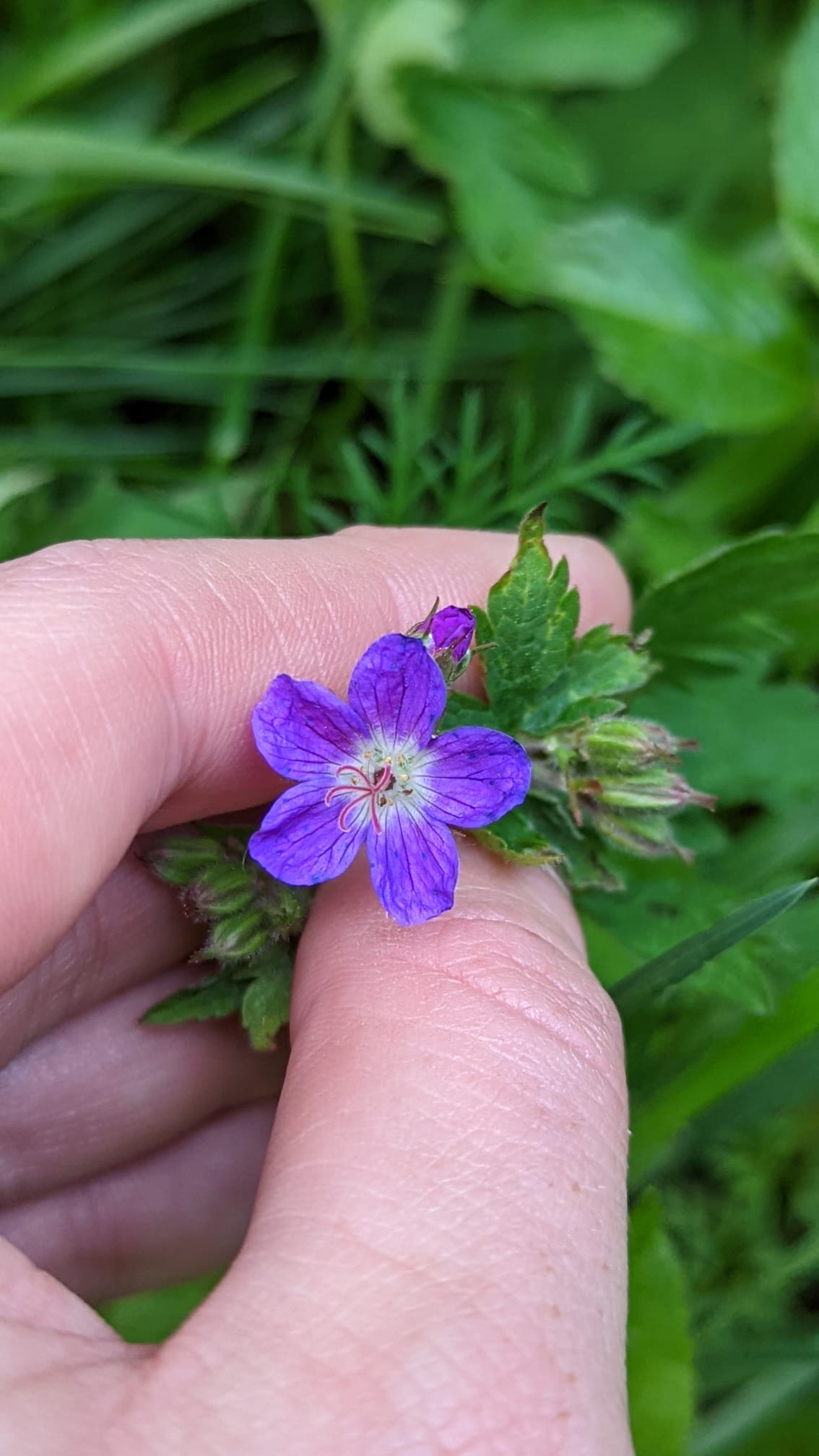
In keeping with similar posts in this series exploring the plants uncovered during efforts to record the Urban Flora of Newcastle and North Tyneside, this week I wanted to take a look at a slightly more modest group of plants familiar from urban spaces nationwide: Speedwells.
So far, I have recorded 16 species of Veronica in Newcastle and North Tyneside, a much more manageable number than the 72 grasses covered here. With their cheerful blue flowers and propensity to bloom for most of the year in urban settings, Speedwells are a charming family and more so than many other plants encountered locally, are associated with highly anthropogenic habitats. Flowerbeds, roadworks, path sides, pavements, and other areas of disturbed ground, all are worth a look.
As always, a big thank you to the iRecorders who have made their photos available for use in articles such as this. In this case, Chris Barlow, Pru Hamed, and David Jarema.
Native Speedwells
Of the speedwells encountered so far in the conurbation, only eight are British natives. The rest are either neophytes—recent human introductions—or archaeophytes introduced many years ago. Of the native species, only a handful can be described as ‘common’ throughout the area.
Foremost among these abundant species is Wall Speedwell (Veronica arvensis), recorded from 42 (25.6%) of monads so far. An annual of disturbed and cultivated habitats, this species is most often encountered growing within the hard, free-draining surfaces of walls, pavements, and wasteground but is equally at home in neglected flowerbeds and on the margins of amenity grasslands. Anecdotally, it is more abundant in suburban neighborhoods where the spraying of weeds is less common.
The next two species, Germander Speedwell (Veronica chamaedrys) and Thyme-leaved Speedwell (Veronica serpyllifolia), are grassland plants. The former, recorded from 31 (18.9%) monads, is still greatly under-recorded but has defied expectations somewhat by proving scarcer than anticipated across the area. Typically, it is found either in good-quality neutral grassland, often that of road verges, or as a weed in garden lawns. However, it also occurs on the edges of amenity woodland and within urban hedgerows. Thyme-leaved Speedwell, recorded from 24 (14.6%) monads, inhabits much the same habitat but appears genuinely scarcer. It seems to favor long-established grasslands in churchyards and parks but may pop up in any suitable grassland area. It should be noted that all plants encountered so far are of the subspecies Serpyllifolia. I would not expect to see subsp. humifusa here, nor have I.
Similar in appearance to Germander Speedwell, at least at first, Wood Speedwell (Veronica montana) is a real rarity in the conurbation with fewer than 10 records since 1990. The majority of these are centered on Newcastle’s wooded denes at Jesmond, Throckley, and Walbottle, with a few records from other older woodlands. So far, this species has been recorded from 5 (3%) monads, all of which, except for a small patch at Heaton Park, come from these areas. Even where present, this plant is rather scarce and seldom forms the extensive colonies seen elsewhere in the county—a result of habitat degradation?
While a common plant of acidic soils elsewhere in the country, Heath Speedwell (Veronica officinalis) is likewise rare in Newcastle and its surrounds, recorded from 3 (1.8%) monads so far. Since 2000, there have only been eight records of this attractive little plant, predominantly from land close to Gosforth Park, much of which was once heathland. It is also present within relic lowland heath at Havannah Nature Reserve, though the greatest densities can be found within Gosforth Nature Reserve.
The final three native speedwells recorded so far are all plants of wetland habitats. Two are very scarce indeed, with Marsh Speedwell (Veronica scutellata) recorded from just 2 (1.2%) monads around established wetlands at Gosforth and Havannah, and Blue Water-speedwell (Veronica anagallis-aquatica) noted from just 1 (0.6%) monad at Gosforth Nature Reserve, where it grows on the muddy margins of recent SUDS.
Thankfully, Brooklime (Veronica beccabunga) is more abundant, recorded from 13 (7.9%) monads so far. This species can be encountered in a variety of wetland habitats ranging from the edges of lakes and ponds, SUDS, and streamsides to ditches and small wet depressions in built-up areas. It also appears to be one of the first riparian species to colonise new ponds, as seen at Kingston Park and Great Park.
Thus far, I have only encountered two archaeophyte speedwells during the survey, and both are rather common within urban habitats. Ivy-leaved Speedwell (Veronica hederifolia) is a prolific colonist of cultivated land, found just about anywhere the ground has been disturbed but most often as a weed of pavements, flowerbeds, wall bases, and allotment plots. Examples in urban habitats tend to be of subsp. hederifolia, which tolerates more open habitats than subsp. lucorum, which thus far has only convincingly been recorded from shaded woodland and parks. Together, these have been recorded from 61 (37.2%) monads.
Green Field-speedwell (Veronica agrestis), recorded from 28 (17.1%) monads, is much more abundant than it ought to be given its inclusion on the Rare Plant Register for South Northumberland. Indeed, despite only being recorded about ten times between 2000 and 2018, it is proving to be a frequent plant of disturbed habitats, though notably those with drier, freer-draining substrates than similar species. It may well warrant downgrading from the register in due course.
Non-native speedwells now, and we’ll start with the simplest one: American Speedwell (Veronica peregrina), recorded from just 1 (0.6%) monad. A weed of cultivated and urbanised land, this attractive little plant was found growing in long-forgotten planters outside the Tyne Pedestrian Tunnel in North Tyneside. How long it has been there is unclear, but this seems to be a new population of what is, by all accounts, a rather rare neophyte locally.
Other alien speedwells are far more numerous. Take Common Field-speedwell (Veronica persica), for example, which genuinely seems to be the most abundant Veronica within the conurbation, recorded from 89 (54.3%) monads thus far. An annual of cultivated and disturbed soils, this species has an uncanny knack for popping up just about anywhere, from flowerbeds and pavements to arable fields and the margins of amenity grasslands. It will surely prove to be much more abundant still.
The same cannot be said for a similar species, Grey Field-speedwell (Veronica polita), which, while sharing the same habitats, appears altogether rare, recorded from just 4 (2.4%) monads to date. Past records of this species within the city are very scarce indeed, and befitting this, it has been recorded only scantly from a wall in Wallsend, a trodden path-side at Walker, and a few other locations.
Last but not least, we have Slender Speedwell (Veronica filiformis), recorded from 19 (11.6%) monads. Given its status as a successful weed of mown and amenity grassland, this one really ought to be more widespread, and I suspect it is significantly under-recorded due to my inability to access private gardens. Indeed, so far, it has predominantly been recorded from front lawns, churchyards, playing fields, and odd scraps of grassland left undeveloped within housing estates. Where present, it can be terribly abundant.
The final two Veronicas worthy of mention are not speedwells at all but Hebes. As they fall within the same family, they warrant inclusion here. Both Narrow-leaved Hebe (Veronica salicifolia) and Hedge Veronica (Veronica x franciscana) are rare escapes from cultivation in the conurbation, recorded from 3 (1.8%) and 2 (1.2%) monads, respectively. In the case of the former, where present, it appears to seed readily from older amenity plantings, while the latter seems to derive from planted garden hedges and is most commonly encountered within cracks in walls.
And there we have it, a round-up of the various speedwells encountered so far within Newcastle and North Tyneside. I have no doubt the numbers included here will change as the survey progresses, but at the very least, the results so far point to a few interesting trends.
While recording for the ‘Urban Flora‘ I have now come across a grand total of 72 grasses growing in a wild or naturalised state within the conurbation. This is roughly 7.5% of all species recorded in the survey area, and more still are being recorded by fellow recorders.
This is an incredibly diverse group and a real focus of the summer recording period. Now we’re a few years in and trends are finally beginning to emerge, I thought I’d share a [not so] brief round-up of the results so far in a similar manner to past posts here and here. Brace yourselves, this could turn out to be quite the essay…
Before I go any further, however, a very big thank you to Chris Barlow, who takes far better photos than I, for several of the images used within, and similarly to Pru Hamed and Joe Dobinson for their contributions made available through iRecord.
Common Grasses
The Big Seven
The ‘big seven’ urban grasses across the conurbation will come as no surprise to anyone. All are common and familiar species capable of thriving in a broad range of habitats. Few grasses demonstrate this better than Annual Meadow-grass (Poa annua) which has been recorded in 161 (98%) monads so far and gets just about everywhere – pavements, walls, garden lawns, quality grassland, you name it. Incidentally, this number corresponds to the total number of monads surveyed to date so it is likely that this species will eventually be recorded from all 164 squares.
Next up is Cock’s-foot (Dactylis glomerata) found in 149 (91%) monads so far. A robust grass characteristic of rank communities atop neutral or basic soils, it is the most frequent grass of roadside verges, urban wasteground and overgrown amenity grassland. I suspect this too will be recorded from all squares, as will the next two species, Red Fescue (Festuca rubra) and Perennial Rye-grass (Lolium perene), recorded from 110 (67%) monads each. Both are very widespread species of lawns and amenity grasslands, but occur too in more natural habitats, as well as in gardens, pavements and other urbanised environments.
Next, we have False Oat-grass (Arrhenatherum elatius) at 108 (66%) monads. Like Cock’s-foot, this species is a dominant fixture of rank neutral communities but anecdotally, occurs equally frequently as a weed of pavements and messy gardens. It will surely prove more widespread still.
Finally, we have Creeping Bent (Agrostis stolonifera) which while commonly encountered in its typical habitat of wetlands and around seasonal floods, also occurs as a frequent colonist of pavements, gutters and tracksides, and Yorkshire Fog (Holcus lanatus). Recorded from 72 (44%) monads thus far, the latter occurs just about anywhere but is most plentiful in damp situations and overgrown lawns.
The next set of common grasses fall roughly into two broad habitats: quality grassland, typically atop neutral soils, and derelict and disturbed land. We will cover the former first but it should be noted that all of the grasses mentioned here are likely subject to under-recorded – there is still much more to do on this front, thus they are probably best described as ‘widespread’ as opposed to truly common.
Of the species I have come to associate with ‘quality’ grassland, Rough Meadow-grass (Poa trivialis) seems most abundant, found in 88 (54%) monads so far. This species is present in most natural grassland communities including those of roadside verges, parkland and field margins and those of neglected amenity grassland and seems absent only where management is most intense. Or perhaps it is simply undetectable when mown! The same can also be said for Meadow Foxtail (Alopecurus pratensis), recorded from 55 (33%) monads thus far, though both seem genuinely scarcer than the generalists featured higher up the list. The same habitats that feature the preceding two species also tend to hold Timothy (Phleum pratense), 43 (26%) monads, and Crested Dog’s-tail (Cynosurus cristatus), 31 (19%) monads; though both appear scarcer, both almost entirely absent from the most urbanised squares. Both appear linked to reseeding in some cases and more so than the previous two species, favour slightly ‘wilder’ grasslands.
Tufted Hair-grass (Deschampsia cespitosa) is also a frequent grass, recorded from some 55 (33%) monads. As a rule, it seems unphased by soil type and instead occurs wherever the land is poorly drained, most commonly in amenity and semi-natural woodland but also in ditches, damp grassland, and around urban ponds and SUDS where at times, it forms a unique community with several juncus species.
Finally in this very generalised category, we have Soft-brome (Bromus hordaceus) at 37 (22%) monads and Common Bent (Agrostis capillaris). The former occurs as isolated colonies just about anywhere there has been some degree of disturbance, typically favouring the edges of tracks, amenity grassland and rank verges where competition is limited. Recorded from 26 (16%) monads, the latter shows a strong preference for relic acidic habitats which are rather rare locally but may occur in neutral communities.
The next set of frequent grasses are those associated with derelict land and disturbed habitats. Of these, two stand out as occurring most frequently in urban areas – Wall Barley (Hordeum murium), 41 (25%) monads, and Barren Brome (Anisantha sterilis), 42 (25%) monads. While they are not tied to it, these archaeophytes occur in areas of high disturbance including roadsides, pavements, wall bases and messy front gardens. Interestingly, both are more numerous in suburban areas such as Heaton, Jesmond and Gosforth but rather scarce in the city centre where efforts to control ‘weeds’ are more intense.
Barren Brome (Anisantha sterilis)
Common Couch (Elymus repens) is an interesting one in that it has only been recorded from 43 (26%) monads so far. An underestimation, for sure, though it does appear to be less frequent than perhaps I anticipated when starting out. Couch occurs scantly in the rank Cock’s-foot-False Oat-grass communities seen on verges but is more frequent on derelict land and brownfield sites. It seems to feature scantly in the lists shared by other local botanists too.
Water Bent (Polypodon viridis) is an interesting species. The story of this successful grass is well known but suffice to say that until recently, it was somewhat of a rarity in Tyneside. Recorded from 25 (15%) monads so far and increasing each year, this no longer seems to be the case. This grass is most numerous in Newcastle City Centre and the surrounding suburbs but as the survey progresses, is turning up in new locations towards the peripheries of the survey area. I suspect it will prove much more numerous when the majority of the area’s gutters and wall bases are thoroughly checked.
Water Bent (Polypodon viridis)
Localised Native Grasses
The vast majority of the grass species recorded so far in the conurbation can be described as uncommon or at the very least, somewhat localised. In many cases, this may be due to a lack of suitable habitat and genuine scarcity but in other cases, may be due to under-recording.
Woodland Species
The most abundant grasses of Newcastle and North Tyneside’s woodlands are undoubtedly the generalist species mentioned previously. Species such as Rough Meadow-grass and Tufted Hair-grass can be terribly common in such habitats, for example. There are, however, a rather select set of species that to date, have only been recorded from woodland settings.
Creeping Soft-grass (Holcus mollis) seems surprisingly picky, found in just 13 (8%) monads so far. This one appears tied to areas of amenity and semi-natural woodland, usually atop dry soils where competition is limited and at times, may form the dominant grass cover. It does pop up in hedgerows and grassland areas too so may yet prove more abundant.
False-brome (Brachypodium sylvaticum) appears to be living up to its reputation as a woodland species, recorded from just 13 (8%) monads to date. Most of this, as expected, take in areas of Newcastle’s wooded denes, though it occurs also in recent amenity woodlands, often on the site of former mines. Less often, this species colonises unshaded, neutral to calcareous habitats where it may be locally abundant. Perhaps the most prominent example of this are the banks of the Tyne at Elswick where it forms a distinctive understory below a range of planted and naturalised ornamental shrubs.
Hairy Brome (Bromopsis ramosa) is by all accounts a genuinely rare grass in the conurbation. Favouring shaded woodland with ample bare or disturbed ground, and just occasionally, mature hedgerows, it seems tied to the ‘wilder’ parts of the city, including Newcastle’s denes and several wooded nature reserves. I have only managed to record in 8 (5%) monads thus far but there are a few possible sites still to check.
Like the previous species, Bearded Couch (Elymus caninus) is a local scarcity, recorded from just 2 (1%) monads. It always has been with only 14 records held by the BSBI as of 2024, the last of which dates to 2011. So far, I have recorded this species from the edge of amenity woodland at Heaton Park, growing where recent works had disturbed the soil, and, rather oddly, from a gravelled front garden in Heaton. I suspect the latter may be the result of seed carried back from the aforementioned park.
Wood Melick (Melica uniflora), 2 (1%) monads, is a rare plant of rich woodland soils. In the greater Newcastle area, it is known historically only from the four city denes. Despite searching all to within an inch of their lives, I am yet to find it in Walbottle or Throckley Dene. Instead, I have observed it on just one occasion in more inaccessible parts of Sugley Dene – perhaps the least trodden of the city’s green spaces – and this week, I encountered in in two small areas of Jesmond Dene well away from areas of high footfall and disturbance. I do wonder if this species is genuinely declining as the health of such sites decreases.
Wood Meadow-grass (Poa nemoralis) seems only fractionally more widespread in the survey area at 5 (3%) monads so far. These correspond almost perfectly to its known range within the area with healthy populations at Havannah, Gosforth Nature Reserve, Jesmond Dene and Woolsington. It should be rather more widespread and indeed, on Friday, was discovered at a new wooded site at Killingworth.
Grassland Species
Yellow Oat-grass (Trisetum flavescens), 4 (3%) monads in total, is another grass with a patchy local distribution. I haven’t had much luck searching the city’s scant calcareous grasslands and with the exception of some former industrial grasslands along Scotswood Road, it seems mysteriously absent from many seemingly perfect areas of habitat. Instead, this species is most numerous on roadside verges near Woolsington, perhaps as an introduction, and around Big Waters Country Park. It is interesting to note that even within these grasslands it is far from common and very much lives up to its reputation as a ‘subordinate’ grass.
Quaking Grass (Briza media), recorded from 6 (4%) monads to date, is almost as picky and one could argue that all populations within the area stem from human introductions. The greatest concentrations occur on former industrial land at Scotswood and Silverlink, both sites which have been restored at one point or another. It is likewise likely introduced at Gosforth Nature Reserve and at further sites, is clearly a more recent escape. Wall tops in Heaton are far from it’s natural habitat.
Sheep’s-fescue (Festuca ovina) is a grass of free-draining, acid to calcareous habitats. Of the 9 (5.5%) monads in which it has been recorded so far, most match this criteria with the greatest concentrations being found on former industrial plots along the Tyne. It does, however, turn up outside of these places as demonstrated by records from a road verge at Gosforth and pastures at Big Waters. I suspect this is another I am guilty of under-recording.
Smooth Meadow-grass (Poa pratensis) is a perennial grass of verges, meadows and amenity grassland and is often found growing cheek by jowl with its more abundant cousin, Poa trivialis. It seems genuinely less plentiful than the latter and thus far, has been recorded from just 18 (11%) monads. This one is almost certainly under-recorded, particularly in areas rich in Poa trivialis where checking many plants may be necessary in order to find it. I suspect this one may be bumped up to the common and widespread list in due course. Smooth Meadow-grass often shares its habitat with another generalist, Tall Fescue (Schedonorus arundinaceus), 11 monads (7%), which appears rather more scarce and anecdotally, favours grasslands that are mown very infrequently (or not at all). So far, the best place to look for this impressive species has proven to be inaccessible road verges, roundabouts and central reservations which are often left to develop absent the constant landscaping that defines our city spaces.
Unlike Tall Fescue, Meadow Fescue (Schedonorus pratensis) is a genuinely rare grass. Recorded from just 4 monads (2.5%) so far, it seems to favour rough patches within established amenity grassland, I suspect where grass or ‘wildflower’ mixes have been sown in the past. Whether it occurs as a containment or a relic, I am unsure, but it is seldom numerous even where present.
Smaller Cat’s-tail (Phleum bertolonii), 6 monads (4%), has always been a rare grass in the area with just 14 records from four sites prior to this survey, usually from long-established grassland on nature reserves. That does not appear to be the true picture, however, as the species occurs scantly in a range of grassland types. It certainly occurs as a component of restorative seed mixes, as demonstrated by several records from sown grassland surrounding new build housing estates, and shows more of a tolerance for parched, infertile grassland than the similar Timothy. It is possible that particularly robust forms of this species, particularly where deliberately sown, have been under-recorded in favour of the larger species.
Wetland Species
Wetland areas are relatively scarce in the conurbation, a fact which largely explains the scarcity of grass species associated with watercourses and inundated areas. Of those which grow with ‘wet feet’ Floating Sweet (Glyceria fluitans) appears to be the most abundant, recorded from 10 monads (6%) so far. The relative success of this species can be explained by its tolerance of high nutrients and stagnation, with G. flutitans growing equally well in ditches and areas of arable run-off as it does in better-quality wetlands. Linked to this, Hybrid Sweet-grass (Glyceria fluitans x notata = G. x pedicellata) has been recorded from just 1 monad (0.6%) so far when it was found by John Durkin at Havannah Nature Reserve.
Reed Sweet-grass (Glyceria maxima), 7 monads (4%), occurs mainly as an introduction within the survey area. Growing within shallow areas of pools and lakes, or on nearby banks, it appears to have been added to several of the city’s wetlands for its ornamental value. Examples include Iris Brickfield Park, Rising Sun Country Park and various SUDS ponds in Gosforth. It may, however, occur naturally within marshland at Fencerhill Wood and Havannah Nature Reserve.
Not strictly a wetland grass, I admit, but one most often found close to water, Marsh Foxtail (Alopecurus geniculatus), found in 14 (8%) monads occurs predominately in waterlogged grassland. It may be locally abundant across successional brownfield sites and seasonally flooded grassland as seen at Iris Brickfield Park, Heaton, but also occurs around the margins of SUDS and urban lakes. Often at the waterside edge of communities dominated by common generalist grasses. I suspect it will prove much more widespread.
Reed Canary-grass (Phalaris aurundinacea) is by far the most abundant grass of the conurbations’ damp spaces, recorded from 44 (27%) monads so far. It can be found in almost all waterlogged areas notably including wet woodland, pool margins, seasonal floods and ditches, often forming dense monocultures where conditions are right. Two interesting observations surrounding this species include the presence of a variegated garden cultivar, var. picta, at several sites where it has been introduced, and the tendency of the species to outlive temporary wetlands. Such sites, commonly observed on the margins of arable fields or areas of brownfield, are rather abundant.
Finally, in this category, we have Common Reed (Phragmites australis). Occurring predominately in an introduced state, it can be found in most areas of suitable habitat but is dominant at only a few select sites. Most notably Gosforth Nature Reserve which holds the area’s largest reedbed. So far it has been recorded from 25 (15%) monads.
Reed Canary-grass (Phalaris aurundinacea) var. Picta
Heathland Grasses
Presumably much more widespread in prehistory, areas of lowland heath and acid grassland are now a rarity in the conurbation, concentrated in just a few corners of Newcastle. Further sites, most notably Prestwick Carr, sit outside the survey area and have not been surveyed on account of their rural appearance. The relative rarity of these habitats means that many of the grasses associated with them are confined to a few select sites, with a few notable exceptions.
The most prevalent grass of acidic swards is undoubtedly, Sweet Vernal-grass (Anthoxanthum odoratum), recorded from 16 (10%) of monads so far. This species can be prolific in such relic habitats, as seen at Gosforth Nature Reserve, but is much more of a generalist than other species within this category. It occurs in density within all relic acid grasslands but is present too in high-quality neutral grasslands and rarely, seemingly calcareous communities. There are undoubtedly still sites to discover for this one but it does appear scarce outside of these acidic communities.
Heath Grass (Danthonia decumbens) has always been a scarce grass in the survey area with only 12 historic records, the majority of which are ageing fast. Not recorded at all since 2004, during the present survey, it has been recorded from just 2 monads (1.2%), both times from ruderal ground close to relic heathland at High Gosforth Park. Similarly scarce, Matt-grass (Nardus stricta) has been recorded from just a single monad (0.6%) at Havannah Nature Reserve where it occurs amid Newcastle’s largest area of relic lowland heath. Both of these species were recorded from the former Brenkley Colliery in the early 2000s but searches of the site so far have failed to refind them. A challenge for local recorders?
Wavy Hair-grass (Avenella flexuosa) ought to be a little more widespread than it has proven so far. Recorded from just 5 monads (3%) to date, it shows a preference for woodland edge and rank grassland close to relic acid habitats, most notably at Gosforth Park, Big Waters and other locations in the North of Newcastle. It has also been recorded from brownfield land at Newburn.
Neither of the two common North East cottongrasses are species that anyone would associate with urban habitats, and they aren’t in truth, occurring in very low densities in isolated corners of the conurbation. Common Cottongrass (Eriophorum angustifolium), 1 monad (0.6%), is a very rare component of the relic heathland community at Havannah Nature Reserve, occurring across just a few metres of boggy land. It is also known from Prestwick Carr, outside of the survey area. Somewhat more surprising is the occurrence of Hare’s-tail Cottongrass (Eriophorum vaginatum) at Rising Sun Country Park in North Tyneside where it was found in 2024 by Joe Dobinson. The habitat here is by no means typical so it is safe to assume that it was introduced during the restoration of the various ponds on site. A process which also introduced Glyceria maxima and non-grass species such as Carex paniculata.
Saline habitats in the city are represented by two major habitat types: salt-strewn roadsides and relic saltmarsh and riverbanks along the Tyne. The latter is rather scarce, persisting in small pockets between Royal Quays and Wallsend to the East to Newburn in the West, while the former is far more widespread on account of our tendency to grit our roads in winter. We’ll cover the natural habitat first.
Common Saltmarsh-grass (Puccinellia maritima) would once have been much more widespread in the area but now exists in mere pockets where bare saline soils have been allowed to persist along the Tyne. Recorded from just 6 monads (3.5%) it is geographically rare but locally abundant at sites such as Walker, Elswick and Willington Gut. Higher up, amid the tidal defences and salt-sprayed walls that fringe the river, these sites too hold populations of Hybrid Couch (Elymus repens x junceiformis = E. x laxus), 5 (3%) monads. A cross between Common Couch (Elymus repens) and Sand Couch (Elymus junceiformis), it is interesting to note that Sand Couch has never been recorded within the survey area and was presumably lost when the river was altered quite some time ago. The hybrid between Sea Couch (Elymus athericus) and Sand Couch has also been recorded in Newcastle but alas, I am yet to find it.
And then we have our saline roadsides. Here, the only relatively widespread coastal grass species is Relfexed Saltmarsh-grass (Puccila distans) which to date, has been recorded from 17 (10%) monads. This species does well in the disturbed ground of verges and pavement cracks close to major roads and as such, is tied predominately to the area’s major throughaffairs where gritting is more prevalent. It is not the only grass to occur in such places, however, and chasing an old record by Gordon Young in Heaton, I was pleased to find Sea Fern-grass (Catapodium marinum) at its only known local site. Perhaps this one will yet occur more widely.
Bare and Disturbed Ground
Disturbed habitats in the city are usually dominated by several of the common and widespread species mentioned previously and increasingly, by Water Bent too. They do, however, host several somewhat more uncommon grasses which inhabit pavements, walls, roadworks, neglected stonework, rubble heaps and other such places.
Perhaps the most plentiful of these grasses is Fern-grass (Catapodium rigidum), recorded from 17 (10%) of monads so far. This inconspicuous little grass does well in a whole host of bare, parched and seemingly inhospitable habitats including wall-tops, pavements and roadsides but with the largest populations being found on the rubble and thin soils of demolition sites. It is easy to miss but is quickly revealing itself to be rather widespread.
Fern-grass (Catapodium rigidum)
Annual Beard-grass (Polypogon monspeliensis), 3 monads (1.8%) is an interesting one. It is widespread across the site of a now demolished brewery in Newcastle City Centre. How it got there remains unclear, but the disturbed, free-draining soils here seem to suit it well. Elsewhere, it occurs as a scant bird-seed alien in urban habitats but has shown itself capable of returning year-on-year in parts of Heaton. It is by no means a casual.
The two ‘tail-fescues’, told apart by their different-sized glumes, share a very similar taste in growing conditions. Both occur almost entirely on bare, free-draining soils, namely within parched amenity flowerbeds, stonework and neglected car parks. Both are rather scarce, though Squirreltail Fescue (Vulpia bromoides) is by far the most frequent, recorded from 12 (7.5%) monads vs the 1 (0.6%) monad of Rat’s-tail Fescue (Vulpia myuros). As annuals, these two are proving hard to account for in the present survey with only a limited window of opportunity to find them each year.
Squirreltail Fescue (Vulpia bromoides)
Four more rare grasses show a preference for bare or disturbed ground. Flattened Meadow-grass (Poa compressa) is easy to miss but has been recorded from 2 (1%) monads close to the Tyne at Walker. On both occasions, it was found to inhabit areas of derelict land. The final three grasses are predominately arable in nature and their relative scarcity may be partially explained by the exclusion of non-urban, arable monads at the onset of the survey. Black-grass (Alopecurus myosuroides) is a troublesome weed in Southern parts of the UK but remains rare in the North East. So far, it has been recorded from just 3 (1.8%) monads, where it was identified twice as a crop weed and once from an earthen mound on a building site. Great Brome (Anisantha diandra) has proven scarcer still recorded from 2 (1%) of monads, from an arable field and area of recent roadworks respectively, while Rye Brome (Bromus secalinus) has been recorded just once (0.6%) from arable margins at Callerton.
Black-grass (Alopecurus myosuroides)
Alien Grasses
A large proportion of the grasses recorded in and around the conurbation occur due to human actions with many attributed to the import of materials, including bird seed and grain. More still occur as garden escapes and as contaminants of amenity seed mixes.
Birdseed and Grain Aliens
Of the birdseed aliens, Bread Wheat (Triticum aestivum) has proven the most abundant, recorded from some 19 (12%) monads so far. A key component of most budget seed mixes, it most often occurs as a casual within pavements and disturbed areas close to human habitation and in areas where waterfowl are regularly fed. The same applies also to Six-row Barley (Hordeum vulgare), 7 (4%) monads, and Two-row Barley (Hordeum distichon), 3 (2%) monads, which despite being far more common in cultivation nowadays, has proven itself scarcer in urban habitats than H. vulgare. Perhaps this is due to the make-up of cheaper, imported seed mixes? Millet (Panicum miliaceum), 1 (0.6%) monad, has also been recorded in such situations.
Some urban grasses associated with birdseed also occur unintentionally as contaminants. Of these, the Canary-grass (Phalaris canariensis), 3 (2%) monads, and Cockspur (Echinochloa crus-galli), 4 (2.5%) monads, have proven the most numerous. Both occur in similar settings to those mentioned above. A final species, Green Bristle-grass (Setaria viridis) also appears to owe its occurrence in the city to birdseed, observed in 2 (1.2%) monads so far.
As a final note on our birdseed aliens, last week I encountered my first example of Smooth-brome (Bromus racemosus) within the survey area. Growing within the pavement close to the margins of an urban lake where waterfowl are fed, one can only assume that this too occurred as a contaminant. There are, after all, no historic records of this native grass within the city limits.
Of the species linked to the import and export of arable products, Oat (Avena sativa) is the most widespread and has been recorded now from 10 (6%) monads where it predominately occurs on roadsides, presumably having blown from passing lorries. The occurence of Rye (Secale cereale) in a single monad (0.6%) in Gosforth can also likely be attributed to this.
Garden Escapees
Ornamental grasses are a key part of many gardens in and around Tyneside and while most are well-behaved and reluctant to spread, a select few have been recorded in a wild state. Most are casuals but a few species can now be defined as naturalised.
Of these, Greater Quaking-grass (Briza maxima) has proven the most abundant, recorded from 4 (2.5%) monads so far. Commonly grown as an ornamental annual, it has occurred for several years as a colonist of pavements, wall-tops and garden beds in Heaton and is particularly prolific in the grounds of a local school. Away from here, it has been recorded too from High Heaton, Jesmond and St. Peter’s. A second species, Rescue Brome (Ceratochloa cathartica) appears well naturalised in a single monad at Benwell where it appears to have spread from a garden to colonise an expansive area of ruderal ground. Recorded in 2023, this marked the first occurrence of this impressive grass in Northumberland.
Just a few weeks ago, another horticultural alien was discovered in the city when Chris Barlow stumbled across an impressive patch of Golden Oats (Celtica gigantea) at Big Waters, in the North of the survey area. How this got here is a bit of a mystery as the site is some distance from nearby habitation. One can only assume a stray seed, or perhaps deliberate introduction in this instance.
Other cultivated grasses are far more ethemeral in nature. A fortnight past, Hare’s-tail (Lagurus ovatus) was encountered by Pru Hamed growing in rough ground close to gardens in Heaton – the only record of this attractive annual during the survey so far. Finally, Argentine Needle-grass (Nassella tenuissima) has been recorded from 2 (1%) monads at High Heaton and Woolsington, on both occasions close to mass amenity plantings. Given how popular this one is in the hardy, low maintence displays created around new build estates and industrial complexes, I wouldn’t be surprised if we see much more of it.
Grass Seed
A final two urban grasses recorded in the city can roughly be attributed to grass seed mixes used to restore former earthworks. While it occurs too as a rare casual in other situations, Italian Rye-grass (Lolium multiflorum) is most numerous on landscaped road verges where presumably it is purposely spread for one reason or another. To date, it has been recorded from 7 (4.3%) monads in the conurbation.
Unlike the former species, Hungarian Brome (Bromopsis inermis), recorded from just a single monad thus far, presumably arrives unintentionally as a contaminant of grass seed. I have encountered this species just once growing on the margins of a restored pit heap at Burradon, though there are historic records from elsewhere.
Italian Rye-grass (Lolium multiflorum)
And there we have it, a rather length tour of the urban grasses recorded so far during the project. I freely admit that the numbers shown here may, at present, be somewhat inaccurate. On account of their limited flowering time, grasses are proving a trickly bunch to nail down as part of the flora and as ever, recorder bias no doubt plays a part too. Cock’s-foot for example is much more obvious than Compressed Meadow-grass. So far, it seems I am doing a much better job at accounting for the very common and genuinely rare grasses in the city (I must try harder with those middling ones) but it is nice to see some trends beginning to emerge.
Now I am getting my eye in, there are a few more grasses that should materialise in due course. Despite searching, I have oddly been unable to locate Silver Hair-grass (Aira caryophyllea) and Early Hair-grass (Aira praecox) at any of their pre-2000 sites and have likewise failed miserably in my searches for Downy Oat-grass (Avenula pubescens) and Giant Fescue (Schedonorus giganteus), last reported in 2016. That one, at least, should still be out there while there are undoubtedly more aliens to discover also. Before embarking on this endeavour, I remember seeing a lovely roadside adorned with Foxtail Barley (Hordeum jubatum) but cannot for the life of me remember where…
Upper Teesdale is one of the UK’s premier botanical hotspots and a place to which I return regularly having experienced the area for the first time in 2020. The Teesdale Assemblage, a delightful mix of rare arctic-alpine and Southern plants, is a thing of beauty and makes for some of the best botanising in Britain. Much to my delight, the past fortnight has presented two opportunities to visit Teesdale, with two visits to Widdybank Fell and Cow Green, stopping briefly at Falcon Clints, and another shorter outing to Low Force and the Tees banks. A condensed round-up of what we encounter follows.
Early May
Stopping by Cow Green in early May, Matt and I had hoped to get our annual fix of everyone’s favourite alpine – Spring Gentian (Gentiana verna). I am pleased to report that we succeeded with hundreds of vivid blue marvels blooming along the nature trail from Cow Green to the nearby dam. Little needs to be said about these remarkable little plants so instead, I’ll let the photos do the talking. They are startlingly pretty!
Spring Gentian (Gentiana verna)Spring Gentian (Gentiana verna)Spring Gentian (Gentiana verna)
Gentians aside, Widdybank Fell felt rather bleak early in the month, the sward at first glance punctuated only by dots of blue and flashes of lilac courtesy of the many Common Dog-violets (Viola riviniana) to be seen across the site. The prolific Mountain Pansies (Viola lutea) that adorn the site later in the month had yet to get going, though we did find a handful in sheltered spots. More interesting, however, were the less obvious plants. Glancing over the grassland, the blooms of Blue Moor-grass (Sesleria caerulea) were easy to make out, and around a flush, we were pleased to spot several examples of Variegated Horsetail (Equisetum variegatum) – a curious little equisetum that I have only ever encountered here and on Lindisfarne in Northumberland. Definitely a plant of nice places…
Here too, we also noted a smart Common Lizard (Zootoca vivipara) and after a bit of searching, came up trumps with Rare Spring Sedge (Carex ericetorum). Nearby, a large colony of Bird’s-eye Primrose (Primula farinosa) provided a welcome dash of colour against the greys and greens of the fell. A special plant indeed.
Having had our fill of gentians and windswept moorland, we soon opted to head somewhere different. Deciding on a trip to Bowlees (via some rather nice scones) we soon set off for a walk up the Tees between Low Force and High Force. I am pleased we did, as there was much to enjoy along the riverbanks. At Low Force itself, Early-purple Orchids (Orchis mascula) were in full bloom, and the woodlands looked fantastic, adorned with Bluebell (Hyacinthoides non-scripta) and other typical species. Somewhat more exciting were sightings of Bitter-vetch (Lathyrus linifolius) – not a species I see often at all, marooned in urban Tyneside – and Tea-leaved Willow (Salix phylicifolia) growing along the banks. A little further upstream, a sizable patch of False Oxlip (Primula x polyantha) gave cause for pause, and we spotted the first of the day’s Shrubby Cinquefoil (Dasiphora fruticosa) plants nestled among a crevice.
Further upstream, things began to pick up. First came some large patches of Globeflower (Trollius europaeus), another species characteristic of this special place, growing at the waterside and later, the early growth of Northern Bedstraw (Galium boreale). Growing beneath a mixed stand of Downy Birch (Betula pubescens) and the aforementioned willow, our attention was also drawn to a curious horsetail with a distinctly one-sided appearance. Remembering that this is a slightly unreliable feature of another rare plant, Shady Horsetail (Equisetum pratense), we decided on a closer look. I’m glad we did and sure enough, the ID was confirmed. Not exactly a standout plant but a nice one to see nonetheless.
Post horsetail, things quieted down a little, but there were still interesting plants to be found (just about everyone at Teesdale is interesting if you look closer). Stone Bramble (Rubus saxatilis) came next, crawling across an area of riverside gravel, and it was nice to see more Shrubby Cinquefoil. Young examples of Juniper (Juniperus communis) were observed in the river banks, and a few more Bird’s-eye Primrose were enjoyed. As the rain began, we decided to head up, knowing we would be back soon with some reinforcements in tow.
My word, what a difference a fortnight makes. Revisiting Upper Teesdale again last weekend, this time as part of the Botanist’s Year course I’m leading for the Natural History Society of Northumbria, Cow Green couldn’t have looked more different. The Spring Gentians had all but vanished, besides a few tucked away on North-facing banks, and even the Blue Moor grass had passed its best. Instead, what we saw was a different set of plants beginning to appear. Mountain Pansy and Bird’s-eye Primrose, both scarce on our previous visit, were now commonplace, and it was nice to stumble across an intriguing white population of the former – not something I knew existed, I confess.
Besides these welcome flowers, other plants had begun to appear. I was beyond thrilled to encounter Moonwort (Botrychium lunaria) in two areas, having failed to find this inconspicuous little fern on several previous visits. In damper areas, Marsh Arrow-grass (Triglochin palustris) could be seen in flower, and the rosettes of Butterwort (Pinguicula vulgaris) were clearly visible among a good cast of common sedge species and the leaves of Alpine Meadow-rue (Thalictrum alpinum).
In one of the fenced-off compounds, a single plant of Alpine Bistort (Bistorta vivipara) was noted in bloom and the first signs of Mountain Everlasting (Antennaria dioica) could be seen – I must remember to come back to see these later in the year. Otherwise, additional highlights here included Spring Sandwort (Sabulina verna) atop exposed patches of the sugar limestone and yet more Variegated Horsetail in soggy patches.
Concluding our time at Cow Green, the group opted for a short trip down to Falcon Clints. This wonderful gorge is about as rugged and beautiful as they come, but it isn’t for the faint-hearted. Indeed, even the ‘steps’ down from the fell are rather challenging. With little time on our hands, we did not have long to explore, but in just a short while, we encountered two of our target ferns: Parsley Fern (Cryptogramma crispa) and Green Spleenwort (Asplenium viride), both of which are rather common in rocky areas around Teesdale. Here too, it was nice to observe some cliff-dwelling Juniper (Juniperus communis) and Aspen (Populus tremula) shrubs and take stock of the more familiar fern species present, including Hard Shield-fern (Polystichum aculeatum), Polypody (Polypodium vulgare) and Hard Fern (Blechnum spicant). A successful little detour and one I intend to make again later in the year.
All in all, the last few weeks have offered two fantastic opportunities to explore Teesdale’s special flora. With plenty more targets in mind, I’ll be back again very soon. In the meantime, here are just a few more photos from our second outing. Look out for more Teesdale updates soon!
Newcastle, my hometown, is a haven for wildlife enthusiasts. While it might not seem obvious at first, the city’s streets, parks, nature reserves, and even industrial zones offer plenty to enjoy throughout the year. In the next instalment of a new series on this blog, I’ve put together a curated list of ten places in Newcastle you should visit to enjoy wildlife. Some are well-known, while others might surprise you. And don’t worry, I promise there won’t be a Kittiwake in sight – they already get plenty of attention elsewhere!
1: Jesmond Dene
Jesmond Dene, a picturesque park located in the heart of Newcastle, has a rich history that can be traced back to the 19th century. The park owes much to industrialist and businessman Lord Armstrong, who, in the mid-1800s, transformed the previously private estate into a public park for the enjoyment of the local community. Armstrong’s vision was to create an urban escape that harmoniously blended natural beauty with innovative landscaping. I’d like to think he succeeded…
Much of the interest in the dene centres on its birds. Kingfishers are a firm fixture of the Ouse Burn here and Grey Wagtail and Dipper can also be found. Add to these a typical mix of woodland birds, and treats like Tawny Owl and Sparrowhawk and you have the makings of a great day’s birding. There are mammals here too, though they are more elusive. Local people often report Roe Deer and Otters are occasionally sighted on the burn. Wander at dusk, and you’re also likely to encounter bats.
What about plants I hear you say? Owing to its roots as a naturalistic garden, the dene is quite eclectic. As well as host of woodland indicator species – Bluebell, Wood Anemone, Dog’s-mercury and the like – you can also expect to see a whole host of modern colonists, from White-stemmed Bramble and Autumn Crocus to Italian Lords-and-Ladies. These aside, a personal favourite of mine has to be the North American Salmonberry, a relative of the Raspberry, that blooms in the Dene each spring. While non-native plants aren’t always to be celebrated, here they add another layer of complexity to an already interesting site.
Established as a nature reserve in 1998, Havannah and Three Hills, formerly the site of a drift mine and slag heaps linked to the Hazelrigg Colliery, is designated as a Site of Local Conservation Interest. This urban oasis is notable for its diverse range of habitats, a relative rarity in Newcastle. Notably, it holds one of only two remaining areas of lowland heath in the city, marked by extensive areas of Heather. Elsewhere, the landscape comprises restored woodlands, grasslands, and small ponds.
Havannah is important for its wildlife, especially as the last known spot in Newcastle where Red Squirrels can be found. Though their numbers have declined recently, sightings from 2024 confirm they’re still around. Other mammals like Weasel, Brown Hare, Roe Deer, and Red Fox can also be seen from time to time and birdwatchers will enjoy the site too thanks to species such as Yellowhammer and Linnet, typically rare in the city. The pond attracts various birds, with the occasional visit from a Little Egret.
Invertebrates add to Havannah’s ecological significance. The heathland supports Dingy Skipper, alongside other specialists like Mother Shipton, while the varied habitats contribute to a thriving community of ladybirds, notably featuring species such as Striped and Heather Ladybirds.
Plants can be interesting too with seasonal highlights including the fluffy heads of Common Cottongrass, the flowers of Northern Marsh Orchid, and the yellow blooms of the scarce Dyer’s Greenweed during the summer months.
Scrub habitat at HavannahIt is worth checking the noticesStriped Ladybird (Myzia oblongoguttata)18-spot ladybird (Myrrha octodecimguttata)
3: Walker Riverside Park
Nestled on the banks of the Tyne River adjacent to Walker, this diverse site encompasses a popular yet somewhat overlooked riverside park under the management of Urban Green Newcastle. The landscape here includes calcareous grassland atop abandoned industrial ground, amenity woodland, intertidal mudflats, and various disturbed habitats. Within the park, remnants of the former St. Anthony’s Tar Works are rich in wildflowers like Wild Basil, Greater Knapweed, Small Scabious, Clustered Bellflower, and Sainfoin. Along the riverside walls, one can find Musk Thistle, Perennial Wall-rocket, and other noteworthy species. Additionally, areas of relic saltmarsh offer a glimpse of coastal flora, including Purple Glasswort, Sea-aster, and other salt-loving species.
The abundance of wildflowers at Walker is mirrored by a diverse insect community. Similar to Havannah, Dingy Skipper butterflies inhabit the area, accompanied by Common Blue, Small Skipper, and Small Copper. The bee, hoverfly, and moth communities add interest too, while the location recognised as the sole local outpost of the Speckled Bush-cricket. A new arrival in the city!
Located close to the River Tyne, sightings of Grey Seal, Common Seal, and even Otter are not uncommon here either.
Managed by the Natural History Society of Northumbria, Gosforth Nature Reserve is perhaps the oldest nature reserve in North East England. An urban oasis, it features many habitats altogether rare in the wider city including fen, wet woodland, expansive reebeds and even some vibrant meadow areas.
The reserve’s larger wildlife is its greatest draw with visitors regularly reporting sightings of Otter, Red Fox, Roe Deer, Weasel and Stoat. More secretive are the Badgers and several bats species, while birds too are diverse. Depending on the season, highlights may include Bittern, Water Rail, Little Egret, Barn Owl and Green Woodpecker. In the warmer months, large numbers of Swallows and martins can be seen and far rarer visitors appear on occasion, among them Marsh Harrier and Hobby.
Gosforth Nature Reserve is similarly noteworthy for its smaller inhabitants. Insects can be exceptionally diverse with a great many dragon and damselflies and of course, a wide-range of butterflies. The latter includes Purple Hairstreak and White-letter Hairstreak and often, Holly Blue. In Spring, look out for Clarke’s Mining Bee on willow flowers and in high summer, Oak Bush-crickets adorning the trunks of trees in the wood.
Finally, if flowers are your forte, the reserve supports its fair share. Look out for the pompon-like flowers of Devil’s-bit Scabious, the tall yellow blooms of Greater Spearwort and several species of orchid among others.
The Lower Ouseburn Valley is a thing of beauty. An amalgamation of industry, dereliction and rejuvination, it perfectly demonsrates the value human centric habitats can hold for biodiversity. Local CIC, Wild Intrigue, share so much lovely content on the the Ouse Burn and the surrounding area that expansion seems unecessary but suffice to say, for the budding botanist, it is a very interesting site. There a few places locally where you can see scarce natives and archaeophytes such as Gypsywort, Water Figwort, Green Field-speedwell and Small Nettle growing side-by-side with such well established recent escapes. Hjelmqvist’s Cotoneaster, Tall Melilot, Giant Hogweed, and so much more, there is no better place to experience the ‘new’ flora of Newcastle.
For those not so fascinated by botanicals, there is a great deal to see. The Ouse Burn itself holds Otter (check out these AMAZING images), Kingfisher, Grey Wagtail, Dipper and resident pair of Mute Swans that insist on breeding in awkward positions each year, much to the delight of residents.
Insect wise, look out for large gatherings of ladybirds on the Ouseburn’s ornamental shrubs. Sure, most will be the non-native Harlequin Ladybird but recent records show Cream-spot, Orange, 7-spot, Pine and so many other species.
As someone who visits the Ouseburn area regularly, I must confess, this site is my guilty pleasure. Jampacked with wildlife and people too, it shows how both can live together in relative tranquility.
Fiddleneck (Amsinckia micrantha)Yellow-wort (Blackstonia perfoliata)A typical view of the Ouse Burn
6: Big Waters Country Park
I love this one. A Northumberland Wildlife Trust reserve shared with Urban Green Newcastle, it is one of the best places in Newcastle to observe our native flora. The ponds are wonderfully diverise with Rigid Hornwort and Fennel Pondweed and the grasslands packed with scarcities such as Fairy Flax and Agrimony. Alas, this isn’t a botanical blog so I will endevor to delve deeper…
Big Waters is most notable for its birdlife. In Winter, you can expect to see an eccelctic mix of wildfowl including Pochard, Teal, Wigeon, Shovler and Goleneye, even the odd Pintail and Whooper Swan. In fact, the site is well known for attracting local rarities including a returning American Wigeon which routinely delights crowds come Autumn and Winter.
Beyond birdlife, this is a phenominal site to observe insects. Bees include Tawny Mining Bee, Buffish Mining Bee, Vestal Cuckoo Bee and more, while ladybirds include the rare 18-spot, a specialist of conifer trees. There are too many records to summarise here but it is worth checking out iRecord for the records of Chris Barlow who has shared much about the site.
A botanical montage from a Summer’s day at Big Waters
7: Scotswood Road
Positioned along Scotswood Road, a significant thoroughfare leading into the city from the west, lies an unexpected haven for wildlife enthusiasts. Despite their urban location, the grasslands, scrub, and wooded areas along the road are rather diverse, providing a home for various species.
An abundance of wildflowers in the grasslands here attracts many insects, especially butterflies. Dingy Skipper, uncommon in the nearby area, are plentiful in spring and later, other butterfly species like Common Blue, Small Skipper, Large Skipper, Meadow Brown, and Ringlet can be seen. Bees are also plentiful here, including Buffish and Chocolate Mining Bees, along with seven species of bumblebees. Lucky observers might even spot the Mother Shipton moth – a grassland specialist with at first, may appear more like a butterfly in flight.
Insects aside, Scotswood Road boasts a variety of wild plants, particularly species associated with calcareous grassland. In the summer, visitors can enjoy sepcies such as Small Scabious, Greater and Chalk Knapweed, Hoary Plantain, Wild Basil, and Kidney-vetch. Bee Orchids are also thriving in the area, with hundreds spotted nearby in 2023.
Surprisingly, an industrial estate well and truly earns its place among the city’s top spots for wildlife enthusiasts. Despite its somewhat neglected appearance, this area offers a remarkable experience throughout the year. Its main allure lies in the fact that it is one of Newcastle’s premier locations to observe wild orchids. During summer, visitors can easily spot varieties such as Bee Orchid, Common Spotted Orchid, Northern Marsh Orchid, and Broad-leaved Helleborine. However, the real gem is the flourishing populations of Dune Helleborine, an rather rare plant with some of its densest concentrations found along the River Tyne. The little video below should give a flavour of what to expect…
But orchids aren’t the only floral treasures here. Newburn boasts an array of local specialties including Nettle-leaved Bellflower, Marsh Pennywort, Viper’s-bugloss, and the delicate Blue Fleabane, thriving in the chalky remnants of former industrial sites.
This site is also an underappreciated haven for urban birdwatchers. Green Woodpecker, a rarity in Newcastle, is a frequent visitor, alongside Kestrel, Sparrowhawk, and Peregrine. In winter, Jack Snipe can be found amidst rushes, while the numerous Alders attract sizable flocks of Siskin and Lesser Redpoll. Gazing across the Tyne towards Gateshead, one might even catch sight of a majestic Red Kite on the wing.
Another park managed by Urban Green Newcastle, and perhaps my favorite of them all, is Iris Brickfield. Despite its small size, this small, green island showcases the rich variety of life that can thrive in tiny spaces.
Thanks to careful management, the park boasts an abundance of wildflowers, with around 220 species recorded in the past year alone. Some notable ones include Sweet Violet, Yellow-rattle, Green Field-speedwell, Field Scabious, and Wood Anemone, among many others. The park also features a lovely small pond, where you can spot Bog Bean, Purple Loosestrife, Mare’s-tail, and other wetland plants not often encountered in the city. Somewhat outdated now, I previously shared a post detailing the flora of this park.
Where there’s water, there’s wildlife. From amphibians like Common Frog and Smooth Newt to dragonflies like Broad-bodied Chaser, there’s plenty to see.
Insects are abundant too, with thriving colonies of several solitary bees such as the Tawny Mining Bee, Buffish Mining Bee, and Gooden’s Nomad Bee. Holly Blue butterflies grace the park in spring, while ladybirds are a year-round highlight. The pond is known to harbor Water Ladybirds, and you might spot 10-spot, Pine, and 2-spot Ladybirds among the trees on site.
Sugley Dene is a new discovery for me, one I started exploring in 2023. It’s one of the few remaining areas of ancient semi-natural woodland in Newcastle, offering a glimpse into the landscape of times past.
The woodland is thriving with ancient woodland wildflowers like Great Wood-rush, Wood Anemone, and Bluebell. If you look closely, you’ll also find two grasses typical of older woodlands: Wood Melick and Wood Millet. Thanks to its damp and shady environment, Sugley Dene is a haven for ferns, including Lady-fern, Hard Shield-fern, Hart’s-tongue, Hard-fern, and Soft Shield-fern.
Since it’s visited by few people and quite distant from nearby roads, Sugley Dene is an ideal spot to experience the dawn chorus. The melodies of birds like Chiffchaff, Blackcap, Willow Warbler, and Song Thrush create a beautiful symphony each spring, making it a perfect place to unwind and enjoy the early morning tranquility.
Get started identifying the common grasses found in urban and ruderal habitats.
Thank you all so much for continuing to read this series of plant cribs – they are evolving over time and it is great to hear your feedback! These resources have been designed primarily for a beginner’s botany course I am leading as part of my role with the Natural History Society of Northumbria but it is wonderful to see them being read, downloaded and importantly, used by so many people online. While I don’t proclaim to be an expert, and there may well be mistakes within, I hope they are coming in useful to someone, somewhere.
After tackling willowherbs, yellow composites and several other pesky groups, I wanted to try something new this week with a crib to the various common and widespread grasses so many of us see on a daily basis. Specifically, those likely to pop up in a whole host of everyday habitats – verges, parks, wasteland and the like. I certainly found it useful to learn these before straying into more complex (and often frustrating) grass species.
Identifying grasses requires at least a basic understanding of plant anatomy and it is useful to know the name of the various parts. This blog post, by Awkward Botany, would be a good starting point.
While this page contains the species that you are most likely to come across in most situations, most of the time, you should remember that there are a great many confusion species out there. A good starting point for taking your interest in grasses further would be this book by the Species Recovery Trust.
Identifying Common Grasses
The crib below covers a 25 species judged to be common and widespread in North East England, and elsewhere in the UK too. The species covered are:
Enjoying this series? Please consider sharing this page with friends or better still, providing a back-link so that more people can find it.
I hope to also produce similar sheets for wetland and coastal grasses, as well as an abridged version of the above featuring another dozen or so species very soon.
As many of you may be aware, since 2022, I’ve devoted a significant portion of my spare time to documenting what I affectionately terming an ‘Urban Flora’ for Newcastle and the adjacent areas of North Tyneside. With spring fast approaching and activities set to pick up, I wanted to provide an update on progress so far. To give you a sneak peek: this winter has proven unexpectedly eventful, with numerous exciting discoveries and some intriguing trends starting to emerge.
Supposedly ‘Rare Plants’
One of the most interesting aspects of undertaking a survey such as this is the trends beginning to take shape for specific plants. Some, for example, are revealing themselves to be far rarer than expected while others are unexpectedly common. So far, several species featured on the Rare Plant Register for South Northumberland have fallen into the latter camp. Green Field-speedwell (Veronica agrestis) is a good example, listed as a regional rarity yet occurring in 23 (13%) of all squares surveyed so far, usually in flowerbeds, pavements or on the edge of lawns. The story is similar for Cut-leaved Dead-nettle (Lamium hybridum) at 15 (8.8%) squares and Great Lettuce (Lactuca virosa) at 17 (10%).
Several other plants, while not covered by the Registar, have also proven more abundant than anticipated. Among these, Bee Orchid (Ophrys apifera) has now been recorded from 17 (10%) of squares and interestingly, Glabrous Whitlowgrass (Erophila glabrescens) which while only found in 7 (4%) squares so far, is turning up wherever purposely searched for. I suspect most of this is down to the historic neglect of our urban spaces when it comes to botanical recording, but it is nice to see my recording efforts beginning to make a difference.
Great Lettuce (Lactuca virosa)Bee Orchid (Ophrys apifera)
The Spring Bulb Conundrum
Spring bulbs pose an interesting challenge when recording the urban flora. Commonly introduced in great drifts along roadsides, hurled over garden fences and left to run wild in churchyards, it can be quite difficult to determine what exactly to record. For the purposes of this flora, a subjective judgement has been made wherein relic or seemingly naturalised populations have been recorded and newer introductions not. This has yielded some interesting results so far.
Snowdrops have been a real flavour of 2024 so far and it has been interesting to note both Greater Snowdrop (Galanthus elwesii) and Green Snowdrop (Galanthus woronowii) at several sites. Equally crocuses, easily the most abundant spring bulb, have recieved quite a bit of attention. Spring Crocus (Crocus neapolitanus) genuinely seems the most abundant in all habitats, whether as a relic or escape, but it has been nice to note Snow Crocus (Crocus x hybridus) and Yellow Crocus (Crocus x luteus) among others.
Add to these a suite other species in Siberian Squill (Scilla siberica), Alpine Squill (Scilla bifolia), Summer Snowflake (Leucojum aestivum) and most recently, Broad-leaved Grape-hyacinth (Muscari latifolium) and the late winter months have been most enjoyable. A nice warm-up for things to come in summer!
Greater Snowdrop (Galanthus elwesii)Siberian Squill (Scilla siberica)Green Snowdrop (Galanthus woronowii)Alpine Squill (Scilla bifolia) on some rough ground within a Jesmond cemetery
The Perks of New-Build Developments
Not something I thought I would write any time soon but I am quickly becoming enamoured with new-build developments. Particularly those under construction or only very recently completed. These estates with their copious areas of disturbed ground routinely yield some of the most diverse annual assemblaages in the city and so far this year, I have visited six. Parsley-piert (Aphanes arvensis), would appear rather rare in the city upon a glance at the distribution maps, but can be incredibly plentiful within these estates. Indeed, out of the five squares from which I have recorded it so far, four have been new-builds.
Other examples of plants strongly associated with these developments include Common Ramping-fumitory (Fumaria muralis), Bristly Oxtongue (Helminthotheca echioides), Field Pansy (Viola arvensis) and Great Lettuce (Lactuca virosa) while to a lesser extent, the same also applies to commoner plants like Charlock (Sinapis arvensis), Common Poppy (Papaver rhoeas) and Weld (Reseda luteola). I suspect some of these estates will yield further discoveries as the survey goes on and sadly for plants not reliant on disturbance, more land is dug up.
One of the true delights of surveying urban plants is stumbling across something unexpected. Since my last update, there have been plenty of exciting discoveries some of which are summarised here.
Back in Autumn, two county firsts were recorded from the West of the city in Rescue Brome (Ceratochloa cathartica), over-taking a small area of verge and nearby gardens, and Henry’s Honeysuckle (Lonicera henryi), bird-sown in a patch of relic scrub. Both are neophytes. Succulents too have proven interesting this winter with a county-second record of Tasteless Stonecrop (Sedum sexangulare) growing beneath a hedge in Gosforth and several records of Rock Stonecrop (Petrosedum forsterianum) from atop graves in local cemeteries. Speaking of cemeteries, a local botanist also brought my attention to a self-sown specimen of Noble-fir (Abies procera) in Jesmond – not one I was necessarily expecting.
Many of the more recent ‘new’ plants have been neophytes and more precisely, garden or amenity escapes. In Woolsington, Argentine Needle-grass (Nassella tenuissima) was noted sowing itself away from planted amenity beds, and recent walks have yielded records of other oddities in Virginia Stock (Malcolmia maritima), Western Red-cedar (Thuja plicata) and a plausible patch of Japanese Honeysuckle (Lonicera japonica) which will need revisiting later in the season.
Non-natives aside, however, there have been some interesting finds on the native front too. On Sunday, I was pleased to encounter what appears to be the areas only patch of Bilberry (Vaccinium myrtillus) growing on a bank at Willington and chasing a record from five years back, finally noted Whorled Water-milfoil (Myriophyllum verticillatum) at Havannah Nature Reserve. Also worthy of note are the Early Dog-violets (Viola reichenbachiana) discussed in this blog post.
Spurred on by a conversation with botanist, Trevor Dines, I have been looking a little closer at the split between natives and neophytes (and archaeophytes too for that matter) in Newcastle and neighboring areas. Interestingly, of the plants recorded so far, 470 are native species vs 322 introductions. Just 52 are archaeophytes, meaning an almost equal split between natives and ‘aliens’ in the city.
This would appear to be substantially higher than several of the similar studies I’ve read and the reason for this remains unclear. Perhaps Newcastle genuinely is home to more alien plants or more likely, I am yet to record a great many of the native species lurking out there. Having excluded all dubious trees and shrubs, as well as mass plantings of bulbs and any species even suspected of having been recently planted, I’d like to think I haven’t over-estimated the neophytes too much.
Springbeauty (Claytonia perfoliata)
Challenges this year
With most of the 169 squares included in the survey now surveyed at least once, 2024 looks set to be a year of gap-filling. Specifically, relating to plants appearing scant in the dataset so far. Grasses need a concerted effort during peak flowering season, specifically to map the common species that are most visible at this time, and aquatics need dedicated surveying at key wetland sites. Some willowherbs too are oddly lacking, though this is largely because they flower for but a short period and surveying them comprehensively is proving a pain!
Furthermore, there are a fleet of ‘missing plants’ still to find, or not. Looking at records post-2011, there are still a great many species lacking from the present dataset – Good-King-Henry (Blitum bonus-henricus), Small Melilot (Melilotus indicus), Small Teasel (Dipsacus pilosus) and Hungarian Brome (Bromopsis inermis) to name but a few. Whether these plants are still out there or not remains to be determined but I am certainly not above a spot of twitching to find out.
Beyond that, though I dread to think it, it am going to have to start learning my hybrid flora. Beyond the 10-15 recorded so far, there are many more that *should* be out there in the city. Broad-leaved x American Willowherb (Epilobium x interjectum), Oxford Ragwort x Common Groundsel (Senecio x baxteri), Field Horsetail x Water Horsetail (Equisetum x litorale), etc. There are even several historic records of interesting hybrid Oraches (Atriplex spp.) by the Tyne which may still pop up during the survey. All of this considered, 2024 looks set to be a fun year!
A few Thank yous
Surveying an area of this magnitude by ones self is a rather daunting task. For this reason, I am incredibly grateful to the various local botanists, and more general naturalists, sharing records too. It is wonderful to see more people looking closer at our urban plants and, in no particular order, thanks are offered to John Durkin, Chris Barlow, Philip Griffiths, Lydia Koelmans, Pru Hamed, Philip Shorrock and Joe Dobinson for their contributions so far. They really have been a big help.
A slightly different blog this week with a surprising local discovery and, happily, a tale of success.
Back in 2022 I visited Silverlink Park in North Tynside and was suprised to discover a small population of ‘curious’ violets growing on a former rail embankment amid a tangle of bramble scrub. A little paler in colour, they had the look of Early Dog-violet (Viola reichenbachiana), and after the record was submitted, were prompty confirmed as such confirming the rather odd occurence of this species in the heart of urban Tyneside.
For context, while common in parts of the south, Early Dog-violet is a rare plant in Northumberland. Known from just a handful of ancient oak woodlands in the south of the county, it features on the Rare Plant Register for South Northumberland and historically, isn’t one to crop up outside of its core range. With this in mind, the discovery of a small colony growing atop an unassuming patch of brownfield in the city gave much cause for excitement. Had they escaped a local garden? Had they been imported with soil when the site was restored? Who knows, but this unassuming green space does have a habit of throwing up curiosities from time to time.
Early Dog-violet (Viola reichenbachiana) Early Dog-violet (Viola reichenbachiana) Early Dog-violet (Viola reichenbachiana)
Fast forward to early 2024 and I am pleased to say that this small colony is expanding rapidly. On Saturday, I counted approximately 50 plants scattered over an area of around about 20m. More suprising still, however, was a report of an even larger colony discovered a few days prior by local naturalist, Joe Dobinson, at Rising Sun Country Park – just a few miles down the road from Silverlink. Again, these plants were observed growing in woodlands and scrub close to a busy footpath, but unlike the former population, there were hundreds, perhaps suggesting that they have gone unreported for some years or at the very least, the smaller Silverlink population was in fact an offshoot.
The occurence of this typically rural plant in the city – and the area covered by my current urban flora project – is definitely intriguing and if these sightings are anything to go by, it may expand further still. It would pay for local botanists to be on the look out in scrubby areas nearby, and perhaps the various urban woodlands that dot the area. What do you look for exactly?
Early Dog-violet is seperated from the very similar Common Dog-violet (Viola riviniana) by its spur shape and colour. In Common Dog-violet, the spur is curved upward and paler than the petals, in Early Dog-violet the spur is straight and noticably darker than the petals. The petals of Early Dog-violet are usually more erect but really, all you need to look at is that pesky spur.
If you spot this plant anywhere across Newcastle and North Tyneside, I’d love to hear from you.
Get started identifying a range of widespread yellow composites with a new simplified crib
Thank you all so much for continuing to read and download recent entries in this series of accessible plant cribs. They are evolving overtime and it is great to hear your feedback!
After tackling willowherbs, I wanted to try something different base the next of these cribs on your feedback. Shock horror, it turns out the two groups you want to see tackled are yellow composites and grasses. I may need a stiff drink before turning my attention to the latter, but we can certainly give the flowers a go!
Now, most of us are familiar with the Dandelions that brighten up grassy areas with their yellow flowers come spring and summer. In many cases, however, a plant which looks like a Dandelion may not actually be so. Instead, there are several superfisically similar plants – the hawkbits, hawk’s-beards, cat’s-ears and sow-thistles – that share a similar look. Each of these shares the familiar yellow flower head making it necessary to examine other parts of the plant. Most notably, the leaves, phyllaries and often, the stem.
Another excellent resource, created by the Norfolk Flora Group, is also worth a look and can be found here.
Identifying Yellow Composites
Yellow composites are a diverse and slightly daunting group. Here, we’ll aim to cover the species botanists are most likely to encounter while out and about in the North East though the information shared should apply equally well elsewhere in the UK. This crib addresses the following species:
Enjoying this series? Please consider sharing this page with friends or better still, providing a back-link so that more people can find it. If you have any suggestions for further groups to cover, I’d love to hear from you.
It’s no secret that I’m a big fan of snowdrops. These delicate flowers, signaling the arrival of spring, have become an obsession of mine in recent years. So much so that I spend a lot of my free time exploring the Northumbrian countryside, looking for new varieties, and browsing the internet for more options to add to our tiny yarden – much to Matt’s annoyance!
Although February is winding down and the peak snowdrop season is almost over, there are still plenty to be found in different parts of my home county. In this week’s blog post, I’ll share some of the snowdrops I’ve spotted recently on jaunts around the county. Let’s start with a new discovery for me – a snowdrop I stumbled upon while walking through rough terrain in Monkseaton last week. With it’s pleated green leaves with a distinct glaucous central band, and after some research, it seems to be the Pleated Snowdrop (Galanthus plicatus), a species not often encountered in these parts, at least according maps held by the BSBI.
Also known as the Crimean Snowdrop, this species is indigeonous to Türkiye, Romania, and Crimea and is thought to have been brought to the UK by British soldiers fighting in the 1850s Crimean war. It is widely grown in gardens but far less common in a wild state than the plentiful Common Snowdrop (Galanthus nivalis).
Churchyards are great places to find snowdrops, as they’re often planted in large numbers and left to spread naturally. Some of the best spots I know locally are in churchyards, and they often have surprises in store. After a meeting with our wedding venue a couple of weeks ago, Matt and I visited two such sites in quick succession, specifically to look for a local specialty: yellow snowdrops, also known as Galanthus nivalis ‘Sandersii Group’.
These yellow snowdrops occur naturally, though not abundantly, within populations of Common Snowdrop in parts of Northumberland. They’re named after James Sanders, who first identified them at Chillingham. While they’re not as common nowadays due to enthusiasts collecting them, they can still be found if you know where to look.
During our visit, we managed to find a few isolated patches of them, alongside plenty of the double-flowered variant of Common Snowdrops, Galanthus nivalis ‘Flore Pleno’. It was a successful trip!
Fast forward to last weekend, and once again, I found myself exploring another remarkable churchyard, this time as part of a course I’m leading for the Natural History Society of Northumbria. This site proved to be quite fascinating, yielding more of the exquisite Sandersii snowdrops along with two interesting snowdrop hybrids: Galanthus x hybridus, a cross between Pleated and Giant Snowdrops (Galanthus elwesii), and Galanthus x valentini, a hybrid of Common and Pleated Snowdrops.
Interestingly, despite our thorough search, we completely failed to find any pure Pleated Snowdrops in the entire cemetery. It left us pondering whether they had bred out of existence in this particular location. Nonetheless, we were treated to large patches of pure Greater Snowdrops, characterised by their broad, glaucous leaves and the variable green markings on their flowers.
Galanthus nivalis ‘Sandersii Group’Galanthus nivalis ‘Sandersii Group’Half way to Galanthus nivalis ‘Flore Pleno’Common Snowdrops (Galanthus nivalis)Greater Snowdrops (Galanthus elwesii)
Howick Hall Gardens
Howick Hall Gardens has become a go-to destination for my Sunday strolls. With its expansive grounds and rich history, it’s especially charming during “snowdrop season.” The dedicated Snowdrop Trail they offer is definitely worth checking out.
While the gardens may not feature a wide variety of snowdrop species, the sheer number of Common Snowdrops blanketing the woodland is quite remarkable. There are millions of them scattered throughout, creating a breath-taking sight.
Of course, it wasn’t just snowdrops in flower at Howick and fabulous scones aside, we also enjoyed the sight of several crocus species, well naturalised at this point, our first Buff-tailed Bumblebee (Bombus terrestris) of the year and even
Early Crocus (Crocus tommasinianus)The year’s first daffodilsBuff-tailed Bumblebee in White Crocus (Crocus vernus)Yellow Crocus (Crocus x luteus)Spring Crocus (Crocus neapolitanus)Snow Crocus (Crocus x hybridus)
And there we have it, a hopefully not too tedious account of a wonderful few weeks spent hunting for these endearing little flowers. To finish on a high, I should say that another snowdrop species, the Green Snowdrop (Galanthus woronowii) is once again flowering in a handful of wilder spaces close to home in Newcastle. A favourite of mine, I am ashamed to admit that I completely forgot to take photos. Instead, you’ll need to make do with this one from 2022.
Northumberland, my home county, is a haven for botanists, offering a rich tapestry of landscapes that range from windswept hills and expansive moors to coastal dunes, wetlands, and impressive woodlands. As a lifelong resident, I may be a tad biased, but the flora here truly spoils enthusiasts for choice.
To help inspire your next stroll in nature, I thought I’d share a curated list of ten great places to enjoy wildflowers in Northumberland. While some may be familiar, a couple might just surprise you, hopefully adding an extra layer of discovery to your next botanical adventure.
As a quick disclaimer, I should add now that list is not exhaustive. There are many other great places out there to be explored…
1: The Snook, Holy Island
Lindisfarne, a part-time island off the North Northumberland coast, needs little introduction. Revered for its religious significance, rich history, and breathtaking scenery, the island is undoubtedly Northumberland’s premier botanical hotspot, offering an abundance that exceeds the scope of a single visit.
Among Lindisfarne’s diverse habitats, ‘The Snook’ stands out with its slacks, grey dunes, and saltmarsh. This peninsula, distinguished by a solitary house famous for its role in the ITV series Vera, is home to botanical treasures too numerous to detail here.
For orchid enthusiasts, early summer unveils a spectacular display of Common Spotted Orchid, Early and Northern Marsh Orchids, alongside various hybrids, Common Twayblade, and a profusion of Marsh Helleborine. Recently demoted to a sub-species but still rather species, drier spots also hold populations of Lindisfarne Helleborine – once thought of as a Northumbrian endemic.
Beyond orchids, The Snook boasts exceptional diversity. Highlights include the rare Seaside Centaury, the delicate Bog Pimpernel, and Scots Lovage, teetering on the southern edge of its range in Northumberland. Brookweed, an unassuming yet notable plant, thrives here, alongside Autumn Gentian and smaller wonders like Lesser Clubmoss, Variegated Horsetail, and Black Bog-rush (okay, these aren’t wildflowers but they are interesting!).
While visiting the Snook, you may also like to pop into the nearby dunes where species like Pyramidal Orchid, Bee Orchid, Blue Fleabane and Viper’s-bugloss also await.
East Chevington, a Northumberland Wildlife Trust reserve perched atop a former mine overlooking scenic Druridge Bay, is well worth a visit. Featuring expansive wetlands, reedbeds, dunes, and grassland, the site is a haven not only for more obvious wildlife but also for a diverse array of plants which we’ll explore here.
As one of the rare pockets of high-quality coastal grassland in South Northumberland, the reserve has an intriguing flora. Standouts include Lesser Butterfly-orchid, Dyer’s Greenweed, Pyramidal Orchid, not to mention Marsh Helleborine and Sea Bindweed, rediscovered at the site in 2023. And, of course, one can’t easily overlook expanses of Bloody Crane’s-bill, Northumberland’s county flower, adorning pathsides and grassy areas.
Beyond the more prominent blooms, attentive visitors will be rewarded with sightings of Zigzag Clover, Fairy Flax, Celery-leaved Buttercup, Long-headed Poppy, and a myriad other plants. For an extra treat, a brief detour to the nearby beach unveils the hardy coastal flora of the county, featuring Prickly Saltwort and other specialists like Sea-rocket and Sea Sandwort.
Accessible to all, like many Wildlife Trust reserves, East Chevington invites exploration.
The town of Warkworth, nestled close to Amble on the Northumberland coast, is picturesque in its own right. However, the nearby dunes, saltmarsh and coastal grasslands, somewhat overlooked compared to more famous sites like Holy Island, possess much more to be admired.
In late spring, the dune slacks come alive with the countless flowering spikes of the Early Purple-orchid and as summer unfolds, visitors can delight in another local specialty, Maiden Pink, as its diminutive flowers peek out amidst a tapestry of interesting, albeit less vibrant, grasses and sedges.
A close inspection of the sward at Warkworth reveals a miniature world with species like Little Mouse-ear, Mouse-ear Hawkweed, Common Stork’s-bill, and an assortment of delicate eyebrights. Yet, larger blooms are equally abundant. Keep an eye out for Viper’s-bugloss, the frothy flowers of Hoary Cress, and treats like Wild Basil and Burnet Rose.
The strandline and saltmarsh at Warkworth add another layer of interest with a rich community of salt-loving plants. Among these, Sea Sandwort, Sea Purslane, Spear-leaved Orache, and the ever-charming Thrift. Undoubtedly, Warkworth is a special place and there undoubtedly new species to be found.
Maidan Pink (Dianthus deltoides) at Warkworth
4: Embleton Quarry Nature Reserve
Embleton Quarry Nature Reserve, a hidden gem often overshadowed by more well-known sites on this list, boasts a quiet charm. Managed with dedication by local volunteers, this small but tranquil reserve has much to offer visiting botanists.
Orchids take center stage at Embleton (don’t they always?) and are represented by Common Spotted, Northern Marsh, and, notably, Bee Orchid. Beyond these fan favorites, the site stands out for harboring populations of Purple Ramping-fumitory and White Ramping-fumitory, alongside a cheery array of familiar species such as Wild Teasel, Red Bartsia, Salad Burnet, and Weld.
Much of Embleton’s interest lies its close proximity to residential areas, responsible for introducing a mix of garden escapes. While none have become invasive, the reserve hosts several botanical oddities like Lamb’s-ear, Garden Peony, Poet’s Daffodil, and Hidcote Comfrey, among a plethora of other aliens.
For those with a penchant for exploration, a visit to the nearby Embleton Churchyard unveils another fascinating plant — Deadly Nightshade, thriving as one of its only Northumberland strongholds.
White Campion (Silene latifolia)Hidcote Comfrey (Symphytum x hidcotense)Poet’s Daffodil (Narcissus poeticus)Scarlet Pimpernel (Lysimachia arvensis)Northern Marsh-orchid (Dactylorhiza purpurella)Garden Star-of-Bethlehem (Ornithogalum umbellatum)
5: Newbiggin-by-the-Sea
Newbiggin and its surrounds stand out as an ecologically rich area that might just surprise visitors. A northward walk from Church Point reveals a varied landscape encompassing sandy shoreline, relic dunes, and the rough grassland of the golf course. Here, several notable wildflower species can be found including the diminutive Bird’s-foot, a member of the pea family, the coastal specialist Purple Milk-vetch, and just occasionally, Bee Orchids. The Church Point car park itself is noteworthy, teeming with Hoary-cress, Thrift, Dwarf Mallow, and other interesting plants.
Exploring the sandy shoreline may yield four species of Orache, among them Frosted Orache and Babbington’s Orache. Additionally, common coastal plants such as Buck’s-horn Plantain and Sea Milkwort are abundant. Heading higher up, the cliffs offer Sea Campion, while the golf course holds rarer species such as Good-King-Henry, Northern Marsh-orchid, Burnet Rose, and Pencilled Crane’s-bill — a notable escapee at the site.
Managed by the National Trust, Allen Banks boasts a distinctive blend of ancient woodland and ornamental planting, reflecting the influence of the past custodians on the estate. Renowned as one of the premier locations in Northumberland to investigate our ancient woodland flora, the site offers much of interest with highlights of Bird’s-nest Orchid, Early-purple Orchid, and the peculiar-looking Toothwort.
A stroll along the wooded banks of the Allen introduces visitors to other indicators of ancient woodland, including Goldilock’s Buttercup, Bitter Vetch, Wood Crane’s-bill, and Great Horsetail. The presence of Calaminarian Grassland, characterised by its soil polluted with industrial metals, adds another layer of interest. In this area, delicate Mountain Pansies flourish.
For those seeking a longer walk, a well-signposted trail to Morralee Tarn is recommended. Once a Victorian boating lake, it has transformed into a rich wetland habitat. Timing your visit right may reward you with sightings of White Water-lily, Mare’s-tail, and the intriguing Marsh Cinquefoil.
Letah Wood, believed to be Northumberland’s last surviving ‘Daffodil wood,’ offers a spectacular display with its abundant Wild Daffodils blanketing the woodland floor each spring.
Beyond the captivating display of Daffodils, the wood boasts a rich diversity of woodland wildflowers. Visitors can expect to encounter Giant Bellflower, Wood Anemone, Pignut, Lords-and-Ladies and the iconic English Bluebell. A special highlight for those exploring the woodland is the much rarer Herb-paris.
Additionally, Letah Wood is a haven for those interesting in trees, ferns and bryophytes. While these aspects are beyond the scope of this post, they contribute to the overall richness of the wood.
Wild Daffodiils (Narcissus pseudonarcissus subsp. pseudonarcissus) at Letah Wood
8: Hen Hole, College Valley
The Hen Hole stands out as arguably the most spectacular gorge in Northumberland, and earns its place as one of the county’s top botanical sites. While its remoteness may pose a challenge, the awe-inspiring scenery and diverse flora make it well worth the effort. Before embarking on the journey, be sure to pack sturdy walking boots and ample snacks for the hike that awaits!
Hen Hole has been visited by many notable botanists over the years, from Baker & Tate to George Swan, and is celebrated for its rare arctic-alpine plants, including Alpine Saw-wort and Roseroot. While these flowers are elusive, the journey toward the gorge from Mounthooley offers more obvious specialities such as Alpine Willowherb, Pale Forget-me-not, Starry Saxifrage, and Butterwort. Be sure to stick close to the College Burn – most of the more interesting plants seldom grow far from water.
The more abundant flora of Hen Hole includes familiar species like Heath Bedstraw, Goldenrod, Heath Spotted-orchid, Wild Thyme, and Wood Crane’s-bill. Beyond those, however, the gorge treats visitors to superb views, scenic waterfalls, and a plethora of other wildlife, ensuring that the journey is rewarding in any season.
Cullernose Point, located between Craster and Howick, is a relatively small but ecologically significant coastal site. As part of the Northumberland Coast Path, it provides easy access for visitors interested in exploring its clifftop grasslands, which boast noteworthy populations of Purple Milk-vetch and Spring Squill – a charming little bulb with bright blue, starry flowers.
Beyond these botanical highlights, the clifftop grasslands support additional plants including Sea Mouse-ear, Thrift, Wild Thyme, Heath Milkwort, Heath Groundsel, and other flora characteristic of coastal environments.
The small size of this site mean it is often better suited as a pitstop, perhaps on route to more floriferous sites further North?
Spring Squill (Scilla verna)
10: Scotch Gill Wood, Morpeth
Scotch Gill Wood, situated just outside the market town of Morpeth, stands out as a prime example of semi-natural ancient woodland. Notably, this woodland offers a much more accessible destination for those interested in exploring our woodland flora.
The wood is home to a variety of plant species characteristic of older woodlands. Careful exploration might reveal Toothwort, Goldilocks Buttercup, Spurge-laurel, Yellow Star-of-Bethlehem, and the intriguing Mochstatel, among others.
In addition to the vibrant species listed above, Scotch Gill Wood hosts several less colorful but equally interesting plants, notably the Rough Horsetail. Damp areas within the wood add another layer of botanical interest with the occurrence of Hemlock Water-dropwort, Brooklime, and Large Bittercress.
The accessibility of Scotch Gill Wood makes it an ideal destination for those seeking a woodland walk without venturing too far from civilisation.
Yellow Star-of-Bethlehem (Gagea lutea)
Planning a trip in search of wildflowers? Remember to record them. Doing so helps conservationists monitor populations and protect rich and important sites like those mentioned in this post.
For a little more information on logging your finds, please see below.
The Urban Flora of Newcastle and North Tyneside is the first comprehensive account of the wild plants growing across the Newcastle and North Tyneside conurbation, one of the largest in the UK.
Based on six years of fieldwork, the book documents more than 1,120 native and naturalised plants -around a third of Britain’s entire flora.
With recording for ‘Plants of Newcastle’ progressing well and new local botanists joining in, for the last few weeks, I’ve been able to catch up on some of the more mundane parts of the project. Top of that list was a need to ‘reaquaint’ myself with some sort of GIS programme, hopefully to save a few pounds when it comes to the final write-up.
Now, I am happy to admit I am rather rubbish at anything techy like this. I loathed GIS modules at university and haven’t touched any sort of mapping software in almost a decade. Still, downloading QGIS (supposedly one of the easiest to use platforms) I thought I’d give it a go. While they may be rough around the edges, I am pretty pleased with the result!
Below, I have included a few example maps created for some interesting urban plants, but what exactly do they tell us?
Oxford Ragwort (Senecio squalidus)
Oxford Ragwort is perhaps the most consicous example of an established neophyte (human introduction) in Newcastle. The story of this tenacious little plant is well-known and according to records held by the BSBI, it arrived in the city sometime around 1960 where it was first recorded by George Swan from the Town Moor. Known to favour dry, rocky subsrtates (especially pavements and railway clincker) it is perhaps unsurprising that most of the records so far come from heavily urbanised areas. Indeed, it is exceptionally abundant in the city centre and suburbs but altogether scarce in more natural areas to the North and West. A trend to be expected, perhaps.
Guernsey Fleabane (Erigeron sumatrensis)
Guernsey Fleabane is a relatively new arrival in Newcastle, first recorded in 2009 by Mick Crawley. Across the UK, it is ungoing a dramatic expansion as it follows in the footsteps of Canadian Fleabane (Erigeron canadensis) to become a familiar weed of urban habitats. Since it was first noted on Dean Street, it appears to have expanded outward to colonise much of the city centre and neighboring districts, with the greatest concentrations on wasteground plots in Heaton, Walker and Jesmond. It will be interesting to see if these initial maps hold true, or whether it is already far more widespread.
Italian Alder (Alnus cordata)
Italian Alder is an incredibly popular amenity tree in Newcastle, frequently planted along streets, in muncipal landscaping schemes and seemingly, on restored industrial land. It is also a prolific seeder capable of colonising a whole host of disturbed and wasteground habitats. The records shown below represent seemingly self-sown specimens of Italian Alder and it is interesting to note a strong southerly bias. I suspect this corresponders to the high level of industry along the Tyne and our tendency to cover-up defunct sites with all manner of interesting trees?
Welsh Poppy (Papaver cambricum)
Welsh Poppy, native elsewhere in the UK but certainly not in Newcastle, is an interesting example of a plant that thrives in gardens. Indeed, most of the time, this attractive plant is observed as a colonist of flowerbeds, driveways and patios where I suspect is left by usually diligent weeders on account of its pretty flowers. It is interest to note that the distribtion of Welsh Poppy appears linked to the presence of larger gardens, with suburban areas holding large populations and relatively few records from the city centre. While not always the case, it also appears reluctant to colonise more natural areas.
Lords-and-Ladies (Arum maculatum)
In contrast to Welsh Poppy which seems to favour artifical environments, I thought it would also be interesting to explore the distribution of a species associated with more natural ones – cue Lords-and-Ladies. Unspurisingly, almost all records of this popular woodland plant come from relic semi-natural woodland, namely in Newcastles denes at Walbottle, Throckley and Jesmond. I wouldn’t be suprised if this one crops up elsewhere, likely beneath a hedgerow, but it will be interesting to see if the same applies to other indcator species like Wood Anemone and English Bluebell.
For those interested in ladybirds, it isn’t every day you have the chance to admire a major rarity. Surprises don’t turn up all that often but when they do, they can be truly spectacular. Today was one of those days.
Following a post online from a local recorder who had discovered a most unusual pink ladybird in a local cemetery, today I was lucky to see it for myself. Meeting with fellow recorders to take a look, there was little doubt that this could be Poplar Ladybird (Oenopia conglobata). A truly spectacular discovery for reasons I’ll share below.
Oenopia conglobata is found in continental Europe, North Africa and temperate regions of Asia, but is conspicuously absent from the British Isles. Indeed, explore the NBN Atlas and you’ll see there are only two records of this species in the UK: one at Flamborough Head, Yorkshire, and another not far from Glasgow. It is by all accounts, a majorly rare species in the UK turning up either as an accidental import from the continent or as a genuine visitor. I don’t have the answer to that, however.
In their Field Guide to British ladybirds, Helen Roy and Peter Brown list this species as a potential colonist in future so the fact it has popped up in an unassuming part of my home city is fascinating, to say the least. That said, regardless of rarity and dubious origins, this ladybird is a real beauty. With light pink wing cases and a striking black seam, it has square spots somewhat reminiscent of the 14-spot Ladybird. You can take a closer look at its various forms here.
The ladybird will need to be scrutinised by the experts before Newcastle appears on the map alongside Flamborough and Glasgow. Until then, a huge well done to the recorder. British ladybirds don’t come much better than that!
Get started identifying the widespread willowherbs you’re most likely encounter in a new, simplified crib
Thank you all so much for continuing to read and download recent entries in this series of accessible plant cribs. They are evolving overtime and it is great to hear your feedback.
After tackling forget-me-nots, now seemed like a good time to produce another simplified crib on an equally appealling group of plants – our pesky willowherbs.
Members of the evening-primrose family, Onagraceae, willowherbs are familiar flowers of our urban spaces. While they occur in all habitats, they are particularly prominent in human-influenced landscapes where around eight species can commonly be encountered in pavements, waste areas and even gardens. The simplified key below covers those most likely to be encountered in the North East but please note, there are several rarer ones out there.
Key factors to focus on when identifying willowherbs include the shape of the stigma, hairiness and importantly, the type of hairs present, and stem/petiole features.
Identifying Willowherbs
Willowherbs are a rather diverse bunch. Here, we’ll aim to cover the species botanists are most likely to encounter while out and about locally; though the information shared should apply equally well elsewhere in the UK. This crib addresses the following species:
Great Willowherb
Hoary Willowherb
Broad-leaved Willowherb
Square-stalked Willowherb
Short-fruited Willowherb
Marsh Willowherb
American Willowherb
Pale Willowherb
Additionally, and more for curiosity than anything else, some information is also included on various willowherb hybrids found across the UK.
Enjoying this series? Please consider sharing this page with friends or better still, providing a back-link so that more people can find it. If you have any suggestions for further groups to cover, I’d love to hear from you.
I love the BSBI New Year Plant Hunt. Each year, this nifty citizen science project provides the perfect reason to head outside, brave the winter air, and find some interesting plants – not something I would have considered just a few years ago! Better still, the project is providing some valuable data about how our wild and naturalised plants are responding to a changing climate. A win win, really!
With only a few days of the holiday left, I confess I have gone a little crackers this year when it comes to the New Year Plant Hunt, with fourwalks in different corners of the local area. A nice way to burn off those Christmas calories perhaps?
Tynemouth
On Saturday morning, the first session of my new ‘Botanist’s Year’ course provided the perfect excuse for some group plant hunting. Meeting attendees at Tynemouth, we set about recording flowering plants growing in sea defences, coastal grassland, priory walls and nearby streets. Cutting a long story short, there wasn’t overly much to see with just 21 species noted in bloom. That said, some of these were rather nice with a good showing of Common Snowdrop (Galanthus nivalis), ample Alexanders (Smyrnium olusatrum) and even a solitary example of Fool’s-parsley (Aethusa cynapium) – I am not sure I have ever seen that one flowering in winter.
Of course, the reliable winter-blooms featured in our total too: Daisy (Bellis perennis), Annual Meadow-grass (Poa annua), Red Dead-nettle (Lamium purpureum) and Ragwort (Jacobaea vulgaris) to name but a few. The group also encountered a stray Garden Pansy (Viola x wittrockiana) in a pavement crack – a surprisingly common occurence.
No visit to Tynemouth would be complete without a moment of appreciation for the copious amount of Wild Cabbage (Brassica oleracea) which grows on site as a relict of cultivation by local monks. They weren’t in flower on this occasion, mind you.
Talking plantainsCommon Snowdrop (Galanthus nivalis)Garden Pansy (Viola x wittrockiana)A great bunchWild Cabbage (Brassica oleracea)
Heaton
For the last four years Matt and I have carried out an annual New Year Plant Hunt on the streets of Heaton, close to home. While being awful good fun, this has also allowed us to gain a good idea of localised changes in the flowering times of several species. Suffice to say, 2023 seems to be a bit of a poor year and in three hours, we recorded just 31 species compared to the 50+ of 2022. Perhaps it was was a touch of frost, or even over-zealous weeders?
The usual supects mentioned previous all featured in our Heaton hunt and by large, most of the plants found were ones you would expect to see in winter. Neophytes (human introductions) in Trailing Bellflower (Campanula poscharskyana), Adria Bellflower (Campanula portenschlagiana) and Yellow Corydalis (Pseudofumaria lutea) that seem to flower year-round and typical winter wildflowers in Common Whitlowgrass (Erophila verna) and White Dead-nettle (Lamium album). It was, however, interesting to note several grasses still in flower with sightings of Water Bent (Polypogon viridis), False Oat-grass (Arrhenatherum elatius) and Wall Barley (Hordeum murinum). I wonder what next year will bring?
One very wet botanistWhite Dead-nettle (Lamium album)Common Snowdrop (Galanthus nivalis)Trailing Bellflower (Campanula poscharskyana)Hogweed (Heracleum sphondylium)
Scotswood
The most botanically interesting hunt of the week now and a new route for Matt and I at Scotswood. Scotswood Road and its associated grassland, scrub and industrial plots is usually rather interesting and in total, we chalked up 31 flowering plants during our yomp. The ‘common ones’ featured heavily again with examples in Gorse (Ulex europeaus) and Feverfew (Tanacetum parthenium) but there were surprises also. On a particularly nice stretch of verge, we found both Field (Knautia arvensis) and Small Scabious (Scabiosa columbaria) in flower alongside Musk-mallow (Malva moschata). Quite a nice display for winter! Elsewhere, we noted Narrow-leaved Ragwort (Senecio inaequidens) and Smooth Hawk’s-beard (Crepis capillaris) while Common Vetch (Vicia sativa) featured surprisingly frequently.
For once, it was actually the non-flowering plants that proved most interesting at Scotswood. Having sadly lost many of them to the mower in spring, it was fabulous to note well over 200 Bee Orchid (Ophrys apifera) rosettes on nearby areas of amenity grassland and some recent roadworks provided a sighting of Parsley-piert (Aphanes arvensis), an entirely new one for the urban flora!
Gorse (Ulex europeaus)Bee Orchid (Ophrys apifera)Pretending to like plants…Field Scabious (Knautia arvensis)Musk-mallow (Malva moschata)
Ouseburn
New Year’s Day now and the last New Year Plant Hunt organised through the Natural History Society of Northumbria. Setting off to explore the streets of Heaton and later, taking a detour to the Ouseburn Valley, we were thrilled to find 35 species of wild and naturalised plant in flower. Better still, the sun was shining – a rare thing of late!
Once again, the usual suspects were out in force but what was more interesting was the abundance of typically ruderal/arable plants blooming in forgotten corners and neglected planters. As a group, we were particularly excited to find Small Nettle (Urtica urens) and Green-field Speedwell (Veronica agrestis), followed closely by Ribbed Melilot (Melilotus officinalis), Cut-leaved Dead-nettle (Lamium hybridum) and Small-flowered Crane’s-bill (Geranium pusillum). Down by the Ouseburn, the first Snowdrops (Galanthus nivalis) of the year had emerged too. Always nice to see…
All in all, a lovely way to spend New Year’s Day and a great way to round off a busy week jampacked with plants!
Creeping Buttercup (Ranunculus repens)Peering at plants in wallsCommon Snowdrop (Galanthus nivalis)Who’d have thought planters could be so diverse?Admiring Small Nettle (Urtica urens)Botanising Heaton’s side streetsSticky Groundsel (Senecio viscosus)