I’ve become rather enamoured with waxcaps and other CHEGD fungi this year, largely thanks to the Natural History Society of Northumbria’s new North East Waxcaps project, and, I guess, because these colourful and important little fungi give bored botanists like me something to do during the botanical off-season.
Often associated with ancient, unimproved grassland, CHEGD is an acronym referring to five groups of fungi:
- C – Clavariaceae: Coral fungi, clubs and spindles.
- H – Hygrocybe: Waxcaps.
- E – Entoloma: Pinkgills.
- G – Geoglossum: Earthtongues.
- D – Dermoloma: Crazy caps.
I’m not a mycologist in any shape or form, so for me it was always going to be the more colourful Hygrocybe that appealed most. I’ve written before about my annual visits to Hadrian’s Wall country and Northumberland National Park in search of waxcaps, but this year that interest has really stepped up a gear, with no fewer than seven visits to various stretches of the Wall to see what I could find. This has included some well-known sites, but also a few new ones, and I’m pleased to say I’ve enjoyed some degree of success, with around 18 species observed so far.
In what has otherwise been a rather disappointing year for fungi, the attractive red waxcaps seem to have done fairly well. Setting aside some of the more recent taxonomic splits, there are a couple of species I’ve encountered with some regularity: Crimson Waxcap Hygrocybe punicea, a great big thing with a markedly fibrous stem, and Scarlet Waxcap Hygrocybe coccinea, which is smaller and lacks that distinctive fibrousness.
However, following a recent workshop led by members of the North East Fungus Studies Group, I was also able to add a third species to the list: Splendid Waxcap Hygrocybe splendidissima. This looks remarkably like Crimson Waxcap, and I doubt I would have picked it out myself. The difference, apparently, is in the smell. Splendid Waxcap has a pleasant honey-like scent, particularly as it dries.

Hygrocybe punicea

Hygrocybe punicea


Hygrocybe coccinea

Hygrocybe coccinea
Red ones aside, there are a handful of relatively common waxcaps that I’m thankfully becoming familiar with, and which seem to turn up at most of the sites I’ve visited.
There are the three generalists that appear happy to grow almost anywhere: Parrot Waxcap Gliophorus psittacinus, Snowy Waxcap Cuphophyllus virgineus and Blackening Waxcap Hygrocybe conica. Then there are the ‘yellow ones’, represented by Golden Waxcap Hygrocybe chlorophana and Butter Waxcap Hygrocybe ceracea. The latter two can be separated by differences in gill attachment and texture, but for this amateur, it isn’t always straightforward! Meadow Waxcap Cuphophyllus pratensis, beige and rather obvious, also proved common.
Another species I’ve found particularly abundant this year is Heath Waxcap Gliophorus laetus. At first glance, it can look rather like a faded Parrot Waxcap, although it lacks the green tones often seen in the latter. It’s a wonderfully variable, rather slimy little thing, and has turned up at many of the sites I’ve visited.


Gliophorus psittacinus


Gliophorus laetus

Cuphophyllus virgineus
With the common ones out of the way, we come to some of the highlights of the waxcap season: the new species I’ve managed to find for the first time during my visits in 2026.
Three of these, Slimy Waxcap Gliophorus irrigatus, Honey Waxcap Hygrocybe reidii and Cedarwood Waxcap
Cuphophyllus russocoriaceus, were perhaps a little overdue. Slimy Waxcap, as its name suggests, is an exceptionally slimy little thing, while Cedarwood Waxcap looks almost identical to Snowy Waxcap but has a rather distinctive smell of, you guessed it, cedarwood. Or perhaps pencils. Or leather. The descriptions vary!
Honey Waxcap has proved to be by far the most abundant of the orange species I’ve encountered. Its distinguishing feature is that lovely honey-like smell, which can be surprisingly difficult to detect in the field. I’ve found that popping a specimen in a sealed container for a little while helps concentrate the aroma, making it just about noticeable even to those of us with a rather poor sense of smell.

Hygrocybe reidii

Cuphophyllus russocoriaceus

Gliophorus irrigatus
I’ve always struggled with identifying the tiddly little waxcaps, particularly those that seem to come in a never-ending range of reddish oranges. Still, I’ve managed to add a couple more to the list this year, with Spangle Waxcap Hygrocybe insipida and Goblet Waxcap Hygrocybe cantharellus both particularly nice to see, even if neither proved especially photogenic!
Far more interesting, though, was a run-in with two much less colourful species on successive trips this autumn. Earthy Waxcap Hygrocybe fornicata and Toasted Waxcap Cuphophyllus colemannianus might not be the brightest of the bunch, but they were certainly among the scarcer finds of the season and rather satisfying additions to the list.

Hygrocybe fornicata

Cuphophyllus colemannianus
Another new species for me this year, although one I’ve since found at almost every site I’ve visited, is Oily Waxcap Hygrocybe quieta. It certainly seems fairly common across the places I’ve been, so I was surprised to discover that it is considered a species of conservation concern. With its salmon-coloured gills and rather unpleasant, oily smell, it is reasonably easy to recognise once you know what to look for. The larger specimens also seem to have a rather nifty habit of contorting themselves into all manner of unusual shapes!

Hygrocybe quieta

Hygrocybe quieta
Last but not least, we come to my favourite finds of the season! After several years of searching, it was rather gratifying to finally stumble across my first Ballerina Waxcaps Porpolomopsis calyptriformis. The specimen below, found at one of my favourite sites in Northumberland National Park, was a tad faded, but still, it counts!
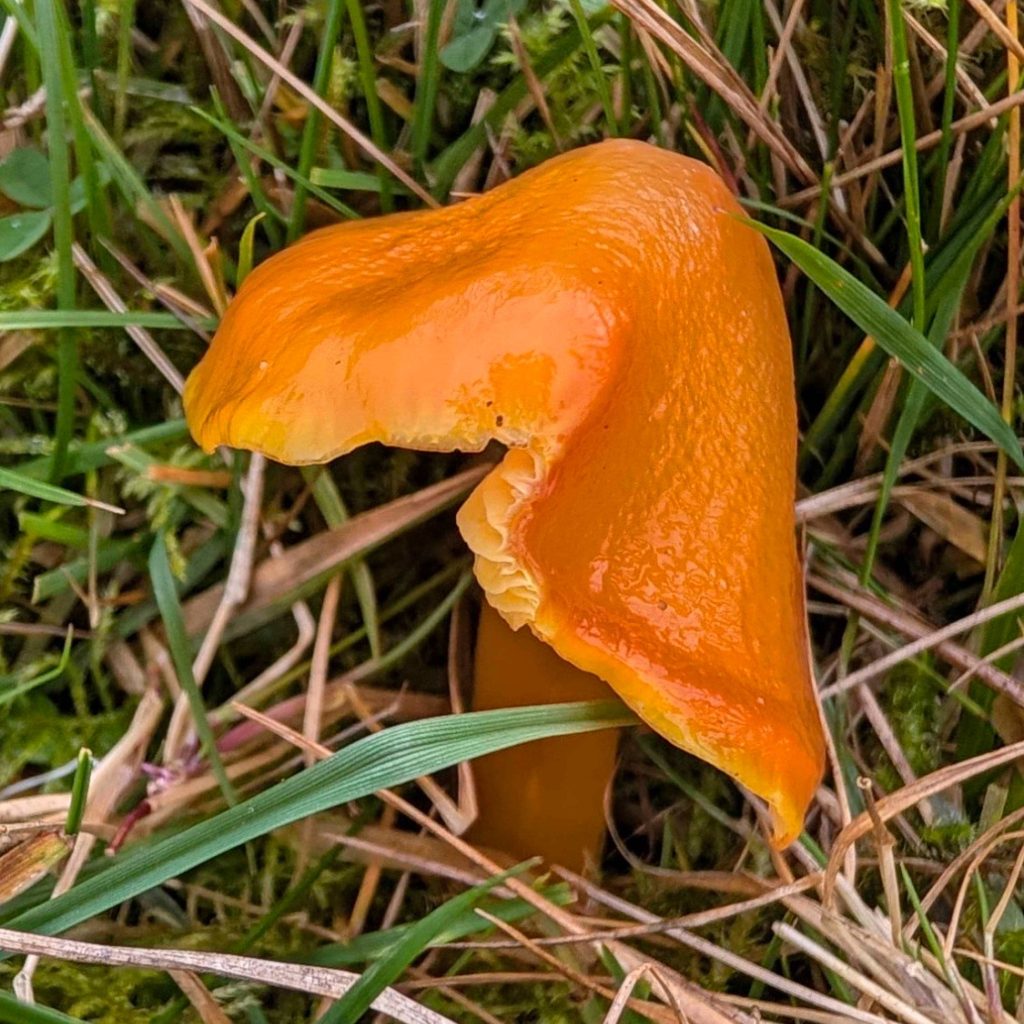
Almost as exciting, one final visit before the first frosts arrived turned up the rather impressive, vivid orange waxcap pictured below. I wasn’t entirely sure what I had at first, but thankfully a local expert has since confirmed it as Orange Waxcap Hygrocybe aurantiosplendens. Durr! It’s a pretty thing, with a slightly pruinose upper stem, which is definitely something I’ll be looking out for should I encounter it again.

Hygrocybe aurantiosplendens

Porpolomopsis calyptriformis
So there you have it, a little rundown of a successful autumn spent exploring an area of natural history that was, until recently, almost entirely alien to me. There’s something quite addictive about waxcaps, and the various corals and earthtongues that so often grow alongside them.
While I won’t be getting hooked on Entoloma just yet, I’ll definitely be continuing my forays into the world of CHEGD grassland fungi. From rarities such as Jubilee Waxcap to more familiar species, like Bitter Waxcap, that have somehow managed to elude me so far, there’s still an awful lot to see and learn. Roll on next autumn!
To that end, I’ve created a new page to keep track of my newfound autumn addiction…




Leave a Reply