A journey through the unusual trees (and shrubs) of Newcastle

A journey through the diverse and beautiful trees and shrubs of Newcastle-Upon-Tyne.

While I can separate the more familiar British species, your oaks, birches and common maples, anything beyond that has traditionally gone straight over my head. Not so useful in the city where planting and landscaping, both historic and recent, mean that would be botanists are presented with a mix of species from across the globe.

From Jesmond Dene to Walker and Heaton Park, in Newcastle, we’re lucky to have quite a few historic green spaces. Stuffed within them, many and more interesting species planted first by the Victorians – the famed Lord Armstrong springs to mind – and later, by successive generations of gardeners. Elsewhere, streets are planted with intriguing species and wasteland areas have been colonised by a whole manner of garden escapes.

For the past two weekends, I’ve spent my time attempting to identify and record as many of these species as possible. In keeping with guidance from BSBI, I’ve ignored anything that appears recently planted, instead focusing on species growing ‘wild’. Or at the very least, planted specimens that now form a permanent piece of the local environment.

Below, you’ll find a selection of the interesting plants discovered. I’ll caveat this post now by saying that I am by no means an expert – corrections welcome!

Shrubs

Particularly abundant in Armstrong Park and present, yet sparser in Jesmond Dene, the ornate, gold-spangled shrub below is Spotted Laurel (Aucuba japonica). A native of Japan and China, I assume this one was once popular in Victorian landscaping. Near the entrance to Armstrong Park, I also noticed a large specimen of what I think is Chinese Barberry (Berberis julianae).

Not quite as numerous as the familiar Cherry Laurel (Prunus laurocerasus) which I forgot to photograph but still plentiful is Portugal Laurel (Prunus lusitanica). With its glossy green leaves and pendant fruits, it is certainly an attractive plant. These ones were photographed in Heaton Park but plants can be found right along the Ouseburn.

With attractive flowers and often interesting leaves, I find viburnum species a pain to identify. The two below, spotted in Jesmond Dene, are only tentatively labelled but I think they could be Farrer’s Viburnum (Viburnum farrei) and Laurestine (Viburnum tinus).

A more straightforward viburnum is the Leatherleaf Viburnum (Viburnum rhytidophyllum) with its wonderfully wrinkled, slightly glaucous leaves. A number of these grow in a tamed setting around Heaton Park but a few wilder looking specimens can be found in Jesmond Dene and at Walker Riverside. Not a viburnum but still somewhat shrubby, Himalayan Honeysuckle (Leycesteria formosa) can be encountered from time to time in Jesmond Dene, and does look to be spreading.

If viburnums are frustrating, cotoneasters are just plain hard. Ignoring some of the species encountered recently, the three below proved somewhat easier to identify – if they are correct, that is. The first, Willow-leaved Cotoneaster (Cotoneaster salicifolius) seems to pop up from time to time in the local area. A number can be seen at Walker Riverside, though this one was spotted in Heaton Park.

Larger in scale, an impressive Tree Cotoneaster (Cotoneaster frigidus) can be seen in the Coalman’s Field area of Jesmond Dene. There are probably more in the dene but alas, I haven’t noticed them.

The final cotoneaster I think might be Hollyberry Cotoneaster (Cotoneaster bullatus), another native of China planted on occasion in the UK and fairly widespread based on BSBI maps.

A couple of oddballs now and the plant with the pretty yellow berries is Firethorn (Pyracantha coccinea), a species popular as a hedgerow plant that grows wild in a few places in Heaton. This would seem to be a yellow-berried cultivar as traditionally, the fruits of this species are red. The second I am less sure about but I wonder if it is Wilson’s Honeysuckle (Lonicera nitida)? Whatever it is, it seems to spread.

Trees in Newcastle

It may seem odd to include a fairly common tree in a post designed to highlight unusual species but White Poplar (Populus alba) is not a species I see too frequently in the North East. Despite its status as a fairly successful non-native, it is certainly one of my favourite trees and I had to include this specimen found close to home in Iris Brickfield Park.

Pointed out by another local naturalist, Iris Brickfield Park also holds a small population of Grey Poplar (Populus × canescens), a hybrid between the aforementioned White Poplar and its close relative, the Aspen.

An odd bunch now and meandering through Heaton Park, I was surprised to notice the large and hairy fruits of Turkish Hazel (Corylus colurna). It was interesting to see this one producing nuts – a search online revealing that this species fruits only once every two or three years.

Next up, English Walnut (Juglans regia) was a nice spot in Heaton Park. While this may be a familiar tree to many in the South, it is not something I see too often up here and makes for quite the attractive tree!

Also in Heaton Park, it was nice to encounter Grey Alder (Alnus incana), a native of the Northern hemisphere from North America through to Northern Europe. Here too, I also bumped into my first ever Tulip Tree (Liriodendron tulipifera). A sought after American species, this one appears to be much more abundant in the South of England.

Before moving on to a number of (much more appealing) oaks, two more oddballs now with New Zealand Broadleaf (Griselinia littoralis) and Sweet Mock-orange (Philadelphus coronarius) observed in Jesmond Dene.

The identification of oaks in the North East is usually a straightforward affair: English, sessile or turkey. Factor in the Victorian obsession with sourcing weird and wonderful plants, however, and things become a little more complicated. Below are two species I hadn’t even heard of until recently: Patagonian Oak (Nothofagus obliqua) and Pin Oak (Quercus palustris). A pair of nice oddities in Jesmond Dene.

The large Red Oak (Quercus rubra) growing on the Coalman’s Field was thankfully much easier and certainly makes for an impressive sight clad in its autumn colours.

Now, I haven’t the foggiest clue with whitebeams. Thankfully, however, others do and it was great to have this Mougeot’s Whitebeam (Sorbus mougeotii) pointed out in Iris Brickfield Park. Apparently, of the two species likely to be encountered up here, the more common Swedish Whitebeam (Sorbus intermedia) has spreading, as opposed to forward-pointing lobes.

I am including the familiar Common Hornbeam (Carpinus betulus) here too as I simply do not see it very often in the city. This one was photographed in Iris Brickfield Park, though others can be seen in Heaton Park and Jesmond Dene. Sweet Chestnut (Castanea sativa) to is seldom encountered and it was nice to stumble across some rather impressive trees in Jesmond Dene. A real treat at this time of year clad in thousands of distinctive spiney fruits.

The rather pretty birch shown below with its papery white bark is Himalayan Birch (Betula utilis), a species commonly used in landscaping which has been planted in the Coalman’s Field area of Jesmond Dene.

Maples are an attractive group of trees come autumn and it has been nice to catch up with a number of interesting ornamental species in Jesmond Dene. The first Paperbark Maple (Acer griseum) is a real beauty with wonderful, flaking red bark and distictive leaves. A couple can be seen in the Coalman’s Field area where the second species, Cappadocian Maple (Acer cappadicicum) also grows.

Silver Maple (Acer saccharinum) has particularly striking leaves quite different to any other maple species in the local area. A single tree grows in the same areas as the species listed above.

Japanese Maple (Acer Palmatum) is a tree familiar to many from gardens across the UK, with a number of bonny cultivars often used in planting. Or containers, in the case of my garden. Individuals of this species can be found in both Heaton Park and close to the Armstrong Bridge in Jesmond Dene.

Finally, for this (rather long) trip through Newcastle’s more unusual broadleaf trees, it would seem that I have been ignorantly walking past the below tree for a number of years. A native of Southern Europe and North Africa, Narrow-leaved Ash (Fraxinus angustifolia) boasts some superb autumn colours. The cultivar of this one would appear to be ‘Raywood’ a variety with great colour and relatively few branches.

Many thanks to Michael for drawing my attention to this, and to others mentioned previously.

I am not yet brave enough to tackle conifers – they’re just so hard to identify – but it was nice to happen across two particularly exciting species in Jesmond Dene. The first, Dawn Redwood (Metasequoia glyptostroboides) grows around Pet’s Corner and crops up again further into the dene and has a really distinctive look about it with its yew-like flattened needles. The world’s largest tree, Wellingtonia (Sequoiadendron giganteum), needs little introduction. In this case, a closer look at the cones and (wonderfully soft) bark had to suffice.

And there we have it! Looking closer at the unusual trees and shrubs of Newcastle certainly has been an eye-opening experience – there are just so many to choose from. Hailing from right across the globe, the variety here is impressive and while all may not be ‘wild’ in the traditional sense, they do form a core part of the local ecosystem.

I will look to tackle conifers in a future post and may also share some of the more abundant, native species to be found in the local area but until then, hope that this post may encourage others to look closer at urban trees. They’re certainly an interesting bunch!

The flora of Iris Brickfield Park

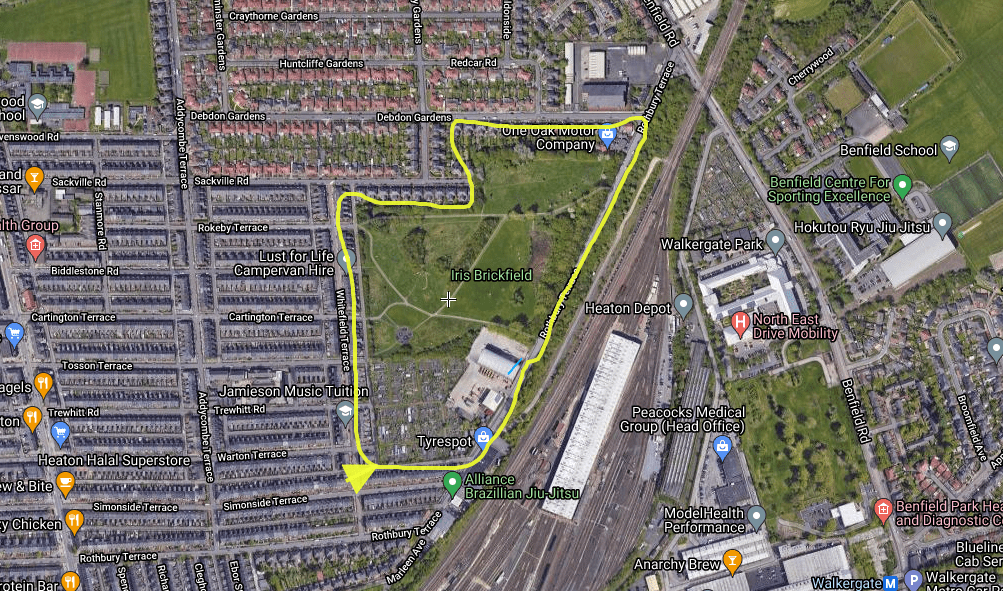
Iris Brickfield Park sits fairly close to our home in Heaton, Newcastle, and as such, has been a mainstay of our local walks during the pandemic. Fairly small, at least when compared to Newcastle’s other parks, and managed by Urban Green, it provides a lifeline to many people living in the local area: dog walkers, joggers, families and of course, naturalists stuck in the city.

This year, I have been making a concerted effort to record as many plants as possible growing in this small park, focusing on those growing in a wild or naturalised state. Plants that have clearly been planted have been ignored, though long-established street trees and hedgerow plants have been recorded per guidance from the BSBI. The aim of this is to create a somewhat comprehensive checklist for future visits, and for anyone else keen to know more about the flora of the park.

As very much a beginner botanist, the site list will not capture everything found within the park. I know for a fact that I have missed some grasses, while I am not yet able to confidently identify the various willowherbs found here. If anything looks out of place, please do let me know.

All records will (or have already been) submitted to BSBI recorders through iRecord.

Species list

In total, I have recorded 159 plant species in the park this year. Not bad for such a small area! For the sake of simplicity, I have not broken this down into grid squares but instead, have broken it down based on the three key areas present: the park, its pond and the nearby Iris Brickfield Allotments. The wider park contained the greatest diversity owing to a mix of both woodland and meadow habitats, though the pond too was surprisingly diverse. The exterior of the allotments held a few interesting species, including several escapes ‘tossed over the fence’.

The full species list can be viewed below.

Trees and shrubs

The trees and shrubs of Iris Brickfield are fairly diverse. Common species such as Ash (Fraxinus excelsior), Sycamore (Acer pseudoplatanus), Wild Cherry (Prunus avium) and English Oak (Quercus robur) are abundant, interspersed with a small number of Field Maple (Acer campestre), Bird Cherry (Prunus padus) and Scot’s Pine (Pinus sylvestris).

Small areas of White Poplar (Populus alba) and Norway Maple (Acer platanoides) are present and Aspen (Populus tremula) appears to be spreading quickly in certain areas. Single trees and anomalies include False Acacia (Robina pseudoacacia) and Hornbeam (Carpinus betulus).

Shrubs are not particularly diverse, though the Western boundary of the site includes Cherry Laurel (Prunus laurpcerasus), Guelder Rose (Viburnum opulus) and plenty of Dogwood (Cornus sanguinea). To the North, Cherry Plum (Prunus cerasifera) is plentiful and elsewhere Blackthorn (Prunus spinosa) grows in abundance.

Wildflowers

Wooded areas of the park hold several species commonly associated with mature woodland and whether these were once planted remains to be seen. Wood Anemone (Anemonoides nemorosa), Ramsons (Allium ursinum) and English Bluebell (Hyacinthoides non-scripta) can be found, and while scarce, one small patch of Lesser Celandine (Ficaria verna) can be found. The non-native Spanish Bluebell (Hyacinthoides hispanica) can be seen too, albeit in small numbers.

Grassy areas away from the playing fields and other mown areas hold a nice mix of typical ‘meadow’ species. Here, Common Bird’s-foot Trefoil (Lotus corniculatus), Red Clover (Trifolium pratense) and Hairy Tare (Vicia hirsuta) are conspicuous and Creeping Cinquefoil (Potentilla reptans) plentiful. Also present are Field Scabious (Knautia arvensis), Common Knapweed (Centaurea nigra) and Goat’s-beard (Tragopogon pratensis). Both Common Ragwort (Senecio jacobaea) and Oxford Ragwort (Senecio squalidus) also pop up sporadically.

Common Mallow (Malva sylvestris), Sweet Violet (Viola odorata), Sneezewort (Achillea ptarmica) and Wild Teasel (Dipsacus fullonum) are less common here but exist in small patches scattered across the site.

Other highlights include scattered patches of Stinking Iris (Iris foetidissima), one of only two native iris species in Britain, and Common Poppy (Papaver rhoeas) which occasionally appears in unusual places.

Non-natives and adventives

Sweet Alison (Lobularia maritima) can sometimes be seen growing by path sides and befitting the park’s urban surroundings, Butterfly Bush (Buddleja Davidii) has a habit of springing up in odd places. Likely an escape from the nearby allotments, Borage (Borago officinalis) occurs but seldom persists long and occasionally, Purple Toadflax (Linaria purpurea) will take hold in a crevice or crack.

Slightly more troubling, Japanese Knotweed (Fallopia japonica) has begun colonising and the small pond is blanketed with New Zealand Pigmyweed (Crassula helmsii).

Wetland area

The small pond in Iris Brickfield makes for an interesting pitstop throughout the year. Despite facing problems from the aforementioned pygmyweed, and the rampant spread of Common Reed (Phragmites australis), Sweet Reed Grass (Glyceria maxima) and Bulrush (Typha latifolia), a few interesting species can be found tucked away in nooks and crannies. The most colourful of these being Flag Iris (Iris pseudacorus), Purple Loosestrife (Lythrum salicaria), Yellow Loosestrife (Lysimachia vulgaris) and Marsh Marigold (Caltha palustris).

Gypsywort (Lycopus europaeus) was observed for the first time in 2021, and the margins hold a healthy population of Water Mint (Mentha aquatica) and Meadowsweet (Filipendula ulmaria). Bogbean (Menyanthes trifoliata) and Water Horsetail (Equisetum fluviatile) persist here too.

A little less showy than the aforementioned flowers, a good variety of rushes and sedges can be found here too including Jointed Rush (Juncus articulatus), Lesser Pond Sedge (Carex acutiformis), Soft Rush (Juncus effusus) and Common Spike-rush (Eleocharis palustris). The alien-looking seedheads of Branched Bur-Reed (Sparganium erectum) are also interesting.

Whilst not numerous, Northern Marsh Orchid (Dactylorhiza purpurella) can also be found in the surrounding damp grassland.

Allotments

Whilst the allotments at Iris Brickfield are private and access is not permitted (or possible), a poke about the margins of the area can reveal some interesting plants. Black Nightshade (Solanum nigrum) is notable here in Summer and in spring, Three-cornered Garlic (Allium triquetrum) can be seen. 

The hedges that screen the site are comprised mainly of ornamentals such as Firethorn (Pyracantha coccinea), Common Lilac (Syringa vulgaris) and Flowering Currant (Ribes sanguineum), though native species such as Wych Elm (Ulmus glabra) have found their way in too. Perhaps the oddest occurrence here is that of a sprawling Grapevine (Vitis vinifera) which appears to have escaped cultivation to colonise the hedge. 

Notable and unusual

Two plants in Iris Brickfield stand out as notable. The first, Milk Thistle (Silybum marianum), is a peculiar one. With two small plants found in the grassland this year, I was optimistic about seeing these flower. Alas, they now appear to have been trodden to death…

The occurrence of Marsh Mallow (Althaea officinalis) close to the pond was most unexpected and represented a notable vice-county record. An escape from cultivation at some point in time, its large, pink flowers stand out like a sore thumb at the height of summer.

And there we have it. I’ve certainly found it interesting getting to grips with the flora of my local patch this year and will endeavour to keep similar lists for other sites I frequent in the future. I hope someone may find this type of post interesting and it goes without saying, if you notice any errors or ‘unusual’ records, please let me know.

A trip into the wildlife garden

Much as it did for great many people, I suspect, lockdown led to an increasing focus on gardening in our household. The focus for us being to transform our little urban yard into something appealing, for both wildlife and ourselves. I wrote about our mini-rewilding efforts a little last year (here) but realising that I hadn’t mentioned the topic since, wanted to provide a progress check.

For us, the major focus of this spring was to incorporate more wildflowers into our space. Sure, dahlias, marigolds and sedums look nice but they offer limited value for wildlife. Whilst we still have all of the above, and a range of more typical garden plants, the ratios have shifted.

The veg patch was first to go, sown in early 2020 with a native meadow mix, it didn’t do much in its first year. The clover did well but little else. This year, however, it has thrived with Oxeye Daisy, Red Campion, Red Clover and Black Medick vying to see who can grow the tallest. If you rummage in the understory, you can find other species in their too – Bladder Campion, Redshank and White Clover – but by large, the other species sown (including my long-awaited Musk Thistles) appear to have been shaded out. No matter – our 6ft seed grown Cotton Thistle has the spiny element covered!

Whilst growing a range of commonplace wildflowers, this year we also wanted to grow a few more unusual species, if only to prove that we could. Henbane was sown as an experiment in Autumn, and is just about to bloom, while both Small Teasel and Moth Mullein are doing well. Chuck in others such as Great Burnet, Salad Burnet and Common Bistort and it seems we’ve succeeded in our initial trial run!

Planning ahead for next year, it looks like we will be taking the cultivation of wildflowers to a new extreme. Already, four species of Mullein have been sown – Twiggy, Dark, Hoary and Moth for those interested. Where we’ll put these huge plants is a little beyond me, but we’ll manage.

Tucked away in the greenhouse there’s also White Horehound, Sea Campion, Field Pansy, Scot’s-lovage, Motherwort and (more) Henbane. I may need to open an online store, especially with the Mountain Pansy and Spotted Hawkweed seeds yet to arrive.

Our challenge next year will be to grow the native Herb Paris seeds purchased recently but I suspect they may turn out to be a tad picky.

But what about the wildlife? This isn’t after all a gardening blog. Well, at our last tally, we have now recorded 155 species in and around the garden since last spring.

Bees have certainly been a stand out highlight and it has been great to welcome back Fork-tailed Flower Bee, Patchwork Leafcutter and Bronze Furrow Bee alongside the more regular solitary bees and bumblebees.

In the last few weeks, we have also recorded two new bees here with Willughby’s Leafcutter Bee and Davies’ Colletes both shown below. Add to these 11 species of hoverfly, sawflies, solitary wasps and four species of butterfly, and the airspace here has been fairly busy.

We didn’t concentrate much on moths in 2020, owing to the installation of a new LED street light overlooking our yard. This year, however, we have persevered and have recorded several new species, albeit in low numbers. The Scalloped Hazel, Lychnis and Figure of Eighty shown below were particular highlights, though the others shown were most welcome. In particular, the Cinnabars, which have occurred in unusually high numbers this year.

It also appears that planting mint and oregano was a good idea and a few weeks back, I was delighted to spot a pair of beautiful Mint Moths, Pyrausta aurata in this case, showing an interest in these. Fingers crossed that they managed to breed – they really are a delight.

lsewhere, there’s bee a lot to see, including egg-laying Green Shieldbugs, sprawling webs of juvenile Garden Spiders and an all too brief Orange Ladybird that sped off quickly when I reached for the camera.
The 14-spot Ladybird adorning our Buddleja was thankfully more obliging.

Wildlife recording on the street – looking back at 2020

When lockdown dawned in 2020 and naturalists across the country were forced to redirect their wildlife-watching close to home, I set myself a challenge: to find and record as many species as possible on and around my Newcastle street. Birds, bees and butterflies; mammals and molluscs, everything and anything counted. An easy task, or so I thought – there couldn’t possibly be much to be found within a small area of parkland, rail verge, and urban conurbation.

Fast forward to the start of 2021, and with a few final pleas for help identifying the last few remaining invertebrates, it seems I concluded the year with 272 species recorded on the streets of Heaton. Not a bad total for someone almost entirely new to biological recording and with little experience with anything lacking feathers.

A few highlights and musings follow…

Botany

Throughout 2020, 137 plant species were recorded during walks in Heaton. Unsurprisingly, the highest total of any group. Many of these were to be expected – Groundsel, Danish Scurvygrass, and Sun Spurge – ‘weeds’ often associated with urban areas. That said, there were several surprises and highlights. The presence of Northern Marsh Orchid and Sneezewort in the local park, deep-red Scarlet Pimpernel and sprawling Bittersweet tucked into the hidden corners of the street, and the odd bloom of Cuckooflower and Goat’s-beard.

Befitting my location, many of the plants recorded here in 2020 were somewhat tropical in origin. Heaton, it seems, is home to a wealth of globe-trotting flora. There was, of course, plenty of Buddleia, Trailing Bellflower, Yellow Corydalis and Opium Poppy to be seen; though there were a few surprises. Stands of Greater Quaking-grass and Black Nightshade were notable, Procumbent Yellow-sorrel was an interesting find and Causican Crosswort was most unexpected. I suspect there will be a few more escapees and garden renegades to uncover in 2021.

Prior to 2020 and the onset of the Natural History Society of Northumbria‘s North East Bee Hunt, I confess, I hadn’t spared much of a thought for bees and certainly couldn’t identify them. With this in mind, I was delighted to record 17 species of bee close to home. Some of these were to be expected – Tree Bumblebee, Common Carder and the omnipresent Buff-tails – but others were slightly more interesting. In the local park, colonies of Chocolate, Tawny and Buffish Mining Bees were unearthed (not literally). In the garden, Bronze Furrow Bee and Blue Mason Bee became regular visitors and a bit of sympathetic planting lured in Patchwork Leafcutter and Fork-tailed Flower Bees.

When it comes to wasps, I still haven’t a clue, though some friendly advice from the good folk of Twitter identified a moribund wasp as Median Wasp – a new species for me altogether.

Flies (mostly hoverflies)

Like bees, flies were new to me in 2020 (and even more confusing). With the help of the superb Wild Guides hoverfly publication, I was, however, able to make a start identifying the various species present on and around my street. In total, 21 species were observed. Among these, Pied Hoverfly and Narcissus Bulb Fly were particularly abundant. The garden also came up trumps again in this regard luring in Scaeva selenitica, Sphaerophoria scripta and Melangyna labiatarum.

Other flies were few and far between or rather, overly taxing, but Dark-edge Bee-Fly, Holly Leafminer and the tiny Trypeta zoe were all interesting spots.

Doubtless, there will be many more to uncover in 2021, should I develop the patience…

Lepidoptera

It was a poor year for moths here owing to street lights that overhang our yard, though the moth trap did yield one notable highlight: Obscure Wainscot, a regionally scarce species and a specialist of marshland and fens. Neither of which are present in the immediate vicinity. A brace of more familiar species including Peppered Moth, Grey Pug, Barred Yellow and Bee Moth at least ensured an entirely unrespectable list of 23 species recorded on the street. Another stand-out highlight was a Mother Shipton netted as it crossed the garden in Spring.

Whilst it was a bad year for moths, it was certainly a good year for butterflies with 9 species seen. Orange-tip in Spring was a welcome addition as was a new colony of Holly Blue that appears to have sprung up on the outskirts of the nearby allotments. Small Skipper and Ringlet adorned the local park throughout summer and our ever-trusty garden Buddleia succeeded in luring in Red Admiral, Peacock and Speckled Wood.

Let us hope for a Painted Lady in 2021, a species conspicuous in its absence last year.

Other smaller life

Records of other insects were few and far between and there is clearly still much to do in this regard. Among the beetles, Rosemary Beetle and Cream-spot Ladybird were highlights, and we did manage four species of Shieldbug. One of which, the Blue Shieldbug, was quite exciting.

We got off to a good start with molluscs too with Great Ramshorn and Great Pond Snail scooped from a local pond and the garden attracting Green Cellar Slug, Iberian Three-band Slug and some impressive Leopard Slugs.

The surprising lockdown hobby of counting woodlice also yield five species, one of which – Porcellio spinicornis – was entirely new to me.

As for spiders? Two notable records were had. The first, Hypositticus pubescens, constituting the first record for North East England for around 90 years. The second, Pseudeuophrys lanigera, is a similarly rare (or under-recorded) jumping spider.

Birdlife

Birds were never going to be the most numerous group so close to the city, but I did manage a respectable 42 species on walks close to home. Setting aside the tits and finches, it was nice to catch up with Siskin and Meadow Pipit as they migrated south over the house and the daily commutes of the local Ring-necked Parakeets added a splash of colour on dull days. A lone male Reed Bunting perched atop the tiny stand of Phragmites in Iris Brickfield Park was most welcome, as were a party of Redwing in late winter. Other highlights included Jay, Blackcap, Stock Dove and Oystercatcher.

What next?

Whereas like many I suspect, I thought lockdown and the resulting banishment from my favourite haunts would lead to endless boredom, I was pleasantly surprised to find the process of observing and recording wildlife close to home both cathartic and educational. I’ve learnt a great deal and, dare I say it, seem to be developing a wider appreciation for natural history in all its forms – as opposed to the birds, colourful orchids and iconic mammals that interested me previously.

I think I’ll continue with the process (or at least the attempt) of documenting my local, urban wildlife in 2021, albeit with a few changes. In the interest of diversity, I’ll be spreading out from the street to cover a circular 1-mile of Newcastle. What I’ll gain from this remains to be seen, but the extra shred of parkland, a small portion of the nearby Ouseburn, a cemetery and a few more streets to comb will undoubtedly help. I’ll also make a much more concerted effort to add everything I find (or at least the species I can competently identify) to iRecord.

Already, at the start of 2021, some twenty new species have been found in the local area. Fungi, bryophytes and molluscs mainly, which coupled with a renewed focus on invertebrates in Spring and Summer should provide challenge enough for this year.

Let’s set a target of 500 species by 2022 within the urban mile…

Bringing the wilds home: a backyard experiment

The problem with living in any city, whether that be London, Manchester or, like me, Newcastle, is that space is often at a premium. Large expansive gardens and idyllic personal grottos are few and far between and, more often than not, residents are forced to make do with small, confined and often uninspiring spaces.

Living in Heaton, a large urban district of Newcastle, our terraced flat comes with very little land. A small back garden, walled on all sides and entirely covered in concrete the sum of the area we have to work with. Our mundane little plot lacked even a small patch of soil in which to grow something, anything green. Far from ideal for someone who yearns to engross himself in nature whenever possible.

Tired of staring uninspired at bricks, steel and concrete, back in the Spring, and my partner set ourselves a small challenge: to attempt to ‘green up’ our little corner of urban Tyneside. In doing so, aiming to make our space as appealing as possible to as many different species as possible. The sum of our garden wildlife sightings, until this point, consisted of little other than a handful of moths and the odd wandering Magpie.

Starting out…

The cornerstone of any garden the first thing we needed to add in order to make our space wildlife-friendly was, of course, soil. And so we set about buying planters of all shapes and sizes – long and shallow, round and deep, hanging, you name it – collected with the aim of growing as many plant species as possible. Including, we had hoped, at least a few edibles, alongside pollinator-friendly blooms and a few ornamentals. Within a few weeks, these initial pots and troughs had been filled: Honeysuckle, Lavander, Thyme, petunias and Bay Laurel representing the first living organisms to grace our plot.

A few weeks later, and lacking space for any substantial body of water, we opted to add a container pond, planting the admittedly rather unattractive plastic tub with a handful of native water plants – Marsh Marigold, Hemlock Waterdropwort and Flag iris. A mini-project closely followed by another with the addition of two mini-meadows – pots planted with Seedball wildflower mixes – and next, a raised bed suitable for our edible produce. The latter soon filled to bursting with chillis, lettuce, Bok Choi and later, a few more varieties of cabbage. Following this, more plants were added. Taller wildlife-friendly options – Raspberry and Blackcurrant – and a range of low-lying species.

Getting there (I promise Matt did not do ALL of the work)

Fast-forward to the end of Summer and, at the time of writing this, the garden – I finally feel comfortable using this word – looks altogether more pleasant. Looking out of the window this morning, I see pleasant green, not grey. And all in all, our space feels altogether different: uplifting as opposed to depressing. The results of our exploits can be seen below for those interested.

The current state of play…

But what of the all-important wildlife? Did it descent on our humble space en masse, as we had intended? Well, yes. To date, we have recorded no less than 66 new species for the garden. The pollinators arrived first, Tree, White-tailed, Red-tailed and Garden Bumblebees, Honeybee, Common Wasp, Common Carder, Marmalade Hoverfly and Large White butterflies representing a few of the more obvious visitors. Among the more common denizens, a few surprises were to be had too – the unlikely discovery of a small, metallic bee deceased in our new bug hotel heralding the arrival of a species which, before its occurrence here, I had never even heard of: the Bronze Furrow Bee. A species with a patchy national distribution; poorly recorded and not overly abundant.

Next came the Red Mason Bees – now in residence within a crack in our neighbour’s wall – while moth numbers to have increased also. Silver Y, Angle Shades, Setaceous Hebrew Character, Heart and Dart, Light Brown Apple Moth and Large Yellow Underwing respecting just a few of our nocturnal records. A more surprising record coming from a Six-spot Burnet found during the day on our Runner Beans in July – not a species I would often associate with the less than wild streets of Newcastle.

Heart and Dart, Angle Shades, Slug-fest, and a bumble rescue.

Of course, with a range of tasty edible crops planted, it was inevitable that ‘pest’ species would follow at some point. And sure enough, they did: our cabbages were besieged by the larvae of Small White and Diamond-backed Moth; our Honeysuckle fell victim to aphids; we lost an entire crop of Swiss Chard to Cabbage Fly and Yellow Cellar Slugs and Garden Snails were quick to find any seedlings. Interesting species in their own right which, in turn, have sparked an increase in other, much more welcome creatures: 7 and 14 Spot Ladybirds, colourful members of the Ichneumonoidea family, Harvestman, centipedes, beautiful Garden Spiders and fearsome-looking House Spiders. Now, equilibrium has been reached and plants remain relatively damage-free.

For the last few weeks, new additions to our growing ‘garden list’ have followed thick and fast. A fortnight back, we were delighted to discover no less than 9 Painted Lady at roost beneath one of our hanging baskets. This morning, they’re still there; although numbers have dwindled somewhat. Elsewhere, Matt discovered a Buff Ermine caterpillar ravenously consuming our small Buddleia plant and today, a glance in our container pond revealed a few new colonists: water fleas and hoverfly larvae.


Now, I will not go so far as to claim that our little urban garden looks all that nice. Nor does it compare to the micro-rewilding efforts often shared on social media – those wonderful tales of gardens transformed into makeshift nature reserves, gorgeous and incredibly biodiverse. We are definitely proud, however, to have created something beneficial to local wildlife and enjoyable (and useful, taking into account all our veggies) to ourselves. We stand content to watch and enjoy for the remainder of this year and already find ourselves looking forward to amending our space further in the future, so to make more of a difference. Perhaps we will invest in a creeper to cover some of the remaining walls, or just maybe, we’ll expand on our mini-meadows with another of our bargain grow beds. We will see!

On a final note, I must apologise for the quality of the photos used in this article – it seems there has been a problem uploading photos from my phone to the computer. Not that this presents too much of an issue, they still get the point across.

An update from the birdtable

It won’t have escaped your attention – at least if you follow me on Twitter – that, just over a month ago now, myself and my partner erected a new feeding station in the front ‘garden’ of his home in the centre of Heaton, Newcastle. Big woop, you might say; though please bare in mind that this is not exactly your typical garden. Rather a 2x2m stretch of cold, grey concrete boasting one measly shrub, positioned right next to a busy road and, worse still, outside and adjacent the front doors of multiple student abodes. Indeed, before this, we were yet to see a bird in the garden. Not a single one. Little wonder really given the constant noise and clamour.

It’s not much, really…

Well, after kitting out the towering stand of cast iron with myriad tasty morsels ranging from sunflower hearts and peanuts, to suet balls and mealworms, I have been watching the proceedings daily – spurred on by claims on social media that, no matter the location, if you provide, they will come. Something that now, after countless vigils, I know to be true.

Sure, given our location we were never going to attract the sweeping accumulations of your typical, rural garden; though what I have observed thus far has been promising. A pair of Dunnocks were first to arrive, now present daily and looking as if they are nesting in the lonely Privet pictured above. House Sparrows came next, and though their visits to date have been fleeting, they are growing in regularity – with the same being said for the Blackbirds and Blue Tits sporadically gracing us with there presence. Singles of Goldfinch and Magpie and a pair of gluttonous Woodpiegons complete the set.

Now, these scant avian visitors may do little to excite readers of this blog: those accustomed to busy feeders and great gatherings of scarce or appealing species in their gardens. To me, however, they represent a victory. A little slice of the natural world right in the heart of the city that can be enjoyed daily – though most often with a coffee in the early morning.

I wonder what will arrive next? My money is on a Robin, or perhaps a Starling; though I did observe a Collared Dove inspecting matters from a neighbours roof yesterday…

Pigeon and Pie – our two visiting Woodpigeons

The eye of the beast

I dislike our tendency to name storms and weather fronts almost as much as I dislike our habit of blowing such things entirely out of proportion in this country. Often panicking without justification when snowflakes fall and temperatures decline ever so slightly. That said, the Beast from the East, as it has been labelled by the story-hungry media, has been pretty unique and I cannot remember a time (in my lifetime, at least) when conditions have appeared so overwhelmingly bleak. Indeed, much of this week has been spent huddled in the house, book in hand, hiding from the worst of the weather. Ignorant, some may say, to the happenings in the wider ecosystem outside.

Breaking from the norm, however, yesterday saw me wandering the wilds of my local park – Heaton, in Newcastle – with the aim of discovering the impact of the beast on my local wildlife. It was not a pretty picture. All around yesterday the signs of hardship were apparent: snow blanketed the floor almost a foot deep in places and covering vital food sources, the temperatures sat at an energy-sapping minus two degrees and areas of open water, from puddles to streams, stood frozen and still. The result being that it took some time – half an hour no less – before the first signs of life became apparent amid the icy desolation.


Weather such as this, of the kind raging outside at present, poses a significant threat to many forms of wildlife; though none more so than small birds – the passerines who must feed near constantly in order to sustain themselves and generate enough body heat to see out our frigid Winter nights. When snow falls, food sources are concealed and untold numbers of birds perish. Indeed, it is frightening to think of just how many creatures must surely have died over the past few days. From tiny Goldcrests to thrushes and riparian wagtails, many must surely have met their demise during the beast. In the wider countryside, in our cities and even in our very own gardens.

On the subject of Goldcrests, I had not expected to see any yesterday; though the sight of two birds feeding at ground level atop the snow proved sobering. The tiny passerines, sporting their sunshine yellow crests, hopping deftly over the crystalline surface, appearing to snatch unseen morsels from the ground before scampering up into the lower branches of a Holly. Doubtless in search of the meagre few spiders and other insects not banished by the cold. It was heartening, truth be told, to see the crests persevering in spite of the weather, and amazing to think that such a small bird can survive such inclement weather at all.

Elsewhere in the park, life appeared equally hard for other species of birds. Usually, timid Blackbirds threw caution to the wind as they fed and dug in close proximity to dog walkers – hunger overriding better sense, in this case. Here too, Woodpigeons had gained confidence, joining their feral kin in enjoy scraps from a small child’s sandwich; while an unruly mass of thrushes – Redwing, Blackbird and Song Thrush – squabbled and fought over the scant Cotoneaster berries still adorning a bush towards the Western periphery of the park. One particular Redwing, set apart from the scrum, providing perhaps the most poignant testament to the hardship of the season: unmoving as I approached and appearing sleepy, lethargic. The bird – shown below – seeming spent, sluggish and beaten – waiting on its branch for the inevitable to a happen. A sorry fate for a bird which arrived in this country back in September hoping to escape the rampant weather of Northern Europe.

Departing and leaving the Redwing to its fate – whatever that may be – I wondered what had become of the parks other avian residents. The tits, finches, robins and wrens usually abundant yet strangely absent during the mornings’ foray: I soon found them. A chance wander into a quieter corner of the park revealing a scene of hope. Here, amid a particularly dense tangle of trees, some person, some saint, had placed out bird feeders. Filled to the brim with sunflower seeds, peanuts and other treasures, they had not gone unnoticed by the birds and myriad species fed en masse, vying for position at times yet oddly at ease with each other. Doubtless the result of the harsh conditions.

Here, the most noticeable deviation from the norm came from the Robins: with no less than ten birds feeding in close proximity. Usually territorial, these birds appeared to accept one another, lashing out half-heartedly at times, yet, by large, much more tolerant. Hunger can work wonders for neighbourhood spirit it seems.

Gazing through the throng surrounding the various seed dispensers, it was the diversity of the accumulation that struck me most of all. It appeared that half of the woodland had descended, keen to make the most of this vital food source. Blue and great tits too numerous to count cackled in the upper branches, occasionally dropping down to feed, Dunnock’s snagged spilt seed from the snowy ground in the company of Blackbirds and a male Great Spotted Woodpecker lorded over its preferred feeder, it’s presence deterring the other species who waited patiently on the outskirts. Add to these countless chaffinches, a pair of Stock Dove and singles of Redwing, Nuthatch and Jay, and there was more than enough to keep me enthralled throughout the morning. Though, as ever, my favourites (if I am allowed favourites) were the Bullfinches – three of which dropped in repeatedly during my stay and even posed for a few acceptable photos.


RSPB Big Garden Birdwatch – My Results

There is still time this weekend to take part in the RSPB’s annual Big Garden Birdwatch – a fabulous (and fun) scheme which contributes greatly to the knowledge surrounding our garden birds. Highlighting current trends, increases, decreases and eruptions in avian populations through the power of citizen science. To take part, you only need a garden or, for those of you like me lacking in this regard, a local greenspace.

For my BBGW efforts this year I focused on two urban parks in Newcastle, dedicating an hour of my time to each over the course of this morning. The first, Iris Brickfield Park, is more or less your typical urban greenspace, boasting little more than an extensive field, a small pond and a series of scrubby areas. Surrounded entirely by housing, the results of the survey here (shown below) were more or less typical for this type of setting.

As you can see, seven of the species seen here also featured in the national top ten from 2017. Albeit in a somewhat different order. For example, my most numerous species, the Goldfinch, features at number one here compared to number six nationally; while House Sparrow takes the number six spot compared to number one nationally. It is little wonder Goldfinch snatched the top spot – they have, after all, increased substantially over recent years – though it was still heartening to record at least some Starlings and House Sparrows. Here Coal tit just edged out the remaining two species seen on my visit – Feral Pigeon and Great Tit – to secure its place in the top ten.

My second site was – Heaton Park – was a much more appealing prospect for a bird survey; boasting no end of mature trees, dense cover and even a small stream on its peripheries. The diversity of the habitat hearing resulting in the surprise addition of Kingfisher to this mornings list (my first in the city) and two Moorhens. Still, if you look at the results below, they remain somewhat true to the national trends…

Here, Goldfinch again snatched the top spot – owing to the charm of fifteen birds putting in an appearance towards the end of my watch – and Woodpigeon, Blue Tit, Blackbird and Carrion Crow featured prominently, once again. At number four on my list, Blue Tit matches its position in the national rankings from last year.

Today’s results are more or less what I expected from this years BGBW (minus the Kingfisher), though there were a few notable omissions. Bullfinch, usually abundant here, were completing absent, as were Greenfinch – little wonder given the state of the wider population. Similarly, not one Collared Dove, Chaffinch or Song Thrush was seen during the course of the morning; although this was offset somewhat by the appearance of Long-tailed Tit and Great Spotted Woodpecker.

This may not be interesting to you guys at home, but to me, it’s positively riveting.