Motivated by last year’s fern forays and spurred on by my new membership of the British Pteridological Society, I have decided to try something different this year: a personal challenge to see as many of Britain’s fern species as possible in a single year. The idea being that, by seeking out our ferns, I’ll learn more about them, their habitats, and the subtleties involved in identifying them. This blog will be part #5.
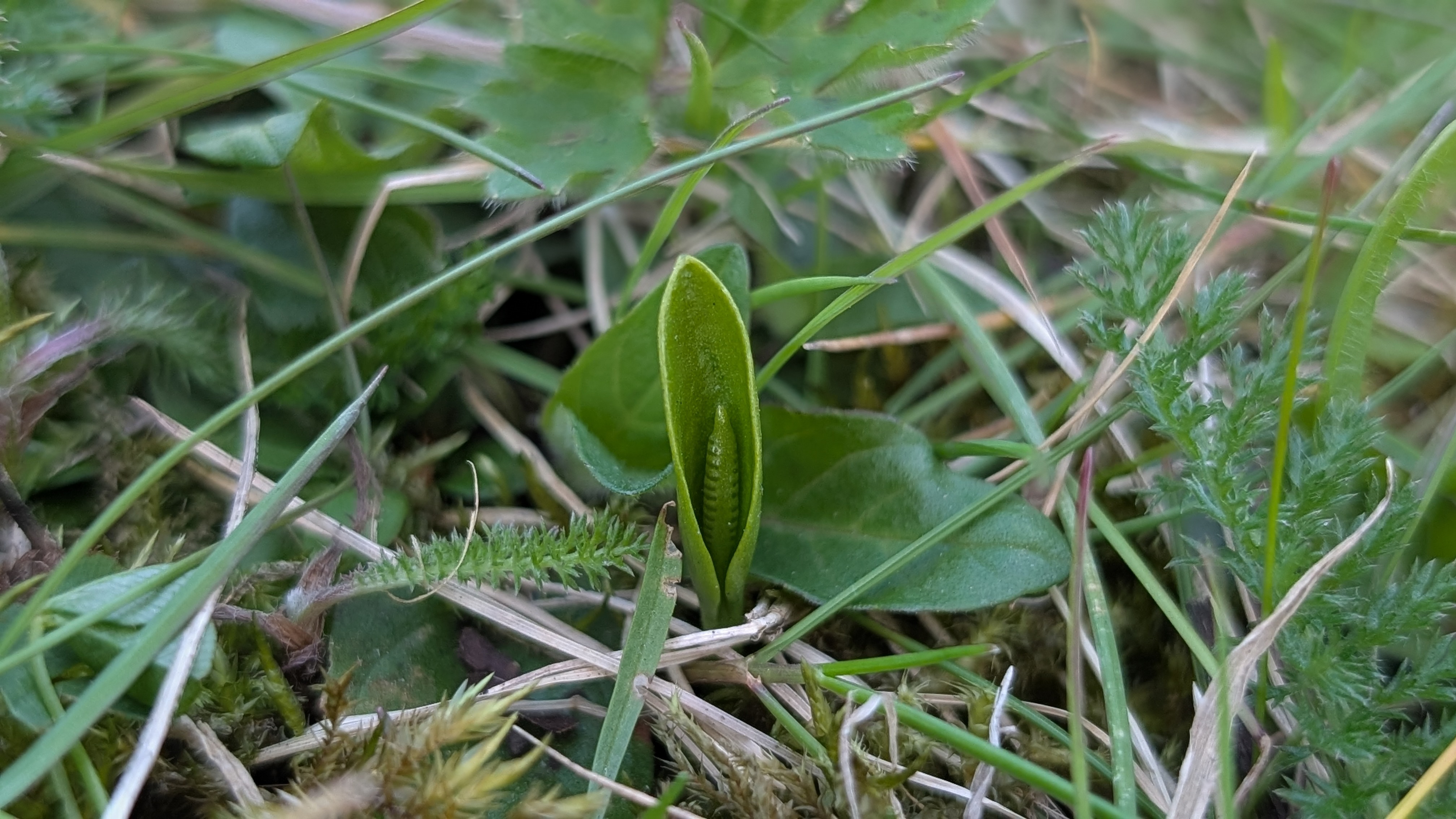
Adder’s-tongue – 17 April
Whilst there hasn’t been much time for fern hunting of late, things have been ticking along nicely. Although I have a few more exciting trips planned, much of my recent botanising has taken place closer to home, resulting in just two new finds. The first was Lady-fern Athyrium filix-femina, which is now beginning to appear almost everywhere. The second find was far more exciting.
Adder’s-tongue Ophioglossum vulgatum is a curious little fern, and one that never fails to raise a smile. I still remember the first time I encountered it, back in 2018, shortly after beginning work with the Natural History Society of Northumbria. During a visit to the Society’s Gosforth Nature Reserve, I was led a few paces outside the reserve gate by Paul, the warden, who directed me towards the low vegetation growing along the unassuming verge between the reserve and a busy main road.
Typically, Ophioglossum appears here in late April or early May, presumably responding to the warmer conditions of spring. This year, however, has been unusual. Many things, from Bluebells to emerging butterflies, seem to be running several weeks ahead of schedule. With that in mind, I decided to check that same verge outside Gosforth Nature Reserve and, hey presto…

An indicator of older, unimproved grassland where both it and its associated fungi flourish, this species has suffered greatly from agricultural intensification, nutrient enrichment, and the loss of traditional grazing regimes. Today, it tends to persist only in places where land management has remained relatively unchanged: damp pastures, species-rich meadows, coastal dunes, etc.
The fact that it survives on this unassuming verge is a testament to the work of NHSN volunteers, who do their best to ensure the grassland is not mown inappropriately, and to the fortuitously placed signpost which protects the small group of ferns growing in the sward at its base. It is always satisfying when a species falls neatly into place ecologically, and nicer still to see a plant growing happily in the same spot where I first encountered it almost a decade ago.

Running Total
Seeing as I rarely carry a notebook, we’ll log our running total for the year here…
| #1 Wall-rue | Asplenium ruta-muraria | 16 January, Newcastle |
| #2 Maidenhair Spleenwort | Asplenium trichomanes subsp. quadrivalens | 16 January, Newcastle |
| #3 Hart’s-tongue | Asplenium scolopendrium | 16 January, Newcastle |
| #4 Black Spleenwort | Asplenium adiantum-nigrum | 16 January, Newcastle |
| #5 Broad Buckler-fern | Dryopteris dilatata | January, Newcastle |
| #6 Male-fern | Dryopteris filix-mas | January, Newcastle |
| #7 Soft Shield-fern | Polystichum setiferum | January, Newcastle |
| #8 Japanese Lace Fern | Polystichum polyblepharum | January, Newcastle |
| #9 Hard Shield-fern | Polystichum aculeatum | January, Newcastle |
| #10 Hard Fern | Blechnum spicant | January, Newcastle |
| #11 Western Scaly Male-fern | Dryopteris affinis subsp. affinis | January, Newcastle |
| #12 Borrer’s Scaly Male-fern | Dryopteris borreri | January, Newcastle |
| #13 Lady Clermont’s Spleenwort | Asplenium x clermontiae | January, Northumberland |
| #14 Rustyback | Asplenium ceterach | January, Northumberland |
| #15 N/A | Dryopteris borreri morph. robusta | February, County Durham |
| #16 N/A | Dryopteris borreri forma foliosum | February, County Durham |
| #17 Greater Scaly Male-fern | Dryopteris affinis subsp. paleaceolobata | March, Newcastle |
| #18 Tunbridge Filmy-fern | Hymenophyllum tunbrigense | March, Northumberland |
| #19 Lady-fern | Athyrium filix-femina | April, Newcastle |
| #20 Adder’s-tongue | Ophioglossum vulgatum | April, Newcastle |




Leave a Reply