
Motivated by last year’s fern forays and spurred on by my new membership of the British Pteridological Society, I have decided to try something different this year: a personal challenge to see as many of Britain’s fern species as possible in a single year. The idea being that, by seeking out our ferns, I’ll learn more about them, their habitats, and the subtleties involved in identifying them. This blog will be part #3.
Asplenium x clermoniae – 26th January
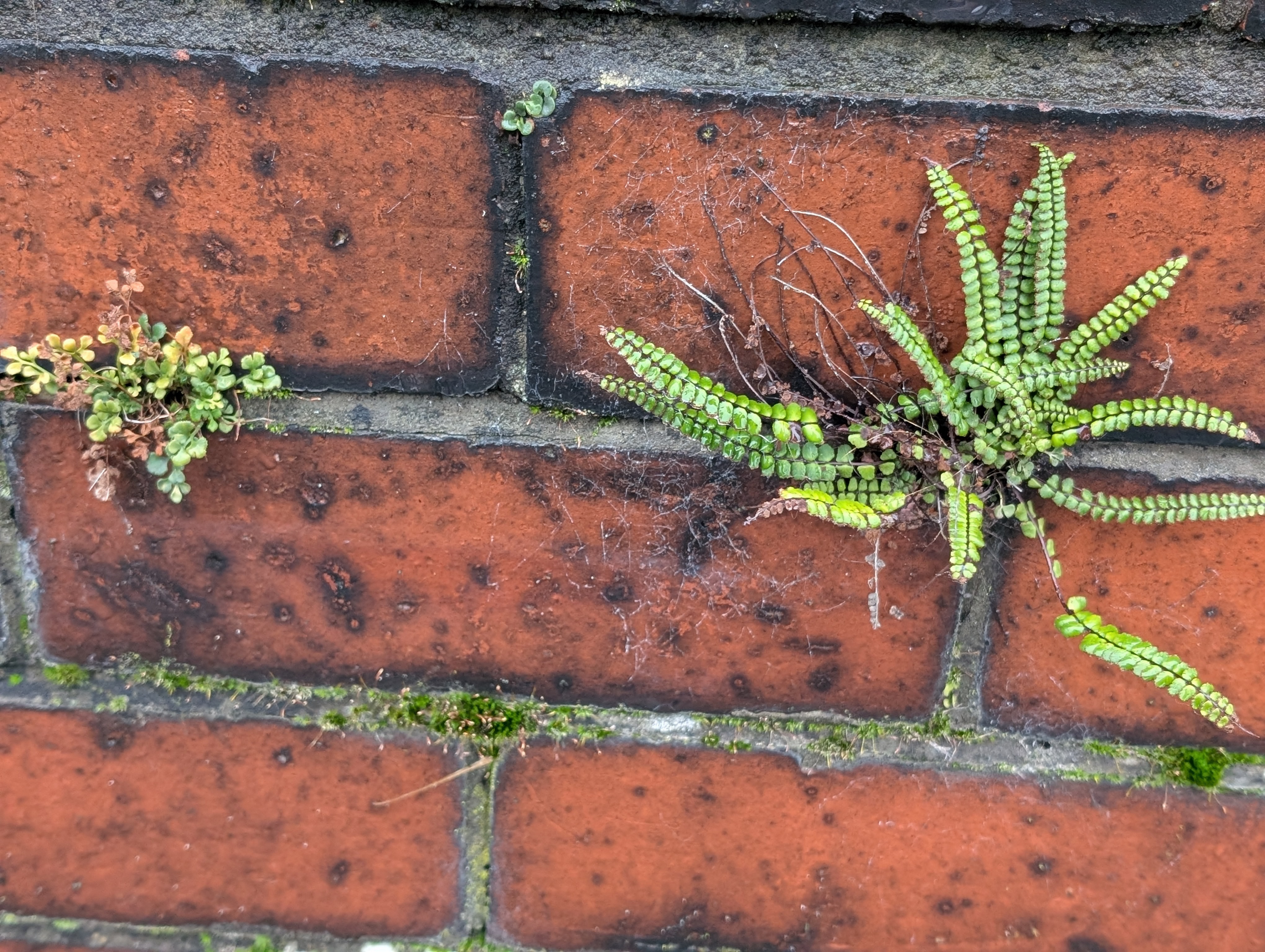
On Sunday, a trip north into rural Northumberland provided a welcome opportunity to check in on one of the rarest and most intriguing ferns in North East England: Lady Clermont’s Spleenwort Asplenium × clermontiae – a hybrid I hadn’t seen since 2023, when I published a short blog about it here.
To cut a long story short, this is an exceedingly rare hybrid between Wall-rue Asplenium ruta-muraria and Maidenhair Spleenwort Asplenium trichomanes subsp. quadrivalens. On paper, it ought to be more widespread, given the abundance of its parent species, but this is very much not the case. In fact, it is currently known from just three individual plants across the entirety of the British Isles. The Northumberland plant has been known since the early 2000s and has been visited by many pteridologists over the years.
It is a rather unruly-looking fern, showing characteristics of both parents, and so far as this year’s pteridological challenge goes, an excellent one to notch up early on.

A short distance away, another unassuming wall played host to a second rare little spleenwort, though not quite so rare as the species mentioned above. Rustyback Asplenium ceterach is common in many parts of the UK but decidedly scarce in the North East and, despite an abundance of seemingly suitable habitat, remains confined to a small number of quarries and walls across the region. I do wonder whether climate plays a part. In North Northumberland, it is a Rare Plant Register species, meaning it should be reported whenever encountered.
A lover of limestone rocks and lime-rich mortar, this species is easy to identify thanks to its thick, leathery, almost once-pinnate fronds and the dense covering of rust-coloured scales on the underside. The images below show one of two plants observed during a brief pit stop at a well-known site.
Another species down…

Running Total
Seeing as I rarely carry a notebook, we’ll log our running total for the year here…
| #1 Wall-rue | Asplenium ruta-muraria | 16 January, Newcastle |
| #2 Maidenhair Spleenwort | Asplenium trichomanes subsp. quadrivalens | 16 January, Newcastle |
| #3 Hart’s-tongue | Asplenium scolopendrium | 16 January, Newcastle |
| #4 Black Spleenwort | Asplenium adiantum-nigrum | 16 January, Newcastle |
| #5 Broad Buckler-fern | Dryopteris dilatata | 17 January, Newcastle |
| #6 Male-fern | Dryopteris filix-mas | 17 January, Newcastle |
| #7 Soft Shield-fern | Polystichum setiferum | 17 January, Newcastle |
| #8 Japanese Lace Fern | Polystichum polyblepharum | 17 January, Newcastle |
| #9 Hard Shield-fern | Polystichum aculeatum | 23 January, Newcastle |
| #10 Hard Fern | Blechnum spicant | 23 January, Newcastle |
| #11 Western Scaly Male-fern | Dryopteris affinis subsp. affinis | 23 January, Newcastle |
| #12 Borrer’s Scaly Male-fern | Dryopteris borreri | 23 January, Newcastle |
| #13 Lady Clermont’s Spleenwort | Asplenium x clermontiae | 26 January, Northumberland |
| #14 Rustyback | Asplenium ceterach | 26 January, Northumberland |


Leave a Reply