
I must confess that although I have been botanising for some time now, ferns have proven a difficult group to master. Indeed, master is probably the wrong word as despite countless trips in search of the species found across North East England, I am still but a novice. Or perhaps an improver!
Despite the difficulties associated with telling many of them apart, August is a great month to look closer at ferns and last week, I decided it was high time I bit the bullet and factored them into the programme of ‘Botanists Year’ trips I am currently leading for the Natural History Society. Knowing the perfect place, with 10 botanists in toe, we decided on a visit to the pteridologist’s paradise that is Hareshaw Linn in Northumberland.


Starting out, a variety of common and widespread ferns were easy to find as we made our way into the wooded valley. Broad Buckler-fern (Dryopteris dilatata), Bracken (Pteridium aquilinum) and Male-fern (Dryopteris filix-mas) came first, followed by the distinctive Hard-fern (Blechnum spicant) and later, some rather nice stands of Polypody (Polypodium vulgare). Upon scrutiny when I returned home, these were confirmed to the be common sort.
In the initial stages of our walk at Hareshaw Linn, several other interesting plants were noted too including Wood Melick (Melica uniflora), Giant Fescue (Schedonorus giganteus) and a sizeable patch of Good-king-henry (Blitum bonus-henricus) but ferns soon rose to the fore once more with new additions in Lady-fern (Athyrium filix-femina), with it’s lovely j-shaped sori, and the first of the day’s scaly male-ferns. After a closer look, this was revealed to be Golden-scaled Male-fern (Dryopteris affinis) on account of the rounded, toothed lower pinnule.


In my experience, most of the scaly male-ferns I check near Newcastle turn out to be Borrer’s Male-fern (Dryopteris borreri) but this did not appear to be the case at Hareshaw. Indeed, checking dozens of ferns along the initial leg of our walk, almost all proved to be affinis. We did, however, find a nice example of Borrer’s Male-fern a little further into the Linn, spending some time ogling its distinctive, square pinnules.
This aside, other new ferns included Soft Shield-fern (Polystichum setiferum), likely a new colonist at this site, and Hard Shield-fern (Polystichum aculeatum) which provided a nice opportunity for comparison. Other notable plants included Wood Horsetail (Equisetum sylvaticum) and Marsh Hawk’s-beard (Crepis paludosa).
The first true highlights came after crossing a small bridge in a deeper part of the Linn where we encountered an entirely new species for me in Beech Fern (Phegopteris connectilis). A rather rare species in our area, this fern is much more numerous in parts of Scotland, Cumbria and Wales were it favours woodlands dominated by Oak. It proved to be quite the lovely little plant.

Pausing for lunch about midway into the wood, we were pleased to stumble across a bankside strewn with Oak Fern (Gymnocarpium dryopteris) – a species I see very infrequently in the North East. This proved ample compensation for failing to find even a single example of Lemon-scented Fern (Oreopteris limbosperma) which I know from past walks inhabits the site also. Keen to add a few more species to our swelling tally, from here it was a straight hike to the site’s famed waterfall where a few more species awaited.
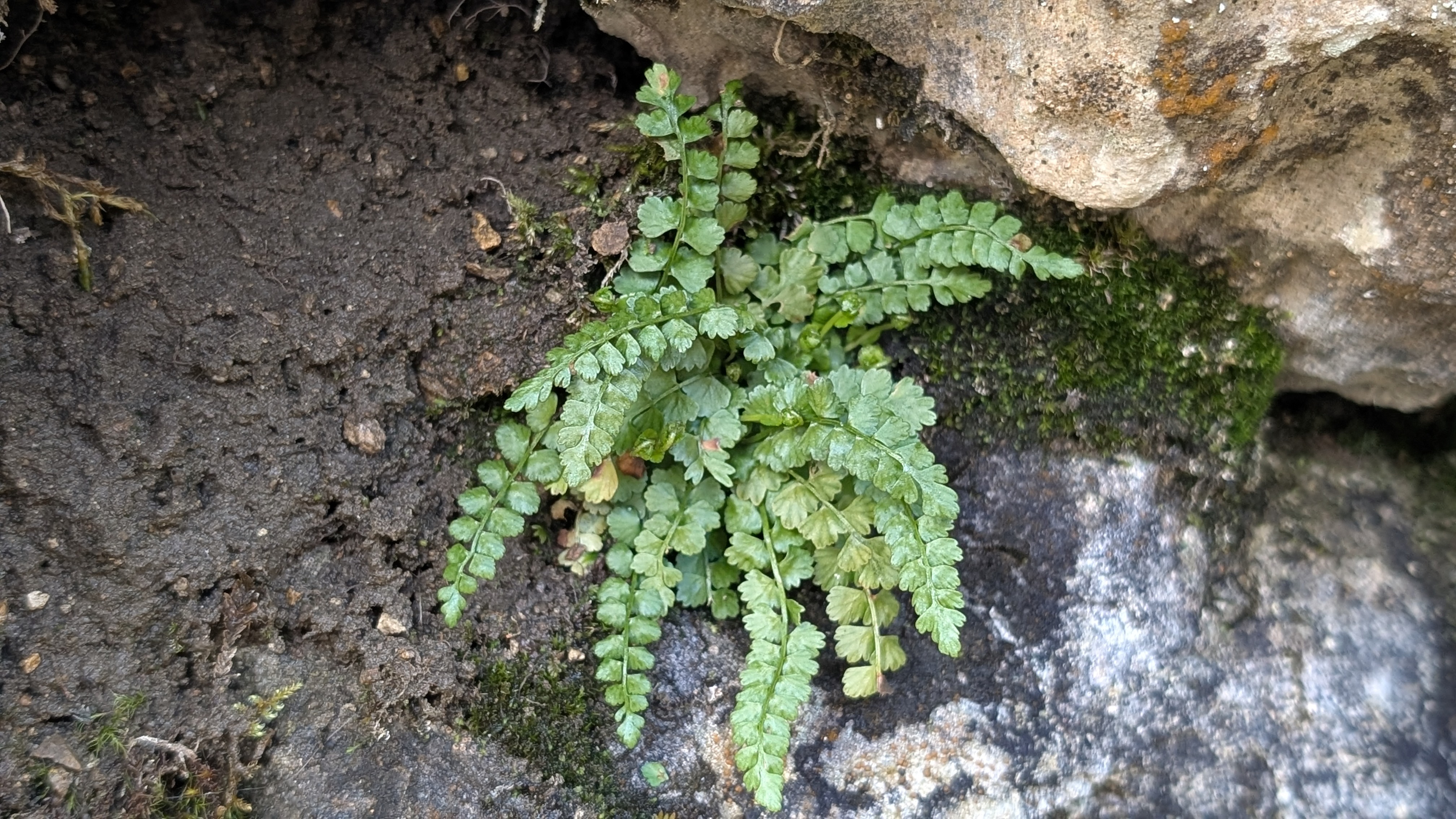
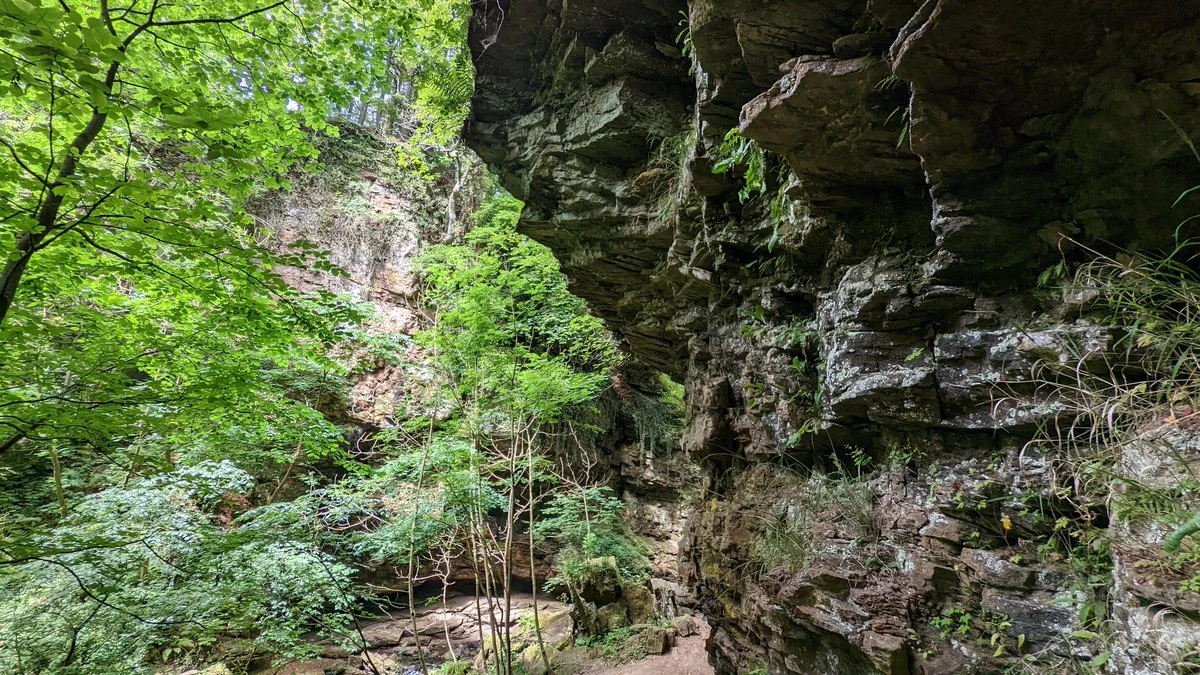
Arriving at the waterfall, we were pleased to note several examples of Hart’s-tongue (Asplenium scolopendrium), a typically common fern that had proved conspicuously absent thus far during our trip. The real excitement here was to be found in the walls of the ravine however, where, alongside some nice examples of Brittle Bladder-fern (Cystopteris fragilis) the group found many examples of Lobed Maidenhair Spleenwort (Asplenium trichomanes subsp. pachyrachis) – this being the only place you can see this lovely little fern in all of Northumberland. The subspecies of Maidenhair Spleenwort differs from that we see in garden walls in having scalloped margins to the leaflets and grows mainly on limestone outcrops, typically where conditions are very humid.
Interestingly, I had also expected to find Green Spleenwort (Asplenium viride) on this outcrop also, having noted it on trips in 2020 and 2022. Hopefully it is still kicking about there somewhere…


I make that 15 fern species in just a few hours – not bad going at all. In reality, the total was 18 including Wall-rue (Asplenium ruta-muraria), Maidenhair Spleenwort (Asplenium trichomanes subsp. quadrivalens) and Black Spleenwort (Asplenium adiantum-nigrum) observed as we departed from Newcastle. All in all, the trip was a success and I would strongly recommend that anyone with a penchant for ferns pay Hareshaw Linn a visit. You will not leave disappointed.


Leave a Reply