

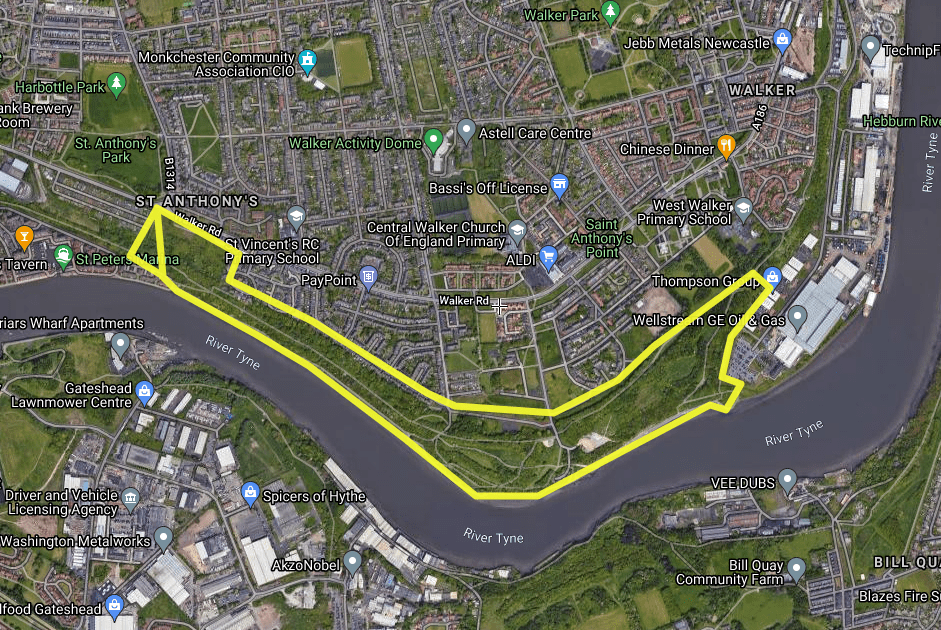
Walker Riverside Park is a funny old place. Created in the 1980s, it sits atop former industrial land and boasts an intriguing mix of habitats, from grassland and woodland areas to salt-strewn riverbanks and disused industrial plots. Overgrown, tangled and messy in places, the species mix here suggests the site was once tended, though now, ornamentals have merged with native flora to create a really interesting site. Truthfully, it doesn’t resemble a park at all.
This year, I have been making a concerted effort to record as many plants as possible here, focusing on plants growing in a wild or naturalised state. Plants that have been planted have been ignored, though long-established street trees and hedgerow plants have been recorded per guidance from the BSBI.
Slightly more challenging in scope than Iris Brickfield covered previously, the list below is almost certainly missing several species. I have not yet brought myself to look at grasses and yellow composites, and there are certainly other shrubs and saline-loving species to be discovered. Still, I hope this post gives a flavour of what you might encounter when visiting this rough and ready but highly interesting city reserve.
All records will (or have already been) submitted to BSBI recorders through iRecord.
Species list
In total, I have recorded 190 plant species in the park. A good count but almost certainly an understatement. Given the mix of habitats here, I wouldn’t be surprised if the actual number was closer to 250.
For the sake of simplicity, I have not broken this down into grid squares or habitats on this occasion but have aimed to indicate as to whether a particular species is historically planted or not. I have also aimed to highlight species brought to the site via seed mixes designed to boost butterfly numbers on site.
The full species list can be viewed below.
Trees at Walker Riverside
The trees of Walker Riverside are reasonably diverse. Native species including Ash (Fraxinus excelsior), English Oak (Quercus robur) and Field Maple (Acer campestre) are common and Aspen (Populus tremuloides) and White Poplar (Populus alba) exist in smaller patches across the site. Both Swedish Whitebeam (Sorbus intermedia) and Common Whitebeam (Sorbus aria) exist as relics of historic planting and in places, a good number of willow species can be seen. Among these, White Willow (Salix alba), Grey Willow (Salix cinerea) and Goat Willow (Salix caprea).
Slightly more unusual trees include False Acacia (Robinia pseudoacacia), Turkey Oak (Quercus cerris) and what I think might be Hybrid Black Poplar (Populus × canadensis), while the site provides a nice opportunity to compare alder species with Grey Alder (Alnus incana), Common Alder (Alnus glutinosa) and Italian Alder (Alnus cordata) all present. The latter clearly spreading along the riverbanks.
Perhaps most unusual of all is the presence of an American species, the Red Oak (Quercus rubra); though Sweet Chestnut (Castanea sativa) is another species seldom encountered in the local area.


Shrubs and climbers
The shrubs occupying the understory of the park are an interesting bunch and many formerly planted species seem to be spreading. Among these, the two most prominent are Wilson’s Honeysuckle (Lonicera nitida), Snowberry (Symphoricarpos albus) and Coralberry (Symphoricarpos orbiculatus). The same likely applies to various species of cotoneaster present on site but alas, the only one I can identify with any confidence is Willow-leaved Cotoneaster (Cotoneaster salicifolius).
By the river, Shrub Ragwort (Brachyglottis x jubar) appears to have escaped what was likely a former flowerbed and is slowly spreading and Japanese Rose (Rosa rugosa) has a habit of popping up in odd places.
Elsewhere, more familiar species include Guelder Rose (Viburnum opulus), Privet (Ligustrum vulgare), Dogwood (Cornus sanguinea), Sea Buckthorn (Hippophae rhamnoides) and plenty of Broom (Cytisus scoparius). The riverbanks here are also a great place to see Wayfaring Tree (Viburnum lantana) and odd shrubs dotted around the site include both Darwin’s Barberry (Berberis darwinii) and Chinese Barberry (Berberis julianae).
As for climbers, Russian Vine (Fallopia baldschuanica) can be found in a single spot and, by the river, a garden variety of clematis (Clematis sp.) appears to be running amock. While the brambles on-site were impossible to identify, the great, thick stems of Armenian Blackberry (Rubus armeniacus) are conspicuous in places.


Grasslands
The grassland areas of Walker can be split roughly into two types: seeded and seemingly natural. The seeded areas contain several interesting species including Musk Mallow (Malva moschata), Lucerne (Medicago sativa), Greater Knapweed (Centaurea scabiosa), Wild Basil (Clinopodium vulgare) and both Small Scabious (Scabiosa columbaria) and Field Scabious (Knautia arvensis). Common Restharrow (Ononis repens) is plentiful here too and Spiny Restharrow (Ononis spinosa) has a toehold.
Where the boundaries between sown and natural become a little fuzzy, Wild Carrot (Daucus carota) and Salad Burnet (Sanguisorba minor) are especially numerous and plenty of Wild Teasel (Dipsacus fullonum) and Perennial Wall-rocket (Diplotaxis tenuifolia) can be seen.
More natural-looking grassland areas at Walker hold Meadow Crane’s-bill (Geranium pratense), Wild Mignonette (Reseda lutea) and Wild Parsnip (Pastinaca sativa), among others.


Non-natives and adventives
Besides the shrubs and climbers mentioned previously, I am yet to stumble across any of the really obvious non-natives. Michaelmas Daisy (Aster agg.) can be found from time to time along the river and a small patch of what I think is Common Evening Primrose (Oenothera biennis) can be seen. Hybrid Bluebells (Hyacinthoides x massartiana) can be found in a few spots and a single patch of Horseradish (Armoracia rusticana) exists close to the boundary with Walker itself.
These aside, the usual array of globetrotters can be seen, including Oxford Ragwort (Senecio squalidus), Red Valarian (Centranthus ruber), Canadian Fleabane (Erigeron canadensis) and of course, Butterfly Bush (Buddleja davidii).
Abandoned industrial plot
At the centre of the site, an interesting former industrial plot can be seen. With lots of exposed concrete, rubble mounds and some seriously shallow soil, this plays host to a number of species absent from the wider site. To date, this is the only place in Newcastle where I have observed Sainfoin (Onobrychis viciifolia) and Clustered Bellflower (Campanula glomerata).
Here too, large expanses of Kidney Vetch (Anthyllis vulneraria) can be seen and lurking atop the crumbling concrete, Wild Thyme (Thymus drucei) was a surprising addition.


Riverbanks and rocky places
The rocky walls that line the river at Walker are largely dominated by a mix of common and widespread species, with a few exceptions. Peached-leaved Bellflower (Campanula persicifolia) was an odd addition here earlier in the year and Black Horehound (Ballota nigra) can be seen in a few patches.
A major exception to this rule comes where what I assume was once some sort of boating ramp allows usually coastal species to grow in close proximity to the salty waters of the Tyne. Here, Buck’s-horn Plantain (Plantago coronopus) and Sea Plantain (Plantago maritime) can be seen, as can Annual Sea-blite (Suaeda maritima). Sea Aster (Tripolium pannonicum) is another nice addition while in places, at least one Glasswort (Salicornia sp.) species can be seen.
Pavement cracks in the car parks and along the main footpath are worthy of investigation too and include species such as Henbit Dead-nettle (Lamium amplexicaule) and plenty of Common Mallow (Malva sylvestris). These areas can occasionally throw up something interesting too with Great Lettuce (Lactuca virosa) and Beaked Hawk’s-beard (Crepis vesicaria) being two recent additions.


Notable and unusual
While plants such as Sainfoin and Clustered Bellflower are scarce in the North East, their suspect origins mean I have not included them here. Instead, two other species have made the cut, both found growing in pavement cracks along the main riverside walkway.
The first, Cut-leaved Dead-nettle (Lamium hybridum)has very few records in VC67 and made for a nice surprise earlier in the year. This species is almost certainly under-recorded, however.
The second, Musk Thistle (Carduus nutans), is another scarce species in the region and with its distinctive, nodding flowerheads is a real delight to see come summer.


