Entry numer #1 in our new Plant of the Week series
It is not every day you encounter an endemic species, nevermind one found exclusively at a single site. That said, that’s exactly what happened this week. To celebrate a fantastic trip to Lindisfarne, the first plant in our new Plant of the Week series is of course, the Lindisfarne Helleborine.
Lindisfarne Helleborine, Epipactis sancta
The Lindisfarne Helleborine is found exclusively on Holy Island, a small island lying just off the coast of Northumberland. Found on the western part of the island, it grows in dune slacks and on dunes themselves alongside Creeping Willow and other plants typical of this habitat.
Originally known as Epipactis dunensis, a species found elsewhere in the UK, the Lindisfarne Helleborine has been on quite the taxonomic journey. Early on it was reclassified as a variety of Narrow-lipped Helleborine, and later as Epipactis pietzi var. sancta. In 2002, researchers settled on a new name, Epipactis sancta, and classified the species as a British endemic.
This plant’s status as a full-fledged species seems to have been short-lived, with new research again demoting it to a subspecies. Either way, it is still a very interesting plant and a joy to behold when spotted.
Part of this plants name, sancta, means ‘sacred’ in reference to it growing on Holy Island.
Epipactis sancta, photographed on a visit to Lindisfarne in July 2022
What does it look like?
Lindisfarne Helleborine is a subdued beauty. Reaching a maximum of 30cm tall, almost all parts of the plant are green. Typically orchid-like, its flowers are green too excluding the lip which is white on the outside on chocolate-brown on the interior. It is easy to overlook where it grows in the company of myriad other green plants.
Given it’s similarities to Epipactis dunensis, identifying this orchid is challenging. Indeed, if all three plants were seen together, I doubt most botanists would be able to tell the difference. Thankfully, this is the only of the group growing on Lindisfarne. As a result, if you spot a green helleborine on the island, it is safe to say you’ve found one!
A close up of the green-white flowers of Epipactis sancta
An account of a fabulous day spent exploring the orchids and other wildlife of Lindisfarne – the jewel in the crown of wild Northumberland.
Lindisfarne is one of those magical places that each time you visit, never fails to take your breath away. Diverse, beautiful and altogether unique, it must surely rank among Britain’s ‘must see‘ sites for nature. Particularly when it comes to botany.
At the weekend, I was able to visit Lindisfarne for the first time this year thanks to a generous lift from a friend. A visit timed perfectly to coincide with the island’s most iconic spectacle: blooming orchids.
It is not only the diversity of orchids on Lindisfarne that takes your breath away but the number of them. Indeed, during our stay, we observed many thousands of orchids strewen across the island. Some of these, and some other highlights, are shared below.
Orchids on the Snook
Starting out at the Snook towards the Western end of the island and what struck me first was the abundance of Common Spotted Orchids. Big ones, small ones, pink ones, even pure white ones; the diversity was striking. The whiter ones almost convinced me they were Heath Spotted Orchid but alas, not this time. The alba variant of common spotted will have to do.
There were good numbers of Northern Marsh Orchids here too, though most had gone over. Where spotted and marsh orchids coexist, hybrids are never far behind and it wasn’t long until we discovered our first: Dactylorhiza x venusta. The hybrid of the former two species, this was significantly larger than all nearby orchids – as shown in the picture below. Hybrid vigour?
Common Spotted Orchids (Dactylorhiza fuchsii), Northern Marsh Orchid (Dactylorhiza purpurella) and their hybrid, Dactylorhiza x venusta
Much to my delight, among the more abundant spotted and marsh orchids on the Snook, several Early Marsh Orchids were also spotted. Indeed, with their pale pink flowers and lower lip folded lower lip, they certainly stood out from the pack.
Early Marsh Orchids (Dactylorhiza incarnata)
Local specialities
It would be impossible to visit Lindisfarne and not marvel at the sight of countless blooming Marsh Helleborines. Probably the most numerous orchid on the island, hundreds were seen on the Snook and then again at further stops thereafter. Growing in profusion across dune slacks and damp areas, when visiting Lindisfarne, it is quite easy to forget that this is actually a rare plant in our region. Indeed, they are found at only a handful of sites in the North East.
Marsh Helleborines (Epipactis palustris)
When talking about orchids on Lindisfarne, it is possible not to mention the endemic Lindisfarne Helleborine. First discovered on the island in 1958, this was once thought to be the same as Dune Helleborine, before being split. The debate now rages on as to its true identity and some suggest it should be lumped once more.
Regardless of the taxonomic discussions, Lindisfarne Helleborine is a scarce and rather lovely plant. Hard to find, encounters are definitely to be savoured. We stumbled across eleven plants during our stay, some of which were thankfully still in flower.
Lindisfarne Helleborine (Epipactis sancta)
A few more orchids
Pyramidal Orchid is not a species I see often. Living where I do in South Northumberland, the species remains an uncommon sight. The same, however, cannot be said for Lindisfarne and away from the Snook, this species is especially plentiful. Walking west towards Chare Ends and then to the North Shore of the island, these beautiful little orchids were especially numerous and proved a hit with the local Narrow-bordered Five-Spot Burnet moths.
Pyramidal Orchids (Anacamptis pyramidalis)
A slightly more muted orchid, Common Twayblade also grows in abundance on Lindisfarne. Present in good numbers towards the Eastern side of the island, we saw perhaps 100 during our stay, including some fairly impressive stalks.
Similarly coloured but much more elusive, Frog Orchid is one of the rarer orchids on Lindisfarne. Tiny, inconspicuous and hard to find, it took us longer than it should to find our first and only flower of the day. A rare orchid in the North East, this isn’t something I see often at all and as such, made for quite the highlight.
Common Twayblade (Neottia ovata) and Frog Orchid (Dactylorhiza viridis)
Other Plants
Of course, there is far more to Lindisfarne than just orchids. With far too much to mention in a single blog post, I have aimed to keep this bit short by including only a few highlights from the trip.
At the Snook, it was fantastic to stumble across some impressive drifts of Seaside Centaury, another rare plant boasting a stronghold on the island. With its lurid pink flowers, it certainly made for an impressive sight. Slightly less ‘in your face’ were the leaves of Round-leaved Wintergreen, a new species for me and a national scarcity.
Exploring some of the dune slacks around the Snook, Autumn Gentian was another nice addition to the day’s tally. The plant in question only just coming into bloom. Damper areas here held an intriguing mix of Bog Pimpernel, Variegated Horsetail, Lesser Spearwort and other nice plants.
Slightly more conspicuous, the sward at the Snook also held an abundance of Lesser Clubmoss – not something I have knowingly seen before elsewhere.
Lesser Clubmoss (Selaginella selaginoides)
Moving off elsewhere on the island, a jaunt to the drier North shore and the small quarry present there produced several nice sightings. Blue Fleabane was noted here and the quarry itself held Brookweed around what was left of the small pond here. The non-native Piri Piri, sadly present across the Island these days, was particularly prolific here too. A shame, and quite problematic for visiting botanists!
Scots Lovage is a rare plant locally and one at the southern edge of its national distribution in Northumberland. At least when it comes to the east coast of Britain. We were pleased to see a rather healthy stand of this low-growing umbellifer in the dunes whilst walking back to the car.
While for me, insects were not the main purpose of the trip, it was nice to observe a few noteworthy species on our travels. Bees were a particular highlight with three new species spotted during the day, at least if our tentative IDs are correct.
Best among the bees were the two elusive coastal leafcutters shown below. Dull-vented Sharp-tailed Bee was also noted and on the bumblebee front, it was exciting to spot Heath Bumblebee.
Looking downward, Dune Chafers made for an intriguing sight as they tunnelled in the sand. In the air, Dark Green Fritillaries were a highlight among a cast of butterflies which also included Common Blue, Small Skipper and Red Admiral.
A quick account of a fruitful few days spend admiring orchids in Newcastle.
As the NHSN’s Discovering Orchids project continues, I’ve been making an effort to check in on my local orchids. Visiting a number of post-industrial sites around Newcastle this week, it is safe to say that the plants did not disappoint. From your ‘everyday’ spotted orchids to a selection of scarcer species, there has been an awful lot to see.
Silverlink
Starting out at Silverlink Park, a site I talk about often, and Bee Orchids are having a good year. Indeed, during a quick visit, Matt and I recorded over sixty in bloom across the site. Big ones, small ones, some growing in grassland, others in flowerbeds, it is great to see this species doing so well here.
Bee Orchid (Ophrys apifera)
Straying from Silverlink for a minute, and Bee Orchids seem to be having a fantastic year locally on the whole. Not only are they performing well at traditional sites but are popping up in a host of new places too. I mentioned those at Scotswood a few weeks back, but I have also encountered them recently at Walker, Wallsend and Cobalt. At the latter, a number could even be seen invading the landscaped gardens of various office blocks!
Bee Orchid (Ophrys apifera)
Back to Silverlink and it was great to see Common Spotted Orchid becoming more numerous too. As expected, these have now taken over from Northern Marsh Orchid as the most numerous species blooming on site. A few marsh orchids could still be seen, of course, though these were invariably those growing in shady locations. The vast majority of those visible only a week back had long since browned and died.
Somewhat more exciting here was the discovery of a single Pyramidal Orchid. Growing within the site’s rich calcareous grassland, this looks to be the first record for the site. Indeed, having visited for many years, I can safely say I have never seen one here until now.
Moving on, a kind tip-off from a local naturalist resulted in a bit of a surprise this week, a few Facebook messages leading to an encounter with an altogether more special orchid. The delicate plant seen below is Heath Fragrant Orchid, an entirely new species for me.
Smaller and with fewer flowers than its larger cousins, this orchid really is a beauty. Better still, it smells amazing! A scent I would describe as sweet and citrusy that others have hailed as ‘spicy’.
Heath Fragrant Orchid is a scarce species in the North East and one usually found in the uplands. To see one in urban Tyneside certainly is a treat.
Heath Fragrant Orchid (Gymnadenia borealis)
Newburn
To some abandoned brownfield land at Newburn now and more Common Spotted Orchids. So many in fact that we lost count at 250! An abundant and familiar species across most of the UK, it is not often I see them in such numbers. The sight of so many flowers swaying in the breeze a welcome reminder of what more grasslands in our nation should look like.
Here too, a few Northern Marsh Orchid were hanging on, though looking a little worse for wear, and we identified several Common Spotted Orchid x Northern Marsh Orchid hybrids. Seeking out the biggest visible plant before looking closer seems to be a good technique for this – Dactylorhiza x venusta tends to be a whopper.
Common Spotted Orchids (Dactylorhiza fuchsii)
Down by the river, we soon discovered the first of the day’s targets: Dune Helleborine. A rare plant nationally, those on the Tyne are said to be the locally endemic Epipactis dunensis subsp. tynensis. Or Tyne Helleborine, to use simple terminology. Either way, for some, the jury remains out as to whether they truly are a subspecies or not. Personally, I quite like them, but perhaps I’m just patriotic?
It was surprising to find over sixty Dune Helleborine in just thirty minutes of casual searching at Newburn. So many, in fact, that they outnumbered their larger and usually more abundant cousin, the Broad-leaved Helleborine. These were present in good numbers, perhaps forty or so, but still seemed scarcer than in previous years. Most of the plants we noticed had yet to flower, but a few had just dared open.
A mongtage of Dune Helleborines (Epipactis dunensis subsp. tynensis)
Well, that concludes this orchid-focused ramble. The diversity of these mesmerising plants around Newcastle never fails to amaze me and I’ll be looking for more in the future!
A quick account of an afternoon spent exploring brownfield and recording wildlife at North Shields.
Poking through the rubble heaps and disused car parks of brownfield sites has become a personal hobby of late. Not only are these sites phenomenal for wildlife, but many offer a rare look at what would happen if nature was permitted to reclaim our towns and cities. One of my favourite areas of local brownfield can be found at North Shields, and inspired by a visit last year, I thought I’d take another look this weekend…
Ladybirds
One of the main reasons for my visit was, unsurprisingly, ladybirds and surveying the site I was pleased to encounter a good variety of species. Some, like the 22-Spot Ladybird (Psyllobora vigintiduopunctata) were to be expected while others were a tad more exciting. Adonis’ Ladybird (Hippodamia variegata) is a scarce species in our region and one commonly associated with dry, rocky sites such as this. It was also interesting to note the inconspicuous ladybird, Rhyzobius litura, and nicer still to spot eight Water Ladybirds (Anisosticta novemdecimpunctata) around a small pool forming on the tarmac of an old car park.
The interesting ladybird larvae shown below may turn out to be 11-Spot Ladybird (Coccinella undecimpunctata), a pretty elusive species up here.
Forgetting ladybirds for a while, a quick look at the other insects out and about proved worthwhile. Butterflies didn’t disappoint with eight species on the wing, the best of which being Dingy Skipper, Small Heath and some fresh-looking Common Blues. Several day-flying moths were seen too including Hummingbird Hawk-moth, Cinnabar and Narrow-bordered Five-Spot Burnet.
Elsewhere a few other interesting beasties recorded here included Golden-bloomed Grey Longhorn, quite the impressive beetle, the soldier beetle, Cantharis rufa, and the bug, Leptopterna ferrugata. Not a bad haul!
The other great thing about brownfield sites such as is often the plantlife. Rubbly, disturbed places such as this often sportian interesting mix of elusive native species, adventives and aliens. North Shields is no exception and clearly having timed my arrival perfectly, the common plant species were putting on an fantastic display – large patches of Black Knapweed, Oxeye Daisy and Mouse-ear Hawkweed interspersed with Wild Mignonette, Weld, Common Toadflax and a whole manner of lovely things.
Perhaps the most interesting observation of the day came from the sheer abundance of Melilot observed during my visit. Indeed, everywhere I looked this attractvive yellow plant could be seen in abundance. Opting to look closer at this, three species were revealed. By far the most common of these was Ribbed Melilot; though a smaller patch of the far rarer Tall Melilot was also discovered. Next, a small area nestled between spoil heaps revealed a nice patch of White Melilot – not a plant I see very often.
With far too many plants seen to cover in a single post, I think it would be best to focus instead on a few highlights and for me, an abundance of delicate Fairy Flax was nice to see, as was a large area of White Stonecrop adorning the tarmac of a former road. Yellow-wort is another scarce species that thrives on brownfield sites and it was good to see plenty of it throughout my visit. Narrow-leaved Ragwort, an invader from South Africa, provided a touch of the exotic.
Orchids were few and far between but I stumble across a few fading spikes of Northern Marsh Orchid while just outside the site, some rather lovely Bee Orchids were not to be scoffed at.
Last weekend, I had the pleasure of leading my first guided walk for Wild Intrigue, a fantastic ecotourism enterprise seeking to bring people in the North East closer to nature. Focused on urban plants (my favourite subject) the walk saw a small group of us head down to the Ouseburn Valley in Newcastle to see what we could find.
Much of Ouseburn consists of what some may describe as fairly typical urban habitats: walls, pavement, verges and neglected flower beds. Befitting this, the usual species were there in abundance, among these, Oxford Ragwort (Senecio squalidus) with its black exterior bracts, Henbit Dead-nettle (Lamium amplexicaule) and of course, plenty of Ivy-leaved Toadflax (Cymbalaria muralis) draped over walls.
More interesting was what appeared to be an abundance of Eastern Rocket (Sisymbrium orientale), while the odd plant of Wild Parsnip (Pastinaca sativa) was also found.
Walking inland along the Ouseburn, it was the formerly cultivated yet recently neglected beds that held the most intrigue. In one particular patch, we found four poppy species growing together, including the Long-headed Poppy (Papaver dubium) which I don’t see all too often. Viper’s-bugloss (Echium vulgare) and Kidney-vetch (Anthyllis vulneraria) were found here too – plants not so frequent in the city!
On the opposite side of the Ouseburn, some long-abandoned grow beds held plenty of Fiddleneck (Amsinckia micrantha) and small amounts of Small Nettle (Urtic urens) and Wild Radish (Raphanus raphanistrum). Again, quite interesting given the location.
Spending a little time admiring the waterside plants of Ouseburn, together we found Marsh Marigold (Caltha palustris), Purple Loosestrife (Lythrum salicaria) and a figwort species, alongside the much more exciting addition of Gypseywort (Lycopus europaeus). Less welcome was Himlyanan Balsam (Impatiens glandulifera) which alongside the similarly thuggish Giant Hogweed (Heracleum mantegazzianum) and Chinese Bramble (Rubus tricolor) spotted during the trip highlighted clearly the issue of invasive non-native species.
Chinese Bramble (Rubus tricolor)
Towards Ouseburn Farm we paused to test out some handy plant identification apps and admire a few of the trees on site. Aspen (Populus tremula), White Poplar (Populus alba) and their hybrid Grey Poplar (Populus × canescens) in particular. In the area around the farm, we also stumbled across Hedgerow Crane’s-bill (Geranium pyrenaicum) and an interesting escapee in Lemon-balm (Melissa officinalis).
Planted in some cases but gradually escaping, I had also not appreciated that it was possible to admire all three of the UK’s common ivy species around Ouseburn. English Ivy (Hedera helix), of course, is the most abundant but Persian Ivy (Hedera colchica) and Algerian Ivy (Hedera canariensis) can also be seen in places. Together, these made for quite a nice comparison!
Many thanks to Cain and Heather at Wild Intrigue for inviting me to get involved in this new series of walks. I look forward to the next one!
Bee Orchids (Ophrys apifera) are like hen’s teeth in the North East. Sure, they’re fairly reliable at a few more calcareous sites in the near area (Silverlink, in particular) but by large, pop up sporadically in odd places. In any given year, I tend to only encounter a few away from my usual haunts – 2021’s surprise colony was found on the site of a former bus depot at Bedlington, for example.
Waiting for a bus outside of the B&Q superstore in Scotswood, Newcastle, it came as quite a surprise last week to find a couple of Bee Orchids growing in the wasteground around the bus stop. One vibrant spike quickly turning into dozens as we scanned the short-cropped verge here, kept tidy by the store’s owners. All in all, around forty plants could be seen in full flower making for quite the sight.
I suspect these orchids had been lucky. The grass had clearly been mowed recently, but likely before the flower spikes had started to emerge. The flowers were also positioned such that they would be seen by relatively few passersby – the store is visited predominately by those in cars meaning the likelihood of ‘accidental’ picking is much reduced.
We’ll certainly be checking on these again in future years…
Bee Orchid (Ophrys apifera)Bee Orchid (Ophrys apifera)Bee Orchids (Ophrys apifera)Even Matt was slightly taken with the number of orchids on show…
With my Natural History Society of Northumbria hat on, yesterday I had the pleasure of leading a small group of students from Newcastle University to one of my favourite local haunts: the glorious National Trust reserve at Allen Banks. The wooded areas here making for a superb location at which to enjoy a range of seldom seem woodland wildflowers and of course, to try our hand at a spot of orchid hunting too.
Starting out from the public car park and heading South on the West side of the river, things started out well with a range of interesting ferns spotted along the way. Among these, Broad Buckler-fern (Dryopteris dilatata), Hard Fern (Blechnum spicant), Male Fern (Dryopteris filix-mas) and both Soft Shield-fern (Polystichum setiferum) and its cousin, the Hard Shield-fern (Polystichum aculeatum). If you had told me a year back that I’d be getting exciting over ferns, I’m not sure I would have believed you…
In flower here was Yellow Pimpernel (Lysimachia nemorum) and Opposite-leaved Golden-saxifrage (Chrysosplenium oppositifolium), while a little further in, we were treated to remains of Toothwort (Lathraea squamaria) and an Alchemilla later [tentatively] ID’d as Intermediate Lady’s-mantle (Alchemilla xanthochlora).
Making plenty of pitstops along the way to our chosen destination, it was interesting to stumble across a mature variegated Sycamore (Acer pseudoplatanus) which made for an impressive sight with its marbled, yellow leaves. Whether this was a naturally occurring mutation or something planted by the Victorians, I am not sure…
Also nearby were a number of white form English Bluebells (Hyacinthoides non-scripta), as well as Bitter-vetch (Lathyrus linifolius), Wood Sedge (Carex sylvatica) and plenty of woodland indicator species. Bugle (Ajuga reptans) and blooming Woodruff (Galium odoratum) certainly made for a pleasing sight.
Further into the wood, after quite a bit of searching, we stumbled across the first of the day’s intended targets – a glorious clump of Bird’s-nest Orchids (Neottia nidus-avis). Growing under Hazel, as opposed to Beech on this occasion, these were not quite in flower yet but still gave plenty of cause for celebration. Nearby a separate, individual flower spike was found soon after.
Bird’s-nest Orchids (Neottia nidus-avis)
Next came a pause and lunch break at a small area of calaminarian grassland strewn with countless Mountain Pansies (Viola lutea). The fantastic array of colour forms on show here certainly made for an enjoyable break with the countless blooms ranging from deep purple to lilac and of course, yellow.
Mountain Pansy (Viola lutea)
Reaching Planky Mill, it didn’t take us long to find our first Early Purple Orchids (Orchis mascula) of the day. While less numerous than on my last visit in 2020, we still managed to count seven flower spikes during our short stay. A few non-blooming rosettes were observed nearby also.
More run of the mill wildflowers were abundant here too with Wood Speedwell (Veronica montana), Common Dog-violet (Viola riviniana) and Sanicle (Sanicula europaea) spotted, among others. A brief foray into a square known for Herb Paris (Paris quadrifolia) yielded no results but alas, it hasn’t been seen here in a good few decades…
Early Purple Orchids (Orchis mascula)
As ever, it wasn’t long before time got the better of us and we were forced to head back. It always amazes me how little ground you cover when looking for plants…
Dashing back, a few interesting species were noted along the upper reaches of the gorge, not least Wood Crane’s-bill (Geranium sylvaticum) and Goldilocks Buttercup (Ranunculus auricomus) – the latter a great find by a member of the group. In addition to these, we were pleased to find yet more Bird’s-nest Orchids in a new square. This particular group looking particularly striking against the dull, grey woodland floor.
All in all, a great day in great company. Our orchid sightings will be added to NHSN’s ongoing Discovering Orchids project seeking to map the distribution of these fascinating plants across the North East. If you’re out and about locally, please do consider sharing a sighting.
2021 has been a funny old year but despite the big c and the various restrictions it brought, it has also been a memorable one. While time outdoors has been limited this year, thankfully, I have still been lucky enough to observe, enjoy and record some fantastic wildlife. As the New Year dawns, I thought I’d share some highlights here.
Truthfully, I have seen more bees in 2021 than in any other year of my life to date, but perhaps that is because I have actually been looking?
Regardless, spurred on by NHSN’s North East Bee Hunt and supported to no end by helpful local experts, I have encountered some rather lovely species this year: my first Moss Carders on Lindisfarne, my first Hairy-footed Flower Bees (a county scarcity) and some delightful Bilberry Bumblebees to name but a few. All of which goes without mention of a dazzling assortment of other leafcutters, yellow-faced bees and bumbles.
Perhaps the highlight of the year on this front was finding this little Northern Mining Bee on spring wander through Ingram Valley in North Northumberland. This marked the first vice-county record for this attractive little insect and certainly made the hike worthwhole.
Northern Mining Bee, Andrena ruficrus
Lots of ladybirds
2021 marked my first year of purposefully seeking out ladybirds and I have been lucky to find and record a great many this year. Some of these, the 22-spot, 7-spot and Orange Ladybirds were familiar while others including the Eyed and 11-Spot Ladybirds shown below were entirely new for me.
A real highlight was discovering the inconspicuous but beautiful Water Ladybird at several new sites around Newcastle; while I also caught up with my first Adonis’ and Kidney-spot Ladybirds locally,
A little account of ladybird recording in Newcastle can be found here.
Befitting two exciting (but equally terrifying) new roles as joint BSBI vice-county recorder for North Northumberland, and joint Botany Specialist Group lead for NHSN, much of this year has been spent admiring plants.
Highlights here are too numerous to list with many interesting sites visited and many species observed. Instead, a few local finds spring to mind including the first county record of Curry Plant growing on the pavement here in Heaton, and a county-first Marshmallow spotted beside a local pond. Vosges Whitebeam was a notable find at a couple of local sites, if only because it took some time to ID it, while it has been interesting to observe several Thorn-apple plants growing close to home. A sure sign of their spread into the North of the UK.
Of course, our native species have enchanted too with a particular highlight coming from an encounter with my first-ever Maiden Pinks on the North Northumberland coast. I will make a point of revisiting these next year.
Spending so much time at home, it was inevitable that more time would be dedicated to recording wildlife in our little garden. With over 200 species encountered, there are too many to list but standout moments include the arrival of Currant Clearwing and Mint Moth, plenty of Davies’ Colletes and some nice moth trap finds, including the superb Figure-of-Eighty shown below.
In the latter half of 2021, I set about attempting to learn urban trees with a focus on the more unusual, non-native species so commonly planted in our parks, towns and cities. Spending countless hours roaming various sites in Newcastle, I was delighted to encounter dozens of new species, from North American Pin and Red Oaks to Himalayan Birch and a range of unusual maples. While conifers still baffle me, getting to grips with the various globe-trotters with whom I share the city has certainly been eye-opening – there are so many out there!
You can share a closer look at Newcastle’s trees (and shrubs) with me here.
A slightly unusual one now and while searching for ladybirds, I have been amazed by the quantity and diversity of shieldbugs uncovered at a range of local haunts. Some of these, like the Green, Hairy and Hawthorn Shieldbugs were familiar to me already; though a range of new species were encountered too including the striking Spiked Shieldbug and aptly named Parent Bug. I will certainly spend more time exploring this group in 2022.
A small, artificial reserve on the fringes of the city, Silverlink Biodiversity Park in North Tyneside has long been a favourite of mine when it comes to plants and invertebrates. Each year, I make a point of visiting the site in Summer with the aim of counting and enjoying its beautiful Bee Orchids and this year, the plants did not disappoint.
2021 was a record-breaking year for these colourful little wildflowers and here, hundreds were observed blooming across the site’s small but diverse grassland areas. It was also great to share this little-known with local naturalists as part of a guided walk back in July.
Bee Orchid, Ophrys apiferaA group walk at SilverlinkBee Orchid, Ophrys apifera
A trip to Teesdale
At the tail end of Spring, I was lucky enough to pay my first visit to the botanist’s paradise that is Upper Teesdale. While our walk may have been a little longer than planned – I severely misjudged the route – it was sensational to observe many of the plants that help make this area so special. Iconic and beautiful Spring Gentians, Alpine Meadow-rue, Bird’s-eye Primrose, Mountain Pansy and Green Spleenwort, there was certainly much to see.
I look forward to visiting again in 2022 and hopefully catching up with a few of the species that eluded me this time around. I’m looking at you Shrubby Cinquefoil and Holly Fern…
While pottering about in search of plants, bees and ladybirds, it would have been rude not to pay closer attention to the other taxa seen on my travels. From butterflies and hoverflies to fascinating fungi, highlights have been too many to count but a few stand out moments include more Dingy Skippers than I can shake a stick at, thirty species of hoverfly, some impressive longhorn beetles and the first record of Diprion similis, a scarce Sawfly, for North East England.
While I have a long way to go before I can confidently identify species in these groups, I look forward to broadening my horizons further next year.
Nature is better when enjoyed together and it would be rude of me not to mention the many passionate naturalists I have had the pleasure to meet and work with this year. By offering help with species identification and sharing experiences in the field, it is the people that have made 2021 so rewarding for this amateur naturalist.
Special thanks go to Louise Hislop and Charlotte Rankin for their help identifying bees and to Chris and Hazel Metherell for some memorable botanical moments, but really, it has been wonderful to share experiences with so many committed wildlife-watchers. I hope to meet many more next year.
Bees at SilverlinkBotany at WylamAdmiring Bombus rupestrisLook, a Moss Carder!
Living as I do in the city, many of the plants encountered daily are fairly tropical in origin. One of the most prominent of these is Oxford Ragwort (Senecio squalidus) which here, in my area of Newcastle, is particularly abundant in pavement cracks, walls, and other rocky places.
Clad in the vibrant yellow flowers typical of ragworts, Oxford Ragwort flowers all year round and never fails to brighten up a walk along our street, even in winter, when little else blooms and even the omnipresent Sheperd’s-purse has given up.
The rather healthy plant above was observed growing as a pavement plant, standing tall behind the bus stop at the end of my street.
Background
The genus name of ‘Senecio’ identifies this plant as a Ragwort and its species, squalidus, means ‘bad-smelling plant’
A member of the daisy family, Asteraceae, Oxford Ragwort is native to rocky and volcanic areas of Sicily, where it arose as a hybrid between two of the islands endemic species, Senecio aethnensis and Senecio chrysanthemifolius.
This species was introduced to cultivation in Britain from Sicily by William Shepard and in the 1700s where it soon made its way to Oxford Botanical Garden. By 1794 the plant had escaped the confined of the garden and could be found growly freely on Oxford’s city walls.
With the onset of rail travel, the plant found a new habitat and quickly spread to colonise the stone chippings used to line railway beds. From here, it was able to spread across the length and breadth of Britain, using railway tracks to reach urban areas across the country.
Oxford Ragwort is now widely distributed across the UK and, true to its nature, prefers seemingly barren habitats such as wasteground, city streets and walls. It is more widespread in the South of the UK but is also found in Northern England and Scotland.
An interesting paper on the introduction of Oxford Ragwort to the UK, courtesy of BSBI, can be found here.
Cinnabar, Tyria jacobaeae, feeding on Oxford Ragwort
Identifying Oxford Ragwort
Superficially similar to any other ragwort, Oxford Ragwort is a medium-sized plant with a well-branched stem. Its leaves are deep green and strongly lobed. Leaf shape in this species can, however, vary drastically from slightly serrate (saw-like) to double-pinnate.
It also has a more spreading habit than the Common Ragwort (Senecio jacobaea) and seldom grows to the same height as the latter species, preferring to grow outwards instead of up.
The flowerheads of this plant are bright yellow, usually with thirteen to fifteen ray florets but generally, look fairly similar to any other member of this family. Instead, the best way to identify Oxford Ragwort is to look at the bracts that form the ‘cup’ behind the flowerhead. In this species, these are tipped black. This applies to the longer inner bracts and much short outer ones.
Oxford Ragwort is commonly encountered growing as a pavement plant
For a more in-depth look at this species, a very useful page can be found here.
It might seem odd to start a new series with a tree few have heard of (I certainly hadn’t until a few weeks past) but recently, I’ve been bumping into the unassuming Sorbus mougeotii quite a bit in my local area.
Looking similar to the Swedish Whitebeam (Sorbus intermedia), at least to my untrained eye, Mougeot’s Whitebeam (Sorbus mougeotii) is a popular choice for landscapers and here in Newcastle, appears to be widely planted in parks and on reclaimed land. But not always…
The tree shown below was encountered in what appeared to be a wild setting, growing on the Banks of the River Tyne between Newburn and Wylam. In contrast to other local sites, no others were observed nearby.
A confirmed specimen of Mougeot’s Whitebeam at Newburn riverside
Background
The genus name, Sorbus, identifies this plant to family while its species name, mougeotii, refers to French botanist, Jean-Baptiste Mougeot.
Sorbus mougeotii is a moderately sized whitebeam native to the mountains of central and western Europe, from the Pyrenees to the Vosges. Its presence at the latter giving rise to its alternate name of Vosges Whitebeam. It was described in 1858 but wasn’t brought truly into cultivation until the 1950s by the Danish Health Society, and was originally marketed as a cultivar of Swedish Whitebeam.
This tree is widely grown as an ornamental in Northern Europe due to its tolerance of difficult growing conditions, including urban habitats and poor soil. For this reason, it is often used as part of land reclamation schemes.
A closer look at the BSBI distribution map for this species would suggest that it is rarely encountered in the UK, though its similarity to other whitebeams means it is almost certainly under-recorded. Indeed, since having this species pointed out to me, I have noticed it at a total of six sites in only a few weeks.
An interesting paper on the discovery of Sorbus mougoutii and its potential as an invasive species in Ireland can be found here.
Identifying Mougeot’s Whitebeam
A deciduous, multi-stemmed tree growing to approximately 10m, Mougeot’s Whitebeam is most closely related to some of the rare and endemic British whitebeam species, most notable the English Whitebeam, Sorbus anglica. Indeed, the only difference between the two is said to be the slightly broader leaves of the former species.
English Whitebeam is a scarce species in the UK and oddly enough given its name, is found predominately in Wales. There are no records in the North of the UK meaning that up here, Mougeot’s Whitebeam is most likely to be confused with the much more abundant Swedish Whitebeam. A tree that is both naturalised and routinely planted across the UK.
Separating these two species is a fun task but can be done, with the leaves of Mougeot’s Whitebeam differing from its Swedish counterpart in being more shallowly lobed in most cases. These lobes also point forward, something I’ve found to be incredibly helpful given how just about every other feature associated with this species seems to vary considerably!
In Swedish Whitebeam, the same lobes are spreading. There is also said to be a difference in the underside of the leaves too with those of Mougeot’s Whitebeam covered in dense white hairs and those of Swedish Whitebeam only slightly hairy. Alas, I’ve struggled to see the difference!
One thing I have also noticed from plants confirmed to be Mougeot’s Whitebeam is that the mid-rib, the central vein running down the leaf, appears yellowish on the underside. That said, I can find nothing about this online and may have made it up…
The leaves of Sorbus mougeotii showing forward-pointing and slightly shallower lobes.The leaves of what I think is Swedish Whitebeam (Sorbus intermedia) showing spreading, as opposed to forward-pointing lobes.
Finally, the fruits of Mougeot’s Whitebeam are said to be less bright red than those of Swedish Whitebeam but again, this seems to be subjective.
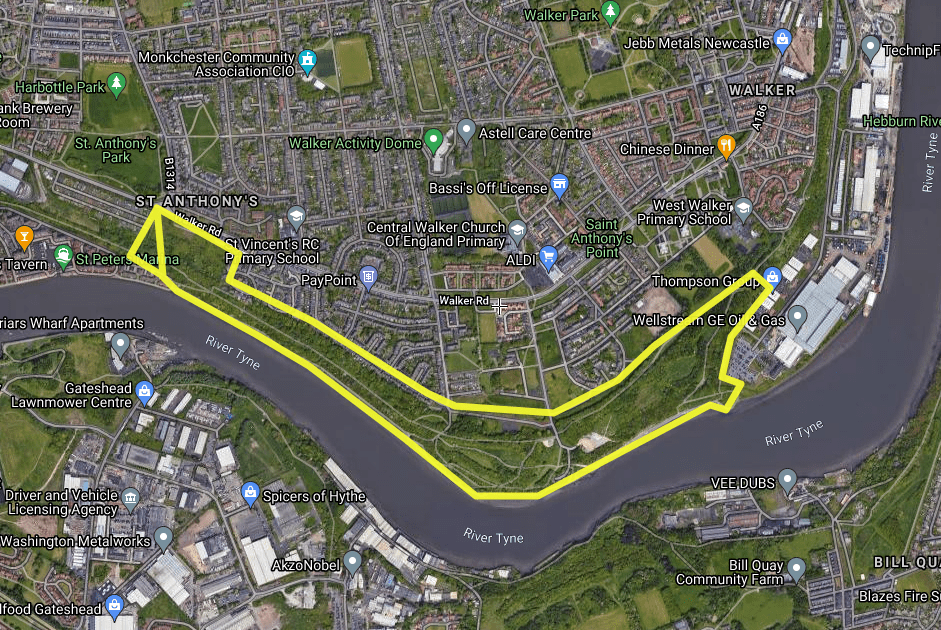
Walker Riverside Park is a funny old place. Created in the 1980s, it sits atop former industrial land and boasts an intriguing mix of habitats, from grassland and woodland areas to salt-strewn riverbanks and disused industrial plots. Overgrown, tangled and messy in places, the species mix here suggests the site was once tended, though now, ornamentals have merged with native flora to create a really interesting site. Truthfully, it doesn’t resemble a park at all.
This year, I have been making a concerted effort to record as many plants as possible here, focusing on plants growing in a wild or naturalised state. Plants that have been planted have been ignored, though long-established street trees and hedgerow plants have been recorded per guidance from the BSBI.
Slightly more challenging in scope than Iris Brickfield covered previously, the list below is almost certainly missing several species. I have not yet brought myself to look at grasses and yellow composites, and there are certainly other shrubs and saline-loving species to be discovered. Still, I hope this post gives a flavour of what you might encounter when visiting this rough and ready but highly interesting city reserve.
All records will (or have already been) submitted to BSBI recorders through iRecord.
Species list
In total, I have recorded 190 plant species in the park. A good count but almost certainly an understatement. Given the mix of habitats here, I wouldn’t be surprised if the actual number was closer to 250.
For the sake of simplicity, I have not broken this down into grid squares or habitats on this occasion but have aimed to indicate as to whether a particular species is historically planted or not. I have also aimed to highlight species brought to the site via seed mixes designed to boost butterfly numbers on site.
The trees of Walker Riverside are reasonably diverse. Native species including Ash (Fraxinus excelsior), English Oak (Quercus robur) and Field Maple (Acer campestre) are common and Aspen (Populus tremuloides) and White Poplar (Populus alba) exist in smaller patches across the site. Both Swedish Whitebeam (Sorbus intermedia) and Common Whitebeam (Sorbus aria) exist as relics of historic planting and in places, a good number of willow species can be seen. Among these, White Willow (Salix alba), Grey Willow (Salix cinerea) and Goat Willow (Salix caprea).
Slightly more unusual trees include False Acacia (Robinia pseudoacacia), Turkey Oak (Quercus cerris) and what I think might be Hybrid Black Poplar (Populus × canadensis), while the site provides a nice opportunity to compare alder species with Grey Alder (Alnus incana), Common Alder (Alnus glutinosa) and Italian Alder (Alnus cordata) all present. The latter clearly spreading along the riverbanks.
Perhaps most unusual of all is the presence of an American species, the Red Oak (Quercus rubra); though Sweet Chestnut (Castanea sativa) is another species seldom encountered in the local area.
Red Oak , Quercus rubraGrey Alder, Alnus incana
Shrubs and climbers
The shrubs occupying the understory of the park are an interesting bunch and many formerly planted species seem to be spreading. Among these, the two most prominent are Wilson’s Honeysuckle (Lonicera nitida), Snowberry (Symphoricarpos albus) and Coralberry (Symphoricarpos orbiculatus). The same likely applies to various species of cotoneaster present on site but alas, the only one I can identify with any confidence is Willow-leaved Cotoneaster (Cotoneaster salicifolius).
By the river, Shrub Ragwort (Brachyglottis x jubar) appears to have escaped what was likely a former flowerbed and is slowly spreading and Japanese Rose (Rosa rugosa) has a habit of popping up in odd places.
Elsewhere, more familiar species include Guelder Rose (Viburnum opulus), Privet (Ligustrum vulgare), Dogwood (Cornus sanguinea), Sea Buckthorn (Hippophae rhamnoides) and plenty of Broom (Cytisus scoparius). The riverbanks here are also a great place to see Wayfaring Tree (Viburnum lantana) and odd shrubs dotted around the site include both Darwin’s Barberry (Berberis darwinii) and Chinese Barberry (Berberis julianae).
As for climbers, Russian Vine (Fallopia baldschuanica) can be found in a single spot and, by the river, a garden variety of clematis (Clematis sp.) appears to be running amock. While the brambles on-site were impossible to identify, the great, thick stems of Armenian Blackberry (Rubus armeniacus) are conspicuous in places.
The grassland areas of Walker can be split roughly into two types: seeded and seemingly natural. The seeded areas contain several interesting species including Musk Mallow (Malva moschata), Lucerne (Medicago sativa), Greater Knapweed (Centaurea scabiosa), Wild Basil (Clinopodium vulgare) and both Small Scabious (Scabiosa columbaria) and Field Scabious (Knautia arvensis). Common Restharrow (Ononis repens) is plentiful here too and Spiny Restharrow (Ononis spinosa) has a toehold.
Where the boundaries between sown and natural become a little fuzzy, Wild Carrot (Daucus carota) and Salad Burnet (Sanguisorba minor) are especially numerous and plenty of Wild Teasel (Dipsacus fullonum) and Perennial Wall-rocket (Diplotaxis tenuifolia) can be seen.
More natural-looking grassland areas at Walker hold Meadow Crane’s-bill (Geranium pratense), Wild Mignonette (Reseda lutea) and Wild Parsnip (Pastinaca sativa), among others.
Besides the shrubs and climbers mentioned previously, I am yet to stumble across any of the really obvious non-natives. Michaelmas Daisy (Aster agg.) can be found from time to time along the river and a small patch of what I think is Common Evening Primrose (Oenothera biennis) can be seen. Hybrid Bluebells (Hyacinthoides x massartiana) can be found in a few spots and a single patch of Horseradish (Armoracia rusticana) exists close to the boundary with Walker itself.
These aside, the usual array of globetrotters can be seen, including Oxford Ragwort (Senecio squalidus), Red Valarian (Centranthus ruber), Canadian Fleabane (Erigeron canadensis) and of course, Butterfly Bush (Buddleja davidii).
Abandoned industrial plot
At the centre of the site, an interesting former industrial plot can be seen. With lots of exposed concrete, rubble mounds and some seriously shallow soil, this plays host to a number of species absent from the wider site. To date, this is the only place in Newcastle where I have observed Sainfoin (Onobrychis viciifolia) and Clustered Bellflower (Campanula glomerata).
Here too, large expanses of Kidney Vetch (Anthyllis vulneraria) can be seen and lurking atop the crumbling concrete, Wild Thyme (Thymus drucei) was a surprising addition.
The rocky walls that line the river at Walker are largely dominated by a mix of common and widespread species, with a few exceptions. Peached-leaved Bellflower (Campanula persicifolia) was an odd addition here earlier in the year and Black Horehound (Ballota nigra) can be seen in a few patches.
A major exception to this rule comes where what I assume was once some sort of boating ramp allows usually coastal species to grow in close proximity to the salty waters of the Tyne. Here, Buck’s-horn Plantain (Plantago coronopus) and Sea Plantain (Plantago maritime) can be seen, as can Annual Sea-blite (Suaeda maritima). Sea Aster (Tripolium pannonicum) is another nice addition while in places, at least one Glasswort (Salicornia sp.) species can be seen.
Pavement cracks in the car parks and along the main footpath are worthy of investigation too and include species such as Henbit Dead-nettle (Lamium amplexicaule) and plenty of Common Mallow (Malvasylvestris). These areas can occasionally throw up something interesting too with Great Lettuce (Lactuca virosa) and Beaked Hawk’s-beard (Crepis vesicaria) being two recent additions.
While plants such as Sainfoin and Clustered Bellflower are scarce in the North East, their suspect origins mean I have not included them here. Instead, two other species have made the cut, both found growing in pavement cracks along the main riverside walkway.
The first, Cut-leaved Dead-nettle (Lamium hybridum)has very few records in VC67 and made for a nice surprise earlier in the year. This species is almost certainly under-recorded, however.
The second, Musk Thistle (Carduus nutans), is another scarce species in the region and with its distinctive, nodding flowerheads is a real delight to see come summer.
A journey through the diverse and beautiful trees and shrubs of Newcastle-Upon-Tyne.
While I can separate the more familiar British species, your oaks, birches and common maples, anything beyond that has traditionally gone straight over my head. Not so useful in the city where planting and landscaping, both historic and recent, mean that would be botanists are presented with a mix of species from across the globe.
From Jesmond Dene to Walker and Heaton Park, in Newcastle, we’re lucky to have quite a few historic green spaces. Stuffed within them, many and more interesting species planted first by the Victorians – the famed Lord Armstrong springs to mind – and later, by successive generations of gardeners. Elsewhere, streets are planted with intriguing species and wasteland areas have been colonised by a whole manner of garden escapes.
For the past two weekends, I’ve spent my time attempting to identify and record as many of these species as possible. In keeping with guidance from BSBI, I’ve ignored anything that appears recently planted, instead focusing on species growing ‘wild’. Or at the very least, planted specimens that now form a permanent piece of the local environment.
Below, you’ll find a selection of the interesting plants discovered. I’ll caveat this post now by saying that I am by no means an expert – corrections welcome!
Shrubs
Particularly abundant in Armstrong Park and present, yet sparser in Jesmond Dene, the ornate, gold-spangled shrub below is Spotted Laurel (Aucuba japonica). A native of Japan and China, I assume this one was once popular in Victorian landscaping. Near the entrance to Armstrong Park, I also noticed a large specimen of what I think is Chinese Barberry (Berberis julianae).
Not quite as numerous as the familiar Cherry Laurel (Prunus laurocerasus) which I forgot to photograph but still plentiful is Portugal Laurel (Prunus lusitanica). With its glossy green leaves and pendant fruits, it is certainly an attractive plant. These ones were photographed in Heaton Park but plants can be found right along the Ouseburn.
With attractive flowers and often interesting leaves, I find viburnum species a pain to identify. The two below, spotted in Jesmond Dene, are only tentatively labelled but I think they could be Farrer’s Viburnum (Viburnum farrei) and Laurestine (Viburnum tinus).
A more straightforward viburnum is the Leatherleaf Viburnum (Viburnum rhytidophyllum) with its wonderfully wrinkled, slightly glaucous leaves. A number of these grow in a tamed setting around Heaton Park but a few wilder looking specimens can be found in Jesmond Dene and at Walker Riverside. Not a viburnum but still somewhat shrubby, Himalayan Honeysuckle (Leycesteria formosa) can be encountered from time to time in Jesmond Dene, and does look to be spreading.
If viburnums are frustrating, cotoneasters are just plain hard. Ignoring some of the species encountered recently, the three below proved somewhat easier to identify – if they are correct, that is. The first, Willow-leaved Cotoneaster (Cotoneaster salicifolius) seems to pop up from time to time in the local area. A number can be seen at Walker Riverside, though this one was spotted in Heaton Park.
Larger in scale, an impressive Tree Cotoneaster (Cotoneaster frigidus) can be seen in the Coalman’s Field area of Jesmond Dene. There are probably more in the dene but alas, I haven’t noticed them.
The final cotoneaster I think might be Hollyberry Cotoneaster (Cotoneaster bullatus), another native of China planted on occasion in the UK and fairly widespread based on BSBI maps.
A couple of oddballs now and the plant with the pretty yellow berries is Firethorn (Pyracantha coccinea), a species popular as a hedgerow plant that grows wild in a few places in Heaton. This would seem to be a yellow-berried cultivar as traditionally, the fruits of this species are red. The second I am less sure about but I wonder if it is Wilson’s Honeysuckle (Lonicera nitida)? Whatever it is, it seems to spread.
It may seem odd to include a fairly common tree in a post designed to highlight unusual species but White Poplar (Populus alba) is not a species I see too frequently in the North East. Despite its status as a fairly successful non-native, it is certainly one of my favourite trees and I had to include this specimen found close to home in Iris Brickfield Park.
Pointed out by another local naturalist, Iris Brickfield Park also holds a small population of Grey Poplar (Populus × canescens), a hybrid between the aforementioned White Poplar and its close relative, the Aspen.
White Poplar, Populus albaWhite Poplar, Populus albaGrey Poplar, Populus × canescensGrey Poplar, Populus × canescens
An odd bunch now and meandering through Heaton Park, I was surprised to notice the large and hairy fruits of Turkish Hazel (Corylus colurna). It was interesting to see this one producing nuts – a search online revealing that this species fruits only once every two or three years.
Next up, English Walnut (Juglans regia) was a nice spot in Heaton Park. While this may be a familiar tree to many in the South, it is not something I see too often up here and makes for quite the attractive tree!
Also in Heaton Park, it was nice to encounter Grey Alder (Alnus incana), a native of the Northern hemisphere from North America through to Northern Europe. Here too, I also bumped into my first ever Tulip Tree (Liriodendron tulipifera). A sought after American species, this one appears to be much more abundant in the South of England.
Before moving on to a number of (much more appealing) oaks, two more oddballs now with New Zealand Broadleaf (Griselinia littoralis) and Sweet Mock-orange (Philadelphus coronarius) observed in Jesmond Dene.
New Zealand Broadleaf, Griselinia littoralisSweet Mock-orange, Philadelphus coronarius
The identification of oaks in the North East is usually a straightforward affair: English, sessile or turkey. Factor in the Victorian obsession with sourcing weird and wonderful plants, however, and things become a little more complicated. Below are two species I hadn’t even heard of until recently: Patagonian Oak (Nothofagus obliqua) and Pin Oak (Quercus palustris). A pair of nice oddities in Jesmond Dene.
The large Red Oak (Quercus rubra) growing on the Coalman’s Field was thankfully much easier and certainly makes for an impressive sight clad in its autumn colours.
Now, I haven’t the foggiest clue with whitebeams. Thankfully, however, others do and it was great to have this Mougeot’s Whitebeam (Sorbus mougeotii) pointed out in Iris Brickfield Park. Apparently, of the two species likely to be encountered up here, the more common Swedish Whitebeam (Sorbus intermedia) has spreading, as opposed to forward-pointing lobes.
I am including the familiar Common Hornbeam (Carpinus betulus) here too as I simply do not see it very often in the city. This one was photographed in Iris Brickfield Park, though others can be seen in Heaton Park and Jesmond Dene. Sweet Chestnut (Castanea sativa) to is seldom encountered and it was nice to stumble across some rather impressive trees in Jesmond Dene. A real treat at this time of year clad in thousands of distinctive spiney fruits.
The rather pretty birch shown below with its papery white bark is Himalayan Birch (Betula utilis), a species commonly used in landscaping which has been planted in the Coalman’s Field area of Jesmond Dene.
Maples are an attractive group of trees come autumn and it has been nice to catch up with a number of interesting ornamental species in Jesmond Dene. The first Paperbark Maple (Acer griseum) is a real beauty with wonderful, flaking red bark and distictive leaves. A couple can be seen in the Coalman’s Field area where the second species, Cappadocian Maple (Acer cappadicicum) also grows.
Silver Maple (Acer saccharinum) has particularly striking leaves quite different to any other maple species in the local area. A single tree grows in the same areas as the species listed above.
Japanese Maple (Acer Palmatum) is a tree familiar to many from gardens across the UK, with a number of bonny cultivars often used in planting. Or containers, in the case of my garden. Individuals of this species can be found in both Heaton Park and close to the Armstrong Bridge in Jesmond Dene.
Finally, for this (rather long) trip through Newcastle’s more unusual broadleaf trees, it would seem that I have been ignorantly walking past the below tree for a number of years. A native of Southern Europe and North Africa, Narrow-leaved Ash (Fraxinus angustifolia) boasts some superb autumn colours. The cultivar of this one would appear to be ‘Raywood’ a variety with great colour and relatively few branches.
Many thanks to Michael for drawing my attention to this, and to others mentioned previously.
I am not yet brave enough to tackle conifers – they’re just so hard to identify – but it was nice to happen across two particularly exciting species in Jesmond Dene. The first, Dawn Redwood (Metasequoia glyptostroboides) grows around Pet’s Corner and crops up again further into the dene and has a really distinctive look about it with its yew-like flattened needles. The world’s largest tree, Wellingtonia (Sequoiadendron giganteum), needs little introduction. In this case, a closer look at the cones and (wonderfully soft) bark had to suffice.
Dawn Redwood, Metasequoia glyptostroboidesWellingtonia, Sequoiadendron giganteum
And there we have it! Looking closer at the unusual trees and shrubs of Newcastle certainly has been an eye-opening experience – there are just so many to choose from. Hailing from right across the globe, the variety here is impressive and while all may not be ‘wild’ in the traditional sense, they do form a core part of the local ecosystem.
I will look to tackle conifers in a future post and may also share some of the more abundant, native species to be found in the local area but until then, hope that this post may encourage others to look closer at urban trees. They’re certainly an interesting bunch!
Weilding the impressive leaves of a Red OakThe Coalman’s Field, Jesmond Dene
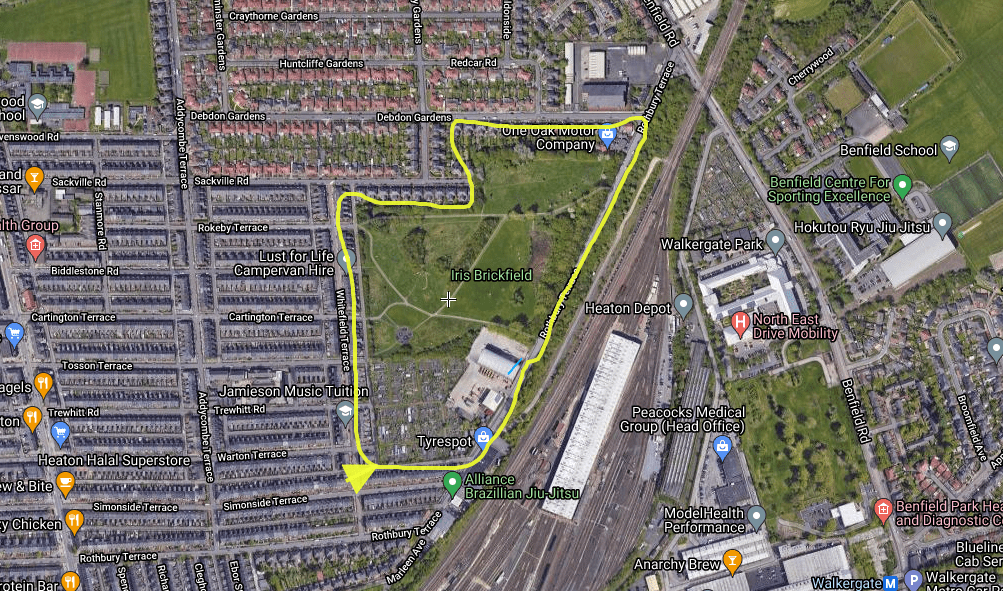
Iris Brickfield Park sits fairly close to our home in Heaton, Newcastle, and as such, has been a mainstay of our local walks during the pandemic. Fairly small, at least when compared to Newcastle’s other parks, and managed by Urban Green, it provides a lifeline to many people living in the local area: dog walkers, joggers, families and of course, naturalists stuck in the city.
This year, I have been making a concerted effort to record as many plants as possible growing in this small park, focusing on those growing in a wild or naturalised state. Plants that have clearly been planted have been ignored, though long-established street trees and hedgerow plants have been recorded per guidance from the BSBI. The aim of this is to create a somewhat comprehensive checklist for future visits, and for anyone else keen to know more about the flora of the park.
As very much a beginner botanist, the site list will not capture everything found within the park. I know for a fact that I have missed some grasses, while I am not yet able to confidently identify the various willowherbs found here. If anything looks out of place, please do let me know.
All records will (or have already been) submitted to BSBI recorders through iRecord.
Species list
In total, I have recorded 159 plant species in the park this year. Not bad for such a small area! For the sake of simplicity, I have not broken this down into grid squares but instead, have broken it down based on the three key areas present: the park, its pond and the nearby Iris Brickfield Allotments. The wider park contained the greatest diversity owing to a mix of both woodland and meadow habitats, though the pond too was surprisingly diverse. The exterior of the allotments held a few interesting species, including several escapes ‘tossed over the fence’.
The trees and shrubs of Iris Brickfield are fairly diverse. Common species such as Ash (Fraxinus excelsior), Sycamore (Acer pseudoplatanus), Wild Cherry (Prunus avium) and English Oak (Quercus robur) are abundant, interspersed with a small number of Field Maple (Acer campestre), Bird Cherry (Prunus padus) and Scot’s Pine (Pinus sylvestris).
Small areas of White Poplar (Populus alba) and Norway Maple (Acer platanoides) are present and Aspen (Populus tremula) appears to be spreading quickly in certain areas. Single trees and anomalies include False Acacia (Robina pseudoacacia) and Hornbeam (Carpinus betulus).
Shrubs are not particularly diverse, though the Western boundary of the site includes Cherry Laurel (Prunus laurpcerasus), Guelder Rose (Viburnum opulus) and plenty of Dogwood (Cornus sanguinea). To the North, Cherry Plum (Prunus cerasifera) is plentiful and elsewhere Blackthorn (Prunus spinosa) grows in abundance.
White Poplar, Populus albaNorway Maple, Acer platanoides
Wildflowers
Wooded areas of the park hold several species commonly associated with mature woodland and whether these were once planted remains to be seen. Wood Anemone (Anemonoides nemorosa), Ramsons (Allium ursinum) and English Bluebell (Hyacinthoides non-scripta) can be found, and while scarce, one small patch of Lesser Celandine (Ficaria verna) can be found. The non-native Spanish Bluebell (Hyacinthoides hispanica) can be seen too, albeit in small numbers.
Grassy areas away from the playing fields and other mown areas hold a nice mix of typical ‘meadow’ species. Here, Common Bird’s-foot Trefoil (Lotus corniculatus), Red Clover (Trifolium pratense) and Hairy Tare (Vicia hirsuta) are conspicuous and Creeping Cinquefoil (Potentilla reptans) plentiful. Also present are Field Scabious (Knautia arvensis), Common Knapweed (Centaurea nigra) and Goat’s-beard (Tragopogon pratensis). Both Common Ragwort (Senecio jacobaea) and Oxford Ragwort (Senecio squalidus) also pop up sporadically.
Common Mallow (Malva sylvestris), Sweet Violet (Viola odorata), Sneezewort (Achillea ptarmica) and Wild Teasel (Dipsacus fullonum) are less common here but exist in small patches scattered across the site.
Other highlights include scattered patches of Stinking Iris (Iris foetidissima), one of only two native iris species in Britain, and Common Poppy (Papaver rhoeas) which occasionally appears in unusual places.
Sweet Alison (Lobularia maritima) can sometimes be seen growing by path sides and befitting the park’s urban surroundings, Butterfly Bush (Buddleja Davidii) has a habit of springing up in odd places. Likely an escape from the nearby allotments, Borage (Borago officinalis) occurs but seldom persists long and occasionally, Purple Toadflax (Linaria purpurea) will take hold in a crevice or crack.
Slightly more troubling, Japanese Knotweed (Fallopia japonica) has begun colonising and the small pond is blanketed with New Zealand Pigmyweed (Crassula helmsii).
Wetland area
The small pond in Iris Brickfield makes for an interesting pitstop throughout the year. Despite facing problems from the aforementioned pygmyweed, and the rampant spread of Common Reed (Phragmites australis), Sweet Reed Grass (Glyceria maxima) and Bulrush (Typha latifolia), a few interesting species can be found tucked away in nooks and crannies. The most colourful of these being Flag Iris (Iris pseudacorus), Purple Loosestrife (Lythrum salicaria), Yellow Loosestrife (Lysimachia vulgaris) and Marsh Marigold (Caltha palustris).
Gypsywort (Lycopus europaeus) was observed for the first time in 2021, and the margins hold a healthy population of Water Mint (Mentha aquatica) and Meadowsweet (Filipendula ulmaria). Bogbean (Menyanthes trifoliata) and Water Horsetail (Equisetum fluviatile) persist here too.
A little less showy than the aforementioned flowers, a good variety of rushes and sedges can be found here too including Jointed Rush (Juncus articulatus), Lesser Pond Sedge (Carex acutiformis), Soft Rush (Juncus effusus) and Common Spike-rush (Eleocharis palustris). The alien-looking seedheads of Branched Bur-Reed (Sparganium erectum) are also interesting.
Whilst not numerous, Northern Marsh Orchid (Dactylorhiza purpurella) can also be found in the surrounding damp grassland.
Northern Marsh Orchid, Dactylorhiza purpurella
Allotments
Whilst the allotments at Iris Brickfield are private and access is not permitted (or possible), a poke about the margins of the area can reveal some interesting plants. Black Nightshade (Solanum nigrum) is notable here in Summer and in spring, Three-cornered Garlic (Allium triquetrum) can be seen.
The hedges that screen the site are comprised mainly of ornamentals such as Firethorn (Pyracantha coccinea), Common Lilac (Syringa vulgaris) and Flowering Currant (Ribes sanguineum), though native species such as Wych Elm (Ulmus glabra) have found their way in too. Perhaps the oddest occurrence here is that of a sprawling Grapevine (Vitis vinifera) which appears to have escaped cultivation to colonise the hedge.
Notable and unusual
Two plants in Iris Brickfield stand out as notable. The first, Milk Thistle (Silybum marianum), is a peculiar one. With two small plants found in the grassland this year, I was optimistic about seeing these flower. Alas, they now appear to have been trodden to death…
The occurrence of Marsh Mallow (Althaea officinalis) close to the pond was most unexpected and represented a notable vice-county record. An escape from cultivation at some point in time, its large, pink flowers stand out like a sore thumb at the height of summer.
And there we have it. I’ve certainly found it interesting getting to grips with the flora of my local patch this year and will endeavour to keep similar lists for other sites I frequent in the future. I hope someone may find this type of post interesting and it goes without saying, if you notice any errors or ‘unusual’ records, please let me know.
Beginning a week of annual leave, a fortnight past, I hopped on the train keen to explore surrounds of Lesbury in North Northumberland. Arriving at Alnmouth station and taking the short walk North to where the circular walk begins beside the River Aln, a roadside field rife with Common Knapweed provided an interesting first port of call.
Here, the plentiful purple flower-heads were strewn with countless bumblebees, making for quite the sight as I set about trying to identify those in front of me. A male Buff-tailed Bumblee came first, followed by Common Carder Bee and a handful of vibrant male Red-tailed Bumblebees. White-tailed were present too, though proved too quick for the camera, and it soon became clear that plenty of cuckoo bumblebees were present also.
With many of these looking somewhat bleached and faded, identifying them was quite a task and I stress that my current identifications are entirely provisional. That said, most numerous was Vestal Cuckoo Bumblebee, followed the red-tailed Hill Cuckoo Bumblebee. More interesting still what was what likely amale Field Cuckoo Bumblebee with its extensive tail markings, and a rather fluffy looking bee may have been Barbut’s Cuckoo Bumblebee. A new species for me if so – I just hope that someone with more knowledge than I can confirm or correct.
Here too, a solitary bee feeding on Cat’s-ear was likely Gwynne’s Mining Bee. My first since spring and no doubt part of a second generation.
Finding myself heading North along the margins of a nearby arable field, my attention soon turned to plants. Most interesting among the lush riverside vegatation was an abundance of Hemp Agrimony, while the lovely white blooms of Common Hemp-nettle were plentiful. Closer to the crop, and at times interwoven with the planted broad beans, a number of interesting arable ‘weeds’ were also spotted. Field Pansy, Sun Spurge, Common Poppy and Redshank were numerous, and Welted Thistle was nice to see.
A closer look at the invertebrate life here revealed a number of 14 and 7-Spot Ladybirds, while Small Copper, Small Skipper and Peacock butterflies made the most of the abundant thistle blooms. Lesser numerous (and not at all interested in the thistles) it was also nice to encounter Wall Brown here, alongside a lone Silver Y.
Perhaps the most interesting insect of the trip, the inconsicuous ladybird, Rhyzobius litura, was found here too while sweeping a stand of Tansy. Tiny and anything but brightly covered, I confess that at the time, I had no idea this was in fact a ladybird. Thank goodness for the UK Ladybirds Facebook group, and many thanks to Richard Comont for the speedy ID.
Further North along the Aln, the vegatation changed somewhat with smaller, arable plants giving way to an abundance of Wild Carrot and Common Ragwort. As ever, these proved popular with pollinators and a number of hoverflies were recorded, among these, Leucozona laternaria and Cheilosia illustrata pictured below. Also spotted here were plenty of Marmalade Hoverflies, along with Syritta pipiens and the striking Leucozona lucorum. More Hill Cuckoo Bumblebees could also be seen, while butterflies included more Small Copper and new for the day, Large White.
Leucozona laternariaCheilosia illustrata
Further on towards the stepping stones at Greenrigg, edible crops gave way to what could almost be described as a somewhat beautiful meadow habitat, chock-full of Musk-mallow, Red Clover and Bird’s-foot Trefoil. This might just have seemed natural if it were not for the the striking (but introduced) flowers of Lucerne and Sainfoin also present. Plants which together with the native species here proved a magnet for insects – new species here including Early Bumblebee and the impressive Pied Hoverfly.
Crossing the river at Greenrigg, a hasty rush along the opposing bank ensued as I tried to squeeze in a look around Lesbury itself before needing the board my train. Trying and failing to ignore the plantlife here, a few interesting finds included Small Bugloss (not a plant I see very often) and an extensive patch of Enchanter’s Nightshade tucked away in a small roadside copse.
Owing to a few too many pauses, I did not have time for a proper look around Lesbury, though I did squeeze in wander along the river. Here, riparian plants proved interesting with Water Figwort spotted first, followed by two mint species. One of which looked a lot like Apple Mint while the other remains a mystery. Both Purple and Yellow Loosestrife were notable here too, and the beautiful yellow flowers of the non-native Monkeyflower were conspicuous.