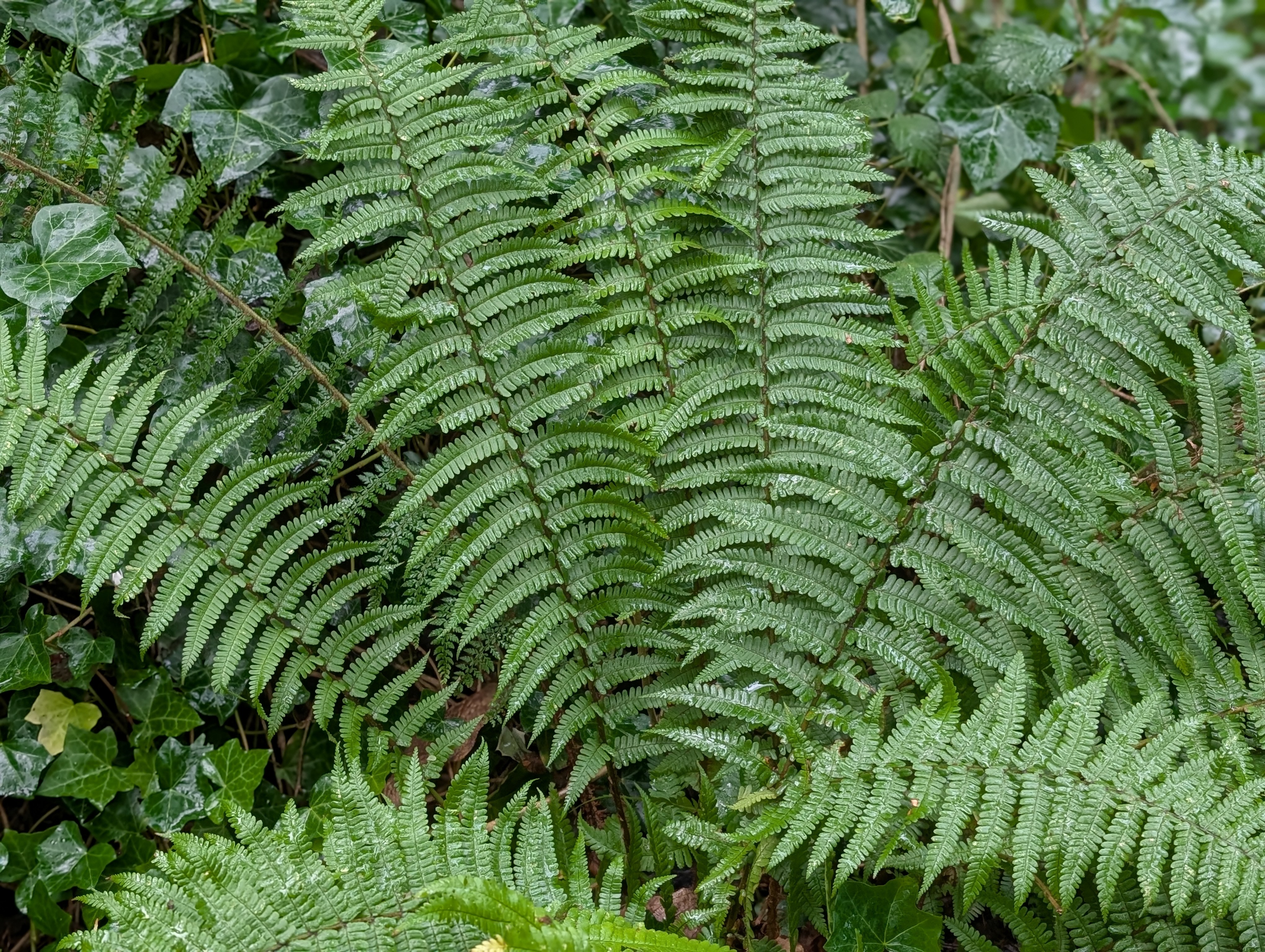
Motivated by last year’s fern forays and spurred on by my new membership of the British Pteridological Society, I have decided to try something different this year: a personal challenge to see as many of Britain’s fern species as possible in a single year. The idea being that, by seeking out our ferns, I’ll learn more about them, their habitats, and the subtleties involved in identifying them. This blog will be part #2.
Woodland Ferns – 17th January
By January, our woodlands are not looking especially vibrant. Cold, wet, and muddy, they are far removed from their spring splendour, and by this point in the year, most of our ferns are looking rather jaded too.
With this in mind, yesterday saw us meandering through Jesmond Dene, keen to see what could still be picked out in the depths of January. As expected, most of the ferns looked rather gnarled by the frosts, but in sheltered spots our two most familiar woodland species could still be found.
Broad Buckler-fern Dryopteris dilatata, with its broad, wedge-shaped fronds and dark-centred scales, was easily located, as was Male-fern Dryopteris filix-mas with its tapering fronds and toothed pinnules. These are perhaps our most abundant native ferns both will look far better come spring.


Continuing our walk, it was also pleasing to see several healthy clumps of Hart’s-tongue Asplenium scolopendrium looking altogether more robust and vibrant than the straggly individuals spotted on walls during our previous outing.

Another group of evergreen woodland ferns still visible at this time of year are the Polystichum species – the Shield-ferns. Our two native species are both fairly common in shady woodland settings and are easily recognised by their distinctly “mitten-shaped” pinnules. They can be told apart by a combination of features, most notably the overall shape of the frond (gradually tapering versus ending abruptly), whether the pinnules are stalked, and the angle of the lowest pair of pinnules (obtuse vs acute).
In images one and three below, we have Soft Shield-fern Polystichum setiferum: soft to the touch, with a truncate base and pinnules set at an obtuse angle. The third image shows an escaped cultivated form, noticeably more frilly in appearance – a reminder of the interesting things we humans have done to ferns. Note in both examples, the pinnules are stalked. This is also a useful factor in separating these species, as set out in the helpful crib here. A good blog on the two native species can also be found here.


Close to the first Shield-fern, we also noticed a rather lovely Polypody Polypodium sp clinging to a bridge. I have learned through bitter experience how difficult it is to separate these species on visual characters alone, so having collected a small sample, I’ll be checking the spores later. Stay tuned for another post on those.

Last but not least on our morning walk through Jesmond Dene, we stopped to check in on a more unusual fern, first noted last year while recording for my upcoming Urban Flora of Newcastle. At first glance, you might notice that it looks rather similar to the Soft Shield-fern shown previously – and that’s because it is, albeit a little more exotic in nature.
This plant is, in fact, Japanese Lace Fern Polystichum polyblepharon, a widely cultivated garden species that appears to have found its way into the Dene of its own accord. This young plant is growing on a steep, muddy bank where deliberate planting seems highly unlikely, and so can presumably be counted towards this year’s fern fest. As mentioned previously, non-native ferns will count provided they appear to be self-sown.

Right Back at It – 23rd January
After work on Friday, I opted for a rather rainy afternoon walk back into the Dene, this time venturing a little further to see what I could find. It was pleasing to come across another Polypodium, this time growing on a tree, though it lacked the spores needed for identification.

Further along the Ouse Burn, the challenge’s next “new” fern became apparent: Hard Shield-fern Polystichum aculeatum, with its sessile, acute-angled pinnules and tapering fronds. This is one of the scarcer of the ‘common’ ferns in my part of Newcastle, so it’s always nice to see.


In the same area that held the shield-fern, it was also pleasing to find two slightly straggly examples of the once-pinnate Hard Fern Blechnum spicant. This species needs little introduction.

Slightly more perplexing are the Scaly Male-ferns Dryopteris affinis agg. These were always going to be the most difficult group to contend with during this year’s fern challenge, and no matter how much time I spend looking at them, they still manage to confuse me. Inevitably, I find myself examining a great many specimens before eventually settling on one that matches the descriptions in the various resources stuffed into my rucksack – most of which contradict one another to some degree.
The two common species involved are Borrer’s Scaly Male-fern Dryopteris borreri and Western Scaly Male-fern Dryopteris affinis subsp. affinis.


D. affinis subsp. affinis is soundly evergreen, so as a first step, I looked for a fern that still appeared reasonably fresh for mid-January. Having succeeded, it was time for a closer inspection. As far as I recall, affinis is the only one of the common Scaly Male-ferns to have an adnate lowest basiscopic pinnule (that is, lacking a stalk). It also has rather lucid veins that extend all the way to the pinnule margin, and lowest pinnules on each pinna that are roughly the same size as their neighbours, unlobed and rounded at the tip.
The fern shown below seemed to fit this description, at least in most respects. With a degree of trepidation, I’m therefore calling it Dryopteris affinis subsp. affinis.


In contrast to affinis, D. borreri has stalked lowest basiscopic pinnules and lowest pinnules that are slightly longer than their neighbours. These are also toothed at the corners (in the typical form, at least) and show slightly more diffuse venation that stops short of the pinnule margins. All quite straightforward in theory.
Taking a frond from one slightly more convincing example and examining it more closely, most of these characteristics are present, particularly in the shape of the pinnules. However, I don’t yet feel that I’ve fully got to grips with the differences in venation. The plant I tentatively labelled as affinis does not appear identical to examples I have seen online. This borreri, however, shows the pale blotching often mentioned in the literature, which is reassuring.


We’ll certainly have to revisit these before attempting any of the rarer ferns within the complex, but hey, practice makes perfect (or so I am told).
Running Total
Seeing as I rarely carry a notebook, we’ll log our running total for the year here…
| #1 Wall-rue | Asplenium ruta-muraria | 16 January, Newcastle |
| #2 Maidenhair Spleenwort | Asplenium trichomanes subsp. quadrivalens | 16 January, Newcastle |
| #3 Hart’s-tongue | Asplenium scolopendrium | 16 January, Newcastle |
| #4 Black Spleenwort | Asplenium adiantum-nigrum | 16 January, Newcastle |
| #5 Broad Buckler-fern | Dryopteris dilatata | 17 January, Newcastle |
| #6 Male-fern | Dryopteris filix-mas | 17 January, Newcastle |
| #7 Soft Shield-fern | Polystichum setiferum | 17 January, Newcastle |
| #8 Japanese Lace Fern | Polystichum polyblepharum | 17 January, Newcastle |
| #9 Hard Shield-fern | Polystichum aculeatum | 23 January, Newcastle |
| #10 Hard Fern | Blechnum spicant | 23 January, Newcastle |
| #11 Western Scaly Male-fern | Dryopteris affinis subsp. affinis | 23 January, Newcastle |
| #12 Borrer’s Scaly Male-fern | Dryopteris borreri | 23 January, Newcastle |


Leave a Reply