
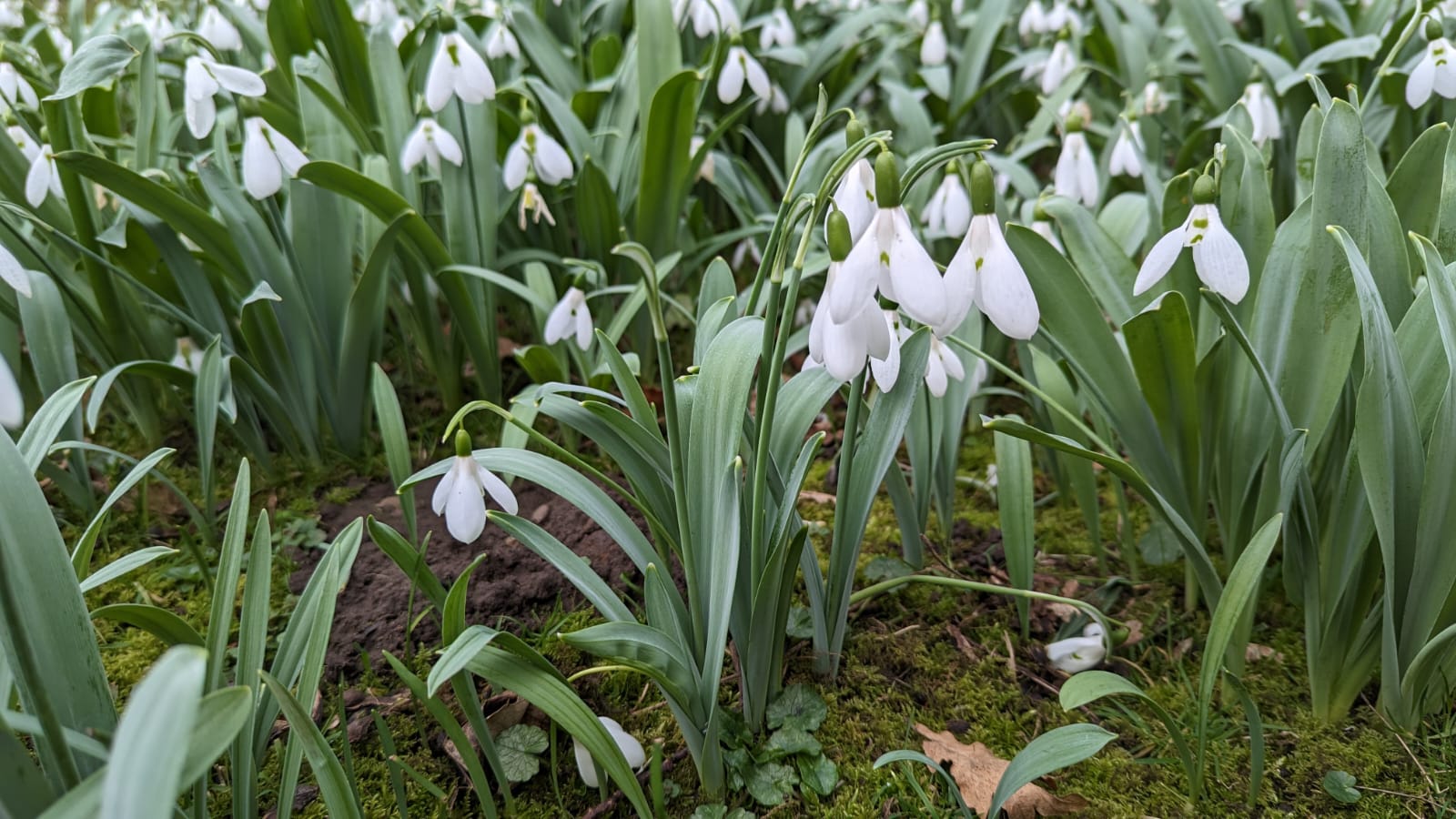
The snowdrops and crocuses that defined late winter’s botanical outings have now faded, and, as if by magic, a new wave of plants is rising to the fore in the local landscape. About time too—I, for one, needed shaking out of the winter doldrums…
Yesterday, Matt and I were lucky to have a rare coinciding day off, so we headed west up the Tyne Valley. Stopping at Watersmeet, Letah Wood, and Bywell, it was wonderful to see just how much the season had advanced since our last visit. Cue some much-needed spring colour!
The highlight of the day was discovering one of my all-time favourite plants—the Yellow Star-of-Bethlehem (Gagea lutea). This charming bulbous perennial boasts golden-yellow, star-like flowers that are sure to lift your spirits on a chilly March day. It thrives in woodlands with basic soils and, as its distribution map shows, is quite a localised species in the UK.
In the North East, it’s restricted to just a handful of high-quality sites. Watersmeet is one of them, and during our visit, we were thrilled to find a large population in full bloom.


Also at Watersmeet, it was lovely to see some of our more familiar woodland plants springing to life. Leading the way were our first Wood Anemone (Anemone nemorosa) and Moschatel (Adoxa moschatellina) flowers of the year. The latter’s genus name, Adoxa, reflects its inconspicuous nature and unassuming growth, while Moschatellina is derived from the Italian moscato, meaning musk.
Other interesting finds at Watersmeet included Opposite-leaved Golden Saxifrage, Monk’s-hood, Sanicle, Creeping Comfrey, and Leopard’s-bane. But before long, another pit stop beckoned…


Believed to be Northumberland’s last remaining Wild Daffodil wood, Letah Wood near Hexham is a breathtaking sight—if you time it right. Unfortunately, we were a little early, with most of the Wild Daffodils (Narcissus pseudonarcissus subsp. pseudonarcissus) just beginning to open. Still, in the sunnier clearings, we managed to find a few in bloom…

Daffodils can be tricky to tell apart, but our native variety is far more delicate than the hulking, luminescent specimens commonly planted in gardens. It’s a relatively small plant, with pale yellow tepals that are noticeably creamier in tone than its vibrant yellow ‘trumpet.’ These tepals usually tilt forward, as shown in the picture below. The true species also tends to have shorter stems and smaller flowers than the hybrids bred from it.

he final leg of our trip took us to Bywell, where the impressive carpets of Snowdrops and Winter Aconite had given way to a fresh wave of spring species. One of the most striking was Forbe’s Glory-of-the-snow (Scilla forbesii), which was widespread along the sandy riverbanks—perhaps having escaped from nearby churchyards. This species boasts distinctive two-toned flowers: blue on the outside with a white centre, and a petal tube that noticeably broadens from the flower stalk.


Another Scilla species was also evident at Bywell—Siberian Squill (Scilla siberica). This one is a true gem, with vivid blue, nodding flowers. It tends to occur as a naturalised relic of cultivation, often found where it was originally introduced in churchyards, parks, and large gardens. It’s rather beautiful, I hope you’ll agree.


Leave a Reply